Translated from french (please notify us of errors)
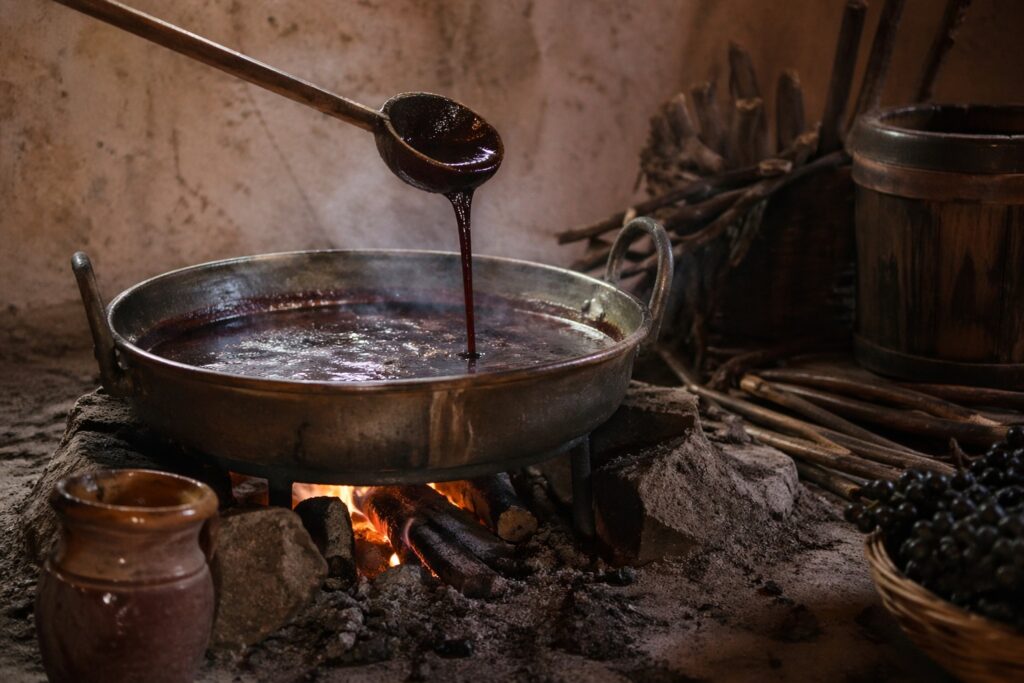
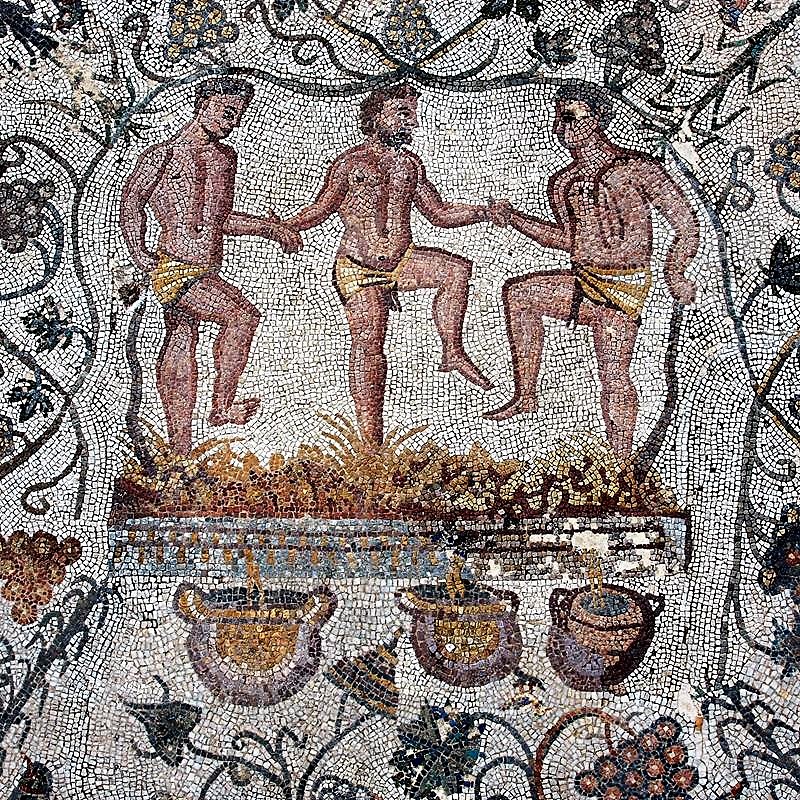
Honey was expensive. Bees demanded time, care, and did not produce on demand. The vine, by contrast, was everywhere — and grapes, once pressed, yielded a must that could be cooked down until thick, dark, and sweet: a substitute for honey, less noble, but available in quantity and obtained with no effort beyond that of fire and patience.
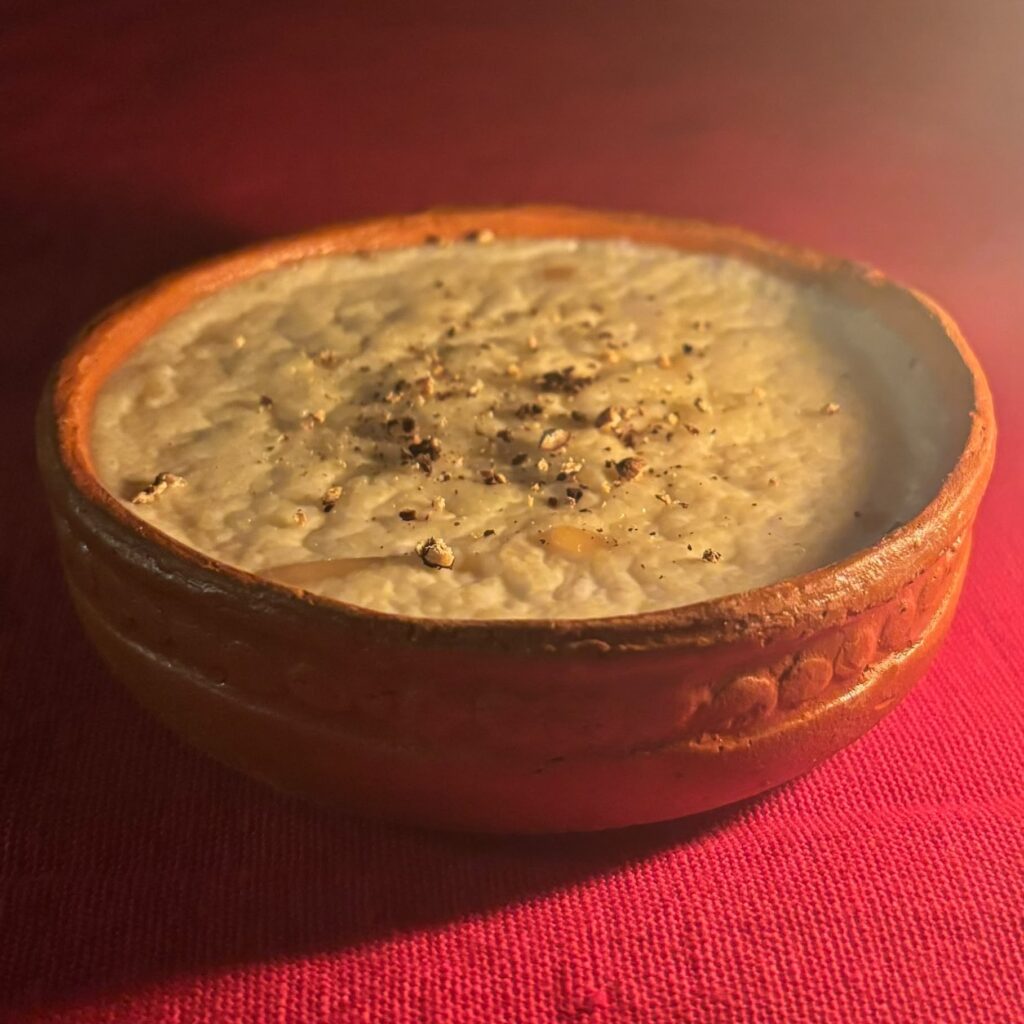
It is of this preparation that Ovid speaks, in the Fasti, when he evokes a simple bowl serving as a mixing bowl, from which one drinks during the Parilia milk as white as snow mixed with purple sapa[1] — that long-cooked grape must whose dark colour betrays its concentration. Behind the image, a commonplace ingredient to which the Romans never gave a definitive name. For while everyone knew how to prepare these cooked must concentrates, no one seemed in any hurry to agree on what to call them. Sapa, defrutum, caroenum: three names circulate in the texts to designate closely related preparations, with definitions that vary from one author to another.
Lead is good for you
The technique, at least, is straightforward. Grape must (mustum) is cooked over a low flame, and the water is allowed to evaporate until only a fraction of the original volume remains. For this, Columella prescribes using a lead vessel rather than a bronze one, which “releases verdigris and taints the flavour of the preparation”[2]. But there may have been more to it: when heated, lead could release compounds such as lead acetate, which has a naturally sweet taste. This may have enhanced the appeal of these preparations… but also given them a toxicity of which no one at the time had any knowledge.
What varies from one author to another is the degree of reduction. And the name of the syrup.
Pliny the Elder cuts through with deceptive confidence. For him, siraeum or sapa is must cooked down to a third of its original volume. When the reduction reaches only half, he calls the preparation defrutum. These transformations are the work “of human skill and not of nature”, he insists[3]. Yet Columella places optimal sapa at precisely this half-reduction[4], and calls defrutum what has been reduced to a third[5] — exactly the reverse of Pliny. Varro, quoted by Nonius, uses both terms in the same passage with yet different proportions[6].
Finally, in later authors — Palladius and Isidore of Seville — a third name appears: caroenum. In these authors, the term designates a must reduced by only a third[7].
One might take this for great confusion. It is rather the sign of a practice so common that it was living and shifting. Everyone called what they had to hand by whatever name seemed fitting.
Why cook the must?
Must was cooked for two quite distinct reasons. The first is prosaic: a mediocre must, poorly suited to keeping after the harvest, became through concentration suitable for blending with wines that were too harsh. Cato prescribes adding to the must, “if need be”, defrutum cooked from free-run must (a grape juice obtained without pressing, simply by the natural draining of grapes after harvest), at the rate of one fortieth part per culleus[8]. Some winemakers did not bother to make a selection: “to avoid all trouble, [they] did not hesitate to cook the whole of their harvest systematically”[9].
The second reason is more appetising: cooking concentrated the natural sugars of the grape to the point of producing a substitute for honey[10] — less noble, less costly, but effective.
From the cellar to the pot
These concentrates first established themselves in food preservation: quinces, pears, mulberries, medlars, and sorb apples were kept in cooked wine to last through the winter out of season[11]. Cato already preserves his grapes “in sapa, in must, in lora“[12] and his olives “without salt in defrutum“[13]. Concentrated sugar preserves — this has always been known — and the Romans had simply found an economical way of producing it in quantity.
But it is in the recipes that one measures how indispensable these preparations had become. In Apicius, defrutum appears in every major category of the corpus — preserves, sauces, poultry, quadrupeds, fish, vegetables —, sometimes as a flavour enhancer in the recurring combination of honey, vinegar, fish sauce (liquamen), and defrutum; sometimes as a simple colourant, with the laconic instruction that recurs from one recipe to the next: defritum modice ut coloret — “a little defrutum for colour”.
Caroenum, absent from the classical agronomists, is in Apicius almost as frequent, often interchangeable with passum — as if the two were equivalent on the plate. This is hardly surprising when one considers that both are sweet concentrates derived from grapes. Apicius even includes a canonical list of basic sweet liquors: mel, defritum, caroenum, piperatum, passum[14].
And sapa? It appears only once in the entire Apicius corpus, for a preserve of mulberries in a glass jar[15]. One occurrence. In the most complete cookery book to have come down to us from Antiquity.
But where are you, sapa?
This imbalance is worth pausing over. Yet sapa is the most anciently attested term, the most firmly rooted in the agronomic tradition. It is the word Pliny identified with the Greek hepsema (ἕψημα) — the Roman equivalent of a practice that Dioscorides and Galen knew by that name[16], even if its use in the classical period remains uncertain[17]. It is sapa that Ovid sang, sapa that stained the shepherd’s bowl purple. And it is sapa that all but vanishes from recipe cookery, while defrutum and caroenum — later terms, less well defined — flood the sauces and roasts.
The reason may lie in the concentration itself. A sapa reduced by two thirds is a thick product, close to treacle, difficult to measure out into a sauce. Defrutum and caroenum, less concentrated and more fluid, lent themselves better to the last-minute adjustments that cooking demands. They won out in the pot. Sapa stayed in the larder — and in the verses of Ovid.
[1] Ovid, Fasti IV, 779-780: “tum licet adposita, veluti cratere, camella / lac niveum potes purpureamque sapam.“
[2] Columella, De re rustica XII, 20, 1: “Ipsa autem vasa, quibus sapa aut defrutum coquitur, plumbea potius quam aenea esse debent. Nam in coctura aeruginem remittunt aenea et medicaminis saporem vitiant.“
[3] Pliny the Elder, Natural History XIV, 80: “nam siraeum, quod alii hepsema, nostri sapam appellant, ingeni, non naturae, opus est musto usque ad tertiam mensurae decocto. quod ubi factum ad dimidiam est, defrutum [vocatur].” “What is called siraeum — which others call hepsema and our people sapa — is the work of human skill, not of nature: must cooked down to a third of its measure. When it has been reduced to half, [it is called] defrutum.”
[4] Columella, De re rustica XII, 19, 1: “nec dubium quin, ad dimidiam si quis excoxerit, meliorem sapam facturus sit.“
[5] Columella, De re rustica XII, 21, 1: “Mustum quam dulcissimi saporis decoquetur ad tertias et decoctum […] defrutum vocatur.“
[6] Varro ap. Nonius 551, 18.
[7] Palladius XI, 18, 1; Isidore of Seville, Etymologiae XX, 3, 15.
[8] Cato, De agri cultura 23, 2: “Si opus erit, defrutum indito in mustum de musto lixivo coctum, partem quadragesimam addito defruti vel salis sesquilibram in culleum.” The culleus denotes both a large leather sack used for transporting liquids and, by extension, a Roman unit of capacity equivalent to approximately 520 litres (20 amphorae).
[9] Columella XII, 20, 7-8; Palladius XI, 14, 4.
[10] André, op. cit., p. 164.
[11] André, op. cit., p. 89-90.
[12] Cato, De agri cultura 7, 2: “eadem in sapa, in musto, in lora recte conduntur.” Lora is the thin wine obtained by soaking grape marc in water — the wine of slaves and agricultural labourers. The three liquids form an implicit hierarchy: sapa (noble concentrate), mustum (fresh must), lora (thin wine).
[13] Cato, De agri cultura 7, 4: “vel sine sale in defrutum condito.“
[14] Apicius, De re coquinaria, Pimentarium 1, 4: “mel, defritum, caroenum, piperatum, passum.” Mel — honey; defritum — must cooked down by half; caroenum — must cooked down by a third; piperatum — peppered wine; passum — raisin wine.
[15] Apicius, De re coquinaria I, 22, 1: “moris sucum facito, et cum sapa misce, et in vitreo vase.“
[16] Pliny the Elder, Natural History XIV, 80.
[17] Janick Auberger, Manger en Grèce classique, PUL, 2010, p. 52-53: “ces mentions sont tardives; le procédé existait-il à l’époque classique?”
Other articles in English from the Nunc est bibendum blog