Translated from french (please notify us of errors)
A badly divided cut of beef, fire stolen from the gods, a mysterious jar rashly opened: it is around a primordial meal that, according to Greek mythology, the fate of humanity is sealed. By exploring this scene through the lens of the symbolism of the meal, we better understand how it embodies the relationship between men and gods. At the heart of this cosmic drama, two titanic brothers incarnate our fundamental duality: Prometheus, ‘he who thinks ahead’, and Epimetheus, ‘he who understands too late’.
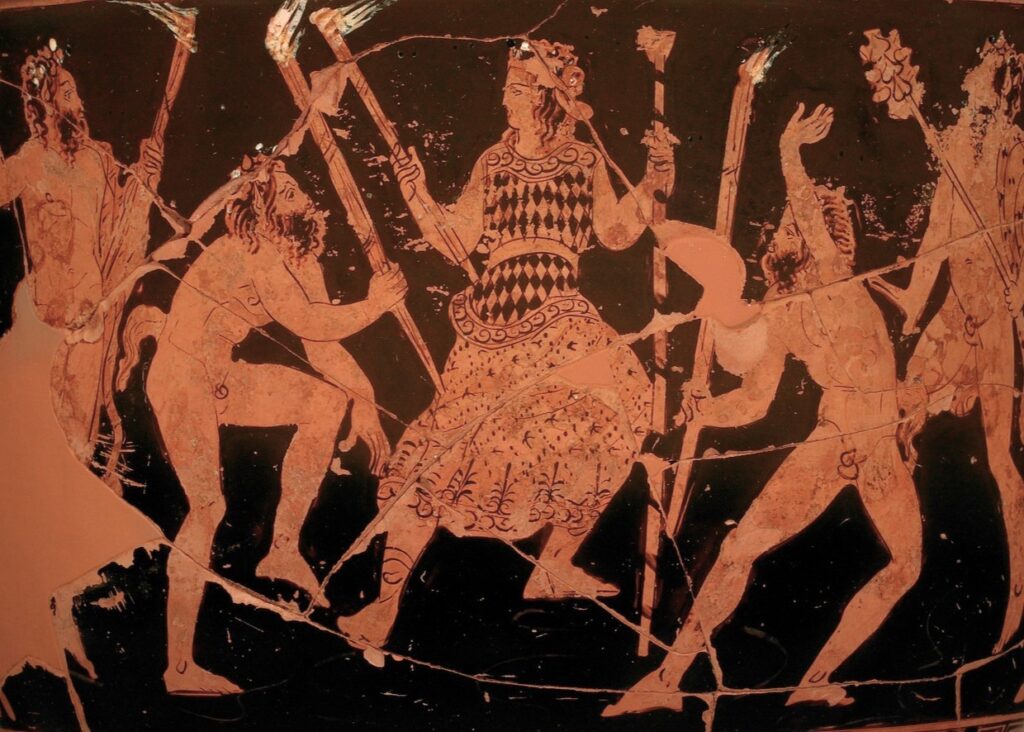
In ancient Mekone, a small town in Boeotia that some identify with Sicyon, a mythic event unfolded whose consequences would resonate for eternity: the first sacrifice shared between gods and men, a symbolic meal at which the definitive separation between mortals and immortals was decided.
This mythic feast takes place during the Golden Age, a period when, according to Hesiod, men lived in perfect happiness. “Like gods they lived, with carefree heart, far and apart from toil and misery.”[1] Divinities and humans still shared their existence — and their meals.
To understand what was at stake at this fateful banquet, one must know its two protagonists: Prometheus and his brother Epimetheus, sons of the Titan Iapetus and the Oceanid Clymene. These two figures embody the two faces of practical intelligence: foresight and improvidence, anticipatory reasoning and belated understanding.[2]
Epimetheus, the reckless host
In his dialogue Protagoras, Plato offers us an interesting variant of the myth, in which the banquet table expands to encompass the very creation of animal species.[3] This version illuminates the fundamental duality between the two titanic brothers.
According to this account, Zeus charges Prometheus and Epimetheus with distributing qualities to the various living species, like a distribution of dishes at a great cosmic feast. Epimetheus, presumptuous, asks to handle it alone: “Let me do the distributing; when I have done it, come and review what I have done,” he says to his brother.
Epimetheus then distributes natural qualities — like dishes at a banquet — to the various animal species. Plato describes this process in detail, explaining how Epimetheus endowed some species with strength, others with speed, some with thick fur, others still with protective shells. But in his improvident haste to serve the first guests, Epimetheus commits the fatal error of the poor host: he exhausts all his resources before every guest has been served. According to Plato, when the turn of the human species came, Epimetheus found that he had already used up all the available faculties on the animals, leaving man entirely destitute.
Prometheus, observing the catastrophe caused by his brother’s recklessness, then intervenes as a saviour. Unable to bear seeing humanity thus destitute, he takes the initiative of stealing from Hephaestus and Athena the knowledge of the arts and fire, without which this technical knowledge would have been useless.
The philosopher Bernard Stiegler holds that this improvident distribution by Epimetheus at the banquet of origins defines the paradoxical condition of humanity: unlike animals endowed with specific qualities, man is characterised precisely by his absence of inherent qualities, by his ‘originary default’ which compels him to technical invention.[4]
The division of a bull and the birth of sacrifice
It is Hesiod who, in his Theogony, gives us the most detailed account of this meal.
“Prometheus, of subtle mind, had already divided a great bull that he had apportioned according to his design, seeking to deceive the mind of Zeus. For one [Zeus], he placed, wrapped in the animal’s skin, the flesh and the fat entrails with the stomach; for the others [men], he arranged, with deceptive cunning, the white bones of the bull, which he had laid out in a fine order and covered with gleaming fat.”[5]
The gastronomic staging is decisive: Prometheus creates an illusion to favour the men he holds dear. The sumptuously appearing portion destined for the gods contains nothing but bones devoid of nutritional value. Conversely, the portion of modest appearance conceals the nourishing flesh and entrails.
Zeus, invited to choose first, obviously sees through the trick, Hesiod tells us, but elects to go along with it. He opts for the most attractive-looking portion. When the deception is revealed, his anger immediately makes Olympus tremble.
This unequal division institutes — a posteriori, of course — the ‘cuisine of sacrifice’. From this founding moment, men will eat cooked meat, marking their condition as mortals, whilst the gods will receive nothing more than the fragrant smoke of burnt bones offered in sacrifice.[6]
Zeus deprives humanity of fire
Zeus’s reaction to the rigged banquet was immediate and terrible: he deprived men of fire. This gesture is not a simple punishment — it strikes at the very essence of the human condition. Without fire, no cooking. Without cooking, man lapses back into animality.
This deprivation amounts to condemning men to eat raw, like beasts, thereby erasing the fundamental boundary between nature and culture.[7] The symbolic distinction established during the sacrificial division risks collapsing entirely.
Faced with this catastrophe, Prometheus refuses to see the men he cherishes reduced to a bestial state. He then commits a founding transgression in the history of humanity: the theft of divine fire.[8] Hesiod’s Theogony specifies that he conveyed this flame in a hollow stalk of fennel (νάρθηξ/narthex) — the first lighter in history, allowing fire to be preserved and transported without burning oneself.[9]
But Zeus’s vengeance was double-edged. He ordered Hephaestus to fashion from clay a creature of irresistible beauty, Pandora, literally ‘she who bears all gifts’.[10] This poisoned gift was sent to Epimetheus.
Pandora and her fateful jar
Zeus’s vengeance takes the form of an ambiguous gift: Pandora. In Hesiod, this ‘gift’ offered to mortals is in reality a punishment in disguise. Prometheus, ever clear-sighted, had nevertheless warned his brother: “Never, Epimetheus, accept a gift from Olympian Zeus, but send it back, lest it become an evil for mortals.”[11]
But Epimetheus, true to his nature, forgot this warning. When Hermes presents him with the first woman, adorned with all divine gifts, he welcomes her with enthusiasm. True to his name, Epimetheus only grasps the full extent of his mistake after he has made it, once he has already received the evil sent by Zeus.[12]
Her very name — Πανδώρα, ‘she who has received all gifts’ — is laden with irony: if all the gods have showered her with gifts, it is so that, through her, every plague may enter the world of men. Hesiod describes her as “a steep-sided trap with no way out”.
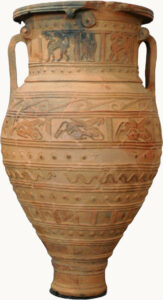
With her, Zeus has delivered a large earthenware vessel, a πίθος (pithos), often mistranslated as “Pandora’s box”. This is no small precious casket, but a vast jar used in the ancient Greek world to store vital commodities such as grain, oil, or wine.[13] Its domestic connotation further heightens the contrast between the expected (preservation) and the actual (destruction).
Driven by a curiosity instilled in her by the gods themselves, Pandora lifted the lid of this jar, which contained all the evils destined for humanity: disease, old age, misery, madness, vice, passion, toil… Hesiod specifies: “Alone Elpis [Hope] remained there, within its unbreakable home, beneath the lip of the pithos, and did not fly out.”[14] Hope remains available to men, but as an ambiguous consolation, since it stays enclosed, barely accessible — perhaps even as a vain expectation or a deception.
This catastrophe marks the definitive end of the Golden Age in which men lived without toil or suffering. Henceforth, humanity will have to work to eat, suffer from disease, and die. The primordial banquet has been transformed into a perpetual labour to secure one’s subsistence.
Sacrifice and banquet as anthropological foundations
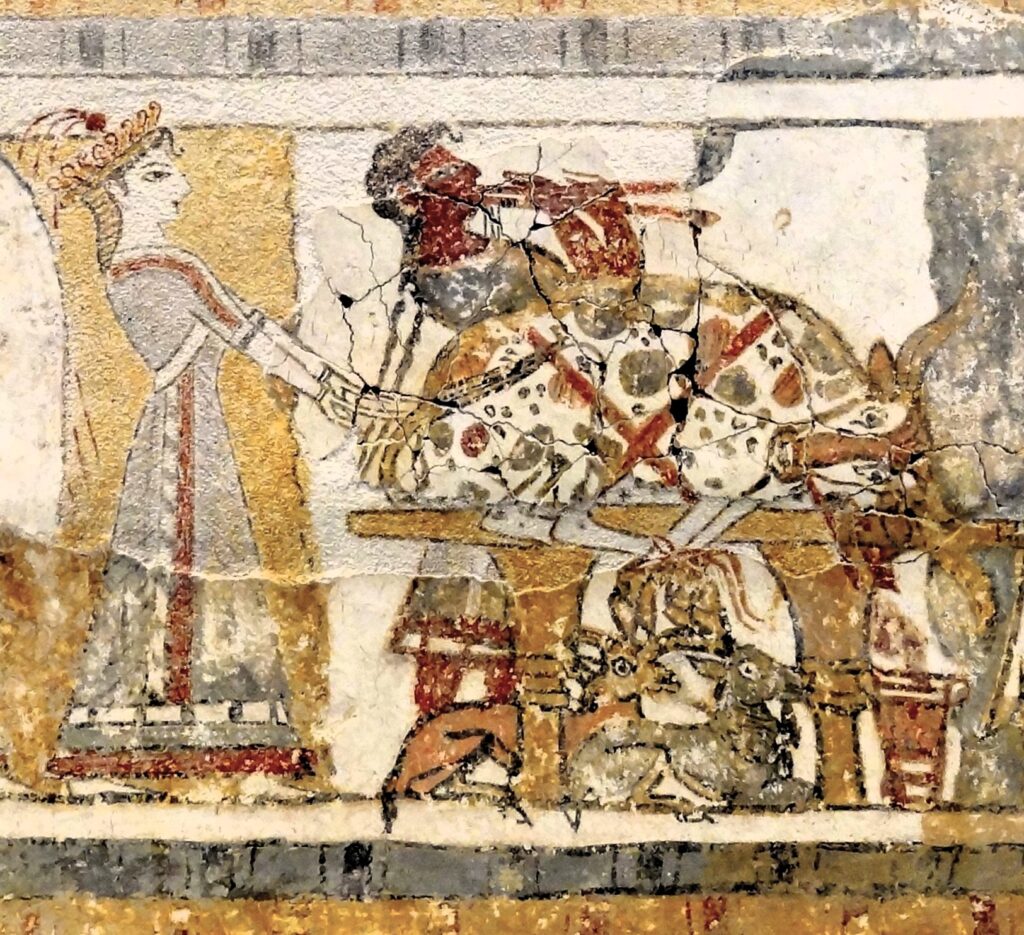
The banquet of Mekone is not a mere mythological episode — it is the founding institution of sacrificial practice, one that would define for centuries the relationship between men and gods in the Greek world. More than that, it establishes man’s place in the cosmos through his alimentary practices.
Greek sacrifice institutionalises the irreversible distance between mortals and immortals. Through the consumption of cooked meat, men affirm their condition as mortals, whilst the gods, receiving the smoke of bones, confirm their divinity.[15]
The Greeks called this sacrificial act θυσία (thusia), a term that designates both the sacrifice and the meal that follows it. It is no coincidence that the central religious practice of ancient Greece took the form of a sharing of food. Sacrifice and the feast that followed it constituted virtually the only form of meat consumption in Antiquity.[16]
What the banquet of Mekone reveals to us is a tripartite organisation of the world around the act of eating:
- The gods, who are nourished by sacrificial odours and nectar-ambrosia
- Men, who eat cooked meats and bread made from cultivated grain
- Wild beasts, who devour raw flesh
This ontological separation, the direct result of Promethean cunning at the meal shared with Zeus, defines the very framework of human existence: neither beasts nor gods, men occupy an intermediary position they must assume.
The sacrificial meal of Mekone may be understood as the symbolic birth certificate of the human condition, establishing for humanity the obligation to labour for food, to sacrifice in order to honour the gods, and ultimately, to die.[17]
At table with Prometheus and Epimetheus
The myth of the primordial banquet and its consequences reveals a fundamental aspect of the human condition: our dual nature, at once Promethean and Epimethean. This duality finds perfect expression in the culinary and alimentary metaphors that run through this narrative.
Indeed, our relationship to food illustrates this tension perfectly. On one side, Promethean foresight: we plan our meals, cultivate the land, store provisions, develop techniques of preservation, elaborate sophisticated culinary arts. On the other, our Epimethean impulsiveness: our tendency towards excessive gluttony, our difficulty in resisting the immediate pleasures of the table, our propensity to forget the consequences of our dietary choices.
The diet of men, composed of cultivated grain and sacrificial meats, defines their intermediary position between beasts and gods.[18] Neither like the immortals, who feed on ambrosia and nectar, nor like the animals, who devour raw flesh, man occupies a median, precarious, and ambivalent position.
This pair of antagonistic brothers represents the two fundamental tendencies that make up humanity. Our capacity for anticipation always coexists with our tendency to understand the consequences of our actions only after the fact.[19] Our humanity resides precisely in this tension between the two poles: without Promethean foresight, we would be reduced to an animal state; without Epimethean improvidence, we would come too close to the gods.
Cookery represents, in the history of humanity, the first of the arts, the one that allows us to pass from the raw to the cooked, from nature to culture.[20] In this sense, Prometheus was not merely the donor of technical fire, but also the founder of human gastronomy.
What distinguishes man from the animal is precisely this mediated relationship to food: we do not devour — we cook; we do not merely consume — we share meals. Greek sacrifice presents itself as a form of cookery in which the relationship between men and gods is established through a complex system of dietary rules.[21]
Further reading
Pierre Judet de La Combe, Quand les dieux rôdaient sur la Terre, France Inter, episode of 3 September 2022. Prometheus and Epimetheus, or the duality between foresight and improvidence in the creation of humanity. Available on France Inter.
[1] Hesiod, Works and Days, lines 112–113.
[2] Jean-Pierre Vernant, Mythe et pensée chez les Grecs, La Découverte, 1996, p. 263.
[3] Plato, Protagoras, 320d–322a.
[4] Bernard Stiegler, La Technique et le temps, vol. 1, Galilée, 1994, p. 201.
[5] Hesiod, Theogony, lines 535–541.
[6] Marcel Detienne and Jean-Pierre Vernant, Les ruses de l’intelligence: La mètis des Grecs, Flammarion, 1974, p. 48.
[7] Claude Lévi-Strauss, The Raw and the Cooked (Mythologiques I), Plon, 1964, p. 172.
[8] Jean-Pierre Vernant, Mythe et société en Grèce ancienne, La Découverte, 1988, p. 193.
[9] Hesiod, Theogony, lines 565–567.
[10] Hesiod, Works and Days, lines 60–68.
[11] Hesiod, Works and Days, lines 86–87.
[12] Jean-Pierre Vernant, Mythe et Société en Grèce ancienne, La Découverte, 1988, p. 187.
[13] Jane Ellen Harrison, Prolegomena to the Study of Greek Religion, Cambridge University Press, 1903, p. 284.
[14] Hesiod, Works and Days, lines 96–97, combined with the interpretation of J.-P. Vernant in Mythe et pensée chez les Grecs, La Découverte, 1996, p. 281.
[15] Marcel Detienne and Jean-Pierre Vernant (eds.), La Cuisine du sacrifice en pays grec, Gallimard, “Bibliothèque des Histoires”, 1979, p. 41.
[16] Walter Burkert, Homo Necans: The Anthropology of Ancient Greek Sacrificial Ritual and Myth, University of California Press, 1983, p. 37.
[17] Jean-Pierre Vernant, Entre mythe et politique, Seuil, 1996, p. 218.
[18] Jean-Pierre Vernant, Mythe et Société en Grèce ancienne, La Découverte, 1988, p. 113.
[19] Drawing on Bernard Stiegler, La Technique et le temps, vol. 1, Galilée, 1994, p. 208, and Marcel Conche, Prométhée et Épiméthée, PUF, 1982, p. 157.
[20] Jean-Louis Flandrin, L’Ordre des mets, Odile Jacob, 2002, p. 29.
[21] Jean-Pierre Vernant, Mythe et religion en Grèce ancienne, Seuil, “La Librairie du XXe siècle”, 1990, p. 76.
Other articles in English from the Nunc est bibendum blog