Translated from French (please notify us of errors)
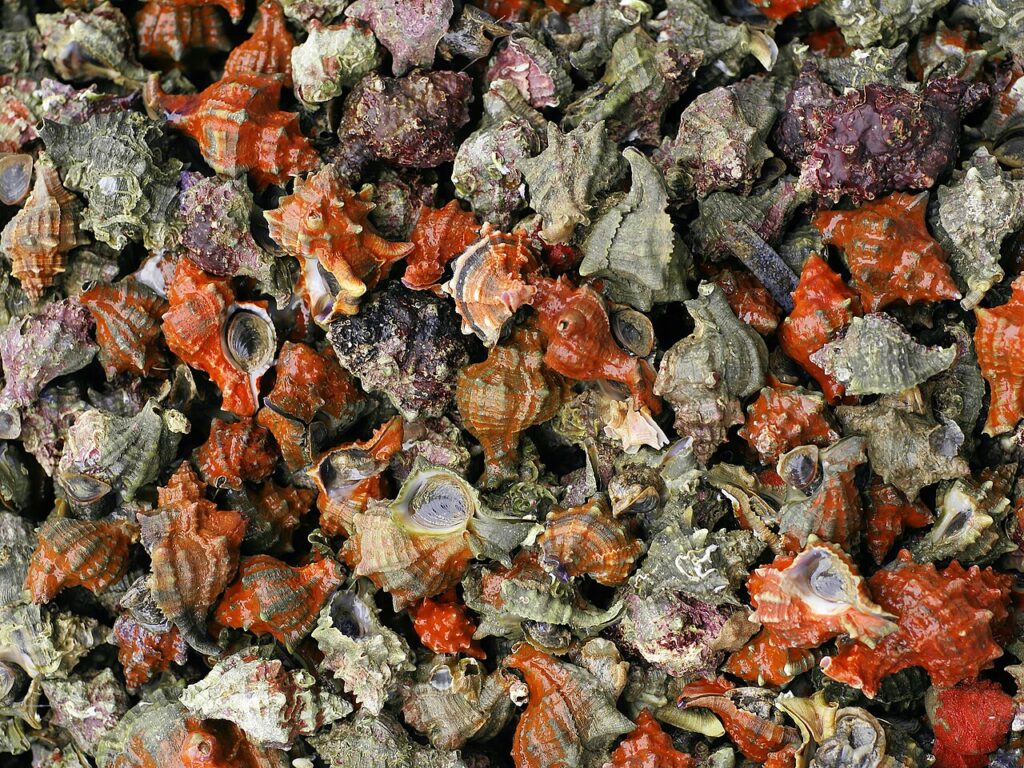
A hecatomb of sea snails, a transparent mucus, and a smell to drive away everyone around you. Tyrian purple was for two millennia the most coveted substance among the powerful… and the most imitated in the ancient world.
Two years ago, in the bay of Kiladha, to the east of the Peloponnese, the team of Genevan archaeologist Julien Beck brought up from the seabed shells of Hexaplex trunculus – the murex – dating from Early Helladic I, that is to say around 3000 BCE. Some bore the mark of a deliberate manual fracture targeted at the hypobranchial gland. If the ongoing analyses confirm the hypothesis, Lambayanna will be the oldest known purple-production workshop to date, half a millennium older than the Cretan sites and two millennia older than the Phoenicians to whom history has credited the invention.
The idea that prehistoric populations of the Peloponnese were already producing this dye overturns a well-established narrative: that purple was first and foremost a matter of power. It would have begun, more simply, as a village craft.
A mucus, a gland, an empire
The most celebrated pigment of Antiquity does not originate in a plant or a mineral. It is born in the pallial cavity of a gastropod of the family Muricidae, in the form of a whitish secretion lodged in the hypobranchial gland – a strip two centimetres long by four millimetres wide, nestled between the intestine and the respiratory apparatus. The liquid contains no colour as yet: it holds colourless precursors that the enzyme purpurase keeps prudently separated for as long as the animal is alive. The fracture of the shell, the death of the mollusc, or simple exposure to air is sufficient to trigger the reaction: enzyme, oxygen, and sunlight transform the transparent mucus into yellow, then green, then blue, and finally into reddish-violet or purple depending on the species.
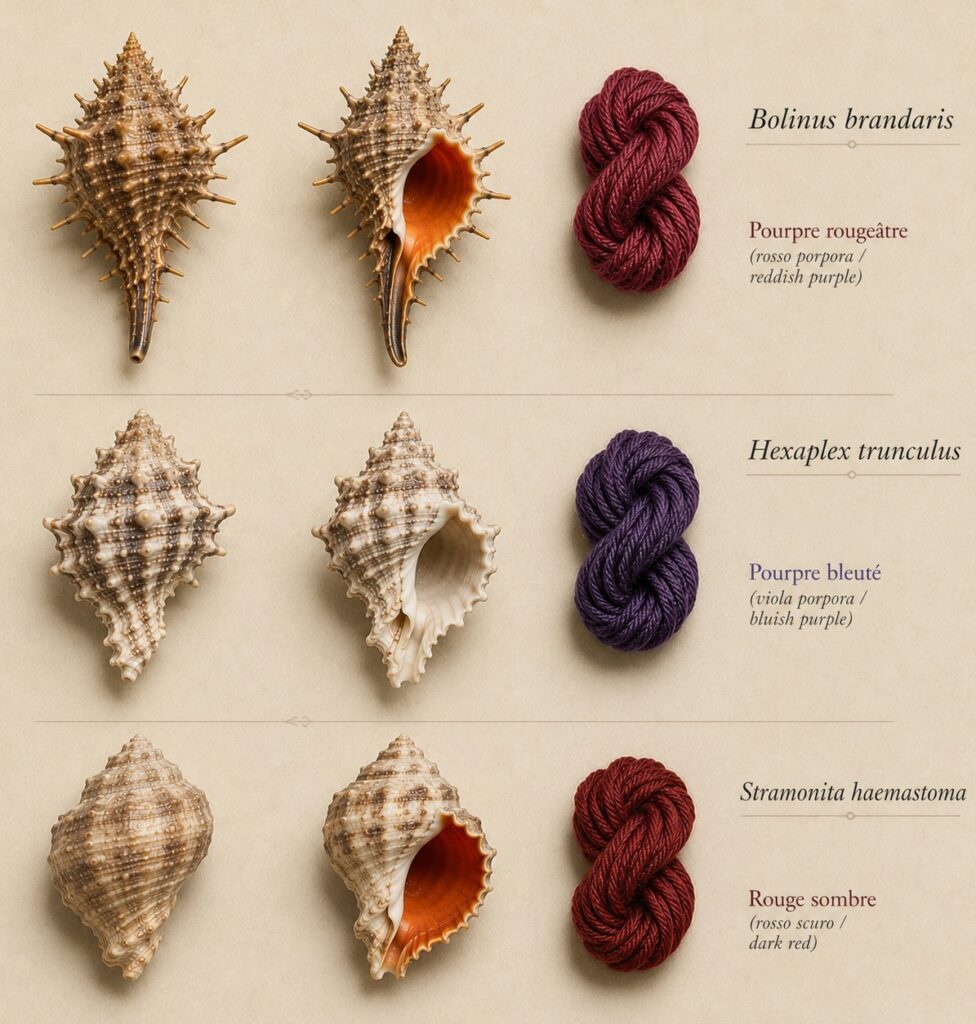 Three Mediterranean species account for the bulk of ancient production. Bolinus brandaris (the spiny murex) yields a reddish purple; Hexaplex trunculus (the banded murex) produces a bluish purple; Stramonita haemastoma (the red-mouthed rock shell) tends towards red. The Phoenicians of Tyre had understood that by combining the first two species in two successive baths – the technique known as dibapha, ‘double-dyed’ – one obtained the most sought-after shade: a dark red verging on black, brilliant in the light, which Pliny the Elder compares to coagulated blood, to Homer’s ‘blood-purple’[1]. The first immersion in the brandaris bath dyes the wool green; the second, in that of trunculus, overlays violet on green to produce that colour which late Latin authors named blatta.
The problem with this dyeing process is that each snail contains only a tiny droplet of precursor. To dye an entire garment in a deep shade, between five thousand and ten thousand molluscs are required. The mounds of crushed shells found at Sidon – one hundred and twenty metres long by seven to eight metres high – or at Delos – a compact layer one metre thick by forty-four metres long – give some idea of the industrial scale reached. Pliny sums up the situation in a lapidary formula concerning Tyre: “all its glory now rests upon the shellfish and the purple”[2].
The recipe and its secret
Pliny the Elder devoted several chapters of his Historia Naturalis to the manufacturing process. The shells of small specimens are crushed whole; those of large ones are pierced at the level of the gland to extract the precious liquid; the resulting pulp is salted – about one sextarius per hundred pounds[3] –; it is left to macerate for three days; it is then slowly reduced in a tin or lead cauldron over some ten days at indirect heat, skimmed regularly; the dye is tested on a tuft of wool before the fibres are immersed for five hours. The process is described with apparent precision – and yet it does not work. Modern chemists who have attempted to reproduce it to the letter have systematically failed. The dyers kept their secrets: King Hiram of Tyre sent King Solomon craftsmen specialised in purple as though it were a skill as rare as sculpture[4].
The key was invisible: a bacterium. Modern reconstructions had dismissed the decomposing flesh of the mollusc as a residue of no interest. Yet it is precisely this flesh that contains the anaerobic bacteria capable of rendering the pigment soluble and therefore fixable on wool.
An epic catch, an insatiable desire
The process gave off, it must be said, a memorable stench – the inevitable consequence of the decomposing flesh that was precisely the key to the procedure. As Strabo observed at Tyre: “the great number of dye-works makes the city disagreeable to live in; but the industry that causes this inconvenience makes it wealthy”[5]. And Martial, in an epigram against Philaenis (one of his habitual targets), summed up the situation in four lines:
“If Philaenis wears purple-dyed clothing night and day, it is not out of ambition or pride: it is the smell she likes, not the colour”[6].
The fishing itself had something of the epic about it. Oppian, in his Halieutica, described with cruel precision the capture by trap: small wicker pots of tightly woven rushes, baited with strombs and gaping shells, attract the murex, renowned for its voracity[7]. The animal slides its long, sharp tongue between the rushes – the very tongue it uses to bore through the shells of its prey; it swells, the trap closes, and the murex remains “stretched in pain” until the fisherman hauls up the pot.
But the true predator in this story is not the murex. Tyrian purple is above all a story of human desire – the desire to possess what others cannot afford. Cornelius Nepos, the historian who died under Augustus, chronicled it in his Chronica:
“In my youth, violet purple was in fashion, selling at a hundred denarii the pound; not long after came the red of Tarentum. Then came the Tyrian dibapha, which could not be bought for less than a thousand denarii the pound. P. Lentulus Spinther, curule aedile, was the first to wear it on his praetexta, and he was blamed for it. Yet who does not now use it for dining-couch covers?”[8]
In less than a century, the supreme badge of the Roman patrician was being used to upholster divans. The mechanism is that of every fashion: scarcity creates prestige, accessibility destroys it, and a new scarcity must be invented.
Purple was worth its weight in silver at Colophon as early as the 4th century BCE, according to Theopompus as reported by Athenaeus[9]. Under Augustus, dyed wool cost four thousand sesterces the pound – forty times the price of natural wool. Ovid, in his Art of Love, is exasperated: “What madness to wear one’s fortune on one’s body!”[10] Three centuries later, Diocletian’s Edict fixed the price of silk dyed in blatta – the darkest imperial purple – at one hundred and fifty thousand denarii the pound. The inflation of scarcity knew no ceiling.
Sacred purple, forbidden purple
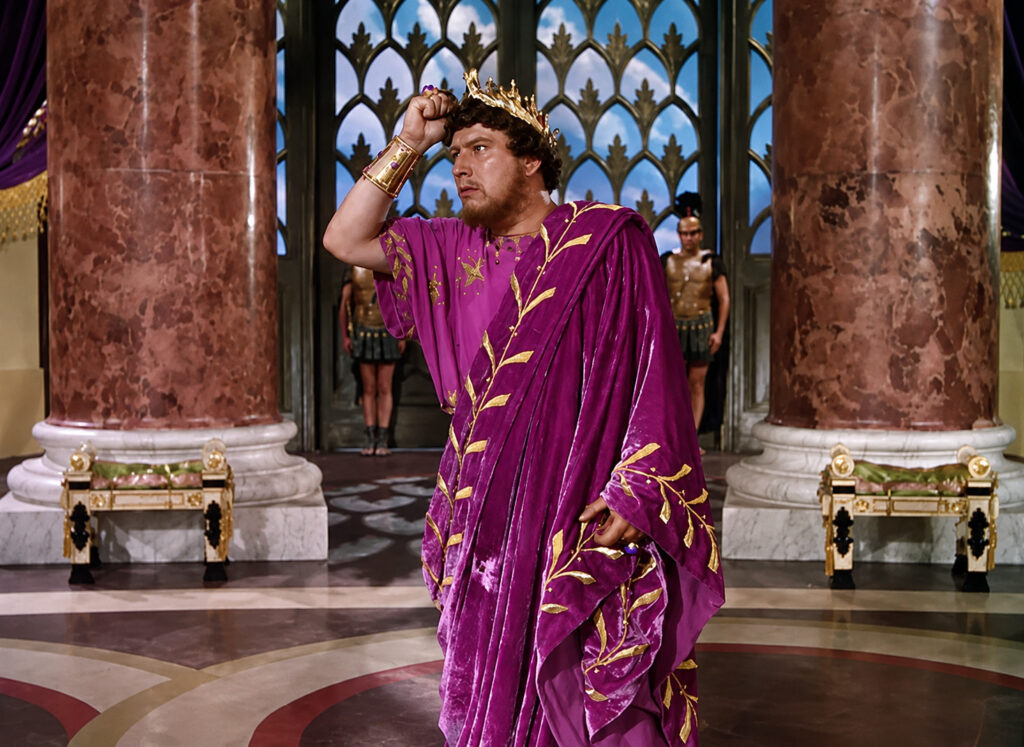
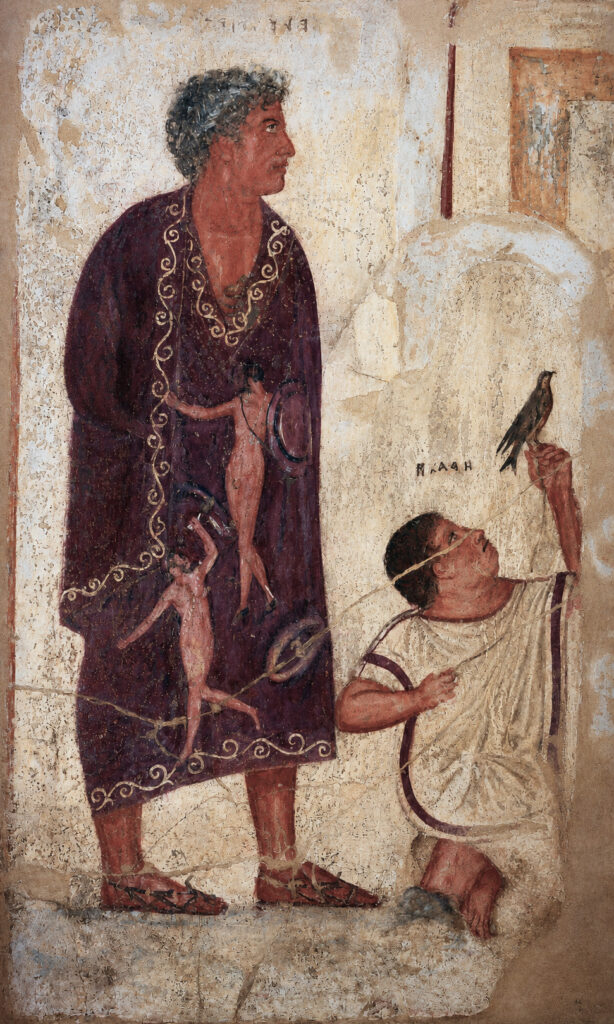
Purple was never simply a colour – it was a badge of power. Etruscan kings wore the toga purpurea, entirely purple; magistrates made do with a stripe on the praetexta; triumphatores donned the toga picta, purple embroidered with gold. The more one governed, the more one wore – and by looking at someone, one could tell exactly where they stood in the order of the world. In 40 CE, the king of Mauretania was killed on Caligula’s orders for entering an amphitheatre dressed in an overly brilliant purple robe. He was a friend of Rome. That was not enough.
Nero pushed the logic to its conclusion. He banned the wearing of amethyst and Tyrian purple by anyone other than himself, closed the shops of those who contravened the rule, and dispatched his agents into the stands:
“Having forbidden the use of amethyst and Tyrian purple, he pointed out to his procurators a matron in the audience wearing the forbidden purple, and she was stripped on the spot, being deprived not only of her garment but also of her property”[11].
Trade was barely slowed. In 383 CE, the emperors took stock: purple became a state monopoly, and the possession of certain purple fabrics a crime of high treason.
The Emperor Julian, in the 4th century CE, had settled the question differently. Informed that a man had had imperial purple garments made for himself, he dismissed the matter and sent the man a pair of shoes in the same colour – to make clear that he did not feel threatened by clothing[12].
Purple and its impostors
Demand had naturally generated alternative supply and a proliferation of counterfeiters. Gaulish dyers, Pliny notes, reproduced Tyrian purple, ostrinum and all the other colours using herbs: “they do not go to seek the murex in the depths of the sea; they do not expose themselves, in catching it, to being devoured by sea monsters”[13]. The porphyrobaphoi of Hierapolis in Phrygia, far from any coast, practised madder-dyeing over an indigo ground that “perfectly imitated the original”, Strabo notes[14]. Two Alexandrian papyri of the 3rd century CE (the Papyrus Leydensis and the Papyrus Holmiensis) compile recipes for counterfeiting: madder red layered over woad blue, or over alkanet, or over orchil.
Even genuine purple had its internal social gradations. The amethystinus (amethyst shade), the ianthinus (violet, from the Greek íon (ἴον), the violet flower), the conchyliatus (murex juice diluted in urine, a pale lavender tone held in high esteem), the hyacinthinus, the tyrianthinus, the thalassinus – the nomenclature expanded at the pace of inflating desires. Vitruvius, the architect of the 1st century BCE, noted that purple varied according to the latitude of production: dark and bluish in the northern Pontic region, red in the southern Mediterranean[15]. Reconstruction experiments suggest that it is less geography than manufacturing methods that determined the shade.
Sacrifices and mysteries
That purple was something other than a mere commodity, the archaeologists of the island of Aegina recently confirmed in an unexpected way. In the destruction layers of a Mycenaean building of the 16th century BCE at Aegina-Kolonna, associated with a purple-dyeing workshop attested by chemical analyses and the massive presence of crushed Hexaplex trunculus shells, were found deposits of animal remains burnt at high temperature – piglets and lambs of one to two months, completely consumed. One does not roast a month-old piglet for an ordinary meal. Dyeing in purple was an act serious enough to invoke divine protection.
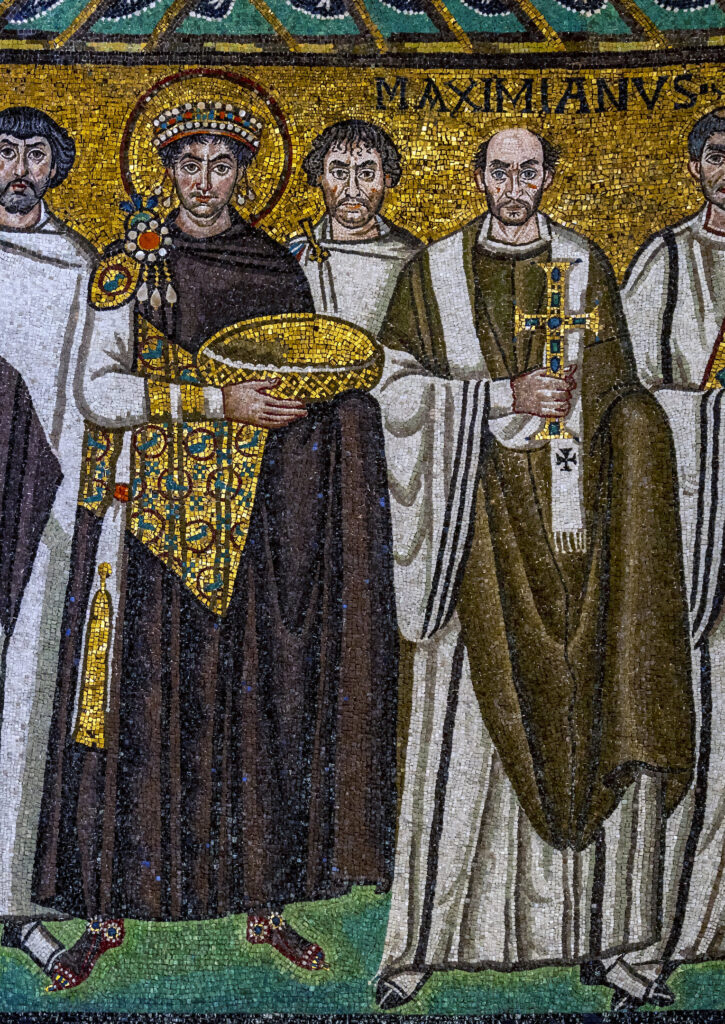
This link between purple and the sacred will come as no surprise: in Hebrew, argaman (אַרְגָּמָן, the red-purple of brandaris) and tekhelet (תְּכֵלֶת, the blue-violet of trunculus) are the two sacred colours of the Temple, the colours of the priests’ vestments and the veils of the tabernacle[16]. The Linear B tablets from Knossos associate the term ‘royal’ with dyers or purple-dyed objects as early as the Mycenaean Bronze Age. Purple and power were acquainted long before Rome.
The end, and what remains
On the morning of 29 May 1453, Constantinople fell to the Ottomans. It was the end of the Eastern Roman Empire. It was also, incidentally, the end of Tyrian purple. The imperial manufactories of the city went dark; the Church, which had been bringing the cardinals’ purple from Constantinople since the 13th century, found itself without a supplier. Scarlet red took over – first dyed with kermes, then, after the conquest of Mexico, with cochineal. The multi-step recipe of the purpura dibapha Tyria, kept secret for two millennia, disappeared with the craftsmen who practised it.
A rubbish heap discovered in 2003 at the site of the ancient port of Andriake in Turkey, dating from the 6th century CE, perhaps tells another ending: at the bottom of the deposit, the murex shells were large and well-formed; towards the top, they became progressively smaller and younger. The population had been over-fished until only juvenile individuals remained. The industry may have exhausted itself before the fall of the Empire – not through forgetfulness, but through depletion of the resource. Today, Stramonita haemastoma, the species that gave the red-purple its most vivid shade, has disappeared from the eastern Mediterranean.
In a garden shed in Ben Arous, on the outskirts of Carthage, Mohammed Ghassen Nouira has spent his weekends since 2007 crushing murex shells. It took him years of trials to approach the authentic shade – blending the secretions of the three species, adjusting the acidity, alternating light and darkness, modulating the cooking times. His pigments and fabrics have been exhibited at the British Museum and the Museum of Fine Arts in Boston. He describes the colour obtained in the words of someone who has seen something that few living people have seen: “It is very alive, very dynamic. Depending on the light, it changes and shimmers… it never stops changing and playing tricks on your eyes.”
Modern studies consulted
- Beck J. et al., “Bay of Kiladha 2023”, Antike Kunst 67, 2024, pp. 110-116.
- Berger L. et al., “More than just a color”, PLoS ONE 19(6), 2024.
- Gratton K., “Production et échange de la pourpre au Proche-Orient aux époques grecque et romaine”, Topoi suppl. 8, 2007, pp. 151-172.
- Koren Z.C., “The First Optimal All-Murex All-Natural Purple Dyeing”, Dyes in History and Archaeology 20, 2005, pp. 136-149.
- Radicke J., “Colores – colour, dress style, and fashion”, in Dress and Human Body, De Gruyter, 2022, pp. 395-461.
- Robert J.-N., Les Romains et la mode, Paris, 1992 – Rothe U., The Toga and Roman Identity, London, 2020.
- Schoelzke M.V., “In pursuit of antique fake purple”, European Textile Forum 2022.
- Sebesta J.L. and Bonfante L. (eds.), The World of Roman Costume, Madison, 1994.
- Verhecken A., “Experiments with the dyes from European purple-producing molluscs”, Dyes in History and Archaeology 12, 1994, pp. 32-35.
[1] Pliny the Elder, Historia Naturalis IX, 133-135: color sanguinis concreti, nigricans aspectu idemque suspectu refulgens – “the colour of coagulated blood, dark in direct light but brilliant in oblique light.” The dibapha technique: first bath in the juice of Murex pelagium (= brandaris), which dyes green; second bath in buccinum (= trunculus). Cf. also IX, 127: laus ei summa in colore sanguinis concreti, nigricans aspectu idemque suspectu refulgens – “its supreme merit lies in the colour of coagulated blood, dark in direct light but brilliant in oblique light.”
[2] Pliny the Elder, Historia Naturalis V, 76: Tyros, quondam insula […] olim partu clara, urbibus genitis Lepti, Utica et illa aemula terrarumque orbis avida Carthagine, etiam Gadibus extra orbem conditis: nunc omnis eius nobilitas conchylio atque purpura constat. – “Tyre, once an island […] formerly celebrated for its offspring, having given birth to the cities of Leptis, Utica, and that Carthage, rival of Rome and hungry for world domination, and even to Gades founded beyond the known world: all its glory now rests upon the shellfish and the purple.”
[3] Pliny the Elder, Historia Naturalis IX, 133: quantum salis circiter sextarium in centenas adicere conveniat – “about one sextarius of salt per hundred pounds”; maceration lasts three days, then slow cooking for approximately ten days.
[4] 2 Chronicles II, 6: Hiram sends Solomon a craftsman “skilled in dyeing in crimson, in purple, and in violet.”
[5] Strabo, Geography XVI, 2, 23: δυσδιάγωγον μὲν ποιεῖ τὴν πόλιν ἡ πολυπληθία τῶν βαφείων, πλουσίαν δὲ διὰ τὴν τοιαύτην ἀνδρείαν. – “the great number of dye-works makes the city disagreeable to live in; but the industry that causes this inconvenience makes it wealthy.”
[6] Martial, Epigrams IX, 62, 1-4: Tinctis murice vestibus quod omni / Et nocte utitur et die Philaenis, / Non est ambitiosa nec superba: / Delectatur odore, non colore. – “If Philaenis wears purple-dyed clothing night and day, it is not out of ambition or pride: it is the smell she likes, not the colour.”
[7] Oppian, Halieutica V, 598-601: Πορφύραι αὖ πέρι δή τι μετ’ ὀστρείοισιν ἔασι / λίχναι· τοίη δέ σφιν ἐτήτυμος ἵσταται ἄγρη. / κυρτίδες ἠβαιαὶ ταλάροις γεγάασιν ὁμοῖαι, / πυκνῇσι σχοίνοισι τετυγμέναι· – “The murex, among shellfish, is particularly voracious (líchnai, λίχναι); and it is precisely by this voracity that its capture is accomplished. Small pots, resembling baskets, are made of tightly woven rushes.”
[8] Pliny the Elder, Historia Naturalis IX, 137, quoting Cornelius Nepos (Chronica): “me,” inquit, “iuvene violacea purpura vigebat, cuius libra denariis centum venibat, nec multo post rubra Tarentina. huic successit dibapha Tyria, quae in libras denariis mille non poterat emi. hac P. Lentulus Spinther aedilis curulis primus in praetexta usus inprobabatur. qua purpura quis non iam,” inquit, “tricliniaria facit?” Spinther was curule aedile in 63 BCE, during Cicero’s consulship.
[9] Theopompus quoted by Athenaeus, Deipnosophistae XII, 526a: purple reached at Colophon the price of silver by weight.
[10] Ovid, Art of Love III, 169-172: Quid de veste loquar? Nec vos, segmenta, requiro / Nec te, quae Tyrio murice, lana, rubes. / Cum tot prodierint pretio leviore colores, / Quis furor est census corpore ferre suos! – “What shall I say of dress? I do not seek you, embroideries, nor you, wool that reddens with Tyrian purple. Since so many colours have appeared at lesser cost, what madness to wear one’s fortune on one’s body!”
[11] Suetonius, Life of Nero 32, 3: et cum interdixisset usum amethystini ac Tyrii coloris summisissetque qui nundinarum die pauculas uncias venderet, praeclusit cunctos negotiatores. quin etiam inter canendum animadversam matronam in spectaculis vetita purpura cultam demonstrasse procuratoribus suis dicitur detractamque ilico non veste modo sed et bonis exuit. – “Having forbidden the use of amethyst and Tyrian purple, he placed agents to sell a few ounces on market days, then closed all traders’ shops. It is said that while singing he pointed out to his procurators a matron in the audience wearing the forbidden purple, and that she was stripped on the spot, being deprived not only of her garment but also of her property.”
[12] Ammianus Marcellinus, Res Gestae XXII, 9, 11: Julian dismissed without follow-up the complaint against a man who had had imperial garments made, and sent him a pair of purple shoes.
[13] Pliny the Elder, Historia Naturalis XXII, 3: Gallia Transalpina […] herbis tingit purpuras Tyrias conchyliaque omnes […] non enim illis opus est petere murices in profundo – “Transalpine Gaul dyes with herbs Tyrian purples and all shellfish colours […] they have no need to go seeking the murex in the depths.”
[14] Strabo, Geography XIII, 4, 14: the dyers of Hierapolis in Phrygia produced with madder an imitation of Phoenician purple that could not be distinguished from the original.
[15] Vitruvius, De Architectura VII, 13, 1: purpura […] non omnibus locis parem habet colorem, sed naturaliter cursu solis temperatur – the purple of Pontus and Gaul is dark; that of the southern Mediterranean is red.
[16] Exodus XXV, 4; XXVI, 1; XXVII, 16; XXXIX, 1: argaman (red-purple) and tekhelet (blue-purple) are among the materials of the tabernacle and the priestly vestments prescribed by God to Moses.
Other articles in English from the Nunc est bibendum blog