Translated from french (please notify us of errors)
At the origins of Rome, there was einkorn, emmer and spelt, three so-called “hulled” cereals. This is a somewhat technical point, but here it is: after threshing, their grains remain enclosed within their husks (glumes), which requires an additional dehusking step. This drawback is offset by several advantages: better protection against disease and insects, along with greater resistance to damp during storage.
These hulled cereals required prior roasting to remove the clinging glumes before they could be pounded or ground. This roasting technique, which predated threshing, was an old Mediterranean practice with the advantage of converting part of the starch into dextrin, giving the flour a mild sweetness. The operation nonetheless had its drawbacks: some of the grains were charred, and sometimes “instead of wheat, nothing but black ash was swept up” (Ovid, Fasti 2, 523).
Although gradually supplanted by “naked” wheat varieties from the late 5th century BCE onwards, these hulled wheats persisted locally, not least because of their hardiness under difficult farming conditions.
“Naked wheat (triticum) thrives better in dry soils, while emmer (adoreum) is less affected by damp”,
notes the agronomist Columella in the 1st century[1].
Einkorn, a marginal cereal
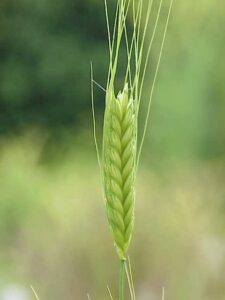
Einkorn, or “small spelt” (Triticum monococcum), represents the most archaic of the cultivated wheats. According to Pliny, this cereal never achieved wide distribution and was grown chiefly in Asia Minor. It appears in Latin sources only under the name tiphe (transliterated from the Greek τίφη), and only in connection with regions outside Italy.
Although archaeobotanical analyses reveal its persistence in certain marginal areas of the Apennines, einkorn always remained a very minor crop in the Roman world. Its hardiness allowed it to survive under difficult conditions, but its low yield and the difficulty of dehusking explain why it never rivalled emmer as a staple cereal.
Emmer, mainstay of the Italic cereals
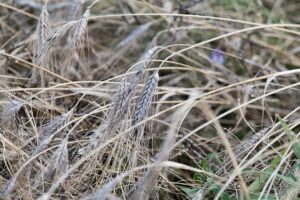
Emmer (Triticum dicoccum) plays a central role in Rome’s dietary history. Generally known as ador in its raw state, and as far once processed (roasted or crushed), this hulled wheat formed the basis of the Roman diet for centuries.
Pliny the Elder reports that:
“Verrius states that for three hundred years, far was the only grain used by the Roman people”[2].
Emmer existed in various forms. Zea, grown in the East (Egypt, Syria, Cilicia, Asia Minor and Greece) but also in Campania and Umbria, corresponded to emmer in its long-bearded forms. Scandala or scandula was a variety grown in Gaul under the name bracis and taxed at a low price in Diocletian’s Edict. Arinca, grown in Gaul and Italy, was a form of emmer with a taller stem and longer, heavier ears, produced in a damp climate.
Under the Law of the Twelve Tables, a debtor held in prison received a pound of far grain per day, a mark of its importance as a staple food.
Despite the arrival of naked wheats, it retained an essential place in Roman diet and ritual. It featured in the preparation of mola salsa (salted flour used for sacrifices) and the wedding cakes of the confarreatio, the traditional patrician form of marriage. Tradition further credited Numa with instituting the Fornacalia, the festival of grain-roasting, and offerings of roasted grain.
Archaeobotanical analyses confirm its enduring presence in the countryside and in mountainous regions, such as Umbria, Etruria and parts of Campania, even after naked wheat had become widespread.
Emmer was also used to prepare alica, a Roman speciality made from grits obtained by pounding in a wooden mortar with an iron-tipped pestle. After dehusking and crushing, sieving yielded three grades: alica minima (fine grits), alica secundaria (medium grits) and alica grandissima (coarse grits). To whiten these grits, chalk was mixed in, drawn chiefly from a hill in Campania called Leucogaeum, “the White Earth”.
In Italy, where it is known as farro, emmer has come back very much into fashion.
Spelt, a cereal of northern adaptation
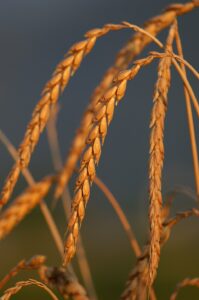
Spelt (Triticum spelta), very close in form to emmer, was often confused with far in ancient texts. It was only late on that a distinct name, spelta, appears. Diocletian’s Edict, in 301, mentions only two species of wheat: frumentum (= triticum) and spelta.
Unlike emmer, which dominated central Italy, spelt took hold chiefly in the northern provinces of the Empire.
Archaeobotanical excavations attest to its wide distribution across Roman sites in Gaul, the Germanic provinces and Britain (present-day England). At Vindolanda, a Roman fort near Hadrian’s Wall, spelt was the dominant cereal, as attested both by charred grains and by writing tablets recording its transport and delivery.
In the Rhineland and the Danubian provinces, spelt was often grown in rotation with rye, forming a cereal system suited to local conditions. This kind of adaptation illustrates the capacity of the Roman agricultural system to adjust itself to the environmental constraints of conquered territories.
Series — Cereals of Antiquity
- I.Grain and humans in pre-Roman Italy
- II.The hulled wheats, rustic ancestors of the Roman cereal system
- III.When wheat sheds its hull, Roman dough rises
- IV.Barley, millet, rye and oats: the cereals of the margin
To find out more
- Jacques André, L’Alimentation et la cuisine à Rome, Les Belles Lettres, 1981, chap. 2 (“Les céréales”).
- Also read our article Et le far fut!
[1] Columella, De Re Rustica, II, 6: Triticum autem sicco loco melius coalescit. Adoreum minus infestatur humore.
[2] Pliny, Historia Naturalis, XVIII, 11 (62): Populum Romanum farre tantum e frumento CCC annis usum Verrius tradit.
Other articles in English from the Nunc est bibendum blog