Translated from french (please notify us of errors)
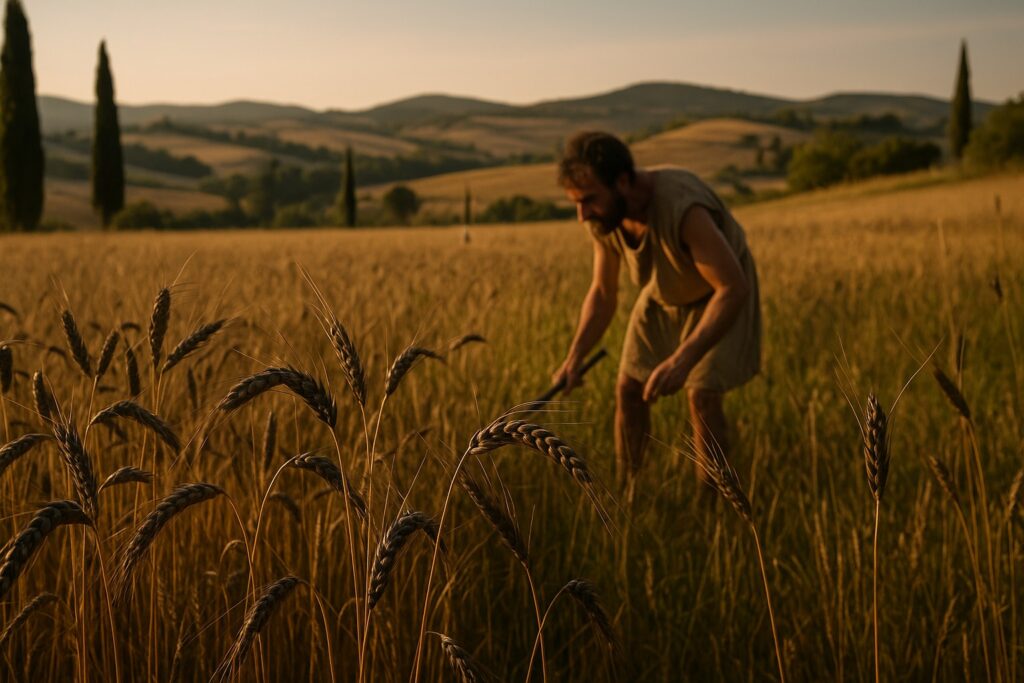
Long before Rome was born, cereals were already feeding the societies of the Italian peninsula. Cultivated since the Neolithic, they shaped not only diets, but also landscapes, exchange networks and ritual practices. Thanks to archaeobotany and archaeology, it is now possible to trace their history with growing precision.
As early as the 4th millennium BCE, the first agricultural communities settled in the Po plain, the foothills of the Alps and the hills of southern Italy. Descended from the Mediterranean Neolithic, these populations introduced several cereal species domesticated in the Near East: emmer wheat (Triticum dicoccum), einkorn (Triticum monococcum), naked wheat (Triticum aestivum/durum) and barley (Hordeum vulgare).
At the site of Rendina (Basilicata), dated to around 5160 BCE, grains of wheat and barley bear witness to this pioneering agriculture. In the north, the pile-dwelling villages of the Lombard and Venetian lakes have yielded, thanks to damp conditions favourable to preservation, abundant cereal remains, notably at Fagnigola and Sammardenchia.
The predominance of emmer and einkorn, two hardy species tolerant of poor soils and climatic variation, reveals an early adaptation to local conditions. This cultural selection already marks a regional specialisation of agriculture.
Diversification in the Bronze Age
During the Bronze Age (2200–900 BCE), Italian societies developed more intensive and diversified agricultural systems. It was in this period that two new cereals of Asian origin appeared: common millet (Panicum miliaceum) and foxtail millet (Setaria italica). Introduced along two major routes (via central Europe and via the eastern Mediterranean), these grasses gradually became established across the peninsula.
Excavations at Terramara di Montale (Emilia-Romagna) and Lavagnone (Lombardy) have yielded traces of millet dated to the Middle and Late Bronze Age. These plants offered numerous advantages: a short growing cycle, good drought resistance, and adaptability to a range of soil types.
Carbon and nitrogen isotope analyses carried out on human remains from this period have revealed a significant rise in millet consumption, particularly among women. This shift reflects dietary diversification and greater resilience in the face of climatic uncertainty.
Opening up the landscape and mastering the soil in the Iron Age
Over the course of the Iron Age (900–200 BCE), agricultural practices continued to evolve. Landscapes were transformed: wooded areas retreated, clearings opened up, and cultivated land expanded, particularly on hillsides.
Two new cereals are occasionally mentioned: oats (Avena sativa) and rye (Secale cereale). Their importance in Italy at this period nonetheless remained limited. These species appear mainly in marginal contexts (Alpine areas, or as volunteer weeds, meaning without having been deliberately sown) and played only a secondary role before the Roman era.
By contrast, land management became more refined: agricultural terraces, irrigation channels and the draining of wetlands became common in certain regions (Etruria, Latium, the Po plain). Pollen analyses carried out on lakes and peat bogs show a marked increase in cereal pollen, reflecting a widespread intensification of grain cultivation.
Agriculture rationalised by the Etruscans
The Etruscans, a people of central Italy (800–280 BCE), developed one of the most advanced agricultural systems in the western Mediterranean. Their estates combined large-scale cereal cultivation, vineyards, olive groves and livestock in an integrated model that prefigured the Roman villa rustica.
Sites such as Populonia, Vetulonia and Spina have yielded remains of naked wheat, emmer, barley and millet. Durum wheat (Triticum durum), probably used for semolina or certain flatbreads, becomes more frequent here, though it did not yet displace older species such as emmer.
The monumental granaries discovered at Tarquinia and Vulci, together with numerous buried silos, testify to a substantial capacity to produce, process and store cereal surpluses. Religious iconography and offerings of grain in sanctuaries confirm the social and ritual importance of cereal farming.
Greek texts, such as those of Theophrastus, also praise the fertility of Etruria. Organic residues analysed in Etruscan amphorae found in Greece and Carthage suggest the beginnings of a cereal export trade, although direct evidence remains scarce.
The refinement of tools accompanied these transformations. The Etruscans employed ploughs fitted with iron ploughshares, more robust than the wooden ones used until then. Serrated sickles, first in bronze and then in iron, made harvesting more efficient.
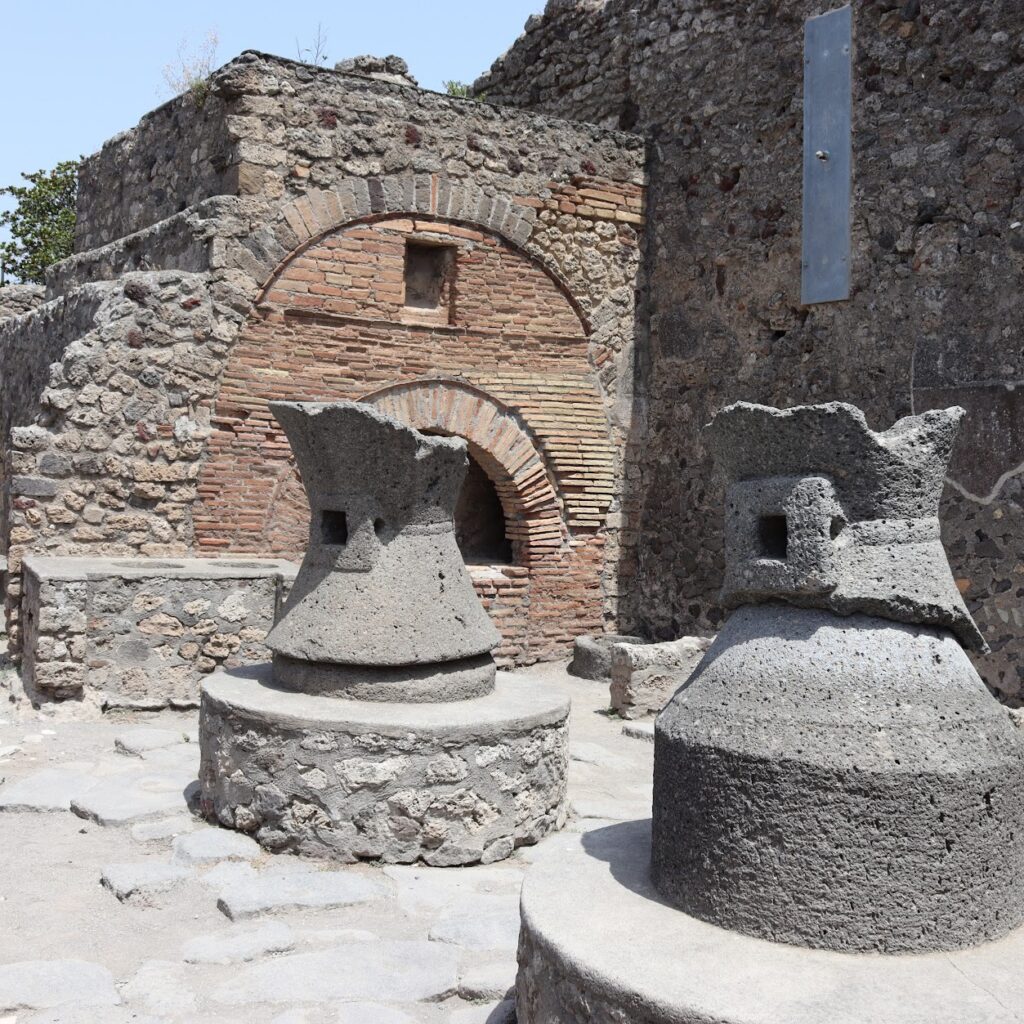
The rotary quern, which appeared around the 4th century BCE, gradually replaced the back-and-forth saddle quern and made it possible to produce finer flour in greater quantities. The use of airtight storage techniques, such as clay linings on the inner walls of silos, is attested by residue analysis in several burnt structures.
Cereals, moreover, were not merely foodstuffs: they also symbolised prosperity, fertility and the bond with one’s ancestors. Sanctuaries dedicated to agrarian deities, such as Ceres (the Italic form of Demeter), often contained votive pits filled with grain.
Etruscan funerary urns frequently contain cereal-based food remains, incorporated into rites of passage. Etruscan art abounds with motifs of wheat ears, visible on frescoes, fibulae and pottery, underlining the central place of grain in the representation of life and death.
The Roman inheritance
When Rome rose to power, it directly inherited this millennia-old cereal tradition. Latin agronomists such as Cato the Elder, Varro and Columella often did little more than formalise earlier know-how: the choice of seed, the organisation of crop rotations, methods of storage.
The real break came with the widespread adoption of the villa rustica, a large-scale integrated agricultural estate, and the development of an imperial supply system drawing on Italy but also on the grain-producing provinces (Sicily, Africa, Egypt).
Series — Cereals of Antiquity
-
- I.Grain and humans in pre-Roman Italy
- II.The hulled wheats, rustic ancestors of the Roman cereal system
- III.When wheat sheds its hull, Roman dough rises
- IV.Barley, millet, rye and oats: the cereals of the margin
To find out more
- Follieri, Maria. L’agriculture des plus anciennes communautés rurales d’Italie. Premières communautés paysannes en Méditerranée occidentale, edited by Jean Guilaine et al., CNRS Éditions, 1987.
Other articles in English from the Nunc est bibendum blog