Translated from french (please notify us of errors)
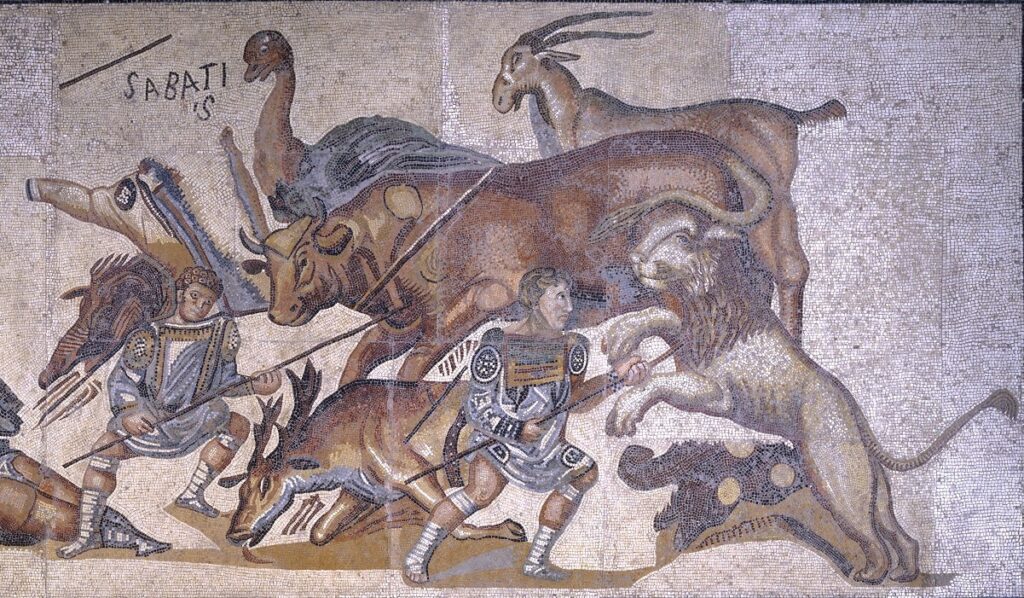
Although we know Roman animal spectacles in great detail, one question remains strangely overlooked: what became of all that meat?
Over the roughly 500 years during which animal spectacles were offered to the Roman people, hundreds of thousands of local and exotic animals were put to death. In 80 AD, during the 100 days of dedication of the Flavian amphitheatre (the Colosseum), Titus had 9,000 slaughtered. And in 107, 11,000 animals paid the price for the celebration of Trajan’s victory over the Dacians.[1]
Orchestrating a mass entertainment
On the sand of the circuses, and later the amphitheatres[2] throughout the Roman world, animals were first staged in great hunts, the venationes. The first official venatio dates back to 186 BC, but it was from the first century BC onwards that these spectacles took on a considerable scale.[3] For the occasion, a natural environment was sometimes recreated, in the manner of a theatrical set.
All manner of animals were released into this enclosed space, then the hunters moved in. The crowd could thrill at the danger faced and admire the courage of the protagonists. The morning was devoted to hunts, as in real life. Midday was the time set aside for the public execution of condemned prisoners. Then, in the afternoon, the gladiators took to the arena.[4]
These spectacles served as outlets, thereby safeguarding the social order to the benefit of the wealthy elites in power. Within this framework, the hunts played a particular role. They reminded city dwellers of their rural origins, weaving a bond between populations and eras. Through the display of exotic animals, Rome also demonstrated to all its territorial dominion over very distant lands, peopled with strange and sometimes fearsome creatures.
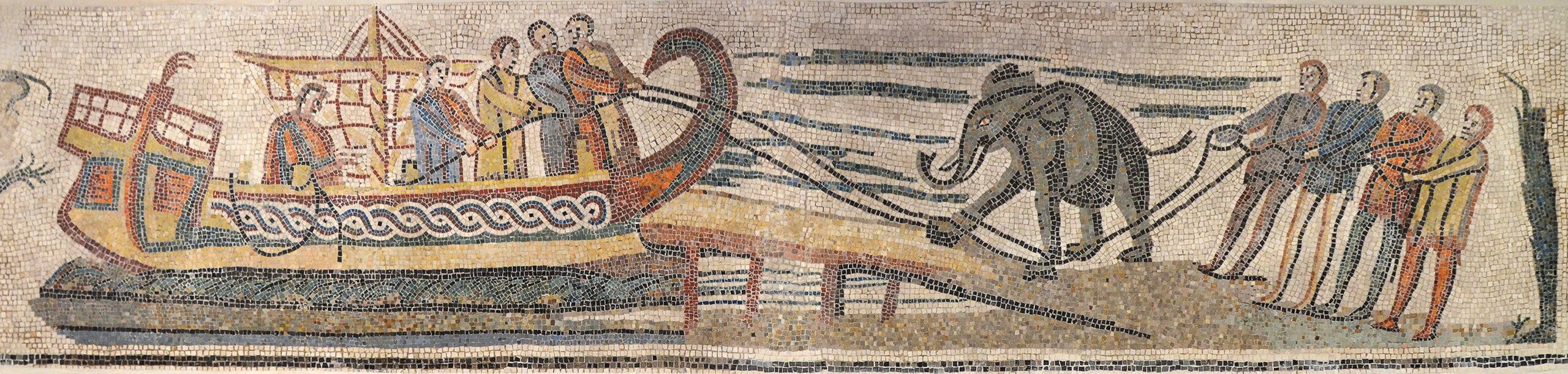
Between the 1st century BC and the 4th century AD, the importation of exotic animals, primarily from Africa and the Near East, constituted an enormous and highly lucrative trade. According to the Edict of Diocletian, promulgated in 301 in an attempt to curb inflation across the Empire, the maximum price of a “prime” African lion was set at 150,000 denarii, equivalent to the wages of an agricultural labourer for 16 years. This staggering price was almost certainly a consequence of the growing scarcity of wild fauna around the Mediterranean basin.
Roman predation for the arena games had, over the centuries, a clear and lasting effect on the ecosystem. Lions, elephants and ostriches had previously been present north of the Sahara. “Where they have made a desert, they call it peace”[5] — this celebrated phrase of Tacitus resonates in this context too.
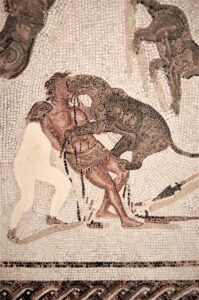
As wild beasts presumably became rarer and therefore more valuable, they were no longer immediately sacrificed but used to execute condemned prisoners. This practice, the damnatio ad bestias, became regular in the 1st century BC and widespread from the beginning of the Empire. Suetonius recounts that Caligula, who reigned from 37 to 41, found that purchasing cattle to feed the wild beasts was becoming too costly, and so chose the prisoners to be sacrificed himself:
“Reviewing the line of prisoners, without examining the charge against any of them, standing merely in the middle of the colonnade, he ordered them to be led away ‘from baldhead to baldhead'”[6]
From the arena sand to the Roman plate
If, then, the beasts devoured Romans, did the Romans eat the beasts? Against all expectation, the literary and archaeological evidence available to answer this question is very scarce.
Archaeology has nevertheless revealed bones of exotic animals in the sewers and substructures of several Roman amphitheatres, suggesting that these carcasses were processed on site rather than simply discarded in mass graves outside the city.[7]
The first argument is simply logical. The ordinary diet of Roman city dwellers was poor in protein. Any supply of meat was hoped for and welcomed. Moreover, in a society as pragmatic as the Roman world could be, it is highly unlikely that the edible parts of arena animals were left to go to waste.

All the more so since the spectacles recreated genuine hunts in which the sharing of game was traditional. Unlike religious sacrifices, which followed precise rituals, the venationes were profane hunts whose produce could be freely distributed. The distribution of meat or the organisation of public banquets must have been an integral part of the social game. The wealthy entertained the people, but fed them too. Beyond the famous panem et circenses (Juvenal 10.81), there existed an equally significant carnem et venationes — meat and hunts wove the bond between the people and the emperor, making violent spectacles a complete experience: to watch, to participate, and to consume.
Furthermore, from the time of Augustus onwards, the distribution of gifts at spectacles became institutionalised: emperors threw tokens (tesserae) into the crowd, exchangeable for various presents, sometimes including meat, as part of what the Romans called sparsio or missilia. As Martial records, these tokens could even “assign the beasts of the arena”[8] to lucky spectators.
Testimonies and culinary practices
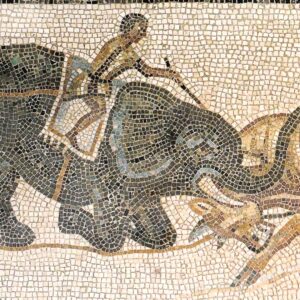
The Historia Augusta, a compilation of imperial biographies dated to the late 4th century, provides evidence of an even more direct form of meat distribution. The emperor Probus (276–282) is said to have organised a most impressive hunt in the Circus. After bringing in 1,000 deer, 1,000 boars and 1,000 ostriches, “the people were admitted and each took what he wished”[9].
According to Galen, physician to Marcus Aurelius, far more exotic animals also ended up in the cooking pots of the most powerful. Whilst studying the anatomy of the elephant, he noted that the animal’s heart had been taken by the emperor’s butcher-cooks.[10]
A final indication of the consumption of arena meat appears in Tertullian. A native of Carthage and a convert to Christianity, he wrote around 200 AD to defend his new religion against the Roman authorities. To those who accused Christians of cannibalism, he replied:
“What of those who dine on the flesh of wild animals from the arena? Who help themselves to boar, who help themselves to deer? That boar was drenched in the blood of the man he tore apart; that deer lay in the blood of a gladiator; and in the bellies of the bears, the limbs of the men they devoured are still quivering.”[11]
No doubt the consumption of meat from beasts killed in the venationes was self-evident to the Romans. That is precisely why the texts most often imply it without mentioning it explicitly. The manner of preparing these rare dishes is likewise undocumented; the common sauces for dressing various types of meat — notably those for game detailed by Apicius — must have sufficed.
Only one beast mentioned in the context of the venationes has specific recipes of its own: the ostrich[12]. This curious bird was doubtless infinitely more affordable than a “prime” lion.
[1] These figures are reported notably by Donald G. Kyle, “Animal Spectacles in Ancient Rome: Meat and Meaning.” Histoire, économie et société 13, no. 2 (1994): 269–292.
[2] The amphitheatre of Statilius Taurus was the first permanent amphitheatre built in Rome, in 29 BC.
[3] The first official venatio was organised by Marcus Fulvius Nobilior.
[4] This tripartite organisation of the day’s spectacles is attested by numerous Roman sources, including Suetonius.
[5] Ubi solitudinem faciunt, pacem appellant. A phrase placed by Tacitus (Life of Agricola, 30) in the mouth of Calgacus, a Caledonian hero, denouncing the rapacity of the Romans.
[6] Suetonius, Caligula, 27, 2: custodiarum seriem recognoscens, nullius inspecto elogio, stans tantum modo intra porticum mediam, ‘a caluo ad caluum’ duci imperavit. With the expression “from baldhead to baldhead”, Suetonius mocks Caligula himself, who suffered from baldness.
[7] Archaeological discoveries of exotic animal bones have been made notably in the sewers of the Colosseum.
[8] Martial, Epigrams, 8, 7: nunc dat spectatas tessera larga feras.
[9] Historia Augusta, Probus, 19, 2–4: inmissi deinde populares, rapuit quisque quod voluit.
[10] Galen, De anatomicis administrationibus, VII, 10: ἀρθείσης μέντοι τῆς καρδίας ὑπὸ τῶν τοῦ Καίσαρος μαγείρων.
[11] Tertullian, Apologeticus, IX, 11 (270): Item illi qui de arena ferinis obsoniis cenant, qui de apro, qui de cervo petunt? Aper ille quem cruentavit colluctando detersit, cervus ille in gladiatoris sanguine iacuit. Ipsorum ursorum alvei appetuntur cruditantes adhuc de visceribus humanis; ructatur proinde ab homine caro pasta de homine
[12] See our article: Ostrich on the menu
See also our Latin bestiary of exotic animals known to the Romans
Other articles in English from the Nunc est bibendum blog