Translated from french (please notify us of errors)
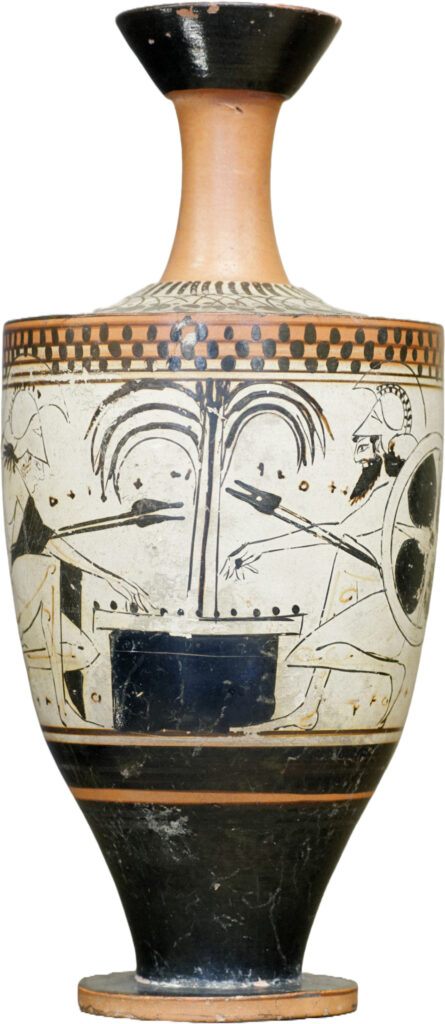
Athens, around 430 BCE. On the theatre stage, masked actors perform The Runaways, a comedy by the comic poet Cratinus of which only a few fragments have survived[1]. A character declaims: “Son of Pandion, king of the city with fertile soil, you know well which city is meant — the one where they play ‘dog’ and ‘city’.” The audience understood the wordplay at once. Kyôn (κύων) denotes both the animal and the game piece; Polis (πόλις) is the city, and also the name of the game itself.
This is the earliest known mention of a board game that must have been very common in ancient Greece, belonging to the general category of petteia (πεττεία) — games played with pessoi (πεσσοί), that is, pieces or counters.
Yet the polis does not lend itself to easy description. As with all ancient games, the sources are fragmentary. Authors mention games to support a metaphor, illustrate a philosophical argument, or recount an anecdote — never to explain the rules.
What Pollux tells us
The most valuable source remains the Onomasticon of Pollux, a Greek lexicographer of Egyptian origin active in Athens[2]. It is through him that the fragment of Cratinus has come down to us, and it is he who provides the only technical information at our disposal: the board is called polis, each piece is called kyôn, and the mechanics of the game rest on capture by encirclement:
“The pieces being divided into two groups according to their colour, the art of the game consists in removing a piece of a different colour by surrounding it with two pieces of the same colour.“
Pollux also indicates that the game is played with many pieces on a board containing squares separated by lines. The term plinthion (πλινθίον) used to designate the gridded board is not without significance: the military writings of Arrian and Josephus use it to describe a body of troops in rectangular formation. The vocabulary is military before it is ludic.
The very name polis was doubtless not chosen at random: the board becomes a kind of territory, organised into squares like a city or a space to be controlled. The pieces move across it, confront one another, encircle one another like groups in struggle. Without reading too much into this, the vocabulary used by the Greeks reveals at least the following: the game was conceived not merely as entertainment, but as a way of representing, in miniature, relations of power and the organisational logics particular to the city-state.
A game so well known it served as a reference
The polis must have been sufficiently widespread to serve as an implicit point of reference for all manner of situations.
Plato certainly has this game in mind when, in the Republic, he has Adeimantus say that Socrates’s interlocutors are like clumsy players “whom the skilled end up blocking, and who no longer know what move to make”[3]. The image presupposes a game in which mobility diminishes with each move, until tactical suffocation sets in. In the Statesman, the same Plato evokes “excellent players of pieces” (ἄκροι πεττευταί) as a skill so rare as to be almost impossible to find[4]. And in the passage of the Republic where Socrates ironises about divided cities, he openly plays on the double meaning of polis: “each of them is not one city but many cities, as they say in the game”[5]. The sentence cannot be translated without losing the pun, which assumes that the reader hears both meanings at once.
Aristotle draws from this mechanic one of the most striking formulations in the Politics: the man without a city is “like an unpaired piece in a game of counters,” azyx hôsper en pettois (ἄζυξ ὥσπερ ἐν πεττοῖς)[6]. The word azyx literally means “not under the yoke,” hence without a partner. In the context of the polis, the metaphor is tactical before it is moral: isolation is not merely an existential condition — it is a losing position.
Polybius, two centuries after Plato, describes the strategy of the Carthaginian Hamilcar against the revolted mercenaries thus: “like a good player of pieces, he isolated them, encircled them, and destroyed them without fighting”[7].
The most pointed anecdote belongs to Diogenes Laërtius. Heraclitus, having withdrawn to the temple of Artemis at Ephesus, was playing knucklebones with the children. To the astonished Ephesians, he is said to have called out:
“What are you staring at, wretches? Is it not better to do this than to ‘politeuesthai’ with you?“[8]
The verb politeuesthai is untranslatable: “to govern the city” on one hand, “to play at polis” on the other. Heraclitus, assuming the anecdote is reliable, knew his audience would hear both meanings. The politics of Ephesus, which he despised, was for him in any case nothing but a bad move on the board.
What we shall never know
To sum up. The polis is a two-player board game with identical pieces, capture by encirclement, and a strategic logic rich enough to have fed the metaphors of Greek philosophers and historians for centuries. That is more or less all that can be said about the rules.
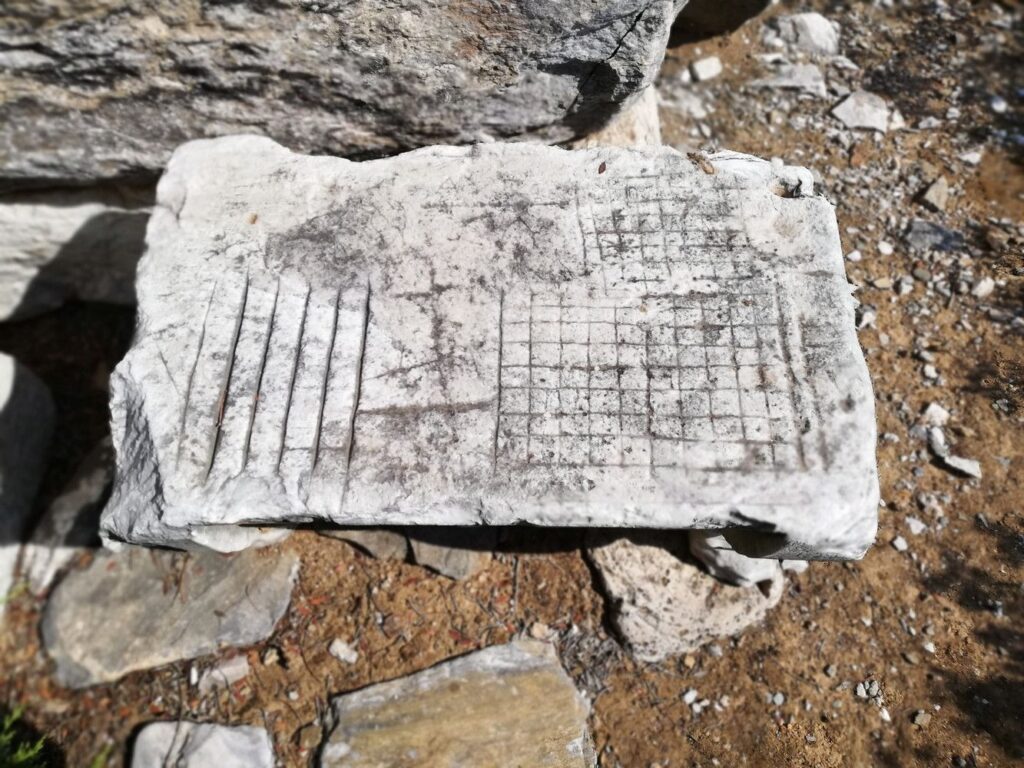
The dimensions of the board are equally elusive, as is the number of pieces. Excavations have uncovered grids engraved in stone in a wide variety of formats — 8×10, 9×9, 11×11, 11×12, 11×8 — without any standardisation being discernible[9]. As for the pieces, two late lexicons report that the game was played with sixty pieces[10]. The figure is suspect. No classical source confirms it, Pollux spoke only of “many pieces,” and thirty pieces per side constitute a considerable number relative to the surviving boards. Scholarly debate remains open: some scholars argue for sixty pieces on an 8×8 grid, others favour more modest numbers.
The comparison between the Greek polis and the Roman ludus latrunculorum recurs regularly in the scholarly literature. The two games share a grid, equivalent pieces, a mechanism of capture by encirclement, and a common absence of dice. The kinship is probable, without it being possible to establish whether this represents a direct lineage or two names for the same game.
Cratinus made the Athenians laugh by playing on the double meaning of polis. Fifteen centuries later, in Constantinople, Byzantine lexicographers were still recording poleis paizein, “playing cities,” as a proverb — whilst noting that people no longer said “cities” but “squares” to denote the spaces of the board [11]. The game had passed through classical Greece, the Roman Empire, and Byzantium — long enough to enter the language, not long enough for anyone to bother writing down the rules.
[1] Cratinus, The Runaways (Δραπέτιδες), fr. 61 Kassel-Austin: «Πανδιονίδα πόλεως βασιλέως τῆς ἐριβώλακος, οἶσθ’ ἣν λέγομεν, καὶ κύνα καὶ πόλιν, ἣν παίζουσιν». The fragment, whose dramatic context is lost, is transmitted by Pollux, Onomasticon, 9.99, and by Zenobius, Corpus Paroemiographorum Graecorum, 5.67. The dating of the play is debated: around 430 BCE, sometimes 443/442. The “son of Pandion” refers to Theseus, the founding hero of Athens.
[2] Pollux (c. 135–c. 188 CE), Onomasticon, 9.98–99: «ἡ δὲ διὰ πολλῶν ψήφων παιδιὰ πλινθίον ἐστί, χώρας ἐν γραμμαῖς ἔχον διακειμένας· καὶ τὸ μὲν πλινθίον καλεῖται πόλις, τῶν δὲ ψήφων ἑκάστη κύων· διῃρημένων δὲ εἰς δύο τῶν ψήφων κατὰ τὰς χρόας, ἡ τέχνη τῆς παιδιᾶς ἐστὶ περιλήψει δύο ψήφων ὁμοχρόων τὴν ἑτερόχρων ἀνελεῖν.»
[3] Plato (c. 428–348 BCE), Republic, VI, 487b-c: «ὥσπερ ὑπὸ τῶν πεττεύειν δεινῶν οἱ μὴ τελευτῶντες ἀποκλείονται καὶ οὐκ ἔχουσιν ὅτι φέρωσιν.»
[4] Plato, Statesman, 292e: «ἴσμεν γὰρ ὅτι χιλίων ἀνδρῶν ἄκροι πεττευταὶ τοσοῦτοι πρὸς τοὺς ἐν τοῖς ἄλλοις Ἕλλησιν οὐκ ἂν γένοιντό ποτε.»
[5] Plato, Republic, IV, 422e: «ἑκάστη γὰρ αὐτῶν πόλεις εἰσὶ πάμπολλαι ἀλλ᾽ οὐ πόλις, τὸ τῶν παιζόντων.»
[6] Aristotle (384–322 BCE), Politics, I, 2, 1253a: «ἅτε περ ἄζυξ ὢν ὥσπερ ἐν πεττοῖς.»
[7] Polybius (c. 200–c. 118 BCE), Histories, I, 84, 7: «πολλοὺς μὲν γὰρ αὐτῶν ἐν ταῖς κατὰ μέρος χρείαις ἀποτεμνόμενος καὶ συγκλείων ὥσπερ ἀγαθὸς πεττευτὴς ἀμαχεὶ διέφθειρε.»
[8] Diogenes Laërtius (3rd century CE), Lives of the Eminent Philosophers, IX, 1, 3: «τί, ὦ κάκιστοι, θαυμάζετε; ἢ οὐ κρεῖττον τοῦτο ποιεῖν ἢ μεθ᾽ ὑμῶν πολιτεύεσθαι;»
[9] Board of 11×12 squares engraved near the temple of Hera at Samos; broken slab of 11×8 at Marisa (Idumaea, Hellenistic period); grid of 11×11 at the Zeugma Archaeological Museum; grids of 9×9 and 8×10 on the benches of the fort at Rhamnous (Attica, 252 BCE).
[10] Photius, Lexicon, π 439: «πόλεις παίζειν· τὰς νῦν χώρας καλουμένας ἐν ταῖς ξʹ ψήφοις» — ‘”playing cities”: what are now called squares in the game of sixty pieces.’ The letter ξʹ represents 60 in Greek numeration. The same information appears in Pausanias the Atticist, Lexicon Atticon, π 26. Pollux (Onomasticon, 9.98) speaks for his part of “many pieces” (διὰ πολλῶν ψήφων), without giving a number.
[11] The expression poleis paizein (πόλεις παίζειν) is attested as a proverb in several lexicons. Scholion on Plato, Republic IV, 422e: «πόλεις παίζειν εἶδος ἐστι πεττευτικῆς παιδιᾶς· μετῆκται δὲ καὶ εἰς παροιμίαν» — ‘”playing cities” is a kind of board game; it has also become a proverb.’ See also Hesychius of Alexandria, Lexicon, π 2757; Suda, π 1911. Zenobius (Corpus Paroemiographorum Graecorum, 5.67) notes that the spaces of the board, formerly called “cities” (poleis), are now called “squares” (chôrai).
Other articles in English from the Nunc est bibendum blog