Translated from french (please notify us of errors)

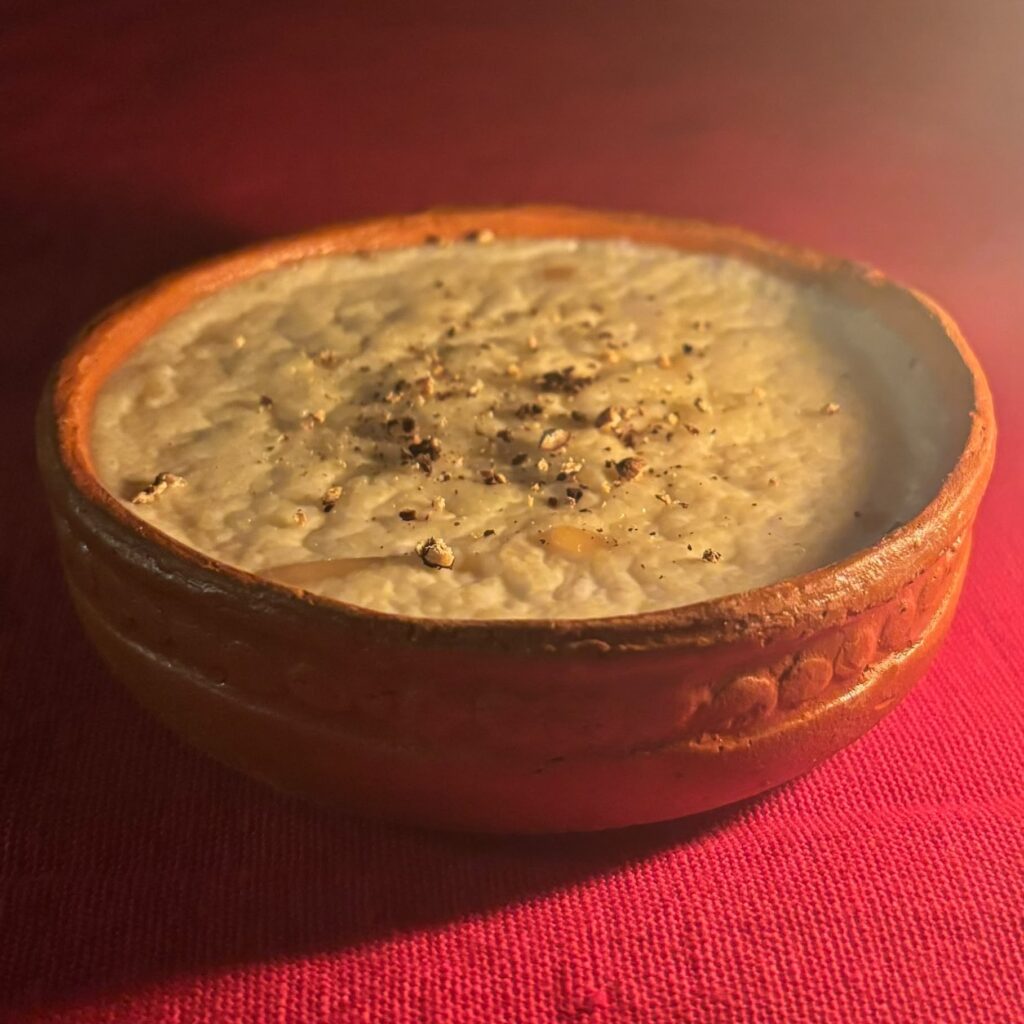
Roman gastronomy was not limited to the extravagant feasts described by Petronius or the imperial banquets displaying peacocks and moray eels. On modest farms, simple but flavoursome dishes were prepared. The moretum is one of the most emblematic. This typically Roman preparation must be made with the help of a mortar (mortarium), from which it takes its name.
Three recipes, each with its own characteristics, have come down to us. But the base is invariable: a mixture of cheese and freshly pounded herbs.
The most remarkable of these recipes comes from a collection of texts attributed to Virgil, the Appendix vergiliana. Most of these texts were probably not written by the great poet of the 1st century BCE. The poem that concerns us here was attached to the corpus at a late stage. Some attribute it to Aulus Septimius Serenus, a little-known author of the 2nd century.
The poem, which bears the name of the preparation it describes, Moretum, consists of 124 hexameters of fine stylistic quality[1]. It belongs to the tradition of Hellenistic poetry evoking the poor and their food, and finds its precedents in the Hecale of Callimachus and in poems describing the festival of the Theoxenia.
Here, then, is the story of a morning in the life of Simylus, a poor peasant, who wakes at dawn after the cock’s crow. In the darkness, he gropes for an ember to relight his lamp. His first task is the preparation of bread. He then makes his way to his modest garden, enclosed by wicker and reeds.

Though small, this garden abounds in varied vegetables: beets, sorrel, mallow, elecampane, skirret, leek, poppy, lettuce, radish, red onion, watercress, endive, rocket and cucumber. The poet notes that “nothing was wanting that the poor man’s needs require”[2]. However, these products are destined for sale, to make ends meet, and not for his own consumption.
The rustic moretum, a Roman peasant’s preparation
The poet then describes how Simylus prepares his modest meal, beginning with the harvest from his garden. The text deserves extensive quotation:
“First, having lightly loosened the earth with his fingers,
he draws out four heads of garlic with their dense fibres.
Then he pulls up the slender stems of parsley and the stiff rue
and the coriander leaves trembling on their slender thread.
Having gathered these herbs, he sits down by the cheerful fire
and calls out clearly to his servant girl to bring the mortar.”[3]
The preparation proper begins.
“Then he strips each head of its knotted outer skin
and peels away the outermost layers, then carelessly scatters them
here and there on the ground and discards them; he moistens in water
the bulb kept with its stem and drops it into the hollow circle of the stone.
He sprinkles grains of salt upon it, then adds cheese hardened
by the salt that has eaten into it, and pours the aforementioned herbs on top.
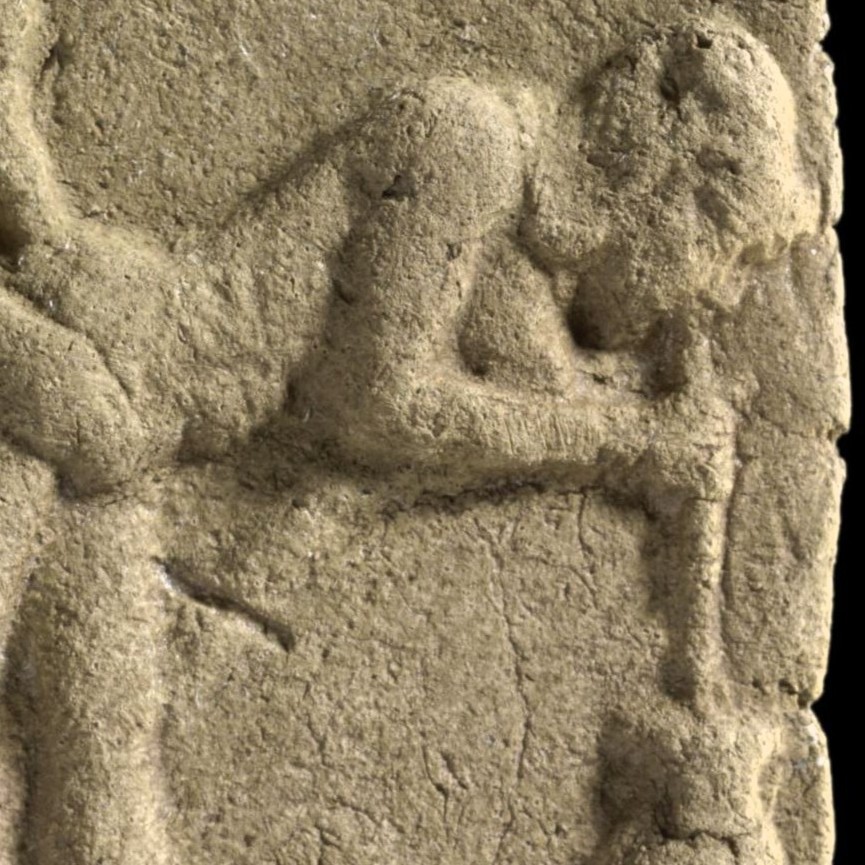
With his left hand he holds his garment beneath his hairy groin,
while his right, with the pestle, first softens the pungent garlic cloves,
then likewise grinds everything together into a blended juice.”[4]
The gesture and the transformation of the ingredients are described with precision.
“His hand moves in circles: little by little, each ingredient
loses its distinct properties; one single colour emerges from many,
not wholly green, for the pieces of cheese resist it,
nor bright with milky white, for it is tinged by so many different herbs.”[5]
The passage is remarkable for its use of the expression e pluribus unus, which describes how the ingredients lose their individual properties to form a homogeneous preparation of a single colour. But let us continue:
“The work progressed; and already the pestle no longer went jerkily as before,
but heavier, it moved in slow circles.
Then he instils drops of Pallas’s oil
and pours over it a little sharp vinegar.
And again he mixes the whole and works the mixture once more.
Finally, with two fingers, he runs round the entire mortar
and gathers into a single ball what had been scattered,
so that the form and name of the moretum may be complete.”[6]

More refined versions
Columella, an agronomist of the 1st century CE, provides a more elaborate and refined recipe, comprising a wide variety of aromatic herbs (savory, mint, thyme, catmint, pennyroyal) and green vegetables (lettuce, rocket, onion), as well as pepper in the vinegar[7].
He uses fresh salted cheese instead of the dry cheese described in the poem of the Appendix vergiliana. These differences illustrate the contrast between two worlds. On one side, a rustic recipe adapted to the limited resources of a poor peasant. On the other, a sophisticated version intended for wealthier landowners, the target audience of Columella’s advice.
Finally, Apicius offers under the title Moretaria a preparation of aromatic herbs intended to be added to cheese[8]. This explains the absence of the latter from his list of ingredients. His recipe is more elaborate, including fennel and lovage. The addition of honey and garum (fermented fish sauce) considerably enriches the flavour profile. These ingredients, typical of refined Roman cuisine, bring a combination of sweetness and umami.
One dish, three variants that illustrate the journey of Roman cooking from rusticity towards the refinement destined for the tables of the élite.
[1] Appendix vergiliana, Moretum, text in Latin.
[2] Line 63: Nil illi deerat, quod pauperis exigit usus.
[3] Lines 86–91: Ac primum leviter digitis tellure refossa, / quattuor educit cum spissis alia fibris; / inde comas apii graciles rutamque rigentem / vellit et exiguo coriandra trementia filo. / Haec ubi collegit, laetum consedit ad ignem / et clara famulam poscit mortaria voce.
[4] Lines 92–100: Singula tum capitum nodoso corpore nudat / et summis spoliat coriis contemptaque passim / spargit humi atque abicit. Servatum germine bulbum / tinguit aqua lapidisque cavom demittit in orbem. / His salis inspargit micas, sale durus adeso / caseus adicitur, dictas super ingerit herbas / et laeva vestem saetosa sub inguina fulcit: / dextera pistillo primum flagrantia mollit / alia, tum pariter mixto terit omnia suco.
[5] Lines 101–104: It manus in gyrum: paulatim singula vires / deperdunt proprias; color est e pluribus unus, / nec totus viridis, quia lactea frusta repugnant, / nec de lacte nitens, quia tot variatur ab herbis.
[6] Lines 109–116: Procedebat opus nec iam salebrosus ut ante / sed gravior lentos ibat pistillus in orbis. / Ergo Palladii guttas instillat olivi / exiguique super vires infundit aceti / atque iterum commiscet opus mixtumque retractat. / Tum demum digitis mortaria tota duobus / circuit inque globum distantia contrahit unum, / constet ut effecti species nomenque moreti.
[7] Columella, De re rustica, 12, 59. For the full text of the recipe, see the page Ancient recipes.
[8] Apicius, De re coquinaria, 1, 21, 1. For the full text of the recipe, see the page Ancient recipes.
Other articles in English from the Nunc est bibendum blog