Translated from french (please notify us of errors)
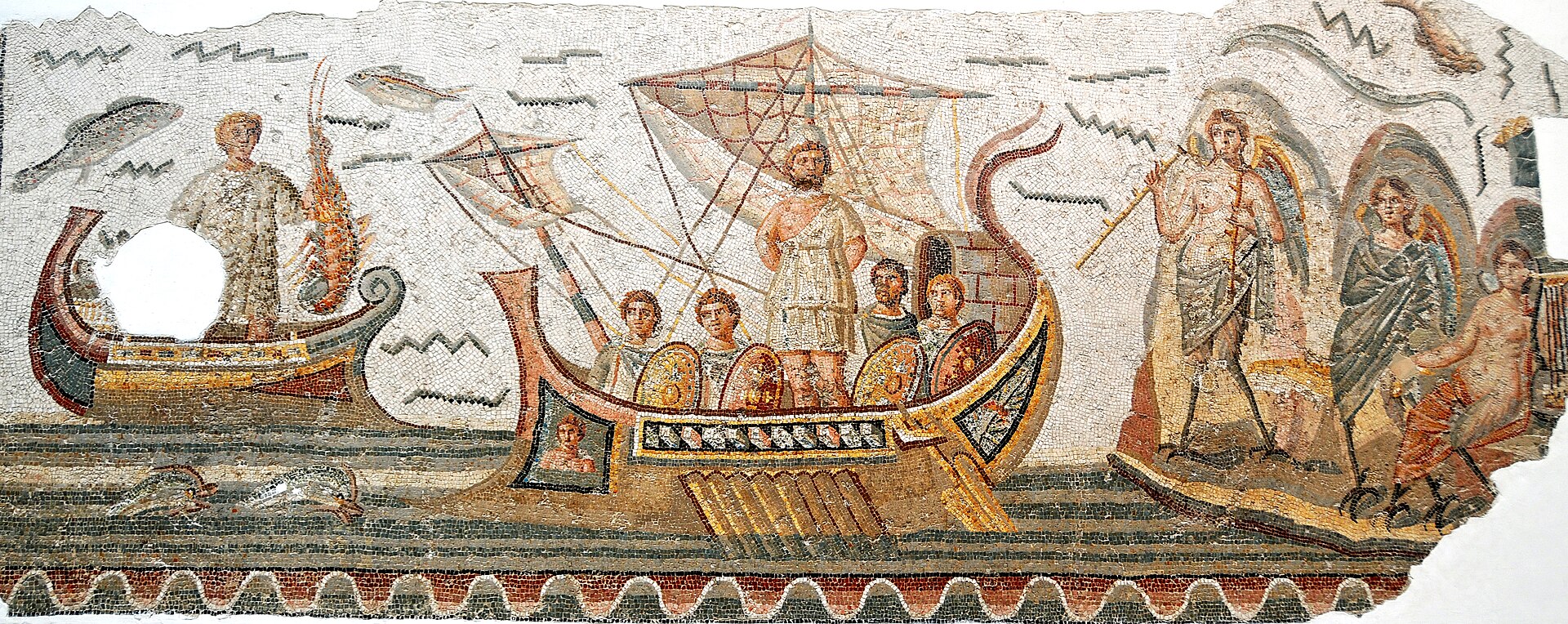
In the Odyssey, eating is never innocent. Every bite says who one is: man, beast, or god. Homer composed an epic of the failed feast – ten years of wandering in which one devours and is devoured, in which one forgets one’s homeland in a cup, in which the belly tyrannises heroes. Odysseus returns home, alone. His companions and the suitors will die, victims of their appetite.
The first great human scene in the Odyssey is a scandalous feast. In the palace of Ithaca, dozens of suitors consume Odysseus’s herds as though they were their own, day after day, for years. The pigs Eumaeus keeps for his master grow ever fewer, Odysseus’s oxen and goats are led to the palace to be devoured, the wine flows freely. The people of Ithaca let it happen.
In the Odyssey, eating is never simply about nourishment. It is sharing or plundering, honouring the gods or forgetting them, welcoming a guest or devouring him. It is taking one’s place in the world.
The dais (δαῖς), the heroic feast, is not a scramble around a leg of meat: it is an ordered sharing-out. Meat is carved, distributed, and the gods are given their share of smoke and libations[1]. When the meal functions properly, the community holds together. When it goes wrong, everything wavers.
The menu of humanity
Before cataloguing the transgressions, one must know the norm. The human meal in the Odyssey is of a disconcerting austerity: grilled meat from sacrificable domestic animals, barley or wheat bread, wine mixed with water[2]. No fish. Homeric heroes never eat it, except when forced by famine[3]. No vegetables on the tables. No fruit either, although Alcinous’s orchards overflow with pears, apples, figs[4]. The poet Homer knows all this; he chose to exclude it from the meals of ordinary mortals. At table, Homeric man is defined by three things: bread, fruit of the cultivated earth; roasted meat, tied to sacrifice; wine mixed with water, a sign of the banquet’s measure.
Allelophagy – literally “eating one another” – marks the lower boundary of the human condition. In Hesiod, probably a contemporary of Homer in the 8th century BCE, fish, wild beasts and birds devour one another because there is no justice among them; man, by contrast, is defined by right order (dikê)[5]. The upper boundary is the immortality of the gods, nourished on nectar and ambrosia, and honoured by the smoke of sacrifices. Man occupies the narrow space between the two: neither a beast given over to devouring, nor a god exempt from mortal food. His place at table is ordered, and the Odyssey constantly shows what happens when one steps outside it.
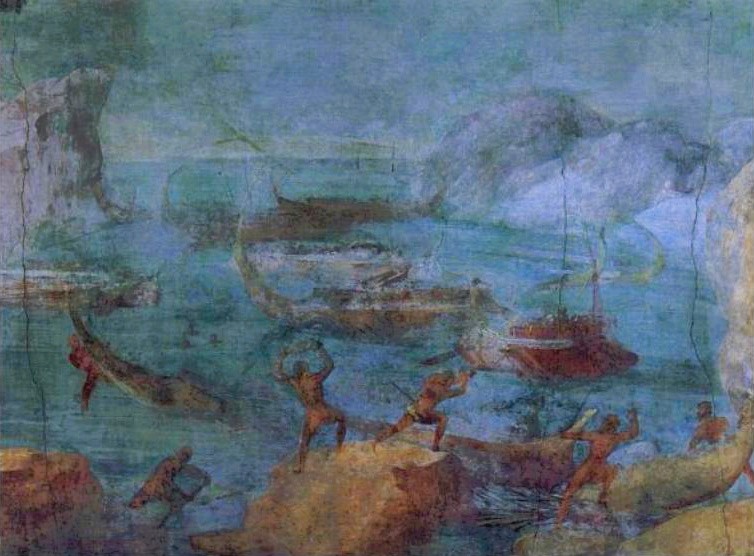
From the Lotus-eaters to Calypso, Odysseus meets not a single human being in the strict sense, not one true “bread-eater”[6]. The Lotus-eaters eat flowers that grow without cultivation; the Cyclops gorges on raw meat like a beast; the Laestrygonians, cannibal giants, spear the Greeks like tuna; Circe turns men into pigs; Scylla tears six companions from the deck and devours them on her rock – Homer says they “writhed like fish pulled from the water”[7]; the Sirens, for their part, no longer even eat: they leave the bodies to rot on their meadow.
Book XI adds yet another table to this disordered world: that of the dead. They eat neither as men, nor as beasts, nor as gods. Odysseus digs a pit, cuts the throats of the victims, and the shades rush to drink the blood[8]. This funerary sacrifice is the reverse of the ordinary sacrificial meal: it does not nourish the living with cooked meat, but briefly restores voice and memory to the dead through blood.
Polyphemus, or the feast reversed
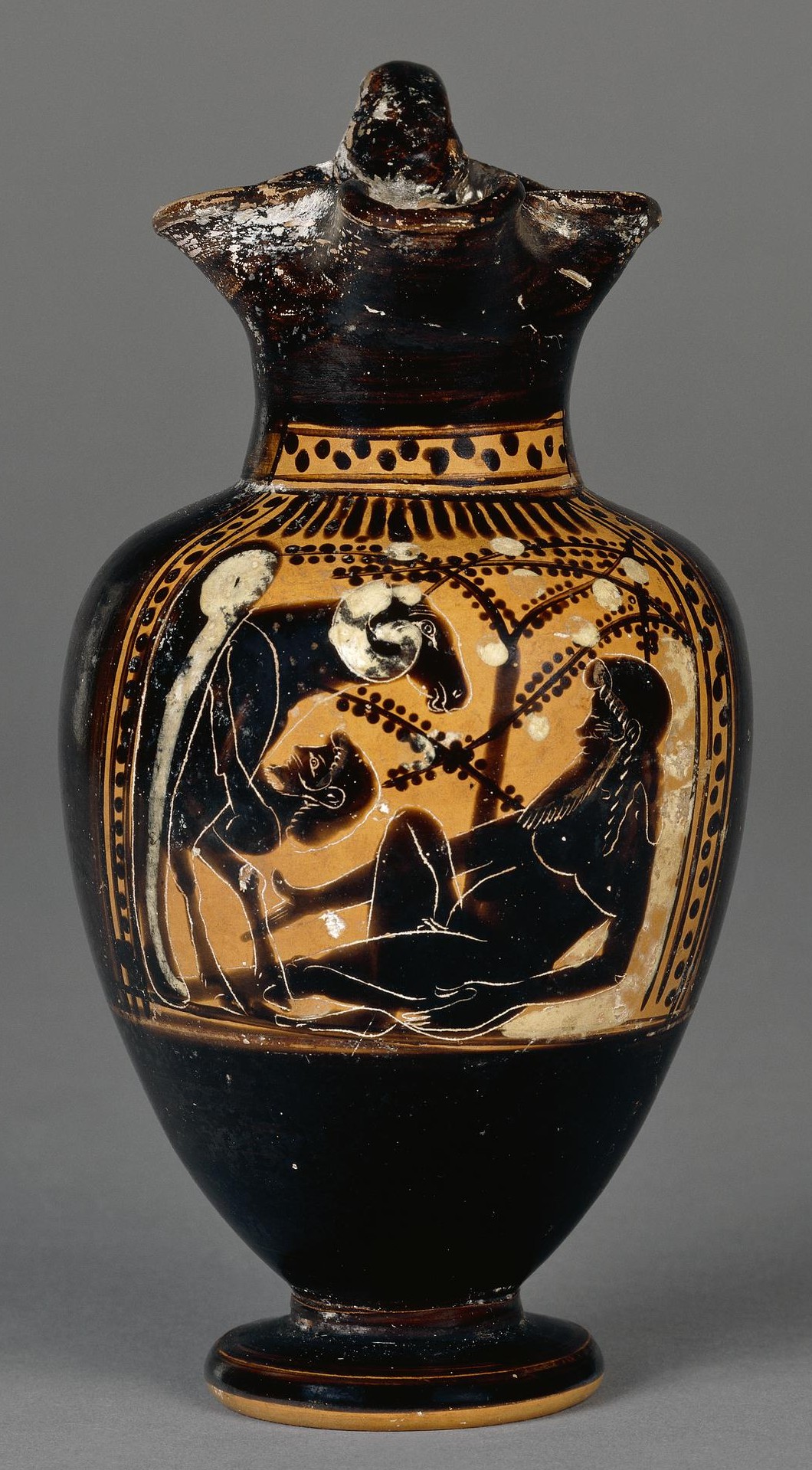
The Cyclops Polyphemus concentrates every possible violation of the human table. His land resembles the golden age described by Hesiod: without labour or sowing, the soil produces everything of itself[9]. But this effortless paradise has its dark side: no city, no assembly, no common laws, no ordered sacrifice[10]. Polyphemus keeps his flocks, but he does not live as a man does. When Odysseus’s companions enter his cave and eat his cheeses while waiting for him, they already commit an offence: a visitor does not help himself before being received[11]. But Polyphemus goes far further still.
On his return, instead of feeding his visitors – the first gesture of xenia (ξενία), the hospitality that requires one to give food before asking who the guest is[12] – he makes his visitors his food. Instead of preparing a meal for his guests, he prepares his guests as a meal. He seizes two companions, smashes them against the ground, dismembers them and devours them: “he ate like a lion raised in the mountains, leaving nothing – entrails, flesh and marrow-filled bones”[13]. Raw. Without sacrificing. Without setting aside the gods’ share.
This last detail is no mere anecdote. In Greek sacrifice, the divine portion – bones, fat, smoke – marks the difference between the human meal and animal devouring. Polyphemus makes no such gesture. He does not recognise Zeus Xenios, the god who protects guests and suppliants: “The Cyclopes care nothing for the blessed gods, nor for Zeus”[14]. As for wine, he will drink it unmixed, as no civilised guest does[15]. He is the perfect anti-human: everything a Greek does not do at table.
The wine of Maron that Odysseus makes him drink – a wine of incomparable strength, which must be diluted with twenty parts water[16] – turns the Cyclops’s savagery against itself. Polyphemus, felled by drunkenness, will lose his one eye through it.
The belly, the gods, and the oxen
If Polyphemus represents excess on the bestial side, Odysseus’s companions illustrate in Homer the excess on the human side: that of the tyrannical belly, the gastêr (γαστήρ). Odysseus himself said as much with painful frankness at the court of the Phaeacians:
“Nothing is more shameless than this accursed belly; it forces itself upon a man despite his afflictions and his inward grief; it commands imperiously: eat, and be satisfied”[17].
The gastêr is an inner tyrant. Odysseus’s companions obey it at the worst possible moment.
On the island of Thrinacia, Odysseus had nonetheless warned them: do not touch the herds of the Sun, Tiresias had foretold it, Circe had confirmed it. But the provisions run out, the winds have been contrary for a month, the men are hungry. Eurylochus persuades the others that it is better to die at sea with a full belly than on the island through starvation[18]. They decide to sacrifice the oxen. But everything about this sacrifice is false. These beasts are not ordinary domestic animals: they belong to the Sun, and the prohibition had been clearly stated. The companions no longer have the barley required for the rite: they replace it with oak leaves. They have no more wine for the libation: they pour water instead[19]. It is a sham sacrifice, emptied of meaning. The signs are not long in coming: the hides crawl, the spitted flesh bellows on the fire. Helios demands justice from Zeus, who intervenes with a thunderbolt. Odysseus alone will survive.
In truth, Odysseus’s companions had begun losing their footing before food long before Thrinacia. Among the Lotus-eaters, they taste the lotus and forget Ithaca. On the Island of Goats, near the land of the Cyclopes, they feast on “boundless meats”[20]. At Circe’s house, they drink the kykeôn (κυκεών), that mixture of barley, cheese, honey and Pramnian wine into which the goddess has slipped a drug to make them forget their homeland[21]. In the Odyssey, food is a deadly trap. With every unfortunate mouthful, Ithaca drifts further away.
For Odysseus alone, temptation takes a different form. At Calypso’s, the danger comes from above: the goddess offers him immortality[22]. But that would mean leaving the world of men, that of bread, sacrifice and return. On the goddess’s island, Odysseus is fed, but he is no longer within the ordinary world of men. No city, no sacrifice, no banquet where mortals and immortals answer one another through smoke and libations. He eats facing a goddess, on an island cut off from men, where the land is not worked and where one does not return home. To refuse Calypso is to choose to remain a man.
For all that, Odysseus is no ascetic. He eats, drinks, feasts willingly. He spends a year at Circe’s, accepts the Phaeacians’ banquets and knows how to appreciate a well-laid table. His difference, then, is not temperance but mêtis (μῆτις): that cunning intelligence which knows how to read traps, to wait for the right moment, and never entirely to lose the thread of the return. Even when Odysseus lingers, he always comes back to the one question that matters: the nostos (νόστος), the return. At Circe’s, he refuses to eat until his men are freed[23] – not out of virtue, but because he knows that at this table, eating may mean remaining a prisoner.
The evening meal is ready
Meanwhile, at Ithaca, they are eating. The suitors have been devouring Odysseus’s herds for years. But what they consume is not merely animals: it is his patrimony, his household, his authority. In Greek, they “eat” his bioton (βίοτον), his life-substance[24]. The devouring is thus at once material and symbolic.
Their feast perverts every rule of the heroic banquet. The sharing-out is no longer governed by legitimate authority. Sacrifice to the gods is vague or absent: the suitors slaughter beasts, but the poem almost never shows them offering these correctly[25]. Reciprocity, too, disappears: instead of hosting meals in turn in their own houses, they always eat at the expense of the same oikos (οἶκος)[26]. This is no longer a dais, a shared feast. It is the plundering of a household.
The symmetry with Odysseus’s companions is clear. The one group ate what should not have been eaten, in the worlds of Elsewhere; the other eats where it should not eat, in Odysseus’s own house. The companions died of it. The suitors will die of it in turn.
Odysseus then returns disguised as a beggar – that is, in the guise of a man asking for food. But hospitality is dead at Ithaca. Ctesippus, one of the suitors, hurls an ox’s hoof at him as a “gift”[27].
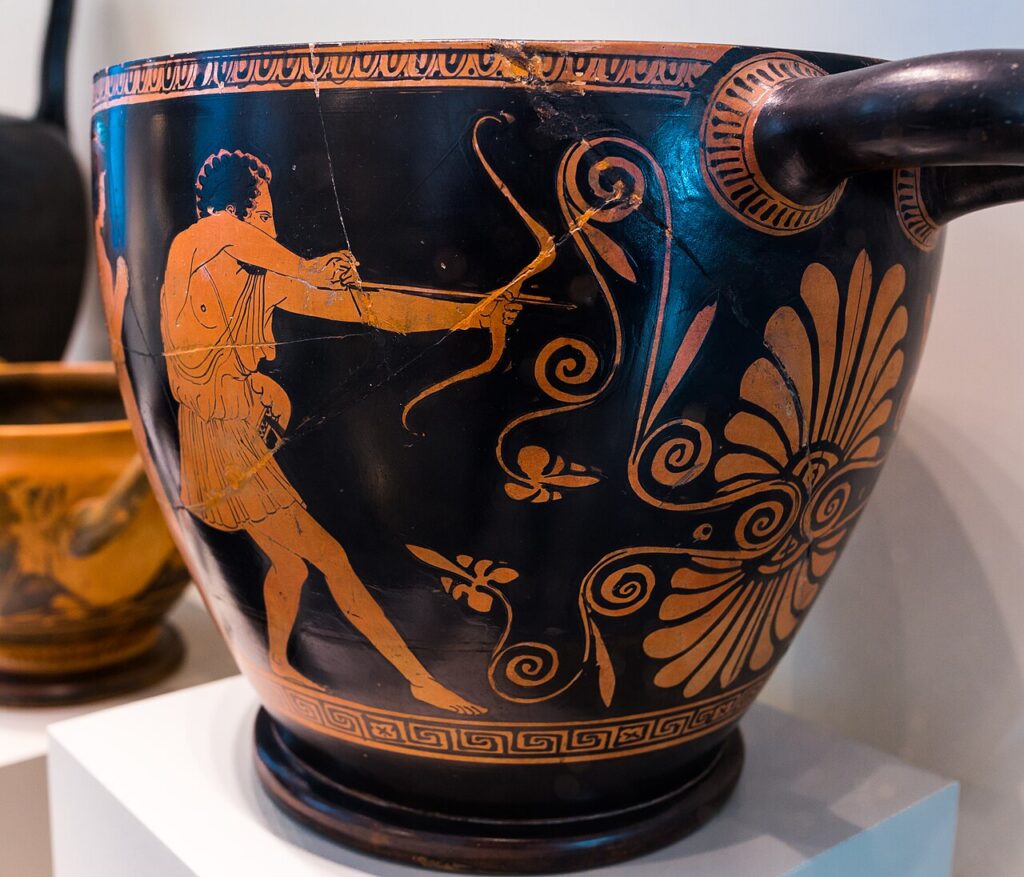
The Odyssey had begun, on the human side, with a scandalous feast; the text returns to the same hall for a final meal. But this time the master has returned, and the vocabulary of the banquet becomes a proclamation of death. Odysseus prepares the slaughter that will restore order:
“Now is the hour to prepare the evening meal for the Achaeans, in the light of the Sun; and afterwards to enliven the evening with song and lyre: for these are the ornaments of the feast.”[28]
Modern scholarship consulted
- Assunção, Teodoro Rennó, “Nourriture(s) dans l’Odyssée: fruits, légumes et les oies de Pénélope”, Nuntius Antiquus 4, 2009, pp. 162-180.
- Bakker, Egbert J., The Meaning of Meat and the Structure of the Odyssey, Cambridge, Cambridge University Press, 2013.
- Sherratt, Susan, “Feasting in Homeric Epic”, Hesperia 73/2, 2004, pp. 301-337.
- Vidal-Naquet, Pierre, “Valeurs religieuses et mythiques de la terre et du sacrifice dans l’Odyssée”, Annales 25/5, 1970, pp. 1278-1297.
- Saïd, Suzanne, “Les crimes des prétendants, la maison d’Ulysse et les festins de l’Odyssée”, in Études de littérature ancienne, Presses de l’École normale supérieure, 1979.
- Williams, Hamish, The Typical and Connotative Character of Xeinoi Situations across the Apologue: Three Studies in Repetition, PhD thesis, University of Cape Town, 2016/2017.
[1] Od. III, 65-66: οἱ δ’ ἐπεὶ ὤπτησαν κρέ’ ὑπέρτατα καὶ ἐρύσαντο / μοίρας δασσάμενοι δαίνυντ’ ἐρικυδέα δαῖτα – “When they had roasted the outer parts and drawn them from the fire, having divided the portions they feasted on a glorious feast.” The etymology of dais (δαῖς, “feast”) is linked to daiein (δαίειν, “to divide, to share out”): cf. Od. IX, 551.
[2] The human menu of the Odyssey is reduced to three elements: roasted meat from sacrificable animals, wheat or barley bread, wine mixed with water. Athenaeus, Deipnosophists I, 9b-c, notes that Homer never has his heroes served fish, poultry, or honey cake.
[3] Od. XII, 331-332: φίλας ὅ τι χεῖρας ἵκοιτο / ἤγρευον· ἔτειρε δὲ γαστέρα λιμός – “They hunted whatever their hands could seize; hunger gnawed at their bellies.”
[4] Od. VII, 114-121: Alcinous’s orchard with pear trees, apple trees, fig trees, pomegranate trees, olive trees – whose fruit is never consumed within the human space of the poem.
[5] Hesiod, Works and Days, 276-278: τόνδε γὰρ ἀνθρώποισι νόμον διέταξε Κρονίων / ἰχθύσι μὲν καὶ θηρσὶ καὶ οἰωνοῖς πετεηνοῖς / ἔσθειν ἀλλήλους, ἐπεὶ οὐ δίκη ἐστὶ μετ’ αὐτοῖς – “Such is the law the son of Cronos has laid down for men: that fish, wild beasts and winged birds should devour one another, since there is no justice among them.”
[6] On two occasions Odysseus wonders among what kind of “bread-eaters” he finds himself: once on landing among the Lotus-eaters (Od. IX, 89), once among the Laestrygonians (Od. X, 101). The exact term σιτοφάγῳ is applied to Polyphemus at Od. IX, 190-191: he does not resemble a “bread-eating man”.
[7] Od. XII, 251-257: ὡς δ’ ὅτ’ ἐπὶ προβόλῳ ἁλιεὺς περιμήκεϊ ῥάβδῳ / ἰχθύσι τοῖς ὀλίγοισι δόλον κατὰ εἴδατα βάλλων / ἐς πόντον προΐησι βοὸς κέρας ἀγραύλοιο, / ἀσπαίροντα δ’ ἔπειτα λαβὼν ἔρριψε θύραζε, / ὣς οἵ γ’ ἀσπαίροντες ἀείροντο προτὶ πέτρας. / αὐτοῦ δ’ εἰνὶ θύρῃσι κατήσθιε κεκλήγοντας, / χεῖρας ἐμοὶ ὀρέγοντας ἐν αἰνῇ δηϊοτῆτι – “As a fisherman on a headland casts his long rod to lure little fish with bait, then flings them writhing out of the water, so Scylla hauled my writhing companions up to the rock, and there, at her doorway, devoured them screaming, as they stretched out their hands to me in their dreadful anguish.”
[8] Od. X, 516-521 and Od. XI, 23-29: Circe’s instructions and the rite of the pit. Sacrifice to the dead – blood poured into a βόθρος (bothros) so the shades may briefly regain speech – is the exact reverse of an ordinary sacrificial meal: feeding the dead with blood, not the living with meat.
[9] Od. IX, 107-111: οὔτε φυτεύουσιν χερσὶν φυτὸν οὔτ᾽ ἀρόωσιν, / ἀλλὰ τά γ᾽ ἄσπαρτα καὶ ἀνήροτα πάντα φύονται, / πυροὶ καὶ κριθαὶ ἠδ᾽ ἄμπελοι, αἵ τε φέρουσιν / οἶνον ἐριστάφυλον, καί σφιν Διὸς ὄμβρος ἀέξει – “They plant nothing with their hands, nor do they plough; all things grow unsown and untilled: wheat, barley, and vines that bear wine of fine clusters, and Zeus’s rain makes them grow.”
[10] Od. IX, 112-115: Τοῖσιν δ᾽ οὔτ᾽ ἀγοραὶ βουληφόροι οὔτε θέμιστες, / ἀλλ᾽ οἵ γ᾽ ὑψηλῶν ὀρέων ναίουσι κάρηνα / ἐν σπέσσι γλαφυροῖσι, θεμιστεύει δὲ ἕκαστος / παίδων ἠδ᾽ ἀλόχων, οὐδ᾽ ἀλλήλων ἀλέγουσιν – “They have neither counselling assemblies nor laws; they dwell on the peaks of high mountains in hollow caves, and each one lays down the law for his children and wives, caring nothing for one another.”
[11] Xenia requires that the guest be fed before being asked his identity: Od. III, 67-68 (Nestor), Od. IV, 60-62 (Menelaus); a rule already violated by Polyphemus at Od. IX, 252-255.
[12] Od. I, 123-124: Telemachus offers food to Athena in disguise and asks his questions only after the meal.
[13] Od. IX, 288-293: ἀλλ’ ὅ γ’ ἀναΐξας ἑτάροισ’ ἐπὶ χεῖρας ἴαλλε, / σὺν δὲ δύω μάρψας ὥς τε σκύλακας ποτὶ γαίῃ / κόπτ’· ἐκ δ’ ἐγκέφαλος χαμάδις ῥέε, δεῦε δὲ γαῖαν. / τοὺς δὲ διὰ μελεϊστὶ ταμὼν ὁπλίσσατο δόρπον· / ἤσθιε δ’ ὥς τε λέων ὀρεσίτροφος, οὐδ’ ἀπέλειπεν, / ἔγκατά τε σάρκας τε καὶ ὀστέα μυελόεντα – “He sprang up, seized two of my companions and dashed them against the ground like puppies; their brains spilled out onto the earth and drenched the ground. He cut them limb from limb and prepared his meal; he ate like a lion raised in the mountains, leaving nothing – entrails, flesh and marrow-filled bones.”
[14] Od. IX, 275-276: οὐ γὰρ Κύκλωπες Διὸς αἰγιόχοιο ἀλέγουσιν / οὐδὲ θεῶν μακάρων, ἐπεὶ ἦ πολὺ φέρτεροί εἰμεν – “For the Cyclopes care nothing for aegis-bearing Zeus, nor for the blessed gods, since we are far mightier.”
[15] Od. IX, 297: the Cyclops drinks pure milk (ἄκρητον) and, soon after, Maron’s wine without cutting it with water (Od. IX, 345-374). In the Greek world, wine is always drunk mixed with water; drinking it unmixed is a transgression reserved for libations or for barbarians.
[16] Od. IX, 196-197 and 203-204: ἀτὰρ αἴγεον ἀσκὸν ἔχον μέλανος οἴνοιο / ἡδέος, ὅν μοι ἔδωκε Μάρων, Εὐάνθεος υἱός, / ἱρεὺς Ἀπόλλωνος – “I had a goatskin of dark, sweet wine, which Maron, son of Evanthes, priest of Apollo, had given me”; Od. IX, 203-204: οἶνον ἐν ἀμφιφορεῦσι δυώδεκα πᾶσιν ἀφύσσας / ἡδὺν ἀκηράσιον, θεῖον ποτόν – “he had drawn off for me twelve jars of sweet, unmixed wine, a divine drink”; Od. IX, 208-210: ἓν δέπας ἐμπλήσας ὕδατος ἀνὰ εἴκοσι μέτρα / χεῦ᾽, ὀδμὴ δ᾽ ἡδεῖα ἀπὸ κρητῆρος ὀδώδει / θεσπεσίη – “one cup would be filled and twenty measures of water poured out beside it: a sweet, wondrous fragrance rose from the mixing bowl.”
[17] Od. VII, 215-221: ἀλλ’ ἐμὲ μὲν δορπῆσαι ἐάσατε κηδόμενόν περ· / οὐ γάρ τι στυγερῇ ἐπὶ γαστέρι κύντερον ἄλλο / ἔπλετο ἥ τ’ ἐκέλευσεν ἕο μνήσασθαι ἀνάγκῃ / καὶ μάλα τειρόμενον καὶ ἐνὶ φρεσὶ πένθος ἔχοντα, / ὡς καὶ ἐγὼ πένθος μὲν ἔχω φρεσίν, ἡ δὲ μάλ’ αἰεὶ / ἐσθέμεναι κέλεται καὶ πινέμεν, ἐκ δέ με πάντων / ληθάνει, ὅσσ’ ἔπαθον, καὶ ἐνιπλησθῆναι ἀνώγει – “Let me first sup, despite my grief; for nothing is more shameless than this accursed belly, which forces itself upon a man however worn down and however great the sorrow in his heart (…) it always bids one eat and drink, it makes me forget all I have suffered, and commands me to be filled.”
[18] Od. XII, 279-293: Eurylochus’s speech.
[19] Anti-sacrifice of the Cattle of the Sun: the oulai, the ritual barley of sacrifices, replaced with oak leaves (Od. XII, 357-358); the libation wine replaced with water (Od. XII, 362-363).
[20] Od. IX, 161-162: ὣς τότε μὲν πρόπαν ἦμαρ ἐς ἠέλιον καταδύντα / ἥμεθα δαινύμενοι κρέα τ’ ἄσπετα καὶ μέθυ ἡδύ – “So all that day, until the sun went down, we sat feasting on boundless meats and sweet wine.” This formula of the krea aspeta (κρέα ἄσπετα, “boundless meats”) recurs six times in the Odyssey, always in the episodes of the Cyclops and of Circe.
[21] Od. X, 233-236: εἷσεν δ’ εἰσαγαγοῦσα κατὰ κλισμούς τε θρόνους τε, / ἐν δέ σφιν τυρόν τε καὶ ἄλφιτα καὶ μέλι χλωρὸν / οἴνῳ Πραμνείῳ ἐκύκα· ἀνέμισγε δὲ σίτῳ / φάρμακα λύγρ’, ἵνα πάγχυ λαθοίατο πατρίδος αἴης – “She brought them in and seated them on couches and chairs, and mixed for them, in Pramnian wine, cheese, barley meal and pale honey; and into this food she stirred baneful drugs, so that they would utterly forget their native land.”
[22] Od. V, 136 and Od. XXIII, 336: Calypso offers Odysseus immortality. Od. V, 196-199: Homer emphasises that Odysseus eats differently from the goddess – he eats as a man, she eats as a goddess. Od. V, 101-102: Calypso’s island is a place where men offer no sacrifices to the gods.
[23] Od. X, 372-376: ἐσθέμεναι δ᾽ ἐκέλευεν· ἐμῷ δ᾽ οὐχ ἥνδανε θυμῷ, / ἀλλ᾽ ἥμην ἀλλοφρονέων, κακὰ δ᾽ ὄσσετο θυμός. / Κίρκη δ᾽ ὡς ἐνόησεν ἔμ᾽ ἥμενον οὐδ᾽ ἐπὶ σίτῳ / χεῖρας ἰάλλοντα, κρατερὸν δέ με πένθος ἔχοντα – “She bade me eat; but my heart did not consent to it; I sat with my mind elsewhere, and my heart foreboded evil. Circe noticed that I sat without putting my hands to the food, gripped by heavy grief.”
[24] Od. XI, 116: οἵ τοι βίοτον κατέδουσι – “They eat up your life-substance.” The term bioton (βίοτον) designates both one’s patrimony and life itself.
[25] The suitors employ the vocabulary of sacrifice, but their acts are not clearly directed towards the gods. Amphinomus is the only one who pours libations (Od. XVIII, 151-156) – and he is also the only one Odysseus tries to spare. Antinous promises a sacrifice to Apollo (Od. XXI, 265-268) which he will never carry out: Odysseus’s arrow strikes him down with the cup still in his hand (Od. XXII, 8-21).
[26] Od. I, 374-375: ἄλλας δ’ ἀλεγύνετε δαῖτας, / ὑμὰ κτήματ’ ἔδοντες, ἀμειβόμενοι κατὰ οἴκους – “Prepare other feasts, eating your own possessions, taking turns from house to house” (Telemachus to the suitors).
[27] Od. XX, 292-301: Ctesippus pretends to offer a guest-gift to the stranger – ἀλλ᾽ ἄγε οἱ καὶ ἐγὼ δῶ ξείνιον – “come, let me too give him a guest-gift”; then he seizes an ox’s hoof from the basket and hurls it – ὣς εἰπὼν ἔρριψε βοὸς πόδα χειρὶ παχείῃ – “so saying, he flung the ox’s hoof with his heavy hand.” Odysseus dodges it slightly by tilting his head, and smiles inwardly a sardonic smile.
[28] Od. XXI, 428-430: νῦν δ’ ὥρη καὶ δόρπον Ἀχαιοῖσιν τετυκέσθαι / ἐν φάει, αὐτὰρ ἔπειτα καὶ ἄλλως ἑψιᾶσθαι / μολπῇ καὶ φόρμιγγι· τὰ γάρ τ’ ἀναθήματα δαιτός – “now is the hour to prepare the evening meal for the Achaeans, in the light of the Sun; and afterwards to make merry with song and lyre: for these are the ornaments of the feast.”
Other articles in English from the Nunc est bibendum blog