Translated from French (please notify us of errors)
Making wine is not a matter of chance but of constant vigilance: from Cato to Galen, the Romans vied in ingenuity to prevent their grape must from turning sour.
Wine needs little encouragement to spoil: once oxygen, bacteria and time intervene, must can end up as vinegar. It is from this chemical stubbornness that the entire Roman technique of winemaking derives its rationale – a long succession of empirical stratagems to delay the inevitable, and sometimes, incidentally, to produce something good. Latin agronomists, from Cato to Columella, recorded this know-how in treatises where the precision of dosages vies with a total absence of chemical explanation: one knew that it worked, but not why. Here is how, from treading to amphora, must became wine.
From foot to screw: three presses for three uses
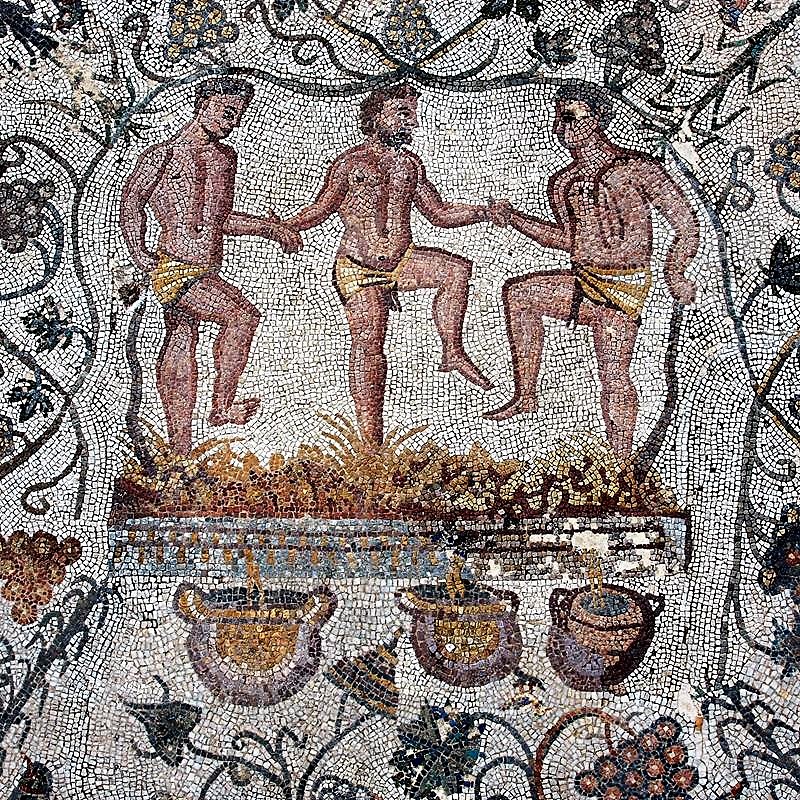
The harvest was gathered by hand, so as not to damage the bunches, and the grapes were taken to the calcatorium (the treading floor), a cemented area fitted with a drainage channel. There, men crushed them with bare feet, and the first juice that ran off – the ‘free-run juice’ – went directly to the settling vats. The operation appeared rudimentary but demanded genuine care: a thick-skinned berry, poorly trodden, could remain intact and subsequently resist the press. An experimental reconstruction carried out at the Mas des Tourelles, in Beaucaire, has quantified the yield: four men, in three and a half hours, trod 4.5 tonnes of grapes to produce 1,500 litres of must.
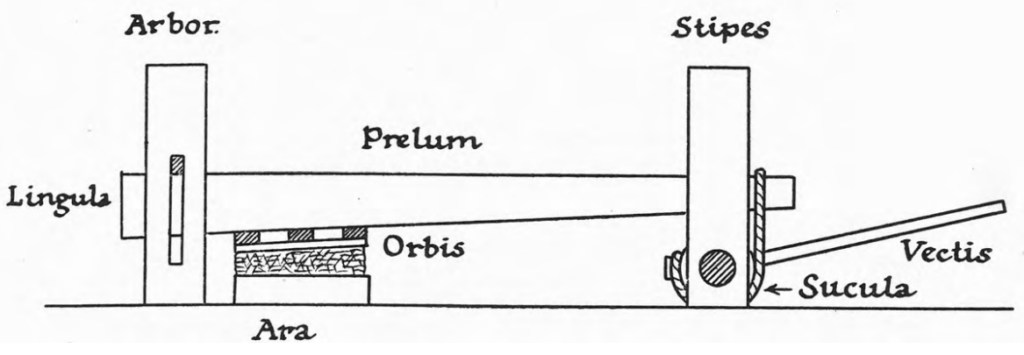
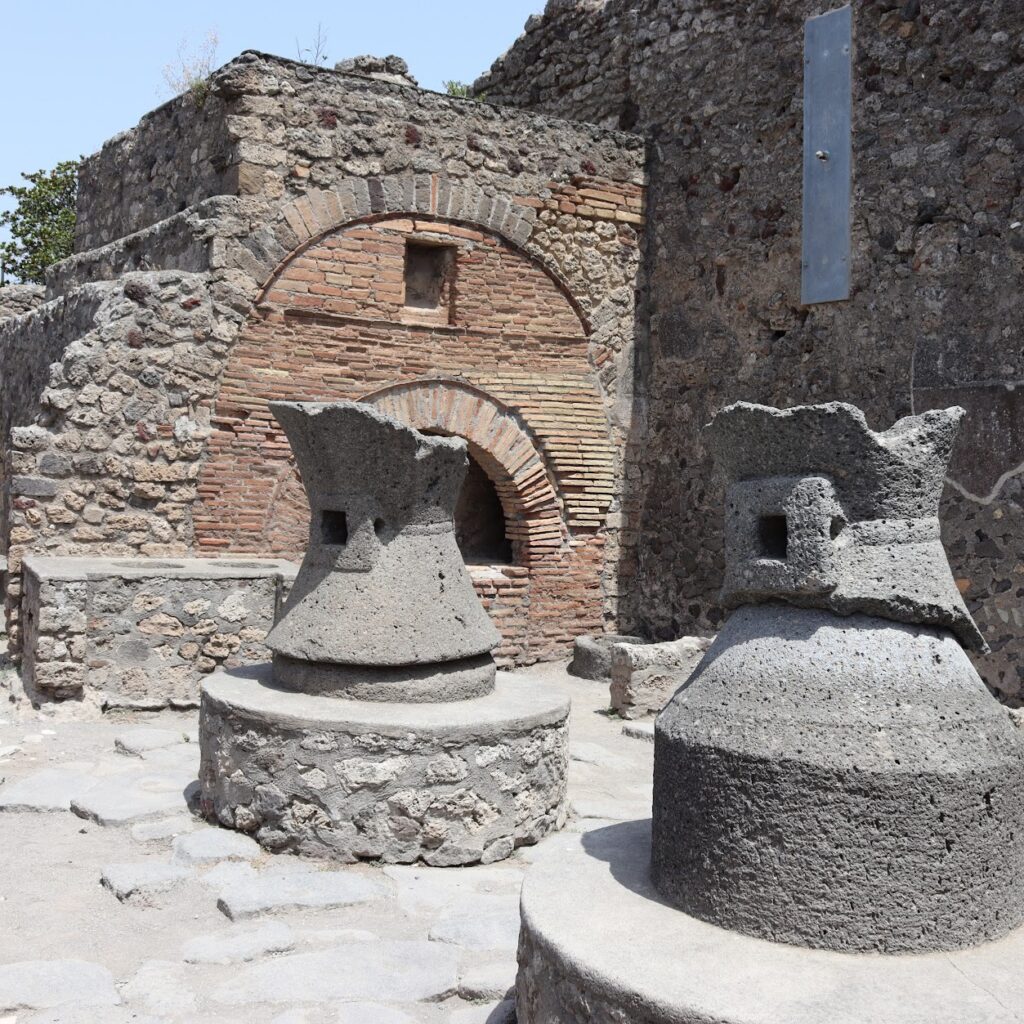
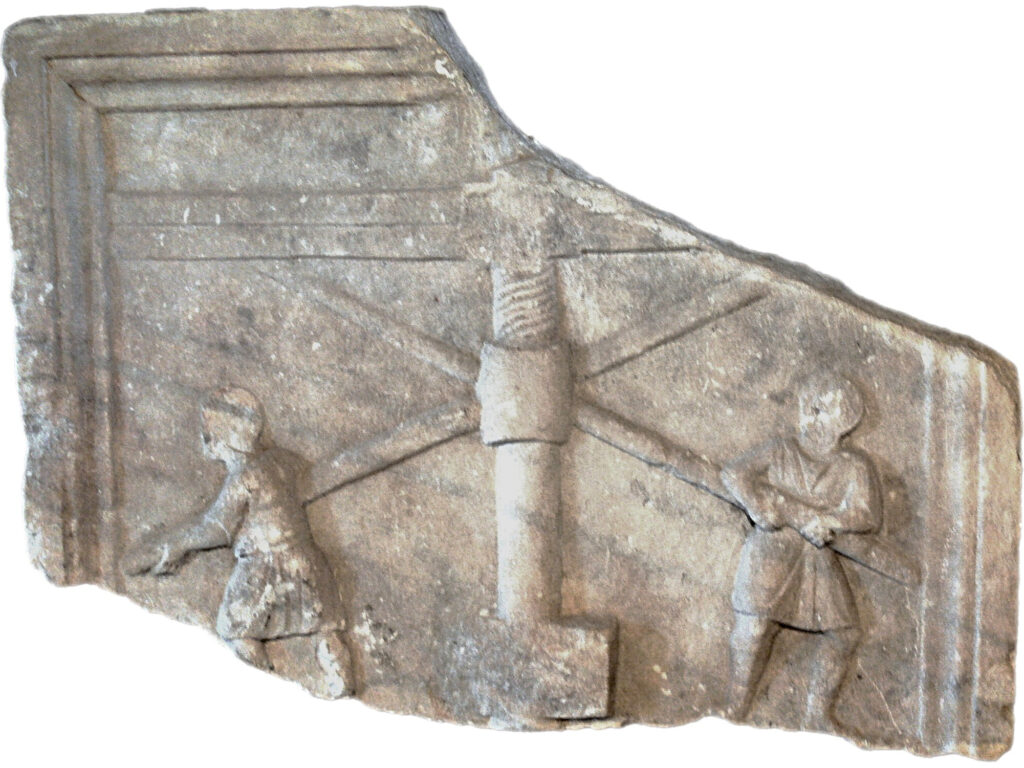
The marc remained, and was then taken to the press. Around 160 BCE, Cato the Elder specified, for a wine-growing estate of one hundred iugera, a precise set of equipment: sixteen people, two oxen, and above all vasa torcula instructa III – three fully equipped presses – as well as dolia capable of holding five harvests.[1] The construction of such a press, the torcularium, was the subject of instructions of architectural exactitude: beams nine feet high with their pivots, borings of three and a half feet, and at the centre the windlass – the sucula – operated by levers eighteen feet long.[2]
Nearly two and a half centuries later, Pliny the Elder describes another type of press, in which the windlass is replaced by a screw – a principle of Greek origin in his view, which he calls Graecanica.[3] A misreading must be avoided here: this term does not mean that the press itself came from Greece, where archaeology has found no trace of it before Late Antiquity – it refers more probably to the principle of the endless screw, attributed by the Romans to the engineer Archimedes of Syracuse, a Greek colony. Pliny even describes two variants of this screw system, and states his preference for the one in which the screw raises a movable counterweight rather than being fixed to the ground.[4] A generation before his account, a third model had been invented: a direct-screw press, without a lever, far smaller, intended not for large estates but for more modest production, in a reduced building.[5] Nothing in Pliny’s text suggests that one model displaced another: all three coexisted, each according to the scale of production envisaged.
Three musts for three uses
Not all pressing was equal. Cato carefully distinguishes the trimming must – that extracted by cutting back all round the marc that overflowed the press – which had to be distributed in equal shares into each jar.[6] What remained, at the end of the chain, was the exhausted marc. Cato distinguished two uses: trodden into pitched jars, it was set aside to feed the oxen through the winter; gradually diluted with water and pressed again, it yielded the lora — the drink reserved for slaves, which kept for no more than three months.[7] Three pressings, three uses: the noble must for the master, the trimming must distributed among the jars, and the last marc-water for those entitled to nothing better.
The jar where wine was truly born
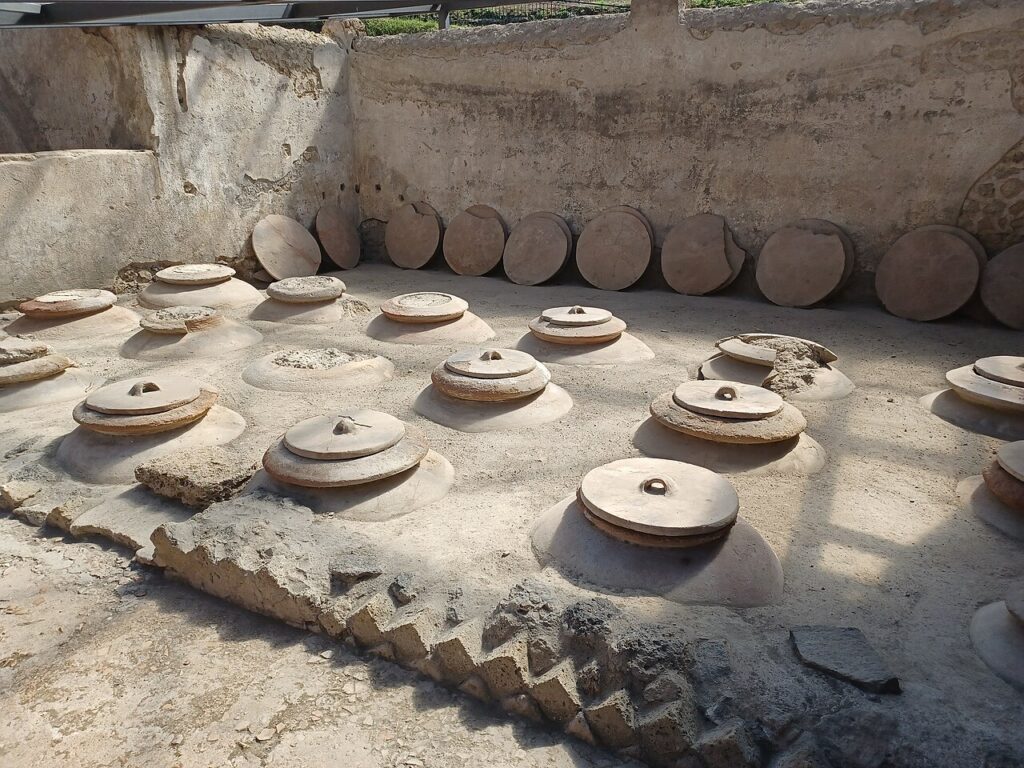
Fermentation took place in the dolia, those immense terracotta jars buried in the floors of the cellars. But clay is porous, and it had to be waterproofed every year, forty days before the harvest. Columella carefully distinguishes the treatment of buried jars – heated from the inside by burning iron lamps, from which the pitch that has pooled at the bottom is then removed with a spatula and scraper – from that of jars standing on the ground, which are exposed to the sun, then turned upside down on three stones before being coated with boiling pitch, the vessel being rolled so that the coating spreads everywhere.[8] The operation had to be carried out in calm weather, without wind, to prevent the jars from cracking on contact with the fire.
Pitch, cooked must and salt
Without the sulphiting of modern oenology, the Romans had at their disposal an arsenal of empirical procedures. Cato gives a precise list: cooked must, salt, pounded marble or resin, each with its dose per culleus – that leather skin of approximately five hundred litres which the Romans used as their standard measure for wine. The resin, in particular, was suspended in a rush basket in the middle of the must, and had to be shaken frequently so that it dissolved.[9] For twenty days, the mixture was stirred every day without respite.
Later, in Columella, cooked must occupies a place of its own, but its name varies according to the degree of reduction. Columella reserves the word sapa for reduction by half, and defrutum for reduction by a third; a distinction that other authors do not always observe, to the point where the two terms end up being confused from one agronomist to another. Its preparation required particular care: the cooking vessels had to be of lead rather than bronze, the latter imparting to the mixture a taste of verdigris.[10] Columella also added specific aromatics – iris, fenugreek, schoenus – at the rate of one pound of each per ninety amphorae of must.[11]
There remained the salt, treated with an almost pharmaceutical precision. Columella recommends taking the whitest salt possible, pouring it into an unpitched earthenware pot, then coating that pot with a mixture of clay and straw. Placed over the fire, it had to be roasted until crackling sounds were heard – the signal that cooking was complete.[12] To this prepared salt was added fenugreek, which was left to macerate for three days in old wine before being dried and ground.[13] The whole aimed at a twofold purpose: to prevent the acidification of the must whilst also clarifying it.
From jar to amphora
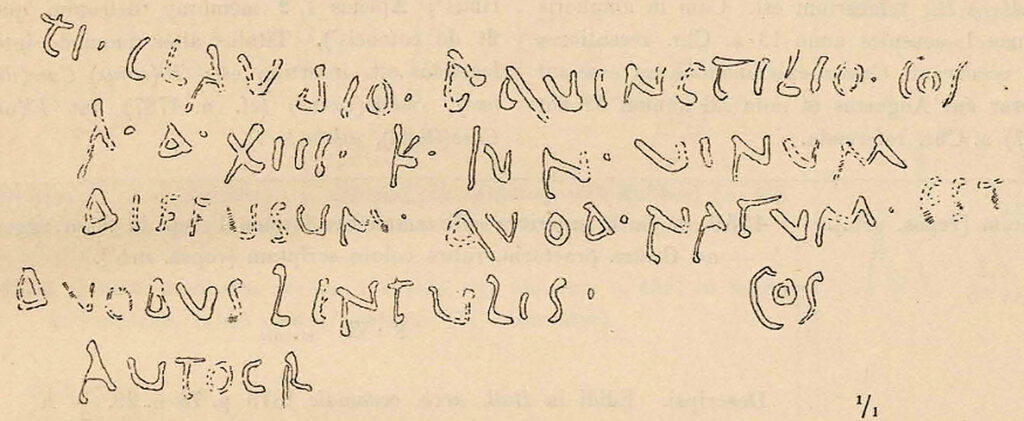
Once fermented, the wine remained in the dolium before being transferred to an amphora. This transfer was sometimes recorded with precision by an inscription painted directly on the vessel: a titulus. One such inscription has survived: it indicates that a wine harvested in 18 BCE, under the consulship of the two Lentuli, was transferred to amphora on 20 May 13 BCE, under that of Tiberius Claudius and Publius Quinctilius[14] – that is, four and a half years spent in the jar before the wine changed container.
During the wine’s time in the dolium, a film of yeasts would sometimes develop on its surface – the flos vini – a sign that it was no longer a new wine. The Sicilian poet Archestratus of Gela, in the 4th century BCE, draws a striking image from this: he recommends drinking after the meal an old wine, with a head quite hoary, whose moist tresses are crowned with a white flower – a wine born of wave-washed Lesbos[15], which he prefers even to the celebrated wine of Byblos in Phoenicia.
Then came ageing proper. The Romans placed their amphorae in an upper room, the apotheca, built above the rooms from which smoke often rose. Columella recommended this location, since wines thus exposed acquired an early maturity and aged more quickly[16] – provided they were subsequently moved, to avoid excessive smoking.
Galen, a physician of the 2nd century CE and a discerning connoisseur, had seen this process at work since childhood: his father, at Pergamon, had tried it on wines too weak and watery to withstand the cold, by sealing them with warm bedding in an overheated room – and the experiment had lived up to its promise, since none of those wines ever turned sour, but all aged very quickly.[17] The more robust wines, meanwhile, were first exposed on the rooftops; the best room, Galen specifies, had to face south and be sheltered from the north.[18] But the effect did not lie in the smoke itself, contrary to what many Roman agronomists believed: it was the heat that aged the wine more quickly, the smoke being merely a by-product. Galen had learnt that wine was heated in this way in many other regions of Italy; such wine keeps well, certainly, but gives headaches on account of the quality imparted to it by the smoke – which is why, in his view, these wines must be excluded from the composition of remedies intended to be taken internally.[19]
For Galen, wine was not primarily a pleasure of the palate: it was a medicinal ingredient. He explained that whoever takes their antidote against poisons every day, following the example of the Emperor Marcus Aurelius himself, is entirely safe from deadly substances.[20] The wine entering into its composition therefore had to be chosen with a collector’s care: he recounts having read, inscribed on each jar, the age of every Falernian, and having devoted himself to tasting, sampling those that were more than twenty years old, working through them until he found those that had lost all bitterness.[21] Compared with the rest of the classification, the Sorrентine was a case apart: it did not become drinkable until twenty-five years old, against ten for the Falernian and fifteen for the Alban. Too dry and lacking in smoothness, it ripened with difficulty. And even when aged, this austere wine suited only those who had acquired a taste for it.[22]
Modern studies consulted
- André Tchernia, Jean-Pierre Brun, Le vin romain antique, Glénat, 1999.
- Jacques André, L’Alimentation et la cuisine à Rome, Les Belles Lettres, 1981.
- INRAP, Archéologie du vin (online resource).
- Paul Burton, Tamara Lewit, Pliny’s presses: the true story of the first century wine press, Klio 101.2, 2019, pp. 543–598.
[1] Cato, De agricultura, 11:
Vasa torcula instructa III, dolia ubi quinque vindemiae esse possint culleum DCCC.
“Three fully equipped presses, jars capable of holding five harvests, that is eight hundred cullei.”[2] Cato, De agricultura, 18:
Torcularium si aedificare voles quadrinis vasis […] arbores crassas P. II, altas P. VIIII cum cardinibus, foramina longa P. III S.
“If you wish to build a press-room with four installations […] beams two feet thick, nine feet high with their pivots, borings three and a half feet long.”[3] Pliny, Naturalis Historia, 18, 317:
Antiqui funibus vittisque loreis ea detrahebant et vectibus. intra C annos inventa Graecanica, mali rugis per cocleam ambulantibus.
“The ancients extracted it with ropes, leather straps and levers. Within the last hundred years, ‘Greek-style’ presses have been invented, in which the grooves of the screw run the full length of the shaft.”[4] Pliny, Naturalis Historia, 18, 317:
ab aliis adfixa arboris stella, aliis arcas lapidum adtollente secum arbore, quod maxime probatur.
“In some, the operating star of the shaft is fixed to the ground; in others, the shaft raises stone boxes along with it, which is the most approved method.”[5] Pliny, Naturalis Historia, 18, 317:
intra XXII hos annos inventum parvis prelis et minore torculario aedificio, breviore malo in media derecto, tympana inposita vinaceis superne toto pondere urguere.
“Within the last twenty-two years a system has been invented with small presses and a smaller press-house, in which a shorter shaft, directed towards the centre, presses with its full weight discs placed on top of the marc.”[6] Cato, De agricultura, 23, 4:
Tortivum mustum circumcidaneum suo cuique dolio dividito additoque pariter.
“Distribute the trimming must, cut back all round, in equal shares into each jar, and add it in the same manner.”[7] Cato, De agricultura, 25:
Vinaceos cotidie recentis succernito lecto restibus subtento, vel cribrum illi rei parato. Eos conculcato in dolia picata vel in lacum vinarium picatum. Id bene iubeto oblini, quod des bubus per hiemem. Indidem, si voles, lavito paulatim. Erit lora familiae quod bibat.
“Sieve the fresh marc each day on a bed of stretched ropes, or prepare a sieve for this purpose. Tread it into pitched jars or a pitched wine-vat. Have it well coated, to give to the oxen in winter. From the same, if you wish, dilute it gradually with water. This will be the lora for the household slaves to drink.”[8] Columella, De re rustica, XII, 18, 5:
Dolia quoque et seriae ceteraque vasa ante quadragesimum vindemiae diem picanda sunt atque aliter ea, quae demersa sunt humi, aliter, quae stant supra terram: nam ea, quae demersa sunt, ferreis lampadibus ardentibus calefiunt, et cum pix in fundum destillavit, sublata lampade rutabulo ligneo et ferrea curvata radula educitur.
“The dolia, jars and other vessels must be pitched forty days before the harvest, differently according to whether they are buried in the ground or stand above it: those that are buried are heated with burning iron lamps, and when the pitch has dripped to the bottom, the lamp is removed and the pitch is taken out with a wooden spatula and a curved iron scraper.”[9] Cato, De agricultura, 23, 2-4:
Si opus erit, defrutum indito in mustum de musto lixivo coctum, partem quadragesimam addito defruti vel salis sesquilibram in culleum. Marmor si indes, in culleum libram indito […]. Resinam si indes, in culleum musti P. III, bene conminuito, indito in fiscellam et facito ut in doleo musti pendeat; eam quassato crebro, uti resina condeliquescat. Ubi indideris defrutum aut marmor aut resinam, dies XX permisceto crebro, tribulato cotidie.
“If need be, add to the must defrutum cooked from free-run must, at the rate of a fortieth part of defrutum, or one and a half pounds of salt per culleus. If you add marble, put in one pound per culleus […]. If you add resin, pound it well at the rate of three pounds per culleus of must, put it in a rush basket and make it hang in the must of the jar; shake it frequently so that the resin dissolves. Once you have added the defrutum, marble or resin, stir frequently for twenty days, working it every day.”[10] Columella, De re rustica, XII, 21, 1 and XII, 19, 1 and 6:
Mustum quam dulcissimi saporis decoquetur ad tertias et decoctum […] defrutum vocatur — nec dubium quin, ad dimidiam si quis excoxerit, meliorem sapam facturus sit — Ipsa autem vasa, quibus sapa aut defrutum coquitur, plumbea potius quam aenea esse debent. Nam in coctura aeruginem remittunt aenea et medicaminis saporem vitiant.
“The must of the sweetest flavour shall be cooked down to a third, and once so reduced […] is called defrutum” – “there is no doubt that if one reduces it by half, one will obtain a better sapa” – “The vessels in which sapa or defrutum is cooked must be of lead rather than bronze, for bronze releases verdigris during cooking and spoils the flavour of the product.”[11] Columella, De re rustica, XII, 20, 2:
Odores autem vino fere apti sunt, qui cum defruto coquuntur: iris, faenum Graecum, schoenum. Harum rerum singulae librae in defrutarium, quod ceperit musti amphoras nonaginta.
“The aromatics generally suited to wine are those cooked with the defrutum: iris, fenugreek, schoenus. One pound of each for the defrutum vessel holding ninety amphorae of must.”[12] Columella, De re rustica, XII, 21, 2:
Sal autem quam candidissimus coicitur in urceo fictili sine pice; qui urceus cum recipit salem, diligenter totus oblinitur luto paleato et ita igni admovetur ac tamdiu torretur, quamdiu strepitum edit; cum silere coepit, finem habet cocturae.
“The whitest possible salt is poured into an unpitched earthenware pot; this pot, once filled with salt, is carefully coated all over with straw-mixed clay, then brought to the fire and roasted for as long as it makes a noise; when it falls silent, cooking is complete.”[13] Columella, De re rustica, XII, 21, 3:
Praeterea faenum Graecum maceratur in vino vetere per triduum, deinde eximitur et in furno siccatur vel in sole; idque cum est aridum factum, molitur.
“In addition, fenugreek is macerated in old wine for three days, then removed and dried in an oven or in the sun; once dried, it is ground.”[14] CIL 15, 4539:
Ti(berio) Claudio P(ublio) Quinctilio co(n)s(ulibus) a(nte) d(iem) XIII k(alendas) Iun(ias) vinum diffusum (est) quod natum est duobus Lentulis co(n)s(ulibus).
“Under the consulship of Tiberius Claudius and Publius Quinctilius, on the thirteenth day before the Kalends of June, was transferred to amphora the wine harvested under the consulship of the two Lentuli.”[15] Archestratus of Gela, cited by Athenaeus, Deipnosophistae, I, 29b:
εἶθʼ ὁπόταν πλήρωμα Διὸς σωτῆρος ἕλησθε, ἤδη χρὴ γεραόν, πολιὸν σφόδρα κρᾶτα φοροῦντα οἶνον, ὑγρὰν χαίταν λευκῷ πεπυκασμένον ἄνθει πίνειν, ἐκ Λέσβου περικύμονος ἐκγεγαῶτα. τόν τʼ ἀπὸ Φοινίκης ἱερᾶς τὸν Βύβλινον αἰνῶ· οὐ μέντοι κείνῳ γε παρεξισῶ αὐτόν.
“Then, when you have taken the cup in honour of Zeus the Saviour, you must drink an old wine, with a head quite hoary, whose moist tresses are crowned with a white flower, born of wave-washed Lesbos. I praise too the wine of Byblos, which comes from sacred Phoenicia; but I do not rank it equal to that one.”[16] Columella, De re rustica, I, 6, 20:
Apothecae recte superponentur his locis, unde plerumque fumus exoritur, quoniam vina celerius vetustescunt, quae fumi quodam tenore praecoquem maturitatem trahunt.
“Wine-stores will rightly be placed above those rooms from which smoke habitually rises, since wines age more quickly when they draw from continuous exposure to smoke an early maturity.”[17] Galen, De antidotis, I, 3 (Kühn XIV):
τινὲς γε μὴν οὕτως ἀσθενεῖς εἰσι καὶ ὑδατώδεις, ὡς μηδʼ εὐθὺς ἐξ ἀρχῆς φέρειν τὸ ψυχρόν· ἐφʼ ὧν ὁ πατήρ μου πείρας ἕνεκεν εἰς θερμότατον οἶκον ἐμβαλὼν στοιβὴν πολλὴν καὶ θερμὴν ἐνέκρυψεν αὐτῇ πληρώσας κεράμια, καὶ τυχὼν τῆς ἐλπίδος οὐδέποτε ἔσχεν οἶνον ὀξυνόμενον, ἀλλὰ πάντας τάχιστα παλαιουμένους.
“Some wines are so weak and watery that they cannot even withstand cold from the outset. For these, my father, by way of experiment, introduced a large quantity of warm bedding into a very warm room and buried filled vessels in it. As the experiment answered his expectations, he never had a wine that turned sour, but all aged very rapidly.”[18] Galen, De antidotis, I, 3 (Kühn XIV):
ἐν ᾧ τὸν οἶνον ὁ πατήρ μου κατετίθετο μετὰ τὸ κατὰ τοὺς πίθους ζέσαι […] ἀμείνων δὲ τῶν οἴκων ὁ πρὸς μεσημβρίαν μὲν ἐστραμμένος, ἀπεστραμμένος δὲ τὰς ἄρκτους.
“It was there that my father stored the wine after it had fermented in the jars […] The best room is one that faces south and turns its back on the north.”[19] Galen, De antidotis, I, 3 (Kühn XIV):
ἐπυθόμην δὲ καὶ κατʼ ἄλλα πολλὰ χωρία τῆς Ἰταλίας οὕτω θερμαίνεσθαι τὸν οἶνον, ἄλλʼ ὅ γε τοιοῦτος, ὥσπερ μόνιμος, οὕτω καὶ κεφαλαλγὴς γίνεται, διὰ τὴν ἐκ τοῦ καπνοῦ προσερχομένην αὐτῷ ποιότητα. φευκτέον οὖν σοι τοὺς τοιούτους ἅπαντας οἴνους ἐν τοῖς συντιθεμένοις φαρμάκοις.
“I have learnt that wine is heated in this way in many other parts of Italy; but such wine, whilst it keeps well, also causes headaches, on account of the quality imparted to it by the smoke. You must therefore avoid all such wines in compounded remedies.”[20] Galen, De antidotis, I, 1 (Kühn XIV):
εἰ δέ τις ἤτοι καθʼ ἑκάστην τὴν ἡμέραν, ὡς ὁ καθʼ ἡμᾶς γενόμενος αὐτοκράτωρ Αὐρήλιος Ἀντωνῖνος […] λαμβάνοι τοῦ φαρμάκου, παντάπασιν ἀβλαβὴς ὑπὸ τῶν θανασίμων τε καὶ δηλητηρίων φαρμάκων […] ἔσται.
“If someone, whether every day, as did the emperor of our time Aurelius Antoninus […] takes this remedy, he will be entirely safe from deadly and noxious poisons.”[21] Galen, De antidotis, I, 4 (Kühn XIV):
ἔγωγέ τοι τῶν οἴνων τῶν Φαλερίνων ἑκάστου τὴν ἡλικίαν ἀναγινώσκων ἐπιγεγραμμένην τοῖς κεραμίοις, εἰχόμην τῆς γεύσεως, ὅσοι πλειόνων ἐτῶν ἦσαν εἴκοσι, προερχόμενος ἀπʼ αὐτῶν ἄχρι τῶν οὐδὲν ὑπόπικρον ἐχόντων.
“For my part, reading the age of each Falernian wine inscribed on the jars, I devoted myself to tasting, choosing those that were more than twenty years old, working through them until I reached those that had no bitterness whatsoever.”[22] Athenaeus, Deipnosophistae, I, 26d-e (Kaibel I, 48):
Συρεντῖνος δὲ ἀπὸ πέντε καὶ εἴκοσιν ἐτῶν ἄρχεται γίνεσθαι πότιμος· ὢν γὰρ ἀλιπὴς καὶ λίαν ψαφαρὸς μόλις πεπαίνεται· καὶ παλαιούμενος σχεδὸν μόνοις ἐστὶν ἐπιτήδειος τοῖς χρωμένοις διηνεκῶς.
“The Sorrентine begins to become drinkable from twenty-five years; for, being devoid of smoothness and very dry, it ripens with difficulty; and even when aged, it is suited almost exclusively to those who drink it habitually.”
Other articles in English from the Nunc est bibendum blog