Translated from French (please notify us of errors)
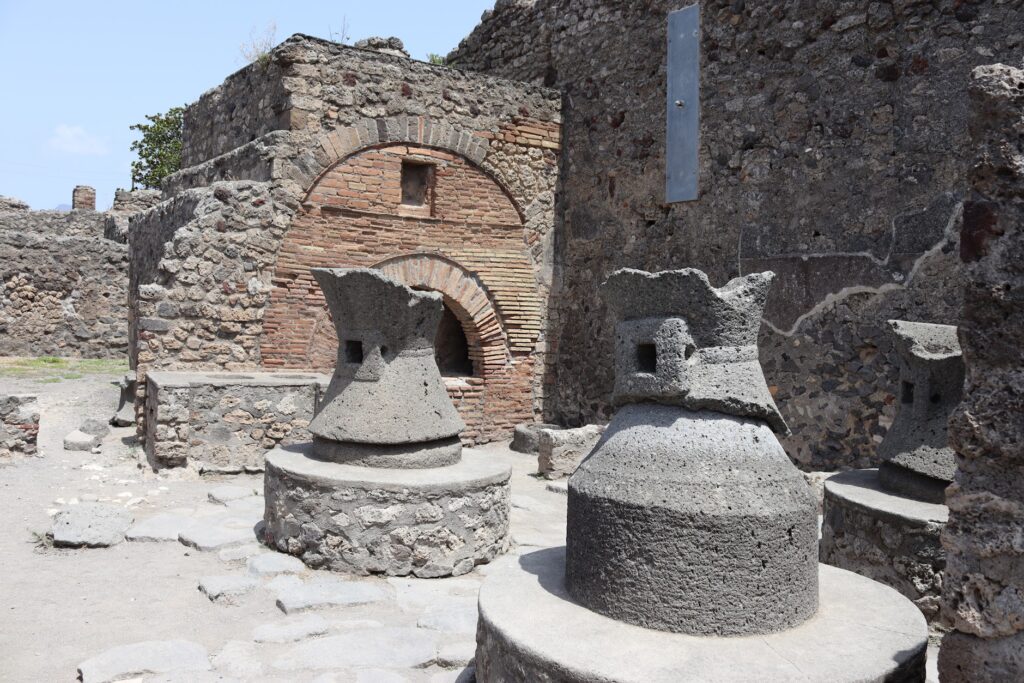
Bread is one of the most obvious markers of Roman identity. Yet how the Romans made it rise remains little known.
The ancient sources – scarce but precise – allow us to reconstruct their methods. They show leavened and unleavened breads existing side by side, the latter often associated with ritual contexts or the simplest domestic settings.
Cato and bread without leaven
In his De agri cultura, Cato (second century BCE) gives two recipes that make no mention whatsoever of leaven. The panis depsticius is a simple mixture of flour and water, kneaded in a mortar and baked under an earthenware cover (testu):
“Make kneaded bread in this way: wash your hands and the mortar well. Put the flour into the mortar, add water little by little and knead it thoroughly. When you have kneaded it well, shape it and bake it under the cover.”[1]
The libum, a sacrificial cake, combines cheese, flour and egg, without any ferment, before being baked under the same cover.[2]
These texts suggest that, in rural or ritual settings, bread could be eaten unleavened. Cato does not mention fermentum, which has sometimes been taken as a sign that he knew nothing of leavening. But it is more likely that he is passing on specific recipes suited to particular uses, rather than being unaware of fermentation techniques known elsewhere.[3] For certain religious purposes, leaven was even forbidden; we shall come back to this.
Pliny the Elder and the diversity of leavens
More than two centuries after Cato, Pliny the Elder (23–79) devotes a long passage of his Natural History to bread. In it he describes several ways of making dough rise, which reveal the range of know-how in Italy and the provinces. Our word “leaven” comes indirectly from the Latin levare, “to lift”: it is the dough that rises. The Romans said fermentum, from fervere, “to boil”: for them, working dough bubbled.
The most common method was probably to keep back a piece of dough from one day to the next, what bakers today call a mother dough or starter.
“Nowadays leaven is made from the very flour that is being kneaded, before the salt is added; it is boiled like porridge and left until it turns sour. But most often it is not even heated: people simply use dough kept from the day before. It is clear that it is sourness that makes the dough ferment, just as bodies nourished on leavened bread are stronger.”[4]
Pliny also describes a dried ferment that could be stored, and which, in the way it was used, recalls our dried yeast.
“Millet is used above all for making leaven: it is kneaded with must and kept for a year. The same is done with the finest wheat bran, steeped for three days in white must, kneaded and then dried in the sun. When bread is to be made, these cakes are dissolved, heated with the finest flour and then mixed into the flour, in the belief that this produces the best bread.”[5]
These cakes, easy to store and transport, suggest that bread-making could be organised beyond the domestic hearth.
Pliny also mentions a regional method: in Gaul and Hispania, the froth of ale, the cereal beer, was used as leaven.
“In Gaul and Hispania, grain is steeped to make a drink, and the froth that forms on it is used as leaven; this is why their bread is lighter.”[6]
This ale yeast, or barm, raised a large share of Europe’s bread until the nineteenth century. More active and less sour than a sourdough leaven, it does indeed give a lighter crumb.
Ferments made from the grape harvest can only be produced once a year. For the rest of the year, Pliny gives a barley-based recipe: two-pound balls of water and barley are roasted under the ashes until they glow red, then shut away in jars until they turn sour. Why they were roasted, which seems to work against fermentation, is unknown. Pliny adds a memory: when barley bread was still made – by his day it had become fodder for livestock – it was leavened with flour of bitter vetch or grass pea.[7]
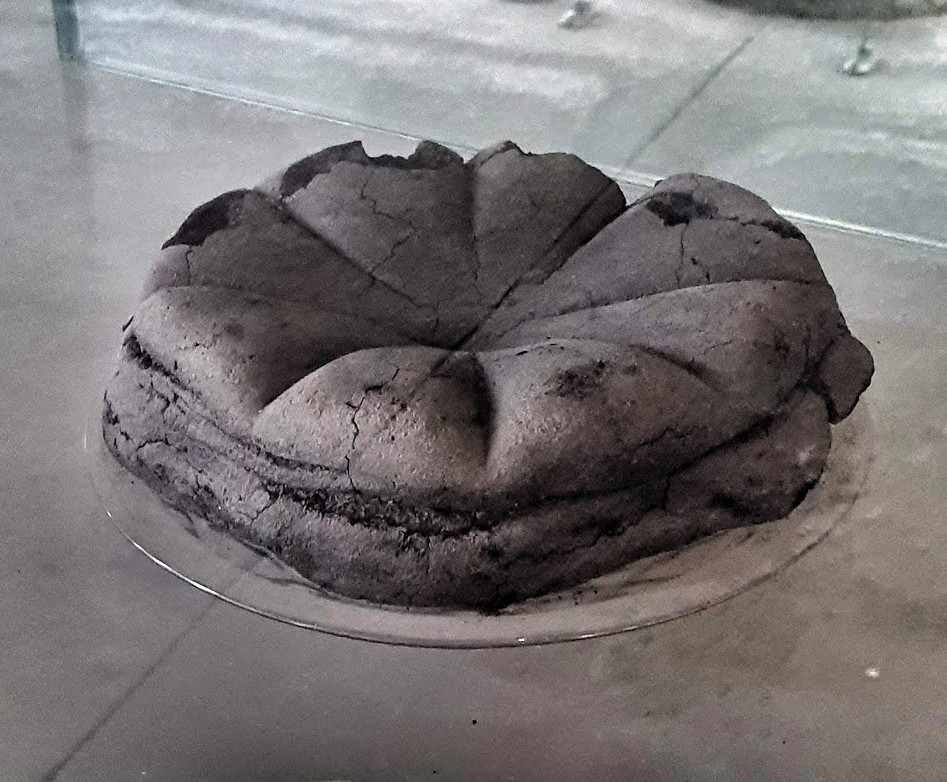
In Pompeii, leavened loaves… carbonised
The excavations at Pompeii and Herculaneum provide material confirmation that ferments were used. In the so-called bakery of Modestus (VII.1.36–37), 81 loaves carbonised in 79 CE were found, all with a leavened crumb.[8] Their distinctive shape (a round loaf scored into eight segments) points to careful shaping and communal baking.
Pompeian bakeries also had built-in terracotta tanks, interpreted as fermentation basins, sometimes more than a metre in diameter.[9] These installations, sometimes cobbled together from recycled dolia reinforced with lead sheets, were probably used for a first bulk fermentation. After shaping, a second fermentation could take place on shelves warmed by the heat of the oven, to speed up rising before baking.
The textiles found in some domestic contexts at Pompeii (more than fifty pieces of cloth in the “House of the Doves”) also suggest that dough may have been covered to keep it moist and help it ferment.[10]
A historiographical debate
When leavened bread spread in Rome remains hard to pin down. Greek texts show that the technique of fermenting bread was known long before the imperial period, whereas Republican Roman sources are far more reticent. By Pliny’s time, however, leavened bread was clearly in everyday use, as the loaves found in Pompeii’s bakeries confirm.
Fermentation, ever suspect
In Rome, at least one priest had to keep away from leaven: the priest of Jupiter (flamen Dialis), who was bound by a long list of prohibitions. Aulus Gellius reports that he was not permitted to touch flour that had been mixed with leaven.[11] Plutarch (c. 46–125), who asks in his Roman Questions why this priest may touch neither flour nor leaven, offers an explanation:
“Leaven is itself born of corruption, and it corrupts the dough with which it is mixed: the dough becomes slack and inert, and fermentation looks exactly like putrefaction; if there is too much, it turns the flour wholly sour and spoils it.”[12]
This is a Greek’s interpretation, three centuries after Cato; it may nonetheless shed light on the use of unleavened breads and cakes in offerings, such as the libum. Rome also had its own unfermented sacrificial preparation: mola salsa, toasted emmer, ground and salted, prepared by the Vestal Virgins. It was sprinkled on the victim’s head before the sacrifice, and it is this gesture that the verb immolare, our “immolate”, refers to.[13]
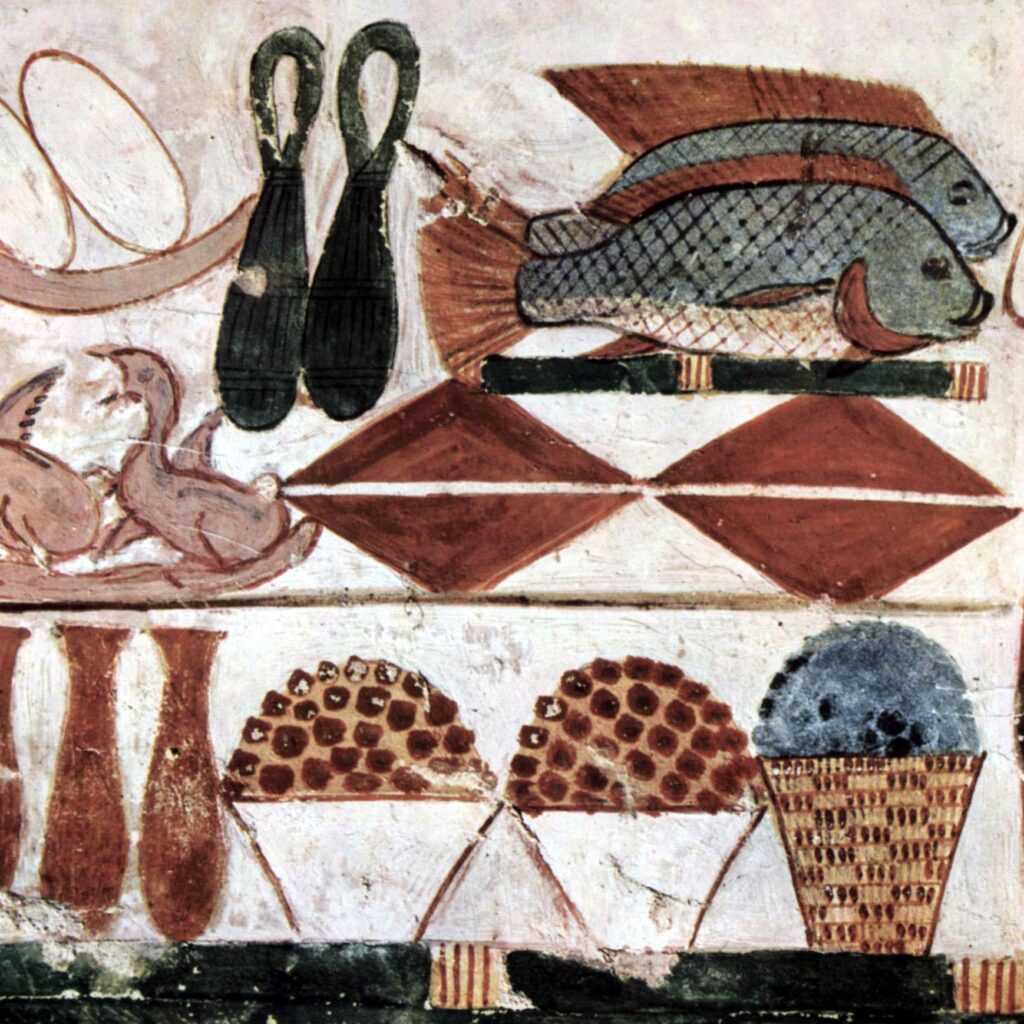
Pharaonic Egypt is one of the earliest known centres of bread-making. From the third millennium BCE, bread moulds attest to organised production, and microscopic analysis of preserved loaves has revealed the use of yeasts.[14] Bread, made from emmer or barley, soon became a social marker. Nothing here suggests any mistrust of leaven: depicted in tombs, bread accompanies the dead into the afterlife, associated with the cycle of death and rebirth embodied by Osiris.
The Greeks distinguished in particular between leavened bread (ártos zymítēs) and unleavened bread (ártos ázymos); zýmē, “leaven”, is also the origin of our word “enzyme”. Their plakoûs, a cake often made with cheese and honey, passed into Latin as placenta: it is the one whose recipe Cato gives immediately after the libum.
The Hebrew Bible forbids leaven on the altar (Leviticus 2:11) and requires unleavened bread (matsa) during Passover (Pessa’h), when all leavened food (‘hamets) must be removed from the home (Exodus 12:15–20). The prohibition is not absolute, however: at the Feast of Weeks, two leavened loaves are offered at the Temple (Leviticus 23:17). Early Christianity inherited both values. Paul asks the Corinthians to purge out the “old leaven” (1 Corinthians 5:6–8), and Matthew’s Gospel warns against “the leaven of the Pharisees” (16:6–12). Yet the same Gospel likens the Kingdom of Heaven “to leaven, which a woman took and hid in three measures of meal, till the whole was leavened” (13:33).
In several ancient traditions, then, fermentation carries ambivalent values: transformation and growth on the one hand, corruption or impurity on the other. This ambivalence sheds light on, without fully explaining, the coexistence of leavened bread in everyday eating and unleavened preparations in certain religious contexts.
Series – Roman bread
- Types of Roman bread
- To leaven or not to leaven: bread-making methods in ancient Rome
- Can the bread of Pompeii be reconstructed?
- From the Graeco-Roman artolaganus to Neapolitan pizza
Related series
[1] Cato, De agri cultura 74: Panem depsticium sic facito. Manus mortariumque bene lavato. Farinam in mortarium indito, aquae paulatim addito subigitoque pulchre. Ubi bene subegeris, defingito coquitoque sub testu.
[2] Cato, De agri cultura 75: Libum hoc modo facito. Casei P. II bene disterat in mortario. Ubi bene distriverit, farinae siligineae libram aut, si voles tenerius esse, selibram similaginis eodem indito permiscetoque cum caseo bene. Ovum unum addito et una permisceto bene. Inde panem facito, folia subdito, in foco caldo sub testu coquito leniter.
[3] Cardon, Bread, Bakers, and Bakeries: A Study of Bread-making in Roman Italy, PhD thesis, University of Auckland, 2022, p. 4–5.
[4] Pliny the Elder, HN XVIII, 104: Nunc fermentum fit ex ipsa farina, quae subigitur, priusquam addatur sal, ad pultis modum decocta et relicta, donec acescat. Vulgo vero nec suffervefaciunt, sed tantum pridie adservata materia utuntur, palamque est naturam acore fermentari, sicut evalidiora esse corpora, quae fermentato pane alantur.
[5] Pliny the Elder, HN XVIII, 102: Mili praecipuus ad fermenta usus e musto subacti in annuum tempus. Simile fit e tritici ipsius furfuribus minutis et optimis e musto albo triduo maceratis, subactis ac sole siccatis. Inde pastillos in pane faciendo dilutos cum similagine seminis fervefaciunt atque ita farinae miscent, sic optimum panem fieri arbitrantes.
[6] Pliny the Elder, HN XVIII, 68: Galliae et Hispaniae frumento in potum resoluto, spuma ita concreta pro fermento utuntur, qua de causa levior illis quam ceteris panis.
[7] Pliny the Elder, HN XVIII, 103: Et haec quidem genera vindemiis tantum fiunt; quo libeat vero tempore ex aqua hordeoque bilibres offae ferventi foco vel fictili patina torrentur cinere et carbone, usque dum rubeant. Postea operiuntur in vasis, donec acescant. Hinc fermentum diluitur. Cum fieret autem panis hordeacius, ervi aut cicerculae farina ipse fermentabatur.
[8] Carbonised loaves from the bakery of Modestus (Pompeii, VII.1.36–37), see Cardon 2022, p. 86.
[9] Monteix, N., “Contextualizing the Operational Sequence: Pompeian Bakeries as a Case Study”, in A. Wilson and M. Flohr (eds), Urban Craftsmen and Traders in the Roman World, Oxford, Oxford University Press, 2016.
[10] Cardon 2022, ch. 3 (sections on the basins and fermentation), and p. 91–93.
[11] Aulus Gellius, Attic Nights X, 15, 19: Farinam fermento inbutam adtingere ei fas non est.
[12] Plutarch, Quaestiones Romanae 109: ἡ δὲ ζύμη καὶ γέγονεν ἐκ φθορᾶς αὐτὴ καὶ φθείρει τὸ φύραμα μειγνυμένη· γίγνεται γὰρ ἄτονον καὶ ἀδρανὲς καὶ ὅλως ἔοικε σῆψις ἡ ζύμωσις εἶναι· πλεονάσασα γοῦν ἀποξύνει παντάπασι καὶ φθείρει τὸ ἄλευρον.
[13] Paul the Deacon, epitome of Festus, p. 97 Lindsay: Immolare est mola, id est farre molito et sale, hostiam perspersam sacrare. On the preparation of mola salsa by the Vestals, Servius, Commentary on the Eclogues 8, 82.
[14] Samuel, D., “Investigation of Ancient Egyptian Baking and Brewing Methods by Correlative Microscopy”, Science 273, 1996, p. 488–490.
Other articles in English from the Nunc est bibendum blog