Translated from French (please notify us of errors)
Milk, semolina, honey, nuts and dried fruit, pepper and sometimes even garum: the apothermum is often presented today as a typical dessert of ancient Rome, supposedly enjoyed on leaving the baths. Yet the ancient recipe preserved in Apicius’s De re coquinaria contains neither milk nor honey. As for making it a bathhouse dish, the evidence is decidedly hazy…
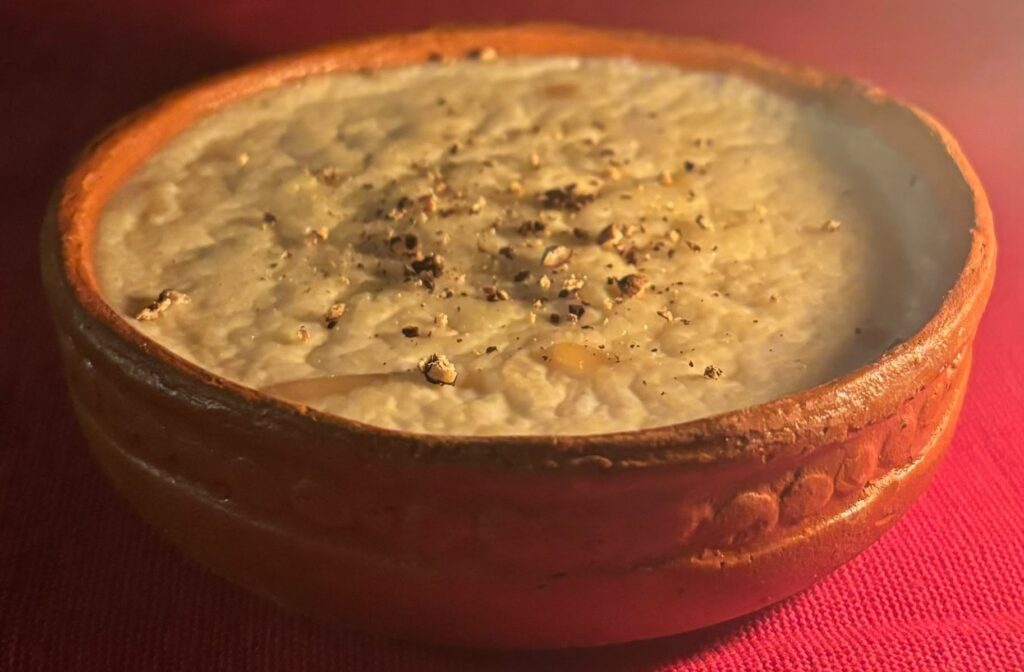
The apothermum is a recipe well known to lovers of Roman cuisine. It appears in many books and on websites devoted to ancient gastronomy, usually as a pudding made with milk and semolina, enriched with honey, almonds, pine nuts, raisins and pepper. Some versions add olive oil and a few drops of garum, the Romans’ famous fermented fish sauce. The whole thing is served cold, with a consistency close to that of a custard.
Its Greek name apothermon (ἀπόθερμον), formed from thermos, “hot”, is often translated as “after the baths”, hence the idea that the Romans ate it on leaving the bathhouse. But this interpretation does not rest on any ancient testimony. The word could just as well refer to a dish served “without heat”, in other words cooled. And Galen, as we shall see, attributes the name to peasants, not to regulars of the baths.
The recipe itself appears in the De re coquinaria, the culinary collection traditionally attributed to Apicius and compiled around the late fourth or early fifth century CE from older recipes:
“This is how to make apothermum: boil alica with pine nuts and blanched almonds, soaked in water and then washed with silver chalk, so that they all reach the same whiteness. Add raisins as well as caroenum or passum. Sprinkle with crushed pepper and serve in a boletar.”[1]
The sweetness comes from the raisins and the grape products, must reduced by boiling (caroenum) or wine made from sun-dried grapes (passum). The base is alica, a preparation of hulled and cracked wheat, coarser than our semolina. The pepper is uncertain: the manuscripts merely say to sprinkle the dish with something “crushed”, and it was a twentieth-century editor who restored the word piper.
Another detail catches the eye: Apicius insists on the whiteness of the pine nuts and almonds, obtained by treating them with creta argentaria, a white chalk whose name suggests the polishing of silverware. This requirement, fortunately little observed in modern reconstructions, echoes a practice described by Pliny the Elder. In Campania, once the grain had been pounded and hulled, a chalk taken from the Leucogaeus hill, between Pozzuoli and Naples, was mixed into the alica, giving it its whiteness and tenderness[2].
So much was at stake that Augustus, when founding a colony at Capua, had two hundred thousand sesterces paid to the Neapolitans every year for this hill: the Campanians claimed that alica could not be made without it. Nothing proves that Apicius’s creta argentaria is the same substance, and the use differs. But whiteness was an expected quality of alica, and Apicius extends it to the other ingredients of the dish.
Finally, the recipe gives no indication of quantities, final consistency or serving temperature. Nor does it specify that the mixture should be poured into moulds to set. It names only the serving vessel: the boletar, originally a dish for mushrooms (boleti). Martial gives a voice to one of these dishes, which complains of serving common cabbage sprouts despite its prestigious name[3].
Galen and the peasants’ apothermon
To find out more, we must go back to the second century CE, well before the compilation of the collection preserved under Apicius’s name.
In his treatise On the Properties of Foodstuffs, Galen of Pergamon, a Greek physician settled in Rome, describes the culinary uses of several cereals. Of einkorn, called tiphê (τίφη), he writes:
“The einkorn grain has an outer husk, like olyra and barley. Once hulled, it is used to make bread and lends itself to various other uses. Boiled in water, it is eaten in the form of what country people call apothermon, with the addition of what we call must reduced by boiling (hepsêma) and others call siraion. It is sometimes also eaten simply boiled with salt, as I said I had done myself with wheat.”[4]
Galen’s last sentence refers back to a memory recounted earlier in the treatise. As a young man, he had gone with two companions of his own age to an estate far from the city. The peasants had already dined and had no bread left. One of them then threw some wheat into a pot, boiled it and seasoned it with a little salt. The visitors, hungry from the walk, devoured this rough-and-ready dish… only to feel at once a heaviness in their stomachs, as if they were full of clay. The next day they had no appetite, suffered from bloating and headaches, and their vision was blurred. The peasants then explained that they only ate this indigestible boiled wheat out of necessity…[5].
In the same passage, Galen describes another preparation, tragos, made from olyra, a hulled cereal often identified, without certainty, with emmer. The best olyra, carefully hulled, is boiled, the cooking water is discarded, and siraion (boiled must), sweet wine or honeyed wine is poured over the grains. Pine nuts soaked in water until they have swollen as much as possible are sometimes added[6]. Pliny knows this dish by the Latin name tragum. It was prepared in Campania and Egypt, and he regarded it as a second-rate alica[7].
The similarities with Apicius’s recipe are striking: hulled cereals, boiling in water, concentrated grape products, nuts soaked beforehand. They suggest the existence of a whole family of grain-based preparations, some of which could be sweet, without corresponding to our modern notion of dessert.
Cream, porridge or dumplings?
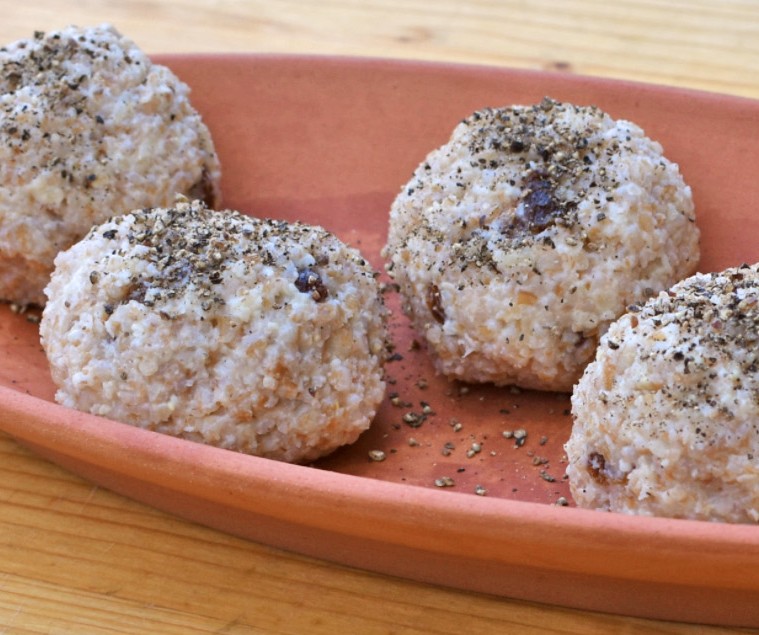
What exact form did the apothermum take? Nothing allows us to establish it with certainty. An Italian culinary reconstruction website offers an original interpretation: rather than a cream, it would have been slightly sweet dumplings or patties, served as an accompaniment to meat or sausages. The author notes that the recipe appears in Book II of Apicius, devoted to dumplings, fish croquettes and sausages, and not among the sweets of Book VII. He also assumes that the ingredients were pounded in a mortar, as in other recipes in that book, and, having tasted the dish, judges it not sweet enough for a dessert.
The collection itself lends some support to the idea of a side dish. In Book III, a recipe for cabbage sprouts ends by pouring over them alica boiled with pine nuts and raisins[8]: it is almost the apothermum, used as a garnish for a vegetable dish. And – lo and behold! – here are the very cabbage sprouts that Martial’s boletar complains about. But the apothermum recipe mentions neither mortar nor dumplings, and nor does Galen. Tragos, drained before being drizzled with boiled wine, merely shows that these preparations did not necessarily look like a cream.
How did milk sneak into the recipe?
It is time to tackle the question that justifies the title of this article. Where does the modern milk-based version come from? It is found notably in Renzo Pedrazzini (Saveurs et senteurs de la Rome antique, 1996), Sally Grainger (Cooking Apicius, 2006) and Mireille Chérubini (Latin de cuisine, 2018), with variations in ingredients and proportions.
One possible explanation lies in Book VII of the De re coquinaria, devoted in particular to sweet preparations (dulcia). There we find several recipes whose ingredients resemble those of the modern pseudo-apothermum.
One of them even combines cooked alica with honey, wine, passum, pine nuts, walnuts and hazelnuts[9]. The next adds milk to a sweet preparation:
“Another sweet dish: grind pepper, pine nuts, honey, rue and wine made from sun-dried grapes. Cook this mixture with milk and tracta (pastry sheets). Cook the thickened mixture with a few eggs. Serve drizzled with honey and sprinkled with pepper.”[10]
Milk, eggs, a thickened mixture: in fact, it is almost a custard.
Milk also appears in Pliny in connection with alica. He notes that certain imitations could be whitened with raw milk rather than chalk[7], and he describes a bread from Picenum made with alica and kneaded with raisin juice, which was only eaten soaked, preferably in honeyed milk[11].
Book V of Apicius offers a model even closer to the modern versions: pultes tractogalatae, a porridge of tracta crumbled into milk, of which he gives a variant with honey[12].
It is therefore possible that modern versions of the apothermum result from a combination of several ancient recipes, pairing the nuts, dried fruit and alica of Book II with the milk and honey of Books V and VII. But this lineage remains a hypothesis: contemporary authors do not necessarily state how they developed their adaptations.
As for garum and olive oil, none of the ancient preparations examined here mentions them. Their presence in some modern recipes is probably due to a wish to give the dish – somewhat artificially – a flavour considered typically Roman.
[1] Apicius, De re coquinaria, II, 2, 10 (no. 53):
Apothermum sic facies: alicam elixa cum nucleis et amygdalis depellatis et in aqua infusis et lotis ex creta argentaria, ut ad candorem pariter perducantur. cui ammiscebis uvam passam, caroenum vel passum, desuper ‹piper› confractum asparges et in boletari inferes.[2] Pliny the Elder, Natural History, XVIII, 112-114:
Alica fit e zea, quam semen appellavimus. tunditur granum eius in pila lignea, ne lapidis duritia conterat, mobili, ut notum est, pilo vinctorum poenali opera. primori inest pyxis ferrea. excussis inde tunicis iterum isdem armamentis nudata conciditur medulla. ita fiunt alicae tria genera: minimum ac secundarium, grandissimum vero aphaerema appellant. nondum habent candorem suum, quo praecellunt, iam tamen Alexandrinae praeferuntur. postea, mirum dictu, admiscetur creta, quae transit in corpus coloremque et teneritatem adfert. invenitur haec inter Puteolos et Neapolim in colle Leucogaeo appellato, extatque divi Augusti decretum, quo annua ducena milia Neapolitanis pro eo numerari iussit e fisco suo, coloniam deducens Capuam, adiecitque causam adserendi, quoniam negassent Campani alicam confici sine eo metallo posse.
“Alica is made from zea, which we have called semen. Its grain is pounded in a wooden mortar, so that the hardness of stone does not crush it. The pestle is worked, as is well known, by chained convicts as a punishment; its tip is fitted with an iron cap. Once the husks have been removed, the kernel thus laid bare is broken up with the same implements. In this way three kinds of alica are obtained: the finest, the medium, and the coarsest, which they call aphaerema. They do not yet have the whiteness that makes them superior, yet they are already preferred to Alexandrian alica. Then, remarkable to relate, chalk is mixed in, which penetrates the grain and gives it colour and tenderness. It is found between Pozzuoli and Naples, on a hill called Leucogaeus. There is a decree of the deified Augustus who, when founding the colony of Capua, ordered two hundred thousand [sesterces] to be paid annually to the Neapolitans from his treasury for this hill. He gave the reason for this claim: the Campanians had asserted that alica could not be made without this mineral.”[3] Martial, Epigrams, XIV, 101 (Boletaria):
Cum mihi boleti dederint tam nobile nomen, / prototomis – pudet heu! – servio coliculis.
“Although boletes have given me so prestigious a name, I serve – oh, the shame! – the first cabbage sprouts.”[4] Galen, De alimentorum facultatibus, I, 13 (Kühn, VI, p. 519; Helmreich, 1923):
τὸ δὲ σπέρμα τοῦτο τὸ τῆς τίφης ἔχει μὲν ἔξωθεν λέμμα, καθάπερ ὄλυρά τε καὶ κριθή, πτισθὲν δ’ ἀρτοποιεῖται καὶ ὅλως εἰς χρῆσιν ἄγεται. καὶ γὰρ ἐξ ὕδατος ἑψηθὲν ἐσθίεται κατὰ τὸ ὑπὸ τῶν ἀγροίκων ὀνομαζόμενον ἀπόθερμον, ἐμβαλλομένου τοῦ πρὸς ἡμῶν μὲν ἑψήματος, ὑπ’ ἐνίων δὲ σιραίου καλουμένου. καί ποτε καὶ μεθ’ ἁλῶν ἐσθίεται ἑψόμενον, καθάπερ ἔφην ἐδηδοκέναι τοὺς πυροὺς αὐτὸς ἐγώ.[5] Galen, De alimentorum facultatibus, I, 7 (Kühn, VI, p. 498-499; Helmreich, 1923, p. 227):
ἐπεὶ δὲ καὶ αὐτὸς ἐγώ πορευθείς ποτ’ εἰς ἀγρὸν οὐκ ἐγγὺς τῆς πόλεως ὄντα μετὰ δυοῖν μειρακίων τὴν αὐτὴν ἡλικίαν ἀγόντων ἐμοί, κατέλαβον ἤδη δεδειπνηκότας τοὺς ἀγροίκους καὶ μελλούσας ἀρτοποιεῖσθαι τὰς γυναῖκας (ἠπόρουν γὰρ ἄρτου), παραχρῆμά τις αὐτῶν ἐμβαλὼν εἰς χύτραν πυροὺς ἥψησεν, εἶθ’ ἡδύνας ἁλσὶ μετρίοις ἐσθίειν ἡμᾶς ἠξίωσεν· ἐμέλλομεν δ’, ὡς τὸ εἰκός, ἑτοίμως αὐτὸ ποιήσειν ὡδοιπορηκότες τε καὶ πεινῶντες. ἐφάγομέν τ’ οὖν αὐτῶν δαψιλῶς ᾐσθανόμεθά τε κατὰ τὴν γαστέρα βάρους, ὡς δοκεῖν ἐγκεῖσθαι πηλὸν αὐτῇ· καὶ κατὰ τὴν ὑστεραίαν ἠπεπτηκότες ἀνόρεκτοι δι’ ὅλης ἡμέρας ἦμεν, ὡς μηδὲν δύνασθαι προσενέγκασθαι, καὶ πνεύματος φυσώδους μεστοὶ κεφαλαλγεῖς τε καὶ βλέποντες ἀχλυῶδες· οὐδὲ γὰρ ὑπεχώρει τι κάτω, ὃ μόνον ἐστὶν ἄκος ἐπὶ ταῖς ἀπεψίαις. ἠρώτων οὖν τοὺς ἀγροίκους εἰ καὶ αὐτοί ποτε πυρῶν ἑφθῶν ἔφαγον ὅπως τε διετέθησαν. οἱ δὲ καὶ πολλάκις ἐδηδοκέναι κατὰ τὴν αὐτὴν ἀνάγκην ἔφασαν, ᾗ καὶ τόθ’ ἡμεῖς συνηνέχθημεν, εἶναί τε βαρὺ καὶ δύσπεπτον ἔδεσμα τοὺς οὕτω σκευασθέντας.
“One day I had myself gone into the countryside, to an estate some distance from the city, with two young men of my own age. We found that the peasants had already dined, and that the women were about to make bread, for they had none left. One of them at once threw some wheat into a pot and boiled it; then, having seasoned it with a little salt, he invited us to eat it. We were naturally quite willing, having walked and being hungry. So we ate plenty of it, and felt such a heaviness in our stomachs that they seemed to contain clay. The next day, not having digested it, we remained without appetite the whole day, unable to take anything, full of wind, with headaches and blurred vision; and nothing passed downwards, which is the only remedy for indigestion. So we asked the peasants whether they too had ever eaten boiled wheat, and how they had fared. They replied that they had often eaten it, driven by the same necessity in which we had found ourselves, and that wheat prepared in this way was a heavy food, difficult to digest.”[6] Galen, De alimentorum facultatibus, I, 13 (Kühn, VI; Helmreich, 1923):
τὴν δ’ εὐγενεστάτην ὄλυραν ὅταν ὡς χρὴ πτίσωσι, τὸν ὀνομαζόμενον τράγον ποιοῦσιν, ᾧ πολλοὶ χρῶνται δι’ ὕδατος ἕψοντες, εἶτα τὸ μὲν ὕδωρ ἀποχέοντες, ἐπιχέοντες δὲ σίραιον ἢ οἶνον γλυκὺν ἢ οἰνόμελι· παρεμβάλλουσι δὲ καὶ κώνους ἐν ὕδατι διαβεβρεγμένους, ὡς ἐπὶ πλεῖστον ἐξῳδηκέναι.
“As for the finest olyra, once it has been properly hulled, they make from it what is called tragos. Many use it by boiling it in water; then they pour off the water and pour over it siraion, sweet wine or honeyed wine. They also add pine nuts soaked in water until they have swollen as much as possible.”[7] Pliny the Elder, Natural History, XVIII, 76 and 116:
§ 76: Simili modo e tritici semine tragum fit, in Campania dumtaxat et Aegypto.
“In the same way [as barley gruel], tragum is made from wheat grain, but only in Campania and Egypt.”
§ 116: Ex zea pulchrius quam e tritico fit tragum, quamvis id alicae vitium sit. candorem autem ei pro creta lactis incocti mixtura confert.
“Tragum made from zea is finer than that made from wheat, although it is a degraded form of alica. As for its whiteness, it is given by an admixture of unboiled milk instead of chalk.”[8] Apicius, De re coquinaria, III, 9, 6 (no. 86):
Aliter: cauliculis conditis ut supra superfundes alicam elixam cum nucleis et uva passa; piper asparges.
“Another way: over the cabbage sprouts seasoned as above, pour alica boiled with pine nuts and raisins, and sprinkle with pepper.”[9] Apicius, De re coquinaria, VII, 13, 4 (no. 303):
‹Aliter› dulcia: piperato mittis mel, merum, passum, rutam. Eo mittis nucleos, nuces, alicam elixatam. Concisas nuces Abellanas tostas adicies, et inferes.
“Another sweet dish: into the peppered mixture put honey, neat wine, wine made from sun-dried grapes and rue. Add pine nuts, walnuts and cooked alica. Add toasted, chopped hazelnuts, then serve.”[10] Apicius, De re coquinaria, VII, 13, 5 (no. 304):
Aliter dulcia: piper, nucleos, mel, rutam et passum teres, cum lacte et tracta coques. Coagulum coque cum modicis ovis. Perfusum melle, aspersum ‹pipere› inferes.[11] Pliny the Elder, Natural History, XVIII, 106:
Durat sua Piceno in panis inventione gratia ex alicae materia. eum novem diebus maceratum decumo ad speciem tractae subigunt uvae passae suco, postea in furnis ollis inditum, quae rumpantur ibi, torrent. neque est ex eo cibus nisi madefacto, quod fit lacte maxime mulso.
“Picenum still enjoys the reputation it owes to the invention of a bread made from alica. It is left to steep for nine days; on the tenth, it is kneaded with raisin juice to give it the appearance of tracta. Then it is put into the oven in pots, which burst there, and baked. It cannot be eaten unless soaked, and it is soaked above all in honeyed milk.”[12] Apicius, De re coquinaria, V, 1, 3 (no. 188-189):
Pultes tractogalatae: lactis sextarium et aquae modicum mittes in caccabo novo et lento igni ferveat. tres orbiculos tractae siccas et confringis et partibus in lac summittis. ne uratur, aquam miscendo agitabis. cum cocta fuerit, ut est, super agninam mittis. ex melle et musteis cum lacte similiter facies, salem et oleum minus mittis.
“Milk porridge with tracta: put a sextarius of milk and a little water in a new pot and boil over a low heat. Dry three discs of tracta, break them up and add them to the milk piece by piece. To stop it catching, stir while adding water. When it is cooked, pour it as it is over lamb. You will do the same with honey and mustei, with milk, adding less salt and oil.”
Other articles in English from the Nunc est bibendum blog