Translated from French (please notify us of errors)
In Rome, saffron was expensive enough to attract counterfeiters. Spice, dye, perfume, medicine and status symbol, it turned up everywhere – even in theatres. The trick was making sure you had bought the real thing.
Someone hands you a pinch of dark red filaments. You rub them between your fingers: they should stain the skin and, pressed in the palm, crackle like something dry and brittle. If the filaments crumble to dust or smell of boiled must rather than of saffron itself, be wary.
“Nothing is so often falsified,” wrote Pliny the Elder[1] in the first century CE.
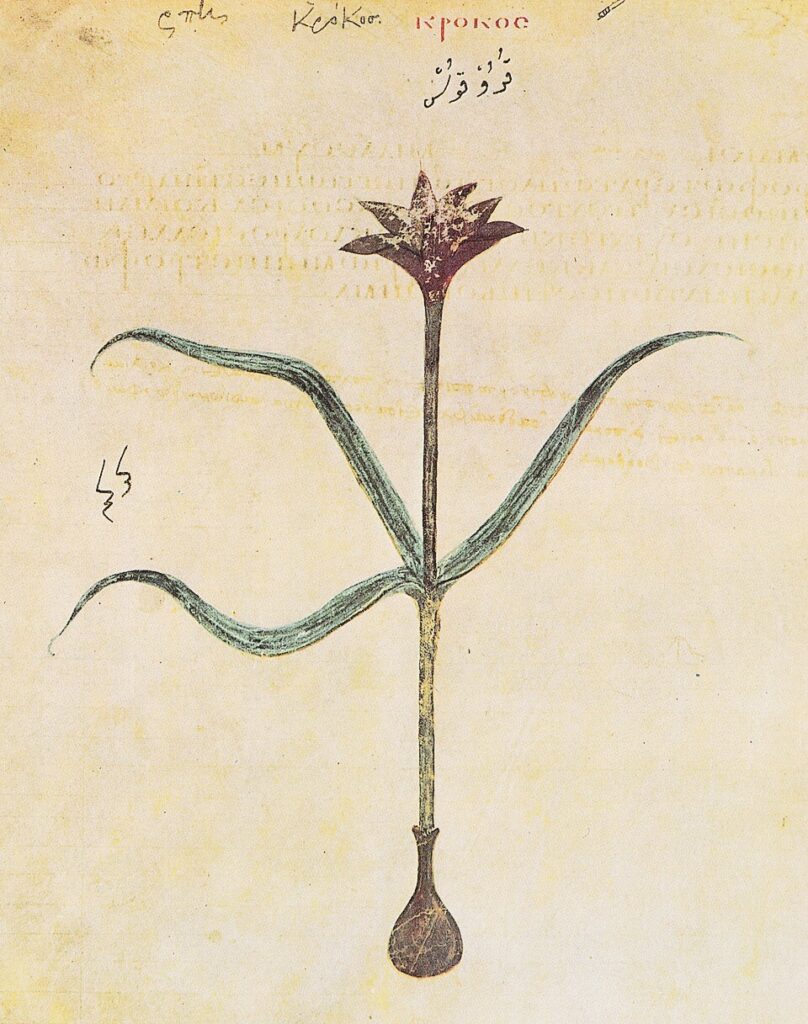
The confusion begins with the terms themselves. The Greek krokos (κρόκος) and the Latin crocum (or crocus – usage wavers on the gender) refer, depending on context, to the plant, its flower, the dried substance extracted from it, or simply its colour. One also had to beware of a by‑product, crocomagma. When saffron is pressed to extract its scented oil, what remains is a compact, fragrant mass, rather like the pomace of grapes or olives. To complicate matters further, Greek has a similarly sounding word, knêkos (κνῆκος), denoting safflower, a related plant with equally yellow‑orange flowers, but far cheaper.
A contemporary of Pliny, Dioscorides describes the fraud with a forger’s precision: crushed crocomagma was mixed into the saffron, along with litharge – the lead oxide produced when refining silver – or molybdaena, a lead‑bearing ore unrelated to the modern metal of the same name. This added weight, after which the mixture was coated with boiled must to disguise it. The deception gave itself away when the substitute crumbled to dust or smelled of boiled must[2].
The counterfeiters’ motive becomes clearer once one knows what the product was worth. In 301, Diocletian’s Price Edict set the maximum price of a Roman pound – about 327 g – of Arabian saffron at 2,000 denarii, of Cilician saffron at 1,000 denarii, and of African saffron at 600. By comparison, pepper was worth 800 denarii a pound, and a top‑quality cow 2,000. On paper at least, a pound of Arabian saffron was worth as much as a cow[3].
Curiously, this monetary value does not match the quality ranking Pliny had established two and a half centuries earlier. At the very top of the producing regions he places Cilicia, and more precisely Mount Corycus, on the southern coast of modern‑day Turkey. Next comes Lycian Mount Olympus, also in present‑day Turkey; then Centuripe, in Sicily. The best saffron has “the thickest and shortest filaments.” Crushed, it “blends wonderfully with wine, especially sweet wine,” and is even used “to fill theatres”[4] with its scent. More on that below.
Dioscorides sets out a comparable hierarchy. For medical use, he too ranks the saffron of Corycus first; those of Cyrenaica and of Centuripe in Sicily are, in his view, far weaker[5]. And the geographer Strabo takes us straight to the spot. Twenty stadia from Corycus – roughly 3.5 km – he describes the Corycian cave, “where the finest saffron grows”[6].
From Theophrastus to Pliny, by way of Horace, Strabo and Dioscorides, Corycus’s reputation is thus remarkably consistent.
Pliny also distinguishes wild crocus, which he judges superior, from cultivated crocus, “broader, larger and glossier, but far weaker.” Prettier, but not as good – rather like our modern industrially farmed fruit and vegetables… True saffron, Dioscorides specifies, should be “fresh, of good colour […], elongated, whole, unbroken, not greasy, well‑bodied,” and should colour the hands when moistened[7]. Pliny offers his own tests: the genuine article “crackles when pressed in the hand, like something brittle” and, brought up to the face, “stings the face and eyes slightly”[8].
When saffron went into the pot
Real or fake, saffron also found its way into caccabuli, cooking pots. In the first century BCE, Horace offers one of the earliest direct accounts. In his Satires, he portrays the gourmet Catius solemnly reeling off his rules for a good sauce: mild oil, robust wine, a brine “no different from that which reeks from a jar of Byzantium,” all brought to the boil with chopped herbs, then “sprinkled with saffron of Corycus,” before finally adding a dash of the finest oil of Italy[9]. Horace is mocking a cuisine grown absurdly learned, but for the joke to land, this sort of refinement had to actually exist.
Some centuries later, Apicius still uses saffron sparingly. A drachm – about 4.36 g – is enough for nearly ten litres of conditum paradoxum, a honeyed, spiced wine[10]. Saffron also features in a wormwood‑flavoured wine, the Absinthium Romanum[11]. Apicius is more generous with his spiced salt: an ounce, about 27 g, to three pounds of salt, just under a kilogram[12]. Finally, the later compiler Vinidarius even ranks it first in his short list of spices a kitchen should always have at hand: ahead of pepper, ahead of ginger[13]. But saffron is not there for flavour alone. In a recipe for scorpion‑fish with turnips, it must be added expressly “for the colour”[14].
This same function explains its use in wine. Saffron could serve to colour it – sometimes fraudulently – while its cheaper cousin, safflower, had culinary uses of its own.
A perfume, a remedy, and perhaps an aphrodisiac
Saffron was also a perfumery ingredient. As early as the fourth century BCE, Theophrastus mentions krokinon (κρόκινον), saffron perfume, and notes that the best comes from Aegina and Cilicia[15]. In Roman times, Pliny in turn records the fame of the crocinum of Soli in Cilicia, soon overtaken by that of Rhodes[16].
Dioscorides even tells us how it was made: the saffron macerated for several days in a prepared oil, stirred regularly and then filtered[17]. The pressed residue formed the crocomagma already mentioned[18].
On the medical side, Pliny credits saffron with a striking array of virtues: it was said to prevent hangovers, resist drunkenness, aid sleep and, he adds almost in passing, “stimulate desire”[19]. Dioscorides also records this aphrodisiac reputation, but tempers it with a rather less enticing warning: three drachms of saffron – about 13 g – drunk in water were said to be fatal[20]. Given the price of the spice, however, such excess was unlikely…
Saffron appears in many other medicinal preparations. Celsus pairs it in particular with lycium, verdigris and myrrh, or with egg yolk, fenugreek and rose in a gynaecological remedy[21].
A pinch of luxury in the theatres and streets of Rome
Saffron was as much a dye as a perfume. In Greek, krokôtos (κροκωτός) denotes a garment dyed with saffron; Homer gives Dawn the epithet krokopeplos (κροκόπεπλος), “clad in a saffron‑coloured robe.” And Columella recommends planting Corycian and Sicilian crocus near beehives “so that it colours and scents the honey”[22].
One surprising use remains: perfuming and colouring theatres and streets.
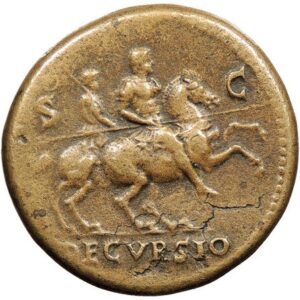
Lucretius describes “the stage […] sprinkled with Cilician saffron”[23]; Ovid, in the Art of Love, recalls that in cruder times theatres were not yet made of marble and their floors not yet “reddened with liquid saffron”[24]; Martial in turn describes a stage sprayed with a “red cloud,” “drenched in scattered saffron”[25]. Spanning several generations, these three authors thus attest to a practice that must have reflected a real taste for unrestrained luxury. A luxury well suited to Nero, of whom Suetonius records the following episode: on his triumphant return to Rome in 67 CE after his victories in the Greek competitions, “saffron was repeatedly scattered along the streets,” amid the birds, ribbons and sweets thrown in his path[26].
Two thousand years on, saffron’s standing has not, in fact, changed all that much. It remains rare, expensive, intensely colouring and powerfully aromatic.
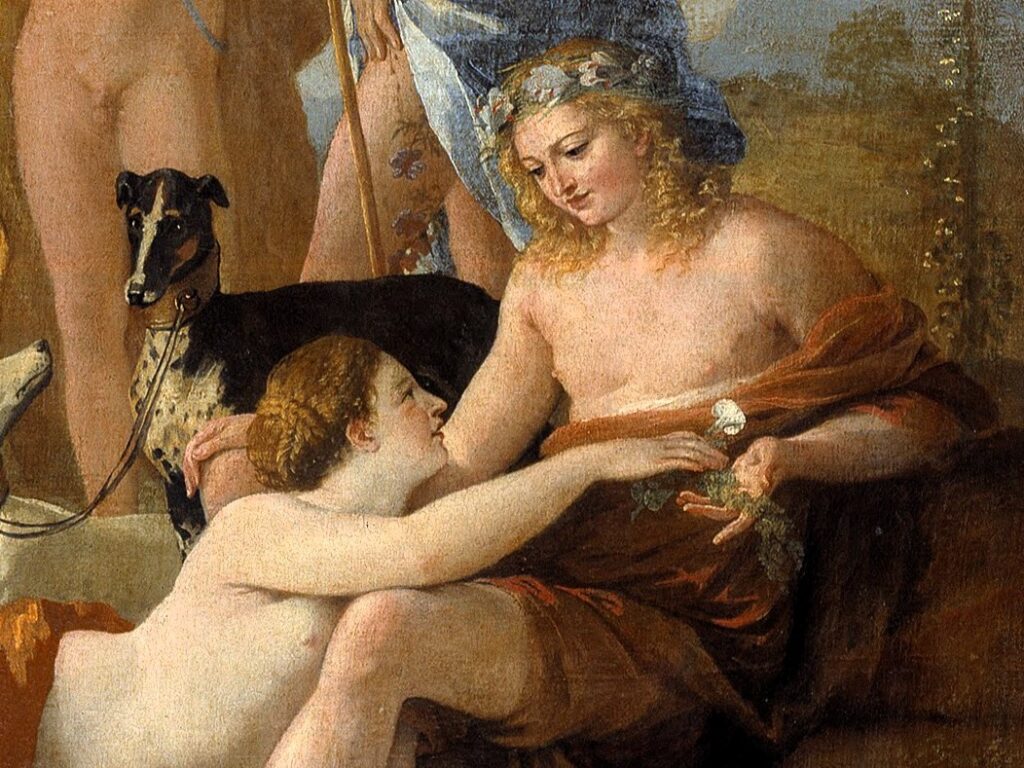
Crocus: a young man, a flower, several legends
The crocus blooms very early in the Greek imagination. In the Iliad, when Zeus and Hera lie together on Mount Ida, the earth makes “fresh grass, dewy lotus, crocus and hyacinth” spring up beneath them, forming a thick, soft bed[27]. But when it comes to explaining the origin of the flower itself, the traditions grow far less coherent.
One tradition brings Crocus and Smilax together in a story of love and metamorphosis, but it has reached us only in fragments and in differing forms. Ovid is particularly frustrating: in the Metamorphoses, he lists, among the stories he chooses not to tell, that of “Crocus changed with Smilax into small flowers.” And he keeps his word: we learn nothing more[28].
Pliny tells a less fortunate version. Smilax is a girl in love with Crocus; but the young man spurns her, and she is transformed into the shrub that now bears her name. It is this unhappy story, he says, that explains why the plant was considered a bad omen and excluded from rites and garlands[29].
Several centuries later, Nonnus still knows the pair, but in a different form: Crocus desires the young Smilax – whom he calls Milax – and must become “a flower of the Loves”[30]. Nonnus says nothing further. So Ovid alludes to a story without telling it, Pliny dramatises Smilax’s unhappy love, and Nonnus dramatises Crocus’s. The same characters recur across the centuries, but the tale that once bound them together eludes us.
A second tradition explains the crocus’s origin far more directly. Galen relates that a young man named Crocus was playing discus with Hermes. Having risen carelessly, he was struck on the head by the discus and died on the spot. His blood flowed onto the ground, and there the crocus sprang up[31]. The story obviously echoes that of Hyacinthus, who likewise was killed by a discus before becoming a flower.
Blood resurfaces, finally, in an unexpected place. In the manuscript tradition of Dioscorides, a list of names given to the crocus notes that the “prophets” called it “blood of Heracles”[32]. No surviving account, however, allows this mysterious name to be explained with any certainty.
There was, then, no single great ancient myth of saffron’s origins, but a cluster of fragmentary, contradictory traditions.
An origin in Attica rather than Crete
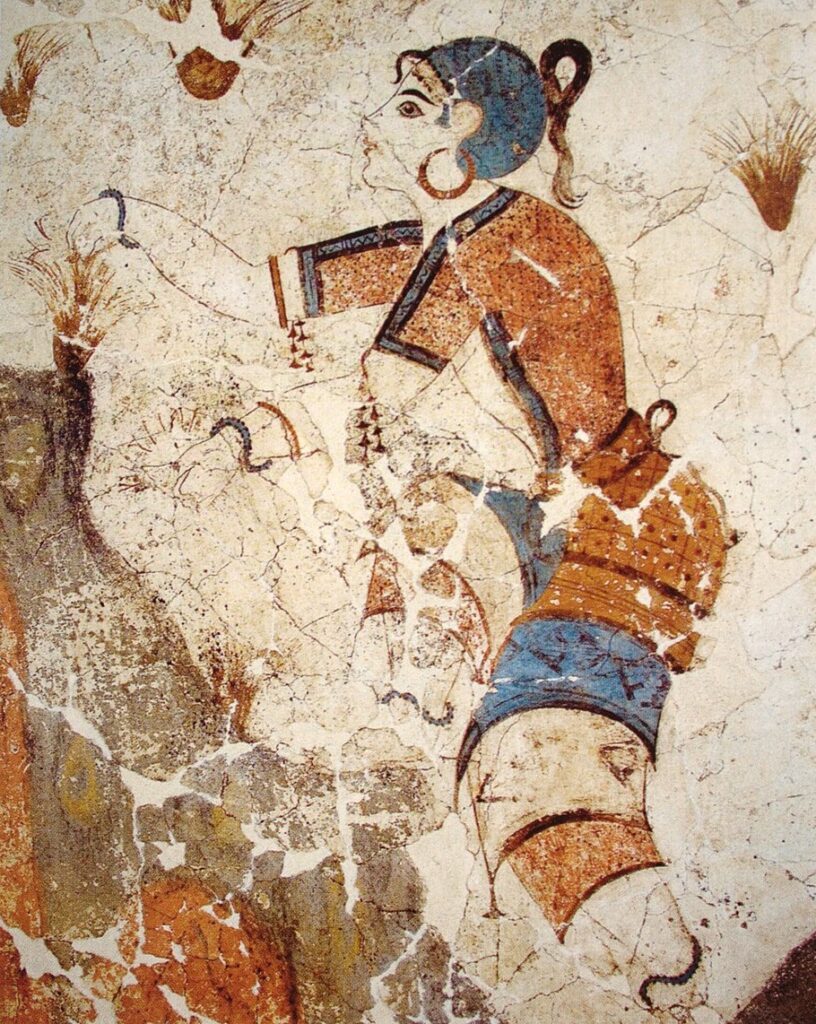
As for its actual origin, it has long been sought in Crete, where its use is attested from a very early date. At Knossos, Linear B tablets from the fifteenth–fourteenth centuries BCE record saffron as a weighed commodity, on a par with precious metals. And at Akrotiri, on the island of Thera (Santorini), frescoes from the seventeenth–sixteenth centuries BCE show women gathering crocus.
But modern genetics has reshuffled the deck. Cultivated saffron, Crocus sativus, is a sterile autotriploid: unable to produce seed, it propagates only through its corms. Two studies published in 2019, one phylogenetic and the other cytogenetic, identified its wild ancestor as Crocus cartwrightianus, an Aegean species. The populations genetically closest to cultivated saffron are found in Attica, around Athens.
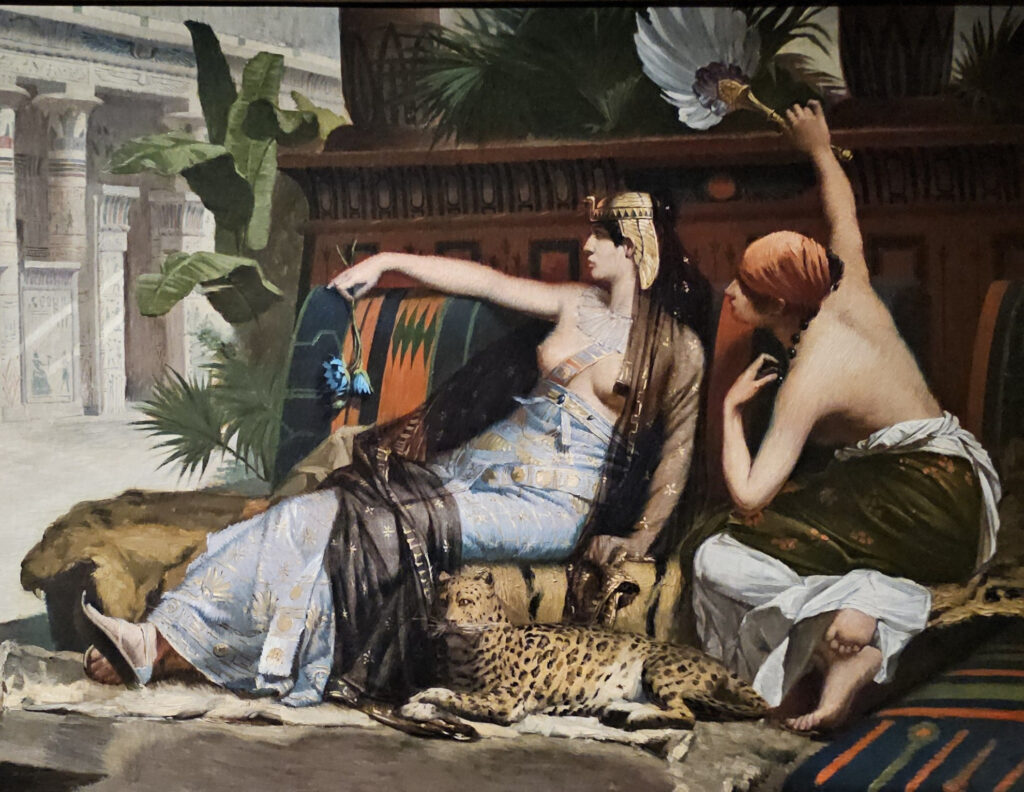
Cleopatra, Alexander and saffron: myths of modern make
Saffron has also inspired a modern mythology, one readily passed off as ancient.
It is often claimed, for instance, that Cleopatra poured saffron into her baths, sometimes with the startlingly precise measure of “a quarter cup.” The trouble is that no known ancient text records any such episode. The legend recalls the equally persistent one about her baths in donkey’s milk, likewise without any ancient source, and probably born of a confusion with Poppaea, Nero’s wife, whose use of donkey’s milk for her skin Pliny does in fact record.
Alexander the Great fares no better. Two stories circulate widely: in one, he treats his wounds with saffron; in the other, in Kashmir, his army wakes one morning to find a field of crocus that has miraculously sprung up overnight, a portent that drives him to retreat. Here too, no known ancient source confirms either episode.
Modern studies consulted
- Jacques André, L’Alimentation et la cuisine à Rome, Paris, Les Belles Lettres, 1981 (1st ed. 1961).
- Jo Day, “Counting Threads. Saffron in Aegean Bronze Age Writing and Society,” Oxford Journal of Archaeology 30/4, 2011, p. 369-391.
- Zahra Nemati, Dörte Harpke, Almila Gemicioglu, Helmut Kerndorff, Frank R. Blattner, “Saffron (Crocus sativus) is an autotriploid that evolved in Attica (Greece) from wild Crocus cartwrightianus,” Molecular Phylogenetics and Evolution 136, 2019, p. 14-20.
- Thomas Schmidt, Tony Heitkam, Susan Liedtke, Veit Schubert, Gerhard Menzel, “Adding color to a century-old enigma: multi-color chromosome identification unravels the autotriploid nature of saffron (Crocus sativus) as a hybrid of wild Crocus cartwrightianus cytotypes,” New Phytologist 222/4, 2019, p. 1965-1980.
- Seyyedeh-Sanam Kazemi-Shahandashti, Ludwig Mann, Abdullah El-Nagish, Dörte Harpke, Zahra Nemati, Björn Usadel, Tony Heitkam, “Ancient Artworks and Crocus Genetics Both Support Saffron’s Origin in Early Greece,” Frontiers in Plant Science 13, 2022, art. 834416.
- Kathleen J. Birney, “Rethinking Pliny’s ‘Sicilian Crocus’: Ecophysiology, Environment, and Classical Texts,” Economic Botany 78, 2024, p. 274-291.
- Daniel Fuks et al., “Orphan crops of archaeology-based crop history research,” Plants, People, Planet 7/3, 2025, p. 562-589.
[1] Pliny the Elder, Natural History XXI, 32: adulteratur nihil aeque – “Nothing is falsified so much.”
[2] Dioscorides, De materia medica I, 26, 1-3: δολοῦται δὲ μείξει κροκομάγματος κεκομμένου καὶ λιθαργύρου ἢ μολυβδαίνης διὰ τὸ βάρος ἑψήματί τε ἀλείφεται. δηλοῖ δὲ ταῦτα τό τε ἐντρέχειν κονιορτῶδες καὶ τὸ τὴν ὀσμὴν ἑψηματώδη τυγχάνειν – “It is falsified by mixing in crushed crocomagma and litharge or molybdaena for the weight, and coating it with boiled must; this is revealed by its crumbling into dust and by its smell turning to that of boiled must.”
[3] Edictum Diocletiani de pretiis rerum venalium, De pigmentis: croci Arabici pondo unum – 2,000 denarii; croci Cilicensis pondo unum – 1,000 denarii; croci Afri pondo unum – 600 denarii. For comparison, the same edict sets the maximum price of a vacca primae formae – “top‑quality cow” – at 2,000 denarii. As the surviving copies are fragmentary, the text is established by comparing several epigraphic witnesses. In Lauffer’s numbering, the three saffrons correspond to 36, 60‑62; the new edition of the Aphrodisias inscription places the De pigmentis section at chapter 68.
[4] Pliny the Elder, Natural History XXI, 31 and 33: crocum silvestre optimum […] sativum latius maiusque et nitidius, sed multo lenius […] prima nobilitas Cilicio et ibi in Coryco monte, dein Lycio e monte Olympio, mox Centuripino Siciliae […] optimum ubicumque quod pinguissimum et brevis capilli […] sed vino mire congruit, praecipue dulci, tritum ad theatra replenda – “Wild crocus is best […] The cultivated kind is broader, larger and glossier, but far weaker […] The foremost reputation belongs to that of Cilicia, and there to that of Mount Corycus; next comes that of Lycia, of Mount Olympus; then that of Centuripe in Sicily […] The best, whatever its origin, is that with the thickest and shortest filaments […] But it blends wonderfully with wine, especially sweet wine; crushed, it is used to fill theatres.”
[5] Dioscorides, De materia medica I, 26, 1: δευτερεύει δὲ ὁ ἐκ τῆς πρὸς Λυκίαν Κωρύκου καὶ ὁ ἀπὸ τοῦ Λυκιανοῦ Ὀλύμπου, εἶτα ὁ ἐξ Αἰγῶν τῆς Αἰτωλίας. ὁ δὲ Κυρηναικὸς καὶ ὁ ἐκ Κεντορίπων κατὰ τὴν Σικελίαν ἀσθενεῖς κατὰ δύναμιν – “Next come that of Corycus near Lycia and that of Lycian Olympus, then that of Aigai in Aetolia. That of Cyrenaica and that of Centuripe in Sicily are weak in potency.”
[6] Strabo, Geography XIV, 5, 5: Κώρυκος […] ὑπὲρ ἧς εἴκοσι σταδίους τὸ Κωρύκιον ἄντρον, ἐν ᾧ ἡ ἀρίστη κρόκος φύεται – “Corycus […] above which, twenty stadia off, lies the Corycian cave, where the finest saffron grows.”
[7] Dioscorides, De materia medica I, 26, 1-3: κρόκος ἐστὶ κράτιστος ἐν ἰατρικῇ χρήσει ὁ Κωρύκιος, πρόσφατός τε καὶ εὔχρους […] ἐπιμήκης, ὁλομελής, ἄθραυστος, ἀλιπής, πλήρης, βάπτων ἐν διέσει τὰς χεῖρας, οὐκ εὐρωτιῶν ἢ ἰκμάζων – “For medical use, the best saffron is that of Corycus: it should be fresh, of good colour […] elongated, whole, unbroken, not greasy, well‑bodied, colouring the hands when moistened, not mouldy or damp.”
[8] Pliny the Elder, Natural History XXI, 32: probatio sinceri, si inposita manu crepitet veluti fragile; umidum enim, quod evenit adulteratione, sentit. altera probatio, si manu relata ad ora leniter faciem oculosque mordeat – “Proof of genuineness is that, pressed in the hand, it crackles like something brittle – for moisture, the mark of adulteration, is at once apparent. A further proof: brought by hand up to the face, it stings the face and eyes slightly.”
[9] Horace, Satires II, 4, 63-69: est operae pretium duplicis pernoscere iuris / naturam. simplex e dulci constat olivo, / quod pingui miscere mero muriaque decebit / non alia quam qua Byzantia putuit orca. / hoc ubi confusum sectis inferbuit herbis / Corycioque croco sparsum stetit, insuper addes / pressa Venafranae quod baca remisit olivae – “It is worth knowing precisely the nature of the two kinds of sauce. The simple one is made of mild oil, which should be mixed with a robust wine and with a brine no different from that which reeks from a jar of Byzantium. Once this mixture has boiled with chopped herbs and settled after being sprinkled with saffron of Corycus, you will add on top the oil the Venafran olive yielded under the press.”
[10] Apicius, De re coquinaria I, 1 (Conditum paradoxum): tum mittis piperis uncias IV, iam triti masticis scripulos III, folii et croci dragmas singulas […] – “Then add four ounces of pepper, three scruples of already‑crushed mastic, a drachm of nard leaf and a drachm of saffron […].”
[11] Apicius, De re coquinaria I, 2 (Absinthium Romanum): […] costi scripulos senos, croci scripulos III, vini vetusti sextarios XVIII – “[…] six scruples of costus, three scruples of saffron and eighteen sextarii of aged wine.”
[12] Apicius, De re coquinaria I, 23, 1 (Sales conditos ad multa): sales communes frictos lib. I, sales ammonicos frictos lib. II […] croci unc. I […] – “One pound of roasted common salt, two pounds of roasted ammoniac salt […] one ounce of saffron […].”
[13] Vinidarius, Brevis pimentorum quae in domo esse debeant ut condimentis nihil desit: crocum, piper, zingiber, lasar, folium, baca myrtae, costum, cariofilum, spica Indica, addena, cardamomum, spica nardi – “Saffron, pepper, ginger, laser, nard leaf, myrtle berry, costus, cariofilum, Indian spike, addena, cardamom, spikenard.”
[14] Vinidarius, Brevis ciborum VII (Pisces scorpiones rapulatos): teres cuminum, lauri bacam dimidiam, addes propter colorem crocum. amulabis de oryza propter spissitudinem – “Grind cumin and half a bay berry; add saffron for the colour; thicken with rice.”
[15] Theophrastus, De odoribus 27: καὶ πρὸς τούτοις τὸ κρόκινον· βέλτιστος δ’ ἐν Αἰγίνῃ καὶ Κιλικίᾳ – “And besides these, saffron perfume; the best is found at Aegina and in Cilicia.”
[16] Pliny the Elder, Natural History XIII, 5: crocinum [in] Solis Ciliciae diu maxime laudatum est, mox Rhodi – “Saffron perfume from Soli in Cilicia was for a long time the most praised, later that of Rhodes.”
[17] Dioscorides, De materia medica I, 54: […] βάλε κρόκου δραχμὰς πεντήκοντα καὶ ἀνακίνει πλεονάκις τῆς ἡμέρας […] – “Add fifty drachms of saffron and stir several times a day […].” The mixture is stirred for several days before the oil is filtered.
[18] Dioscorides, De materia medica I, 27: τὸ δὲ κροκόμαγμα γίνεται ἐκ τοῦ κροκίνου μύρου τῶν ἀρωμάτων ἐκπιεσθέντων καὶ ἀναπλασθέντων – “Crocomagma comes from saffron perfume, after the aromatic substances have been pressed and then shaped.”
[19] Pliny the Elder, Natural History XXI, 138: qui crocum prius biberint, crapulam non sentient, ebrietati resistent […] somnum facit, caput leniter movet, venerem stimulat – “Those who have first drunk saffron will not feel the effects of overindulgence and will resist drunkenness […] It induces sleep, mildly affects the head, and stimulates desire.”
[20] Dioscorides, De materia medica I, 26, 3: παρίστησι δὲ καὶ πρὸς ἀφροδίσια […] φασὶ δὲ καὶ ἀναιρετικὸν αὐτὸν εἶναι μεθ’ ὕδατος πινόμενον πλῆθος δραχμῶν τριῶν – “It also aids lovemaking […] some say it is even fatal when drunk with water at a dose of three drachms.”
[21] Celsus, De medicina V, 28, 16c: crocum quoque, Lycium, aerugo, murra, cinis aequis portionibus recte miscentur – “Saffron too, lycium, verdigris, myrrh and ash are usefully mixed in equal parts”; V, 21, 2: ad vulvam molliendam ovi vitellus, et foenum graecum, et rosa, et crocum temperantur – “To soften the womb, egg yolk, fenugreek, rose and saffron are blended.”
[22] Columella, De re rustica IX, 4, 4: Corycius item Siculusque bulbus croci deponitur, qui coloret inodoretque mella – “The bulb of Corycian and Sicilian crocus is also planted, so that it may colour and scent the honey.”
[23] Lucretius, De rerum natura II, 416: cum scaena croco Cilici perfusa recens est – “When the stage has just been drenched with Cilician saffron.”
[24] Ovid, Art of Love I, 103: nec fuerant liquido pulpita rubra croco – “And the stage was not yet reddened with liquid saffron.”
[25] Martial, Epigrams V, 25: rubro pulpita nimbo / spargere et effuso permaduisse croco – “To spray the stage with a red cloud and drench it with scattered saffron.”
[26] Suetonius, Life of Nero 25, 2: incedenti passim victimae caesae sparso per vias identidem croco ingestaeque aves ac lemnisci et bellaria – “As he passed, victims were slaughtered everywhere, saffron was repeatedly scattered along the streets, and birds, ribbons and sweets were thrown at him.”
[27] Homer, Iliad XIV, 347-349: τοῖσι δ’ ὑπὸ χθὼν δῖα φύεν νεοθηλέα ποίην, / λωτόν θ’ ἑρσήεντα ἰδὲ κρόκον ἠδ’ ὑάκινθον / πυκνὸν καὶ μαλακόν – “Beneath them the divine earth made fresh grass spring up, dewy lotus, crocus and hyacinth, thick and soft.”
[28] Ovid, Metamorphoses IV, 283-284: et Crocon in parvos versum cum Smilace flores / praetereo – “And Crocus, changed with Smilax into small flowers, I pass over in silence.”
[29] Pliny the Elder, Natural History XVI, 154: infausta omnibus sacris et coronis, quoniam sit lugubris virgine eius nominis propter amorem iuvenis Croci mutata in hunc fruticem – “[Smilax is] inauspicious for all rites and garlands, since it mourns the girl of that name who, for love of the youth Crocus, was transformed into this shrub.”
[30] Nonnus of Panopolis, Dionysiaca XII, 85-86: Ἐυστεφάνοιο δὲ κούρης / Μίλακος ἱμείρων Κρόκος ἔσσεται ἄνθος Ἐρώτων – “And Crocus, longing for Milax, the fair‑garlanded girl, shall become a flower of the Loves.”
[31] Galen, De compositione medicamentorum secundum locos IX, Kühn XIII, p. 269: ἐπειδὴ μειράκιον καλούμενον Κρόκος, ἅμα τῷ Ἑρμῇ δισκεύων […] ἐμπεσόντος αὐτῷ δίσκου τῇ κεφαλῇ, συνέβη μὲν ἀποθανεῖν αὐτίκα, τοῦ δ’ αἵματος εἰς τὴν γῆν […] ἐξ αὐτοῦ φῦναι τὸν κρόκον – “A youth named Crocus was playing discus with Hermes; struck on the head by the discus, he died at once; his blood having flowed onto the ground […] the crocus sprang from it.”
[32] Dioscorides, De materia medica I, 26, manuscript tradition: κρόκος· οἱ δὲ κάστωρ, οἱ δὲ κυνόμορφος, προφῆται αἷμα Ἡρακλέους – “Crocus; others [call it] kastôr, others kynomorphos; the prophets, blood of Heracles.”
Other articles in English from the Nunc est bibendum blog