Translated from French (please notify us of errors)
Long before it sweetened desserts, honey softened wines, enhanced meats, healed wounds and fed myths. For the Romans, bees were not merely producers of sweetness: they formed an exemplary society, a precious economic resource and, at times, a formidable weapon.
The Romans never ran out of sweet words for bees, apes in Latin. Pliny the Elder, in particular, marvelled at the feats of these remarkable creatures:
“They gather honey, that very sweet, very light and very wholesome juice; they make combs and wax, which have a thousand uses in life; they endure labour, carry out works, have a political society, private councils, common leaders and, most astonishingly, customs different from all others.”[1]
To Pliny’s ears, moreover, the sound made by bees was gentle: they “murmur”[2].
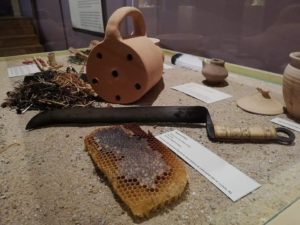
Beekeeping was not born on the banks of the Tiber. The earliest evidence for the keeping of bees dates back to the Egyptian Old Kingdom, more than 4500 years ago. The bas-reliefs of the temple of Abu Ghurab depict scenes of beekeeping, from the harvest to the storage of honey. This know-how spread throughout the ancient Mediterranean civilizations.
Sweet and sour everywhere
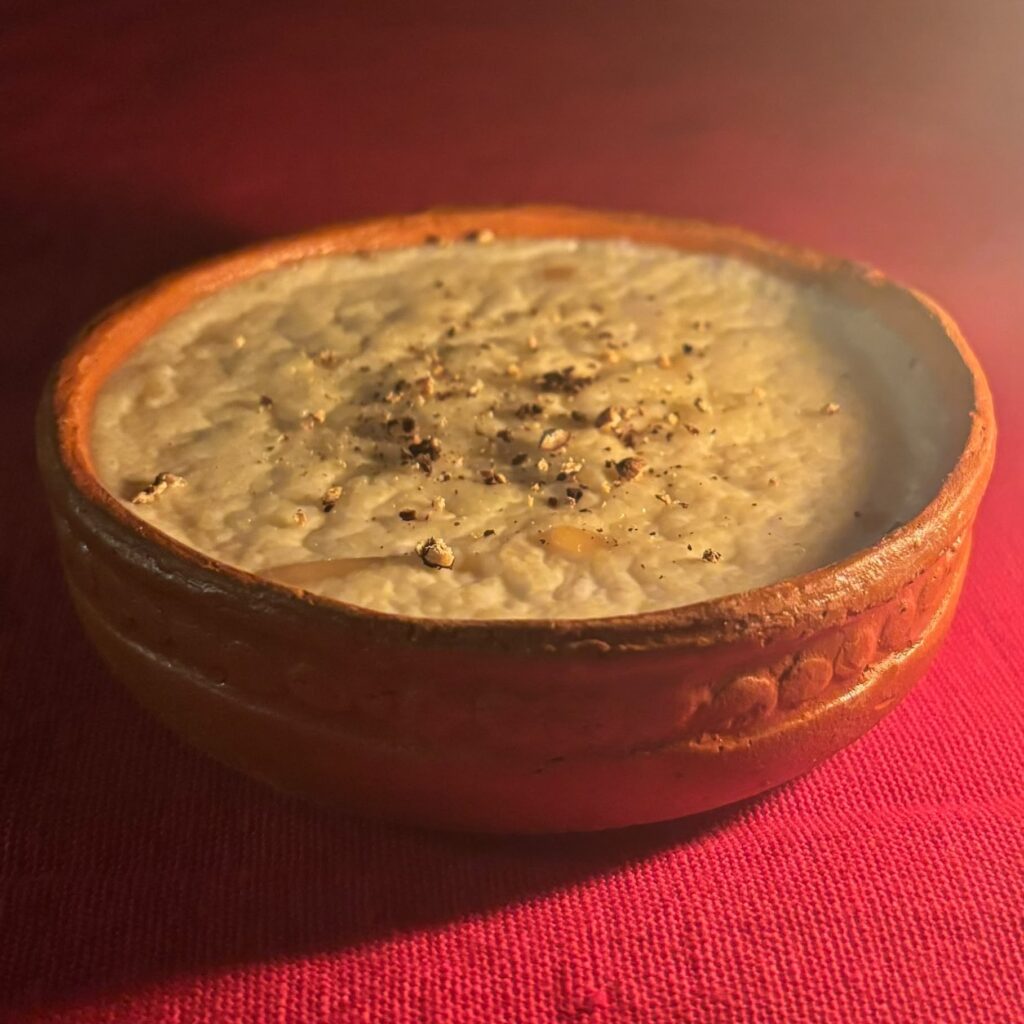
The main use of honey was, of course, culinary, as a sweetener, while refined sugar, as we understand it today, was not in common use in the Roman world. It was an essential ingredient in ancient dishes, even with meat, giving them the characteristic sweet-and-sour flavour of Roman cuisine. Honey was added to wine to prepare mulsum[3], a much-prized aperitif. Honey was also used to preserve food, in preparations that were the ancestors of candied fruit and jams.
There were already different qualities and kinds of honey, depending on the region, the season and the flowers visited by the bees, with a preference for honey from thyme, savory, wild thyme or marjoram. Since hives were usually smoked in order to remove the honey safely, “smokeless” honey, mel acapnon, was more valuable. Even more prized was virgin honey, which flowed by itself from the combs. It deserved the name mel optimum.[4]
But honey also belonged to the ancient pharmacopoeia. Dioscorides recommended cooking it with powdered rock salt to treat wounds, earaches and other ailments. Galen advised it for fighting tissue inflammation.[5]
Beware the honey that drives you mad!
From medicine to poison, there is only a short step. At the beginning of our era, the geographer Strabo related that three maniples of Pompey’s army learned this to their cost during the war against the Heptacometae in Asia Minor[6]. The local populations knew the hallucinogenic properties of a honey produced by bees foraging on rhododendrons containing grayanotoxins. They therefore placed vessels containing this “mad honey” along the route of their enemies. After consuming this poisoned gift, the soldiers were easily defeated by their opponents. Bees were thus at the origin of one of the first known cases of biological warfare…
In addition to honey, hives also produced wax, whose uses were countless: making writing tablets in wooden frames, producing sculptures using the so-called “lost-wax” technique, or practising magic, with figurines shaped in the likeness of a person targeted by a ritual.
Queens mistaken for kings
Although their knowledge of bees was remarkable, the Romans were still wrong about a number of things, and not only about details.
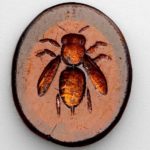
They thought, for example, that queens were kings. Pliny also mentions certain authors who claimed that, “when the species has been completely destroyed, it can be renewed in the belly of a freshly killed ox covered with manure”[7]. This belief was clearly influenced by the figure of Aristaeus, a hero of Greek mythology, son of Apollo and the nymph Cyrene. According to the myth, then, Aristaeus invented many agricultural techniques: he was said to have been the first to curdle milk, cultivate olive trees and keep bees. But the hero also liked to forage. He fell in love with Eurydice, Orpheus’ betrothed. As she fled, Eurydice was fatally bitten by a snake. To avenge her, her fellow nymphs killed Aristaeus’ bees. In despair, he sacrificed four bulls and four heifers.
Let the poet Virgil tell the ending:
“Then, a sudden prodigy, wondrous to tell, they saw, among the liquefied entrails of the oxen, bees buzzing and filling their flanks, bursting from the broken ribs, spreading out in immense clouds, then gathering at the top of a tree and letting their cluster hang from its flexible branches.”[8]
An art and an industry
Beekeeping, however, was not merely a matter of myth and poetry. The Romans turned it into a true industry in order to meet a considerable demand for honey and wax. To do so, Rome imported from Sardinia, Corsica, Greece or Spain.
Many works describe in detail the techniques of raising and caring for bees. The hives of wealthy landowners were entrusted to a specialized slave, the apiarius. Roman law also precisely defined the rights of beekeepers. For example, they remained the owners of a swarm that had left their hive as long as they could see it and follow it; otherwise, it became the property of whoever found it. One way, like any other, of spreading a little sweetness among the population.
[1] Pliny the Elder, Natural History, Book XI, 4, 1: mella contrahunt sucumque dulcissimum atque subtilissimum ac saluberrimum, favos confingunt et ceras mille ad usus vitae, laborem tolerant, opera conficiunt, rem publicam habent, consilia privatim quoque, at duces gregatim et, quod maxime mirum sit, mores habent praeter cetera.
[2] Pliny uses the noun murmur, uris, n and the verb murmurare to describe the buzzing of bees, whereas bombus, i, m and bombilare/bombinare are more specific.
[3] See: Mulsum, wine of celebration, glory and healing
[4] Jacques André, L’alimentation et la cuisine à Rome, Les Belles Lettres, Paris, 2018, pp. 186-190.
[5] Claude Viel, Jean-Christophe Doré, Histoire et emplois du miel, de l’hydromel et des produits de la ruche, in Revue d’histoire de la pharmacie, 91st year, no. 337, 2003, pp. 7-20.
[6] Strabo, Geography, XII, 3, 18. But “mad honey” was already known to Xenophon in the 4th century BC. He mentions it in the Anabasis, Book IV, chapter VIII, 19-21. Pliny had also heard of this toxic honey and mentions it in his Natural History, Book XXII, chapter 13, 45.
[7] Pliny the Elder, Natural History, Book XI, 23, 1: in totum vero amissas reparari ventribus bubulis recentibus cum fimo obrutis.
[8] Virgil, Georgics, Book IV, 554-558: Hic vero subitum ac dictu mirabile monstrum / adspiciunt, liquefacta boum per viscera toto / stridere apes utero et ruptis effervere costis, / immensasque trahi nubes, iamque arbore summa / confluere et lentis uvam demittere ramis.
First published August 2023. Reproduction prohibited.
Other articles in English from the Nunc est bibendum blog