Translated from french (please notify us of errors)
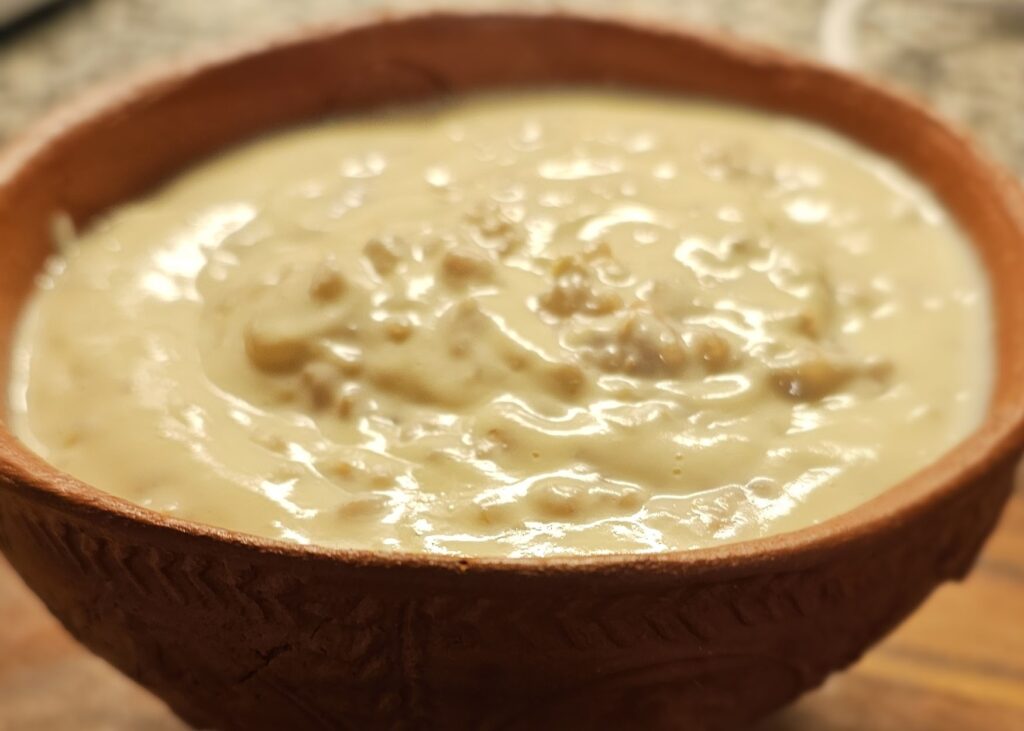
Varro and Pliny agree: before bread, there was puls. This cereal porridge, associated with the far of the ancient Latium, went on to enjoy a double career: a gastronomic preparation in Apicius, a ritual offering at the Kalends of June. When Cicero mocks the sacred chickens hurling themselves at their lump of puls, he fixes the fate of a food that left the table without ever leaving the altar.
Varro is brief: in matters of diet, “porridge is the most ancient”[1]. He adds an etymology: puls supposedly owes its name to the sound it makes falling into boiling water, according to Apollodorus; and moves on. Pliny elaborates further: “the Romans lived for a long time on porridge, not bread”[2]. The formula does not describe a mythical golden age, but a memory of origins that Pliny links to far, an ancient husked grain, the first foodstuff of the old Latium. Between the two authors, a century and a half, and the same certainty: before bread, there was puls. It was moreover considered highly nourishing; Pliny notes in passing: “the body grows on porridge”[3].
What is less often remarked is that puls is not an ingredient but a technique. Pliny notes that in Campania a white variety is prepared from millet[4]. Varro, in the same passage of the De lingua Latina, carefully distinguishes puls from pulmentum: the latter originally denotes what is eaten with the porridge, not the porridge itself[5]. In other words, puls is a category of cereals or pulses boiled until thickened, and pulmentum its accompaniment. In Plautus, puls even becomes a comic marker: Romans could be mocked as pultiphagus, “porridge-eaters”[6]. The insult, if such it is, says something about a food identity constructed from outside.
Porridge moving up in the world
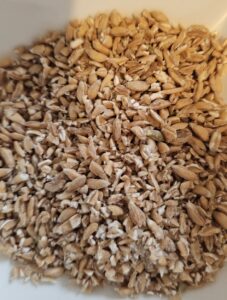
Cato preserves at least one recipe explicitly named puls: the pultem Punicam. He does not specify what makes it “Punic”, but the name places it within a set of practical borrowings from the Carthaginian world (the enemy par excellence), well represented in Roman agriculture and rural life. Here is the recipe:
“Put a pound of alica (coarse semolina) in water and ensure it soaks thoroughly. Then pour it into a clean vessel; add three pounds of fresh cheese, half a pound of honey and one egg; mix everything well together. Then pour this preparation into a new pot”[7].
This is far from a survival porridge. The cheese, honey and egg make it an already elaborate preparation, closer to a dessert than a ration. The neighbouring recipe, granea triticea, though it does not bear the name puls, belongs to the same technical family: hulled wheat cooked in water then extended with milk until it forms a thick cream[8]. Pliny, for his part, notes that porridge serves as a reference for the texture of leaven: cooked “in the manner of puls“[9]. Puls as a standard of consistency, semi-solid, hydrated, thick.
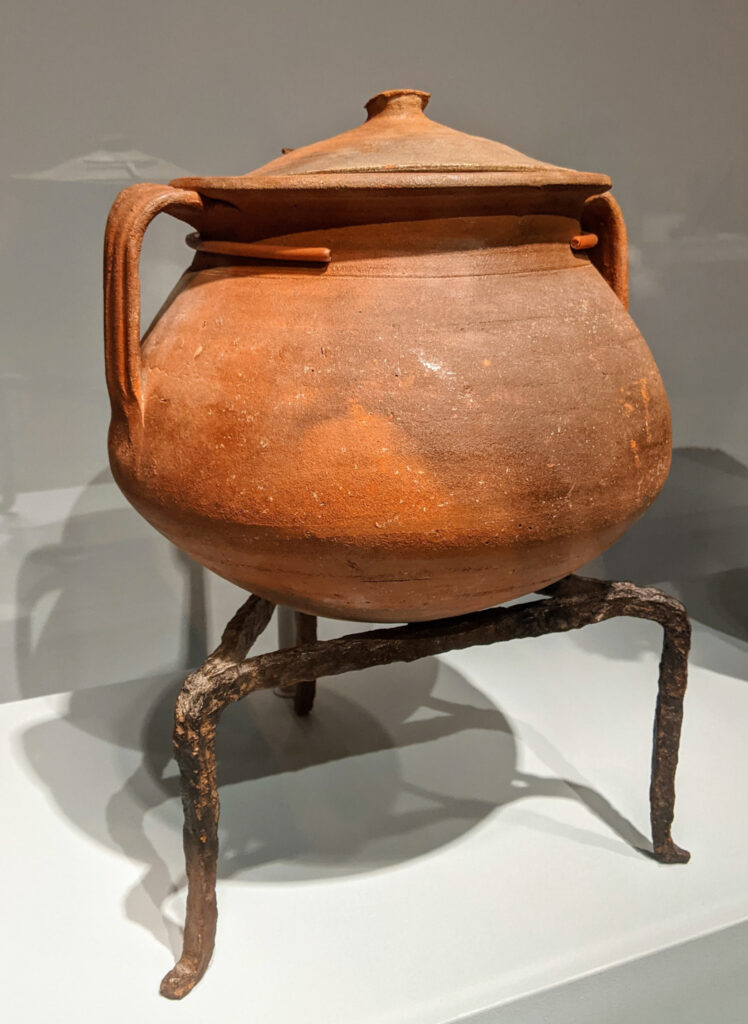
Apicius goes further. At the opening of Book V of the De re coquinaria, in the section De pultibus, the pultes bear little resemblance to what Pliny had described. The pultes Iulianae combine alica with cooked brain, sausage meat, pepper, lovage, fennel, garum and wine. The pultes tractogalatae blend dried pasta discs, milk and honey[10]. The cereal base persists, but it has become just that — a base. Puls has changed social register without changing its name. The decline of porridge is perceptible even in military camps. During the war against Jugurtha, Sallust notes that soldiers sold the grain distributed by the State to prepare their puls and bought their bread ready-made[11].
What the gods eat
While puls was growing more sophisticated on the tables of the wealthy and retreating as a staple food of the people, religion was fixing it in its most archaic forms. Pliny notes that according to an ancient rite, pulsa fabata—bean porridge—figures in sacrifices to the gods[12]. It belongs to the sacra prisca, the ancient rites. The bean, which the Pythagoreans proscribed because it was said to harbour the souls of the dead, is for that very reason employed in funerary rites.
Ovid, in the Fasti, explains why at the Kalends of June one eats bacon and beans mixed with warm far: Carna is an ancient goddess, “she feeds on the foods to which she was accustomed. The earth then yielded only beans and hard far“[13]. Eating the two mixed together on that day was held to preserve the entrails. Macrobius confirms this in his own way: to Carna one sacrifices with a bean porridge and bacon — pulte fabacia or fabaria depending on the edition, et larido — because these foods strengthen the body[14]. The Kalends of June are indeed called Kalendae fabariae: in this month, ripe beans enter into divine rites.
Cicero closes the matter with his sharp pen. In the De divinatione, a text in which the author systematically dismantles the foundations of Roman divination, he turns his attention to the practice of the sacred chickens. The caged birds, exhausted by hunger, hurl themselves at a lump of puls — an offa pultis. The crumbs falling to the ground were considered a favourable sign called tripudium solistimum. Cicero sees in this nothing but an absurd mechanism: “if something falls from its beak, is that an auspice? Did Romulus take the auspices in this way?”[15]
Puls will thus have traversed the whole of Roman history without ever truly disappearing: the porridge of origins on the tables of archaic Latium, a sophisticated preparation in the kitchens of Apicius, an offering preserved intact on the altars of Carna. Until Cicero, in fine, makes of it the derisory instrument of a divination he judges absurd.
Modern studies consulted
- Jacques André, L’Alimentation et la cuisine à Rome, Les Belles Lettres, Paris, 1961.
- Lucienne Deschamps, ‘L’alimentation des anciens Romains selon Varron’, in Saveurs, senteurs: le goût de la Méditerranée, Presses universitaires de Perpignan, 1998, pp. 73–84.
- Marie-Pierre Zannier, ‘Du champ à la table: thèmes alimentaires chez les agronomes romains (IIe siècle av.–Ier siècle apr. J.-C.)’, in Des mets et des mots, Actes du 138e Congrès national des sociétés historiques et scientifiques, Rennes, 2013, Paris, CTHS, 2014, pp. 54–67.
[1] Varro, De lingua Latina V, 105: de victu antiquissima puls; “in matters of diet, the most ancient food is porridge”.
[2] Pliny, Natural History XVIII, 83: pulte autem, non pane, vixisse longo tempore Romanos manifestum; “it is clear that the Romans lived for a long time on porridge, not bread”.
[3] Pliny, Natural History XXII, 127: pulte corpus augetur; “the body grows on porridge”. The passage appears in a medical context devoted to the uses of flour.
[4] Pliny, Natural History XVIII, 100: Milio Campania praecipue gaudet pultemque candidam ex eo facit; “Campania is particularly fond of millet and from it prepares a white porridge”.
[5] Varro, De lingua Latina V, 108: quod edebant cum pulte, ab eo pulmentum, ut Plautus; hinc pulmentarium dictum; “what was eaten with the porridge received from this the name pulmentum, as in Plautus; hence pulmentarium“.
[6] Plautus, Mostellaria 828: pultiphagus; Poenulus 54: Pultiphagonides.
[7] Cato, De agricultura 85: Libram alicae in aquam indito, facito uti bene madeat. Id infundito in alveum purum, eo casei recentis P. III, mellis P. S, ovum unum, omnia una permisceto bene. Ita insipito in aulam novam.
[8] Cato, De agricultura 86: Selibram tritici puri in mortarium purum indat, lavet bene corticemque deterat bene eluatque bene. Postea in aulam indat et aquam puram cocatque. Ubi coctum erit, lacte addat paulatim usque adeo, donec cremor crassus erit factus; “put half a pound of pure wheat in a clean mortar, wash well and hull carefully. Then place in a pot and cook in pure water. Once cooked, add milk little by little until a thick cream has formed”.
[9] Pliny, Natural History XVIII, 104: ad pultis modum decocta et relicta, donec acescat; “cooked in the manner of puls and left until it turns sour”.
[10] Apicius, De re coquinaria V, 1, 1: alicam purgatam infundis, coques, facies ut ferveat. cum ferbuerit, oleum mittis. cum spissaverit, lias diligenter. adicies cerebella duo cocta et selibram pulpae quasi ad isicia liatae, cum cerebellis teres et in caccabum mittis. teres piper, ligusticum, feniculi semen, suffundis liquamen et vinum modice, mittis in caccabum supra cerebella et pulpam. ubi satis ferbuerit, cum iure misces. ex hoc paulatim alicam condies, et ad trullam permisces et lias, ut quasi sucus videatur; V, 1, 3: lactis sextarium et aquae modicum mittes in caccabo novo et lento igni ferveat. tres orbiculos tractae siccas et confringis et partibus in lac summittis. ne uratur, aquam miscendo agitabis. cum cocta fuerit, ut est, super ignem, mittis melle.
[11] Sallust, Jugurtha 44, 5: frumentum publicum datum vendere, panem in dies mercari; “to sell the grain distributed by the State and to buy bread each day”.
[12] Pliny, Natural History XVIII, 118: quin et prisco ritu pulsa fabata suae religionis diis in sacro est; “according to an ancient rite, bean porridge has its sacred place in the worship of the gods”.
[13] Ovid, Fasti VI, 169–170; 171; 179–180: Pinguia cur illis gustentur larda Kalendis / mixtaque cum calido sit faba farre rogas? / prisca dea est, aliturque cibis quibus ante solebat […] terra fabas tantum duraque farra dabat; “why at those Kalends are fatty pieces of bacon tasted, and why is the bean mixed with warm far? She is an ancient goddess, she feeds on the foods to which she was accustomed […] the earth yielded only beans and hard far“. The protective mixture refers to the beans and the far, not the bacon. On larda: neuter plural, “pieces of fatty bacon”. On far: an ancient husked grain related to emmer, often rendered as “spelt” in modern translations.
[14] Macrobius, Saturnalia I, 12, 33: Cui pulte fabacia et larido sacrificatur, quod his maxime rebus vires corporis roborentur. Nam et Kalendae Iuniae fabariae vulgo vocantur, quia hoc mense adultae fabae divinis rebus adhibentur; “to her one sacrifices with a bean porridge and bacon, because these foods above all strengthen the forces of the body. The Kalends of June are moreover commonly called fabariae, because in this month ripe beans are employed in divine rites”. Variant fabaria in certain editions.
[15] Cicero, De divinatione II, 35, 73: nunc vero inclusa in cavea et fame enecta si in offam pultis invadit, et si aliquid ex eius ore cecidit, hoc tu auspicium aut hoc modo Romulum auspicari solitum putas?; “now, shut in a cage and exhausted by hunger, if it hurls itself at a lump of porridge, and if something falls from its beak, do you call that an auspice? or do you believe that Romulus was accustomed to take the auspices in this way?”
Other articles in English from the Nunc est bibendum blog