Translated from french (please notify us of errors)
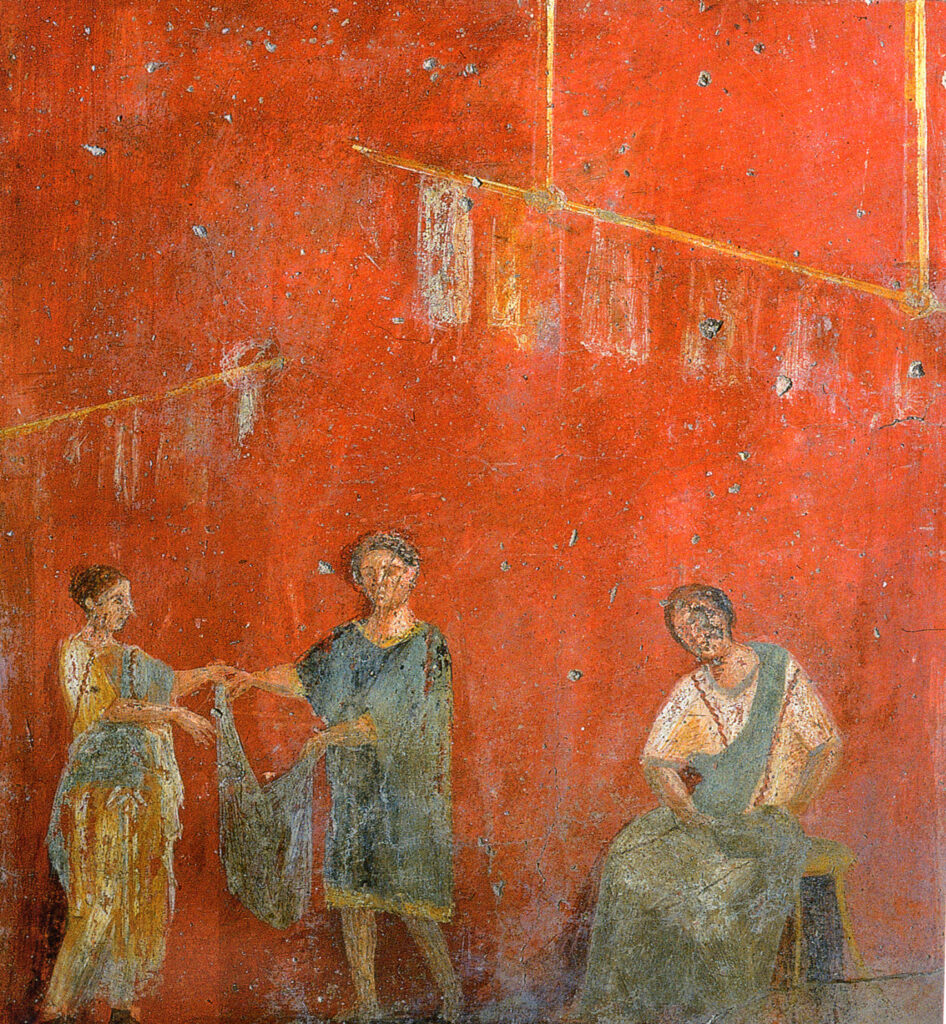
For centuries, the question of what a Roman garment was made of hardly needed asking: it was wool, produced locally, woven at home, worn without ceremony. Only with the gradual expansion of Mediterranean trade, and then of conquests in the East, did other materials make their mark — linen, cotton, and finally silk —, each bringing with it not only new sensations against the skin, but new debates about what a Roman worthy of the name was entitled to wear.
The first material is also the oldest. Wool — lana in Latin — dominated without challenge from the origins to the end of the Empire, and for good reason: sheep farming was everywhere in central Italy. But it would be naïve to suppose that ‘wool’ denoted a uniform material. A careful distinction was drawn between the fine-fleeced ewe, kept indoors and protected under a cloth garment — the ovis tecta, literally the ‘clothed’ sheep — and her ordinary sister that grazed outside with no regard for the quality of her fleece[1]. The most prized breeds came from Apulia, Calabria, Tarentum, and Canusium; Columella adds the wool of Miletus, which our ancestors, he says, counted among the finest, and Pliny notes that no white wool surpasses that of the Po plain[2].
The natural colours of wool already served as social markers even before dyeing. White or black wool was the most sought after. The brown wool of Canusium in Apulia is so distinctive that Columella presents it as having ‘its natural value’ alongside white and ordinary brown[3]. Pliny calls it fulva — tawny, somewhere between honey and ochre — Martial calls it rufa (reddish), two perspectives on the same characteristic warm shade[4]. As for the fineness of the weave, Martial again notes that the thick tunics of Padua in ‘triple twill’ are so robust that ‘they can only be cut with a saw’[5], the very opposite of the Eastern transparencies we shall encounter further on.
Wool, finally, takes dye well: one pound of dyestuff is needed to dye one pound of wool, and for vivid colours, several successive baths. It is expensive, therefore it is chic. Undyed garments, in natural shades — black, brown, grey, cream — were the lot of the poor and of those in mourning.
Linen takes the dye badly
Linen appeared very early after wool. In Italy it was cultivated notably in the region of Alia between the Po and the Ticino, and at Cumae in Campania; the Gauls also wove it into sails in great quantities [6]. In Rome, linen cloth served first for undergarments; women adopted it fairly early for their outdoor clothes, in place of wool.
The use of fine linen did not truly spread until the development of Mediterranean trade. It was in Cicero’s time that the fine-linen handkerchief, which spectators waved at the circus instead of applauding, became widespread — a small gesture that says a great deal about the diffusion of refinement in everyday life [7]. Pliny carefully distinguishes two fine imported cloths: carbasus, a linen of remarkable fineness first found in Spain near Tarragona [8], and byssus, the most precious cloth of all, which he locates around Elis in Achaia and describes as ‘the delight of women’ [9].
Unlike wool, linen took dye very poorly with the colorants available to the Romans. It was therefore generally left white or bleached. This has a practical consequence for the interpretation of ancient images: a white garment in a fresco may be either wool or linen, but a coloured garment is almost certainly wool[10]. Linen has, moreover, a considerable drawback: it creases very easily, and the sources remain silent on how the Romans dealt with this.
The great popularity of linen in classical Rome is also documented by Egyptian papyri: apprenticeship contracts with weavers, wills, and dowry inventories methodically include linen garments among bequeathed goods.
The East in the wardrobe
Cotton was known in Rome from the beginning of the 2nd century BC. It was probably the wars in Asia that enabled its importation[11]. It came from India. Herodotus was already aware of it, but believed it grew on trees; it was the Macedonian soldiers who, according to Strabo, first encountered it[12]. Despite its advantage over linen for dyeing, cotton remained little used for clothing in Rome; Pliny indicates that cotton garments were worn mainly by Egyptian priests[13]. Mixed with linen, however, it inspired ostentatious consumption: brightly coloured ships’ sails and theatre awnings, with which Julius Caesar is said to have draped the Forum during his games.
Silk is quite another matter. Tradition holds that it reached Rome through the campaigns against the Parthians, and it would unleash passions that neither censors nor emperors ever fully managed to quell. Its origins were threefold, though at different periods. The silk of Cos (a Greek island in the south-eastern Aegean) is the oldest: drawn from a local wild silkmoth, its production dates back to the 3rd century BC. A woman from the island, Pamphile, daughter of Platea, is said to have been the first to unravel these threads and weave them into cloth. Pliny credits her with ‘the glory of having devised the means of undressing women through their clothing’[14] — a formula that sums up rather well what the moralists held against these transparencies. Its vogue peaked and then declined rapidly under Augustus. Next came Assyrian silk, highly regarded for its fineness and transparency, and of a yellow hue; and Chinese silk, very white, imported along the Hellenistic Eastern route. The poets of that generation — Tibullus, Propertius, Horace, Ovid — multiplied allusions to Eastern fabrics: Ovid advises the seducer to praise his mistress’s Coan fabrics if she is wearing them, whilst Martial uses the term bombycina directly to designate these silken stuffs[15].
Chinese silk served rather as a raw material: it was mixed with linen and cotton to produce half-silk fabrics, light as gauze, dyed in many colours. In the 1st century AD, not only women but also ‘effeminate men’ wore robes of such fabric. The Senate decreed, under Tiberius, that the silk garment ‘should no longer defile men’[16] — a decree that Tiberius himself hastened to qualify by declaring that ‘this was not the moment for censure’. His successor Caligula appeared in public sericatus (clad in silk) among other sartorial extravagances that Suetonius enumerates with visible disapproval[17]. It is no surprise that the Tiberian senatus consultum had little lasting effect.
Pure silk cost, at the end of the 3rd century, its weight in gold. The emperor Aurelian possessed none. When his wife asked him for a single purple silk cloak, he replied: ‘let us not go weighing threads against gold’[18]. Rome would never produce silk herself: the secret of silkworm rearing remained jealously guarded by the Seres (the Chinese), and it was not until the emperor Justinian in the 6th century that the first silkworm farms appeared in Byzantium.
Felts, leathers, and furs
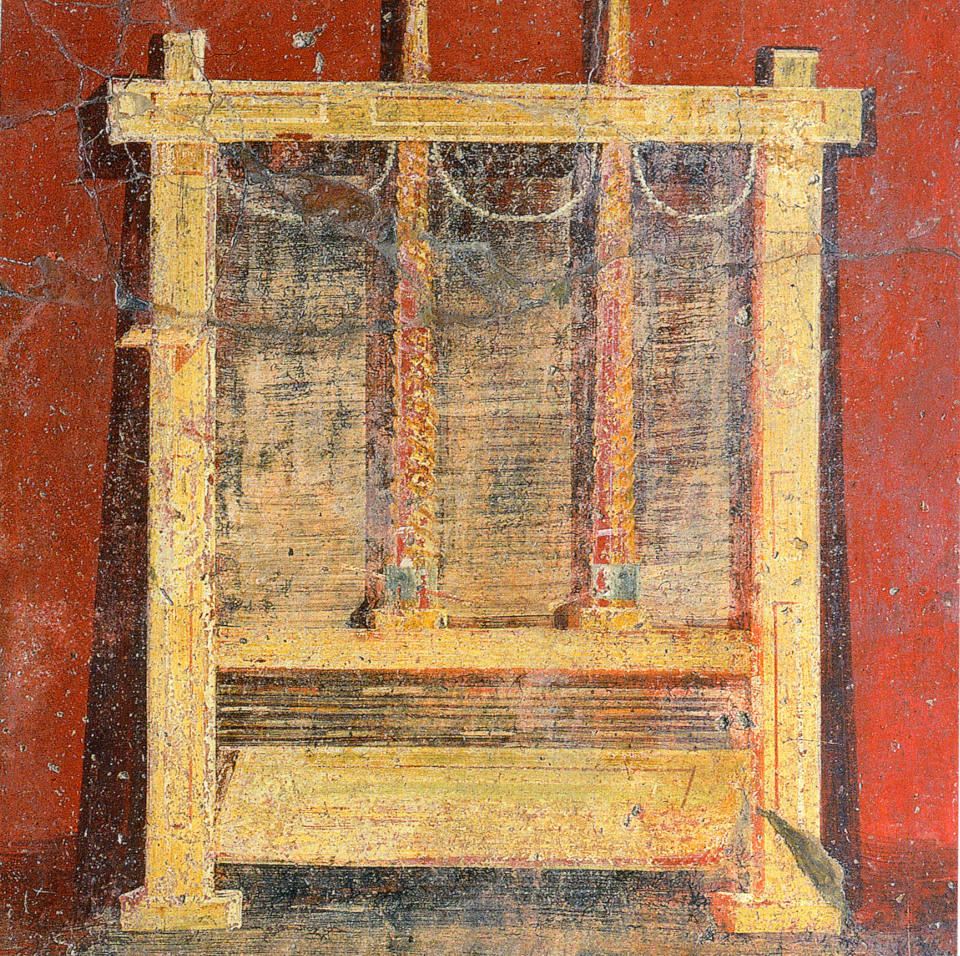
Wool could also be worked into felt, a technique considerably older than spinning and weaving. Warm and waterproof, it served first for hats and shoes. Pliny notes that gausapae (long-piled cloaks) appeared in his father’s time, and amphimallia (cloaks piled on both sides) in his own[19].
As for furs, the Republic almost entirely ignored them for clothing. Under the Empire, fine pelts gradually spread — hides of oxen, goats, sheep, deer, bears, wolves, and foxes, but also of leopards and lions, according to the schedule drawn up by Diocletian’s Edict at the end of the 3rd century[20]. Fur robes properly speaking did not reach Rome until the 5th century with the Germanic invasions — and were immediately banned in 416. The Italian climate was decidedly ill-suited to this kind of apparel.
Weaving the hierarchy
What strikes one in following this evolution over several centuries is that materials are never innocent. White wool or coloured wool, fine or coarse linen cloth, Assyrian silk or mixed half-silk — every choice speaks a social language that every Roman could read instantly. Columella complains that the women of his day ‘do not even deign to take charge of overseeing wool production’ and are satisfied only with ‘garments bought for large sums and at almost the cost of their entire fortune’[21]. On one side the matrons who symbolically spin their wool, a millennial domestic virtue; on the other, the merchants who bring back from the East fabrics no one has yet seen.
Novelty in textiles is always a little suspect. It is also what makes it irresistible. Plautus, in the 2nd century BC, puts into the mouth of the slave Epidicus a dizzying list of fashionable tunics: the light one, the close-fitting one, the little blue-grey cloth, the one ‘with a golden border’, the saffron-coloured, the reddish, the veil, the ‘royal’, the ‘foreign’, the sea-blue, the downy one, the walnut-brown, the wax-coloured[22] — before adding that ‘it is all these names that compel men to hold auctions’.
Modern studies consulted
- Judith Lynn Sebesta, ‘The Colors and Textiles of Roman Costume’, in J. L. Sebesta & L. Bonfante (eds.), The World of Roman Costume, Madison, University of Wisconsin Press, 2001.
- Jean-Noël Robert, Les Romains et la mode, Paris, Les Belles Lettres, 2011.
- Alexandra Croom, Roman Clothing and Fashion, Amberley, 2012.
[1] Pliny the Elder, Naturalis historia, VIII, 190: Ovium summa genera duo, tectum et colonicum, illud mollius – ‘There are two main categories of sheep: the covered sheep and the ordinary sheep, the former finer [in its fleece].’
[2] Columella, De re rustica, VII, 2, 3: Generis eximii Calabras Apulasque et Milesias nostri existimabant earumque optimas Tarentinas – ‘Our ancestors considered the finest breeds to be those of Calabria, Apulia, and Miletus, and among them the Tarentines as the best’; Pliny the Elder, Naturalis historia, VIII, 190: circa Tarentum Canusiumque summam nobilitatem habent … alba Circumpadanis nulla praefertur; Varro, De re rustica, II, 2, 18 (sheep breeds of Apulia). Cf. also Varro, II, 1, 4: ad corpus vestitum et pelles adtulerunt – ‘[the sheep] provided clothing and hides for the body’.
[3] Columella, De re rustica, VII, 2, 4: Color albus cum sit optimus, tum etiam est utilissimus … sunt etiam suapte natura pretio commendabiles pullus atque fuscus – ‘white is not only the best colour, but also the most useful … brown and tawny also have their natural value’. The characterisation of Canusium wool as the ‘poor man’s purple’ is transmitted by Sebesta, who refers to Columella and to Cicero, Pro Rabirio Postumo, 40. The latter passage, however, describes the Egyptian goods of Rabirius Postumus — chartis et linteis et vitro (papyrus, linen and glass), described as fallaces et fucosae — without mentioning Canusium wool. If Cicero did indeed make this remark, it is in another unidentified passage.
[4] Martial, Epigrams, XIV, 129: Canusinae rufae / Roma magis fuscis vestitur, Gallia rufis, / Et placet hic pueris militibusque colos – ‘The [wools] of Canusium are reddish; Rome dresses rather in dark brown, Gaul in red, and this colour pleases children and soldiers.’ Pliny the Elder, Naturalis historia, VIII, 191: Canusium fulvi – the same fabric seen as fulvus (tawny) in Pliny, rufus (reddish) in Martial, two terms for the same warm shade.
[5] Martial, Epigrams, XIV, 143 (Tunicae Patavinae): Vellera consumunt Patavinae multa trilices, / Et pingues tunicas serra secare potest – ‘The [cloths] of Padua in triple twill consume many fleeces, and a saw can cut through their thick tunics.’
[6] Pliny the Elder, Naturalis historia, XIX, 8-9: Galliae universae vela texunt – ‘all the Gauls weave sails’; for Italy: Aliana inter Padum Ticinumque amnes et Cumano in Campania (§ 10).
[7] Pliny the Elder, Naturalis historia, XIX, 9-13: ranking of European linens by quality (Saetabi first, then the region of Alia, Faventina, Retovina), and Paelignian linen for fullers.
[8] Pliny the Elder, Naturalis historia, XIX, 10: tenuitas mira ibi primum carbasis repertis – ‘it is there that carbasa of remarkable fineness were first invented’, referring to Tarragona in Spain. Carbasus denotes in Latin a variety of very fine linen (Gaffiot), a generic term attested in Virgil, Propertius, and Ovid for garments, sails, and awnings; Tarragona is said to have produced a particularly fine variety.
[9] Pliny the Elder, Naturalis historia, XIX, 20: proximus byssino, mulierum maxime deliciis circa Elim in Achaia genito – ‘next comes byssus, the especial delight of women, grown around Elis in Achaia’.
[10] Pliny the Elder, Naturalis historia, XIX, 13: nullum est candidius lanaeve similius – ‘nothing whiter or more similar to wool’ (referring to the linen of the Paeligni); and § 9: candore Alianis semper crudis Faventina praeferuntur – ‘for whiteness, the [linens] of Faventina are preferred to those of Alia, always unbleached’.
[11] Pliny the Elder, Naturalis historia, XIX, 14 (importation of cotton to Rome; cf. note 13 for the same passage on Egyptian uses).
[12] Herodotus, Histories, III, 106 (wool-bearing trees of India); Pliny the Elder, Naturalis historia, XIX, 14: gignit fruticem, quem aliqui gossypion vocant, plures xylon – ‘[Upper Egypt] produces a shrub which some call gossypion, most call xylon‘; Strabo, Geography, XV, 1 (the Macedonian soldiers and cotton in India).
[13] Pliny the Elder, Naturalis historia, XIX, 14 (the gossypion/cotton, uses in Egypt).
[14] Aristotle, Historia animalium, V, 19 (the silkmoth of Cos); Pliny the Elder, Naturalis historia, XI, 76-78: prima eas redordiri rursusque texere invenit in Coo mulier Pamphile, Plateae filia, non fraudanda gloria excogitatae rationis, ut denudet feminas vestis – ‘the first to unravel [these threads] and reweave them was, at Cos, a woman named Pamphile, daughter of Platea; she should not be denied the glory of having devised the means of undressing women through their clothing’. And at § 78: nec puduit has vestes usurpare etiam viros levitatem propter aestivam … Assyria tamen bombyce adhuc feminis cedimus – ‘men were not ashamed to wear these garments for their lightness in summer … for Assyrian silk, we still yield to women’. — The chapters of Florus devoted to the Parthian wars (II, XIX-XX, former numbering III, 11) contain no mention of silk; the reference sometimes cited at that point is inaccurate.
[15] Ovid, Art of Love, II, 297-299: Sive erit in Tyriis, Tyrios laudabis amictus: / Sive erit in Cois, Coa decere puta – ‘If she is in Tyrian purple, praise her Tyrian dress; if she is in [fabrics] of Cos, think that Coan [fabrics] become her’ — a seduction tip that mentions the Coa (fabrics of Cos) without explicitly using the term serica. Martial uses bombycina in XIV, 24: Splendida ne madidi violent bombycina crines – ‘Lest wet hair should spoil the lustrous silken stuffs’. See also Tibullus, II, 3, 53; II, 4, 29; Propertius, I, 2, 2; II, 1, 5.
[16] Tacitus, Annals, II, 33: decretumque ne vasa auro solida ministrandis cibis fierent, ne vestis serica viros foedaret – ‘it was decreed that no solid gold plate should be made for serving meals, and that the silk garment should no longer defile men’. The senatus consultum, proposed by Q. Haterius and Octavius Fronto, was immediately debated: Gallus Asinius replied that private wealth had grown with the Empire, that this was nothing new, and that excess is measured by each person’s fortune. Tiberius concluded that this was not the moment for censure.
[17] Suetonius, Life of Caligula, 52, 2: aliquando sericatus et cycladatus — ‘sometimes clad in silk and in a robe with circular flounces’. Suetonius specifies that Caligula never wore a garment conforming to the customs of his country, neither civil, nor even manly, nor even human (neque patrio neque civili, ac ne virili quidem ac denique humano).
[18] Historia Augusta, Aurelianus, 45, 4-5: vestem holosericam neque ipse in vestiario suo habuit neque alteri utendam dedit. et cum ab eo uxor sua peteret, ut unico pallio blatteo serico uteretur, ille respondit: “Absit ut auro fila pensentur.” libra enim auri tunc libra serici fuit – ‘he had no garment of pure silk in his own wardrobe and gave none to anyone else to wear. And when his wife asked him to wear a single purple silk cloak, he replied: “Let us not go weighing threads against gold.” For a pound of gold was then worth a pound of silk.’
[19] Pliny the Elder, Naturalis historia, VIII, 193: gausapae patris mei memoria coepere, amphimallia nostra sicut villosa etiam ventralia. nam tunica lati clavi in modum gausapae texi nunc primum incipit – ‘gausapae [long-piled cloaks] began in my father’s time; amphimallia [piled on both sides] in our own time, as did the tufted waistbands. And the broad-striped tunic is for the first time being woven in the gausapa style.’
[20] Diocletian’s Edict (AD 301), section on hides and leathers.
[21] Columella, De re rustica, XII, preface, 9: cum pleraeque sic luxu et inertia diffluant, ut ne lanificii quidem curam suscipere dignentur, sed domi confectae vestes fastidio sint, perversaque cupidine maxime placeant, quae grandi pecunia et paene totis censibus redimuntur – ‘most give themselves over to such luxury and idleness that they do not even deign to oversee wool production; garments made at home are an object of contempt, and their perverted desire leads them to prefer those bought for large sums and at almost the cost of their entire fortune’.
[22] Plautus, Epidicus, 222-235: Quid erat induta? an regillam induculam an mendiculam? / Inpluviatam, ut istaec faciunt vestimentis nomina (v. 222-224) — ‘What was she wearing? An “impluvium” — that is how they give names to their garments’; then (v. 229-235): tunicam rallam, tunicam spissam, linteolum caesicium, / indusiatam, patagiatam, caltulam aut crocotulam, / subparum aut subnimium, ricam, basilicum aut exoticum, / cumatile aut plumatile, carinum aut cerinum — gerrae maxumae. / cani quoque etiam ademptumst nomen. [PER.] Qui? [EP.] Vocant Laconicum. / haec vocabula auctiones subigunt ut faciant viros — ‘a light tunic, a close-fitting tunic, a little blue-grey cloth, one “with an undergarment”, one “with a golden border”, a saffron-coloured one or a reddish one, a very light one, a veil, a “royal” one or a “foreign” one, a sea-blue one or a downy one, a walnut-brown one or a wax-coloured one — utter nonsense. They have even stolen the dog’s name: they call it “Laconian”. It is all these names that compel men to hold auctions.’
Other articles in English from the Nunc est bibendum blog