Translated from French (please notify us of errors)
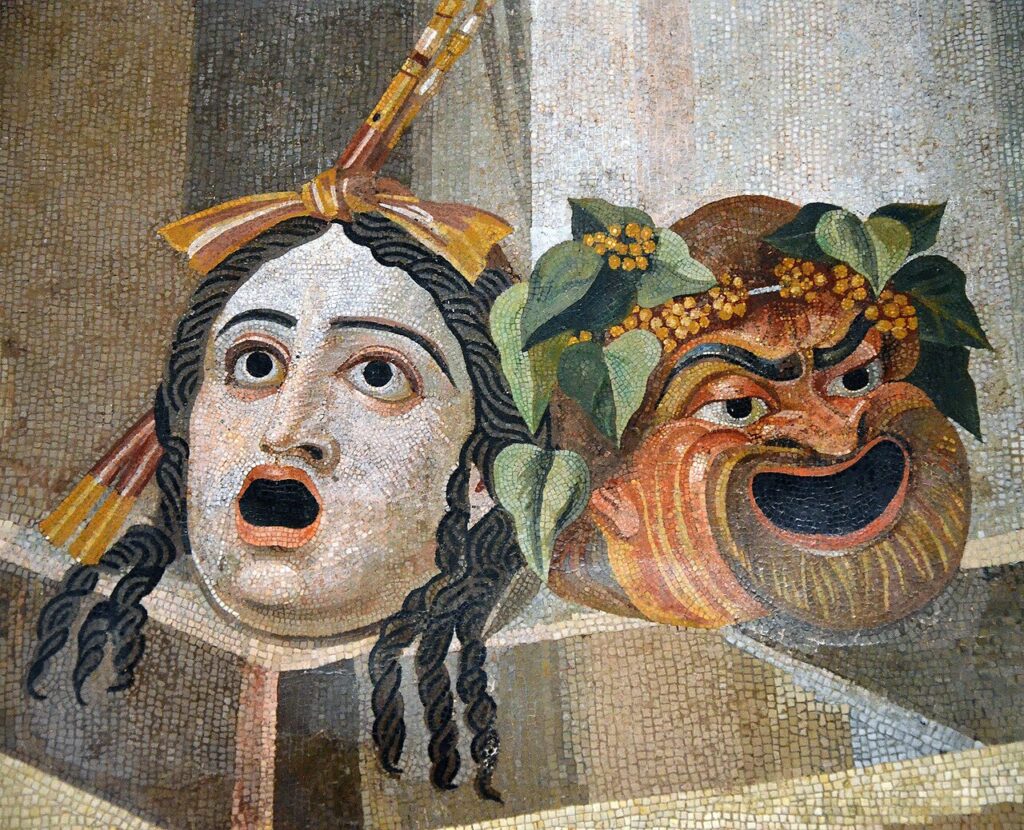
He was called parasitos by the Greeks, parasitus by the Romans, ate at others’ expense and boasted of it. A religious official in origin, he became the most clear-sighted comic character of antiquity: the one who understood, before anyone else, that the meal is a stage.
At the outset, the word is positive. In ancient Greece, Parasitos (Παράσιτος, para, “beside”, sitos, “grain, food”) initially designates one who eats beside someone, not one who eats at someone’s expense. The “parasite” is thus an honourable figure: selected within a deme (civic district), he assists the priest of Heracles or Apollo, takes part in the collection of sacred grain, and eats at the sanctuary… at the god’s expense: the drift is already visible. Athenaeus of Naucratis, who devotes a lengthy discussion to the subject in his Deipnosophistae, cites the Athenian decree displayed at Cynosarges: “Let the priest sacrifice with the parasitoi. Let the parasitoi be chosen from among bastards and their sons, according to ancestral custom”[1]. A parasiteion – an official building – was reserved for them. The function was a serious one.
Then the word drifted.
A belly with a tongue
Epicharmus of Syracuse, in the 5th century BCE, offers one of the earliest surviving portraits of a professional dinner guest. The character introduces himself in Hope or Wealth:
“I dine with whoever will have me – an invitation is all it takes – and with whoever won’t have me – no invitation needed. There I am charming, I raise a good laugh, and I praise the host. If someone tries to vex my host, I take them on and make an enemy of them. Then, having eaten and drunk my fill, I go home. My slave carries no torch for me; I make my way alone in the dark, slipping as I go.”[3]
A portrait in negative of a world where access to the table is never assured. The ancient meal – Greek as much as Roman – is a codified, hierarchical social act, laden with meanings that the ordinary guest ignores at his peril. Who eats with whom, in what seat, in what order: nothing is innocent. The parasitos has studied these codes better than anyone. His survival depends on it.
Greek comedy seized on the character. Eupolis’s Kolakes (421 BCE) stages a chorus of professional flatterers surrounding Callias, the great Athenian spendthrift. The chorus spokesman explains the method: spot a wealthy and sufficiently foolish man in the agora, approach him, admire everything he says, follow him to the table.
Fail: be thrown out with a dog collar, like the unfortunate Acestor[4].
Succeed: dine for free until the next season.
Athenaeus attributes to Araros, son of Aristophanes, one of the earliest comic uses of the word parasitos; Alexis the Comic, a poet of the 4th century BCE, enshrines the nickname in a play entitled Parasitos: “All the young men call him Parasitos as a nickname – he takes not the slightest offence”[2]. The cultic term had become a nickname, then a comic type.
The duo that made antiquity laugh
The fabula palliata – Roman comedy in Greek costume – took up the character and made the most of him. The Greek parasitos became the Latin parasitus, but the mechanism remained identical. It is Plautus, in the 2nd century BCE, who gave him his most memorable face, by pairing him with his natural double: the braggart soldier. The couple Pyrgopolynices and Artotrogus, in the Miles gloriosus, is one of the great inventions of ancient comedy.
The spring of the device is simple. Pyrgopolynices (“Glorious Tower-Taker”) puffs out his chest; Artotrogus (“Bread-Gnawer”) agrees with everything. The soldier boasts: he has broken an elephant’s thigh with a single punch, strewn thousands of corpses in his wake. Artotrogus agrees, goes further, invents additional exploits.
In an aside, he sneers: all of it is false, he knows perfectly well. But the food is good. He must agree with everything the soldier will lie about[5], he concludes soberly, before adding, in confidence to the audience: “the tasty morsels remind me”[6]. Two Latin words that sum up a philosophy. The parasitus does not believe a word of what he says. He plays the role expected of him, with the full self-awareness of an actor. And he is proud of it.
This is where the genius of the device lies. The aside creates a complicity between the parasite and the audience that the soldier will never share: Artotrogus knows he is in a comedy, Pyrgopolynices does not. The audience shares the parasitus‘s secret; it becomes his accomplice, not the braggart’s. Throughout the play, it is the character lowest in the social hierarchy who commands the clearest view.
And above all, he does not pay the bill. Pyrgopolynices will be humiliated, beaten, sent back to his vanity; Artotrogus, meanwhile, has already left the stage. Comedy does not punish the one who eats at others’ expense, provided he knows exactly what he is doing.
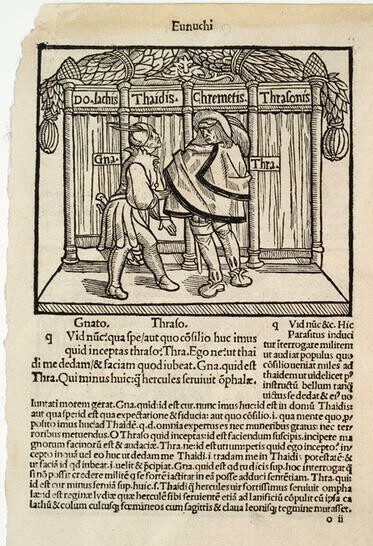
Terence, some decades later, refines the portrait with Gnatho, in The Eunuch. Gnatho (from the Greek gnáthos, the jaw) is no longer merely a hanger-on clinging to his patron; he is a theorist of happy dependence. He has understood that it is no longer enough to make oneself amusing or to absorb blows: one must admire the master before even knowing what he thinks, supply his words when he gropes for them, hear the same stories for the hundredth time as though it were the first. “Whatever they say, I applaud; if they say the opposite, I applaud that too”, he explains[7] – and he is so proud of this new method that he wishes to make a school of it, that of the Gnathonici.
In Terence, the game shifts. Artotrogus sneered in asides; Gnatho practises a subtler flattery, made of hints that Thraso does not always catch, but which the audience understands. The complicity remains, simply more discreet. The parasite no longer contents himself with feeding the soldier’s vanity: he governs it. Thraso believes he holds his entourage through his glory; Gnatho holds Thraso through his need to be admired. The hierarchy blurs. Who truly depends on whom?
The answer comes at the end: weary of “rolling this boulder”, Gnatho betrays Thraso and goes over to the enemy, delivering his former patron bound hand and foot to his rival. The parasitus serves only himself – and changes sides when the meal demands it.
What comedy puts on the table
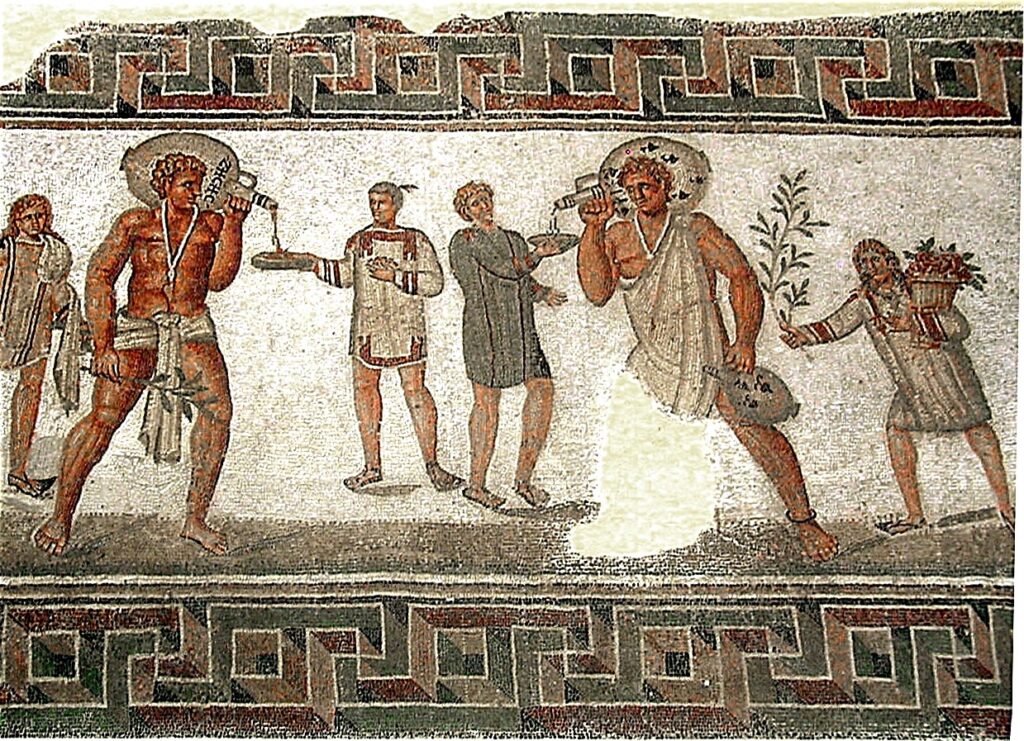
These duos raise laughs, but they say something else as well: the parasite is not merely a glutton. He makes visible a rule that fellow diners prefer to forget: at table, everyone occupies a place. The host distributes food, but also signs of favour; the guests recognise one another, rank one another, judge one another. The one who eats without contributing – the asumbolos – disturbs this balance. He benefits from the shared meal without fully entering into the exchange.
Athenaeus cites in this connection a fragment of Diodorus of Sinope, taken from the Epiklēros (The Heiress), in which a parasite pleads his case by comparing himself to Zeus philios, god of hospitality:
“He enters houses without distinguishing between poor and rich. Wherever he sees a well-made bed and a table furnished with everything needful, he stretches out decorously, takes his meal, has his dessert, drinks, and departs without having paid his share. And I do likewise.”[8]
The argument is insolent, but effective: if hospitality is a sacred value, why not make the most of it?
The same speech nonetheless distinguishes the ancient parasitoi of Heracles – carefully selected from respectable men – from the modern parasites, capable of praising their patron’s belches and sniffing his flatulence while asking where that fragrance of incense comes from[9]. The whole history of the word is there: on one side, the sacred table companion; on the other, the professional sponger. Between them, the same seat at table, but an entirely different prestige.
A thick-skulled lineage
Plautus gave this profession its most entertaining coat of arms. In the Persa, Saturio claims his trade as a family inheritance: father, grandfather, great-grandfather, all lived as parasites before him, “like mice, always gnawing at other people’s food”[10]. They are nicknamed the “Hard Heads”: skulls shaped by generations of blows received, of doors slammed in their faces, and of invitations wrested by the skin of their teeth.
The parasite is not merely the one who eats. He is the one who persists. He absorbs humiliations, transforms shame into technique, dependence into a trade, flattery into a skill.
But this skill has a price. To remain at table, one must become what the other expects: flatterer, buffoon, messenger, accomplice, whipping boy. The parasite lives by his wits, but hires them out to those richer than himself. He owns neither house, nor table, nor power of his own; he possesses something still more useful in comedy: the precise sense of the situation.
One final avatar pushes the logic further still. In the Querolus (The Grumbler), a late Latin comedy of the 4th or 5th century, Mandrogerus no longer seeks merely a meal: he wants gold, an inheritance, independence. He is granted the chance of which every parasite dreams – to depend on no one – but he wants everything and loses everything. At the end, he is tolerated beside Querolus in a subordinate position: his attempt to escape dependence leads him straight back to it. Comedy allowed him to attempt an exit. Then it closes the door.
After him, the character type does not vanish at a stroke; it disperses: dependent clients (clientes), professional flatterers (assentatores), table buffoons (scurrae). But none quite retains the theatrical swagger of Artotrogus, Gnatho, Saturio, or Mandrogerus. The comic parasite had at least this to his credit: he knew he was performing. The true fall of the character therefore lies not in his gluttony. It lies in his lucidity. While the others eat, he observes. While they talk, he calculates. He understood, before Pirandello, that the meal is a stage – and that one must play one’s part upon it, or be thrown out with a dog collar.
Works consulted
- Elizabeth Ivory Tylawsky, Saturio’s Inheritance: The Greek Ancestry of the Roman Comic Parasite, Peter Lang, 2002.
- Élisabeth Gavoille, “The braggart soldier and his parasite in Plautus and Terence”, Euphrosyne, University of Tours, 2020.
- Stephan Flaucher, Studien zum Parasiten in der römischen Komödie, Mannheim, 2002.
- Goran Vidović, Dish to Cash, Cash to Ash: The Last Roman Parasite and the Birth of a Comic Profession, MA Thesis in Medieval Studies, Central European University, Budapest, 2009.
[1] Athenaeus, Deipnosophistae VI, 234 c–d: ψήφισμα Ἀλκιβιάδου […] τὰ δὲ ἐπιμήνια θυέτω ὁ ἱερεὺς μετὰ τῶν παρασίτων· οἱ δὲ παράσιτοι ἔστων ἐκ τῶν νόθων καὶ τῶν τούτων παίδων κατὰ τὰ πάτρια, “Decree of Alcibiades […]: let the priest sacrifice with the parasites at the monthly assemblies; let the parasites be chosen from among bastards and their sons, according to ancestral custom”.
[2] Alexis, Parasitos, fr. 183 K.-A. (ap. Athenaeus VI, 235 a): καλοῦσι δ᾽ αὐτὸν πάντες οἱ νεώτεροι / Παράσιτον ὑποκόρισμα· τῷ δ᾽ οὐδὲν μέλει, “All the young men call him Parasite as a nickname – he takes not the slightest offence”.
[3] Epicharmus, Elpis ē Ploutos, fr. 34–35 Kaibel (ap. Athenaeus VI, 235 e–f): συνδειπνέων τῷ λῶντι, καλέσαι δεῖ μόνον / […] τηνεὶ δὲ χαρίης τ᾽ εἰμὶ καὶ ποιέω πολὺν / γέλωτα καὶ τὸν ἱστιῶντ᾽ ἐπαινέω, “I dine with whoever will have me, an invitation is all it takes […]; there I am charming, I raise a good laugh, and I praise the host”.
[4] Eupolis, Kolakes, fr. 172 K.-A. (ap. Athenaeus VI, 236 e–237 a).
[5] Plautus, Miles gloriosus, v. 32–35: venter creat omnis hasce aerumnas: auribus / peraurienda sunt, ne dentes dentiant, / et adsentandumst quidquid hic mentibitur, “It is my belly that causes me all these tribulations; my ears must endure them so that my teeth do not go hungry – and I must agree with everything he will lie about”.
[6] Plautus, Miles gloriosus, v. 49: Offae monent, “the tasty morsels remind me” – Artotrogus’s reply to Pyrgopolynices, who has just praised his memory.
[7] Terence, Eunuchus, v. 250–253: quidquid dicunt laudo; id rursum si negant, laudo id quoque; / negat quis: nego; ait: aio; postremo imperavi egomet mihi / omnia adsentari, “Whatever they say, I approve it; if they then deny it, I approve that too. Someone says no: I say no; he says yes: I say yes. In short, I have commanded myself to agree with everything.” For the “Gnathonici”, see v. 263–264: parasiti ita ut Gnathonici vocentur.
[8] Diodorus of Sinope, Epiklēros (The Heiress), fr. 2 K.-A., fragment preserved by Athenaeus, Deipnosophistae, VI, 238c–239a: Διόδωρος δὲ ὁ Σινωπεὺς ἐν Ἐπικλήρῳ περὶ τοῦ παρασιτεῖν καὶ αὐτὸς οὐκ ἀγλαφύρως τάδε φησίν· βούλομαι δεῖξαι σαφῶς ὡς σεμνόν ἐστι τοῦτο καὶ νενομισμένον καὶ τῶν θεῶν εὕρημα· τὰς δʼ ἄλλας τέχνας οὐδεὶς θεῶν κατέδειξεν, ἀλλʼ ἄνδρες σοφοί· τὸ γὰρ παρασιτεῖν εὗρεν ὁ Ζεὺς ὁ φίλιος, ὁ τῶν θεῶν μέγιστος ὁμολογουμένως. οὗτος γὰρ εἰς τὰς οἰκίας εἰσέρχεται οὐχὶ διακρίνας τὴν πενιχρὰν ἢ πλουσίαν. οὗ δʼ ἂν καλῶς ἐστρωμένην κλίνην ἴδῃ, παρακειμένην τε τὴν τράπεζαν πάνθʼ ἃ δεῖ ἔχουσαν, ἤδη συγκατακλιθεὶς κοσμίως ἀριστίσας ἑαυτόν, ἐντραγών, πιών, ἀπέρχετʼ οἴκαδʼ οὐ καταβαλὼν συμβολάς. κἀγὼ ποῶ νῦν τοῦτʼ, “Diodorus of Sinope, in The Heiress, speaks of parasitism in these terms […]: ‘I wish to show clearly that this practice is venerable, sanctioned by custom, and devised by the gods […]. It is Zeus Philios who invented parasitism […]. He enters houses without distinguishing between poor and rich. Wherever he sees a well-made bed and, beside it, a table furnished with everything needful, he stretches out at once decorously, takes his meal, has his dessert, drinks, then returns home without having paid his share. And I, now, do likewise.'”
[9] Diodorus of Sinope, Epiklēros (The Heiress), fr. 2 K.-A., fragment preserved by Athenaeus, Deipnosophistae, VI, 239a: οἷς ἐπειδὰν προσερύγῃ ῥαφανῖδα καὶ σαπρὸν σίλουρον καταφαγών, ἴα καὶ ῥόδα φασὶν αὐτὸν ἠριστηκέναι. ἐπὰν δʼ ἀποπάρδῃ μετά τινος κατακείμενος τούτων, προσάγων τὴν ῥῖνα δεῖθʼ αὑτῷ φράσαι· πόθεν τὸ θυμίαμα τοῦτο λαμβάνεις; “When he belches in their faces after eating a radish and a rotten sheatfish, they say he has dined on violets and roses. When he breaks wind while lying beside one of them, the parasite brings his nose close and asks: ‘Where do you get this incense?'”
[10] Plautus, Persa, v. 53–60: veterem atque antiquom quaestum maio / servo atque obtineo et magna cum cura colo. / nam numquam quisquam meorum maiorum fuit, / quin parasitando paverint ventres suos: / pater, avos, proavos, abavos, atavos, tritavos / quasi mures semper edere alienum cibum, / neque edacitate eos quisquam poterat vincere; / atque eis cognomentum erat duris Capitonibus, “I maintain and preserve with great care the old and ancient trade of my forebears […]; father, grandfather, great-grandfather, great-great-grandfather, and beyond, always like mice, eating other people’s food […]; they were nicknamed the Hard Heads”.
Other articles in English from the Nunc est bibendum blog