Translated from french (please notify us of errors)
For centuries barley fed the Greeks, millet sustained Roman peasants, rye survived in the Germanic forests and oats were regarded as a weed. These are the cereals that Rome tolerated, sometimes despised, and yet badly needed.
The three previous instalments of this series followed the great trajectory of wheat – from the archaic hulled wheats to Campanian siligo, champion of leavened bread-making. But alongside this rising narrative, other cereals coexisted, sometimes indispensable, sometimes relegated: those distributed to the troops when the wheat granaries stood empty, those grown at the margins of the Empire because nothing else would grow there, those that fed the poor peasant while never appearing on the rich man’s table. Barley, millet, rye, oats: four cereals whose histories differ, yet which share the same marginal fate.
Barley, a dethroned queen
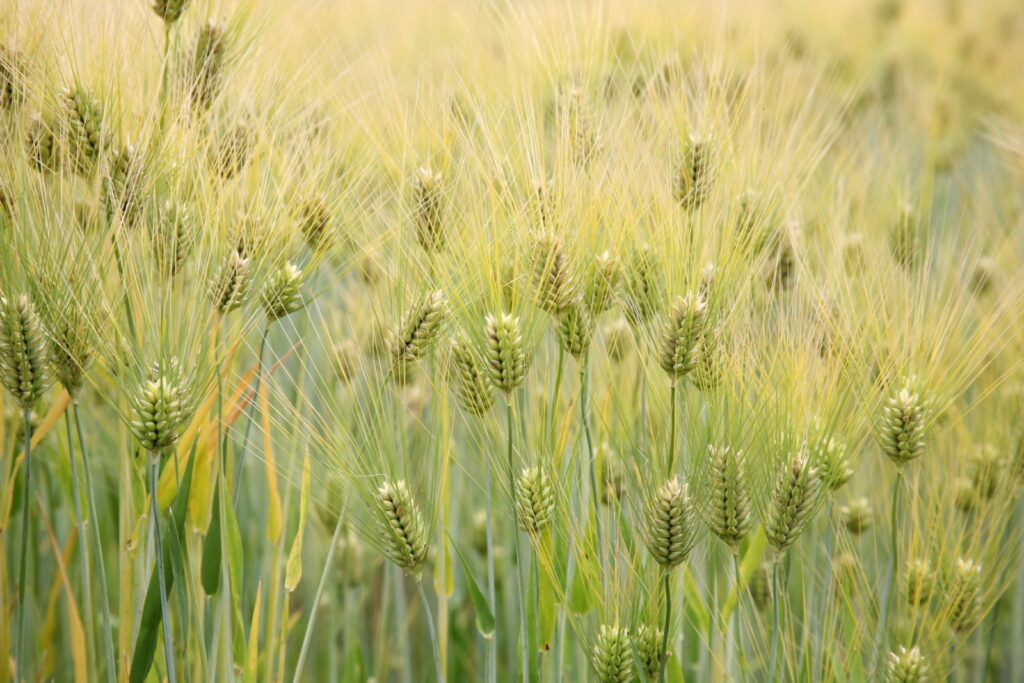
Barley (hordeum, in Greek krithê-κριθή) is one of the oldest cultivated cereals of the Mediterranean basin, and the first to reign supreme on the Greek table. Pliny holds it to be “the oldest of foods”, drawing on Menander, who attests to its ritual use among the Athenians, and recalls that gladiators themselves were called hordearii – barley men[1]. Its hardiness and early ripening earned it a preference that wheat, more demanding, could scarcely rival.
Its principal transformation was not bread – barley’s gluten, poorly elastic, produces a heavy loaf that does not rise. The fundamental gesture was roasting: the barley was soaked overnight in water, roasted the following day, then ground at the mill – this is how the Greeks prepared their polenta, of which Pliny notes they were particularly proud[2]. The same logic produced alphita, a pre-cooked barley flour that kept for months and, at the moment of eating, needed only an addition of water or honey-flavoured milk. From it was prepared maza, the staple of the Greek diet: a cold gruel, or balls and cakes kneaded by hand, without cooking. Thucydides reports that the oarsmen of the trireme sent in haste to cancel the order for the extermination of the Mytilenians, forced to eat while rowing so as not to lose time, fed on barley flour mixed with wine and oil – food substantial enough to sustain men in the midst of exertion[3].
The kykeon, another preparation based on alphita and water, was a drink that also contained wine or cheese, flavoured with pennyroyal. A drink of the Eleusinian mysteries, a rustic drink, a drink of physicians too: the Hippocratic Corpus devotes several preparations to it. Ptisanê, a decoction of hulled barley halfway between remedy and everyday beverage, was so renowned that Hippocrates was said by Pliny to have devoted an entire volume to it, adding that the best came from Utica[4]. This gives some measure of the place barley occupied in Greek culture: a cereal that Sophocles, in his play Triptolemus, mentioned as a foil to praise the wheat of Italy – “happy Italy, which sows white wheat”. In celebrating Roman wheat, he underlines the omnipresence of barley in Greece[5].
At Rome, barley underwent a spectacular reversal of fortune. According to Galen, barley loaves are less nourishing than those of wheat, emmer or millet, and Polybius attests that barley was issued to soldiers as rations only as disciplinary punishment[6]. Suetonius, Appian and Cassius Dio all confirm this usage. This shows just how far the hierarchy of cereals had shifted: besieging Pompey’s troops entrenched at Dyrrhachium in 48 BCE, Caesar’s soldiers, short of wheat and reduced to barley and pulses, accepted them without a murmur – proof that the situation was exceptional, not that barley was their ordinary fare[7].
Pliny is terse:
“barley bread, once in use among the ancients, has been condemned by life; it is very nearly the food of quadrupeds”[8].
It was thought bad for the stomach, even the food of a philosopher detached from the world. The countryside still produced it, and the poor of Ravenna ate it during Saint Germanus of Auxerre’s stay in 448. But archaeology tells a different story from the texts: among the carbonised remains unearthed at Pompeii and Herculaneum and held at the National Archaeological Museum of Naples, barley is the second most represented cereal, just after einkorn. This much-maligned cereal was very much present in Campanian stores in the 1st century.
Millet, food of the peasant
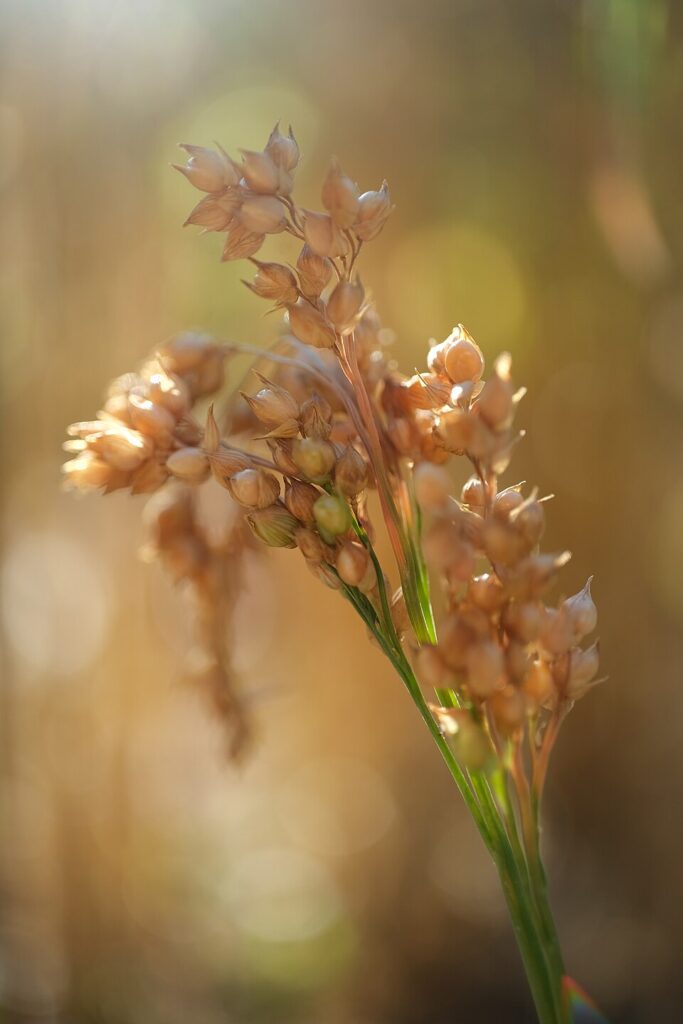
Millet (milium, Panicum miliaceum) is an old Mediterranean crop, and its importance at Rome is far greater than the poets and historians of antiquity would suggest. Columella and Strabo are unequivocal: millet is the surest resource against famine, because it withstands every kind of weather and is never at risk of failing[9]. It ripens quickly in cold climates and withstands drought better than any other cereal. Polybius and Pliny record its cultivation in both Cisalpine Gaul and Campania; it had also been sown throughout Gaul[10].
Two quite distinct species were distinguished: common millet (milium, Panicum miliaceum), with round grains, and foxtail or bird millet (panicum, Setaria italica), with smaller grains and a longer growing season – five months against two to three for the former. The latter was grown chiefly in Gaul, Aquitaine, Marseille and Cisalpine Gaul. Both cereals are essentially porridge plants. Cakes were also made from them: Columella says those of common millet could be eaten hot without distaste, more nourishing than those of barley, but likewise bad for the stomach – peasant food, he states without ambiguity[11].
Millet flour also played an unexpected role in Roman baking: it was with millet, kneaded into must at the time of the grape harvest, that the annual leaven was prepared and then kept for the whole year[12]. This leaven was less effective than the beer yeast used in Gaul and Spain – hence, according to Pliny, the denseness of Roman bread compared with that of the western provinces[13].
Rye and oats: the foreigners
Rye and oats occupy a place apart in this picture: cereals that Rome knew without ever truly adopting them, relegating to the periphery of the Empire what other peoples had placed at the centre of their diet.
Rye (secale, sometimes centenum) arrived alongside wheat as a weed, and its cultivation in Europe is relatively recent. It was in the Iron Age that it became common north of the Alps, in southern Germany and Switzerland. Italy proper never knew it as a crop: in the 1st century, it was found only at the foot of the Alps, among the Taurini, a Celto-Ligurian people of Piedmont whose chief town was present-day Turin. Pliny’s verdict is final: rye is the worst of cereals for food, good only in times of famine, and its taste is so bitter that it is mixed with emmer to sweeten it[14]. In Germania, Macedonia, Thrace and Gaul, it established itself wherever nothing else would really grow. This status as a cereal from the edge of the world nonetheless earned it a mention in Diocletian’s Price Edict (301), at the same rate as barley – a sign that it was worth something, but only at the margins[15].
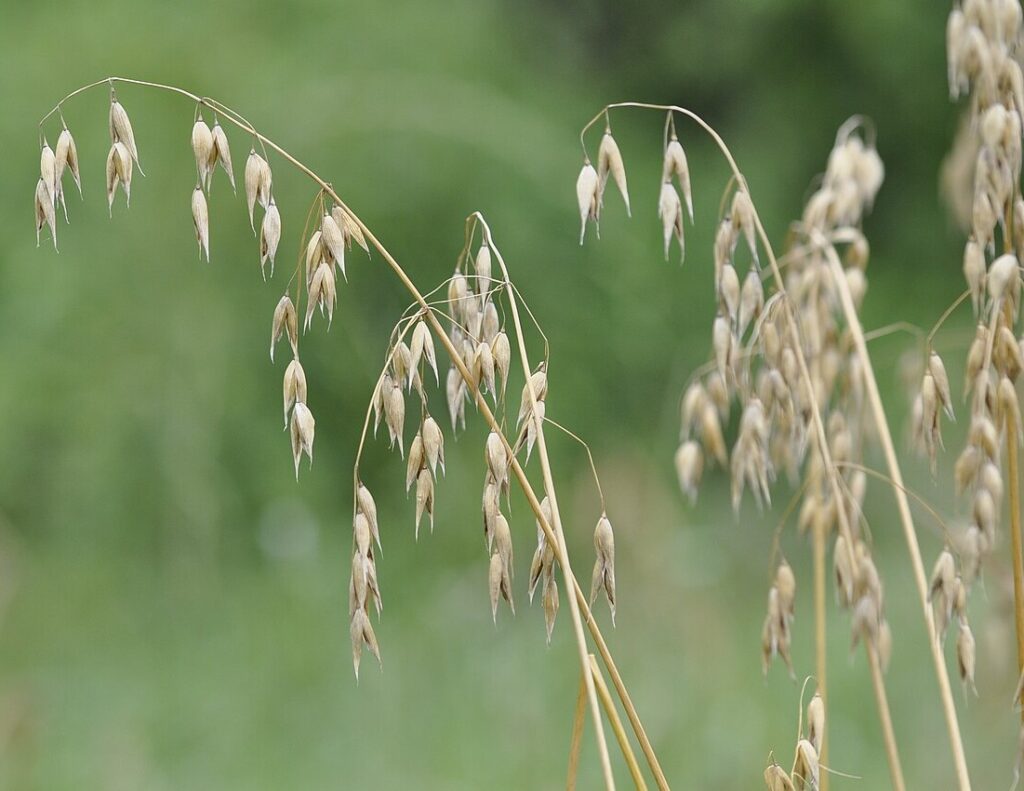
Oats (avena, Avena sativa) fare even worse at the hands of the Latin authors. Pliny defines this cereal as “the first of all the diseases of wheat” – and states that barley itself degenerates into oats[16]. In Cato’s day it was still nothing more than a weed, which he prescribes rooting out of wheat fields alongside brambles[17]. Italy took to growing it only later, as green fodder or for its seed, but only Germania made it a food crop in its own right[18]. In Diocletian’s Edict, it is the cheapest of the cereals, alongside hay and unhulled emmer: thirty denarii per modius[19] – a sign that its nutritional worth was held to be minimal.
In Greece, oats and rye are likewise absent. Wild oats (aigilops-αἰγίλωψ, “wild oat grass”) are attested there, but not the cultivated form. As for rye, it is absent from classical Greek literature; Pliny places it at the foot of the Alps and beyond, far from the Greek world [20].
A map and a hierarchy
This picture of the marginal cereals traces a map as much as a hierarchy. Wheat dominates the centre – Italy, Sicily, Africa, Egypt. Barley, once a queen now dethroned, holds on in the countryside and among philosophers. Millet clings to the peasant’s skin, in Cisalpine Gaul as in Campania, surviving crises that wheat cannot weather. Rye and oats remain beyond the Alps, markers of an otherness that Rome observes with condescension.
Series — Cereals of Antiquity
- I.Grain and humans in pre-Roman Italy
- II.The hulled wheats, rustic ancestors of the Roman cereal system
- III.When wheat sheds its hull, Roman dough rises
- IV.Barley, millet, rye and oats: the cereals of the margin
To find out more
- Jacques André, L’Alimentation et la cuisine à Rome, Les Belles Lettres, 1981, chap. 2 (“Les céréales”).
- Janick Auberger, Manger en Grèce classique, Presses de l’Université Laval, 2010, chap. 1.
- Alessia D’Auria & Gaetano Di Pasquale, “The unknown archaeobotany: The great Collezione dei Commestibili e degli Avanzi Organici of the National Archaeological Museum of Naples”, Quaternary International 725-726 (2025).
[1] Pliny, Historia naturalis, 18, 72: Antiquissimum in cibis hordeum, sicut Atheniensium ritu Menandro auctore apparet et gladiatorum cognomine, qui hordearii vocabantur – “barley is the oldest of foods, as attested by the rite of the Athenians according to Menander, and by the nickname of gladiators, who were called hordearii”.
[2] Pliny, Historia naturalis, 18, 72: Graeci perfusum aqua hordeum siccant nocte una ac postero die frigunt, dein molis frangunt – “the Greeks soak barley in water, dry it overnight, roast it the next day, then grind it at the mill”.
[3] Thucydides, History of the Peloponnesian War, III, 49, 3: ἤσθιόν τε ἅμα ἐλαύνοντες οἴνῳ καὶ ἐλαίῳ ἄλφιτα πεφυραμένα (“they ate while rowing barley flour kneaded with wine and oil”).
[4] Pliny, Historia naturalis, 18, 75: unum laudibus eius volumen dicavit Hippocrates e clarissimis medicinae scientia. tisanae bonitas praecipua Uticensi – “Hippocrates, one of the most illustrious figures of medical science, devoted an entire volume of praise to it. The finest tisane is that of Utica”.
[5] Pliny, Historia naturalis, 18, 65 (Sophocles, Triptolemus): et fortunatam Italiam frumento serere candido – “and happy Italy, which sows white wheat”; Pliny is surprised that Greeks after Alexander no longer mentioned this wheat.
[6] Galen, De alimentorum facultatibus, 1, 10: εἰσὶ δ᾽ οὐ μόνον τῶν πυρίνων, ἀλλὰ καὶ τῶν ὀλυρίνων καὶ πολὺ μᾶλλον ἔτι τῶν τιφίνων ψαθυρώτεροι μηδὲν ἐν ἑαυτοῖς ἔχοντες ὥσπερ ἐκεῖνοι γλίσχρον. εὔδηλον οὖν ὅτι τροφὴν ὀλίγην παρέχουσι τοῖς σώμασι – “[barley loaves] are more crumbly not only than those of wheat, but also than those of emmer, and even more so than those of einkorn, having in them none of the binding quality of the latter; it is therefore evident that they provide the body with little nourishment”; Polybius, Histories, 6, 38, 3: τοῖς δὲ λοιποῖς κριθὰς δοὺς ἀντὶ πυρῶν ἔξω κελεύει τοῦ χάρακος καὶ τῆς ἀσφαλείας ποιεῖσθαι τὴν παρεμβολήν – “to the rest, he gives orders to receive barley instead of wheat and to camp outside the rampart and its protection”.
[7] Suetonius, Augustus, 24, 2: cohortes, si quae cessissent loco, decimatas hordeo pavit – “the cohorts that had given ground, he decimated and fed on barley”; Appian, Illyr. 26; Cassius Dio, 49, 27, 1 (military punishment). – Caesar, Bellum Civile, 3, 47, 6: Non illi hordeum cum daretur, non legumina recusabant – “they refused neither the barley given to them, nor the pulses” (famine at Dyrrhachium).
[8] Pliny, Historia naturalis, 18, 74: Panem ex hordeo antiquis usitatum vita damnavit, quadripedumque fere cibus est – “barley bread, once in use among the ancients, has been condemned by life; it is very nearly the food of quadrupeds”.
[9] Columella, De Re Rustica, 2, 9, 17 and 19: Inter frumenta etiam panicum ac milium ponenda sunt, nam multis regionibus cibariis eorum coloni sustinentur – “among the cereals must also be counted panicum and millet, for in many regions the peasants are sustained by these foods”; Strabo, Geography, 5, 1, 12: Ἔστι δὲ καὶ κεγχροφόρος διαφερόντως διὰ τὴν εὐυδρίαν· τοῦτο δὲ λιμοῦ μέγιστόν ἐστιν ἄκος· πρὸς ἅπαντας γὰρ καιροὺς ἀέρων ἀντέχει καὶ οὐδέποτ᾽ ἐπιλείπειν δύναται, κἂν τοῦ ἄλλου σίτου γένηται σπάνις – “the region is remarkably productive of millet thanks to its abundant water; this is the greatest remedy against famine, for it withstands every kind of weather and can never fail, even should the other grains grow scarce”.
[10] Polybius, Histories, 2, 15, 2: Ἐλύμου γε μὴν καὶ κέγχρου τελέως ὑπερβάλλουσα δαψίλεια γίνεται παρ᾽ αὐτοῖς – “elymus and millet are produced there in altogether exceptional abundance”; Pliny, Historia naturalis, 18, 100-101: Milio Campania praecipue gaudet pultemque candidam ex eo facit… Panico et Galliae quidem, praecipue Aquitania utitur – “Campania delights especially in millet and makes of it a white porridge… as for panicum, the Gauls make use of it, above all Aquitaine”.
[11] Columella, De Re Rustica, 2, 9, 19: Panis ex milio conficitur, qui antequam refrigescat, sine fastidio potest absumi – “bread is made from millet, which, before it cools, can be eaten without distaste”; Pliny, Historia naturalis, 18, 101: Panico et Galliae quidem, praecipue Aquitania utitur – “as for panicum, the Gauls make use of it, above all Aquitaine”.
[12] Pliny, Historia naturalis, 18, 102-104: Mili praecipuus ad fermenta usus e musto subacti in annuum tempus (“millet flour kneaded into must is used chiefly to prepare leaven for the whole year”).
[13] Pliny, Historia naturalis, 18, 68: Galliae et Hispaniae frumento in potum resoluto… spuma ita concreta pro fermento utuntur, qua de causa levior illis quam ceteris panis (“Gaul and Spain use as leaven the foam thus thickened, which is why their bread is lighter than that of others”).
[14] Pliny, Historia naturalis, 18, 141: deterrimum et tantum ad arcendam famem… admiscetur huic far, ut mitiget amaritudinem eius – “the worst of the cereals, good only for warding off hunger… emmer is mixed with it to soften its bitterness”.
[15] Diocletian’s Edict, 1, 3: centenu‹m› sive sicale, 60 denarii per castrensian modius, the same price as barley (1, 2), half the price of wheat (1, 1).
[16] Pliny, Historia naturalis, 18, 149: Primum omnium frumenti vitium avena est, et hordeum in eam degenerat – “the first of all the diseases of wheat is oats, and barley degenerates into it”.
[17] Cato, De Agricultura, 37, 5: avenamque destringas (“and that you strip out the oats”).
[18] Columella, De Re Rustica, 2, 10, 24 and 32; Pliny, Historia naturalis, 18, 149: Germaniae populi serant eam neque alia pulte vivant (“the peoples of Germania sow it and live on no other porridge”).
[19] Diocletian’s Edict, 1, 19: avenae, 30 denarii per castrensian modius.
[20] Pliny, Historia naturalis, 18, 141: Secale Tauri sub Alpibus asiam vocant – “rye, which the Taurini at the foot of the Alps call asia”.
Other articles in English from the Nunc est bibendum blog