Translated from French (please notify us of errors)
Two Roman funerary stelae found near Bologna: one shows a mortar, the other a swineherd. Together, these two-thousand-year-old stones may tell the story of how the famous mortadella began.
In October 1894, in the Santa Viola district west of Bologna, workers extracting gravel from the bed of the Reno, downstream of the Pontelungo, struck an imposing stone structure. A catastrophic flood the previous year had shifted the gravel and exposed the remains. The structure, known as the Muro del Reno (“Wall of the Reno”), had been built in late Antiquity, probably in the fourth century CE, reusing Roman funerary monuments from a nearby necropolis. Excavations begun in 1894 and continued notably in 1897 and 1912 recovered more than two hundred funerary stones, whose inscriptions record the names of some 250 inhabitants of Roman Bononia, ancient Bologna.
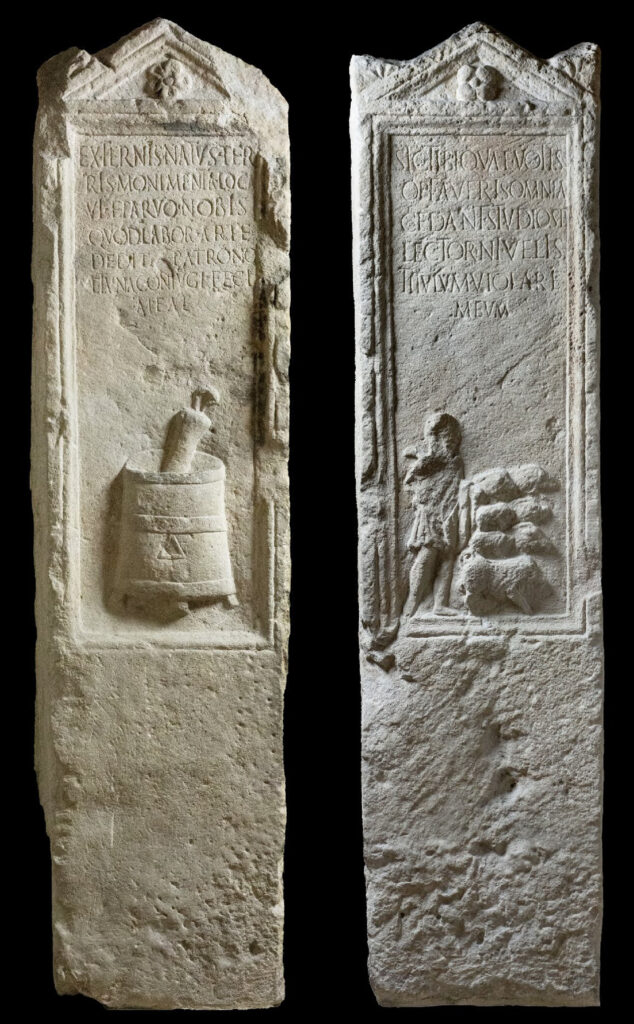
Among these monuments are two sandstone stelae, now in the Archaeological Museum of Bologna. Dated to the late first century BCE or the early first century CE, they share a similar composition: a Latin verse inscription above a relief depicting a trade.
On the first, a man drives seven pigs. He is probably a suarius, someone who raised or traded pigs. On the second is a large circular vessel with a pestle, generally interpreted as a mortar.
The two monuments probably belonged to the same funerary group. Their resemblance and the complementary nature of their images suggest that they may represent two aspects of a single activity: the pig trade and the processing of pork into food.
A former slave proud of his work
The mortar stela bears an inscription full of gratitude:
“Born in foreign lands, I set up these monuments with the modest means that our labour and our skill brought us. I made them for my patron and, at the same time, for my wife.”[1]
The man did not leave us his name. The mention of his patronus suggests that he was a freedman. In Roman society, a freed slave remained bound by legal and social ties to his former master, who became his patron. The inscription does not, however, state explicitly that the man had been a slave, nor how he obtained his freedom.
What stands out above all is the place given to work. Where other funerary monuments celebrate public offices or military feats, this one claims a success founded on labor and ars, effort and skill.
The second stela addresses the passer-by directly:
“May all your wishes come true, attentive reader, provided you do not seek to desecrate my inscription.”[2]
The formula is a shrewd one: rather than threatening anyone who might disturb his rest, the dead man promises them the fulfilment of their wishes, on condition that they respect his tomb.
If the two stones did belong to the same monument, together they would form an unusual portrait: that of a man proud of his trade, mindful of his family and determined to preserve his memory.
What went into Roman sausages?
The pairing of pig and mortar in these images has led several writers to link the stelae to the history of mortadella, and not without reason.
The Romans were thoroughly versed in the art of preparing minced, seasoned meat stuffed into casings.
The culinary collection handed down under the name of Apicius, the De re coquinaria, contains several recipes of this kind. Lucanicae, sausages associated with Lucania, are made with carefully pounded meat, pepper, cumin, aromatic herbs and garum, a fermented fish sauce. The filling is pushed into a casing, then the sausages are hung up to smoke.[3]
Other recipes, grouped under the name farcimina, describe stuffed meat preparations, sometimes boiled before being browned in a pan. One of them specifies that the ingredients should be mixed in a mortar with pine nuts and peppercorns.[4]
The connection with the Bologna stela is tempting: the mortar may have played a part in Roman charcuterie-making, for crushing the meat or grinding the spices, herbs and other ingredients added to the filling.
From mortar to mortadella, by way of myrtle
The boldest writers have therefore claimed to see in these images proof of a direct line of descent between the famous Bologna mortadella and a craft dating back to Roman antiquity.
In support of this theory, there is an etymological clue. The word mortadella is said to derive from mortarium, the mortar depicted on the stela.
But of course it is not that simple. Etymological dictionaries generally favour another origin: the Latin murtatum or myrtatum, a preparation seasoned with myrtle, a Mediterranean shrub whose berries were used as a condiment in antiquity.
Once again, Apicius provides the evidence: a recipe for a meat preparation wrapped in caul fat includes the optional use of a myrtle berry ground with pepper.[5]
Mortadella proper appears in medieval sources. In Bologna, its production gradually became a specialised trade, regulated in particular by the guild of the Salaroli, the craftsmen of salt and salted meats. In 1661, Cardinal Girolamo Farnese had a regulation issued to protect the quality of this speciality and to prevent fraud.
More than a millennium separates the Roman recipes from the first precise mentions of mortadella. It would therefore be rash to claim a direct culinary lineage. Still, two thousand years ago, an inhabitant of Bononia, perhaps a freedman working in the meat trade or in meat processing, saw fit to have carved in stone what his labour and skill had enabled him to achieve. He may already have been part of a charcuterie tradition that is still Bologna’s pride today.
(MG)
Modern studies consulted
- Susini, Giancarlo, Il lapidario greco e romano di Bologna e Supplementum Bononiense ad CIL XI, Bologna, 1960.
- Reddé, Michel, “Les scènes de métier dans la sculpture funéraire gallo-romaine”, Gallia, 36, 1978, p. 43–63.
- Museo Civico Archeologico di Bologna, catalogue entries for the funerary stelae of the swineherd and the mortar.
[1] Funerary inscription from Bononia (Bologna), CIL XI, 6841; CLE 2154:
Externis natus terris monimenta locavi / e parvo nobis quod labor arte dedit. / Patrono et una coniugi feci meae.[2] Funerary inscription from Bononia (Bologna), CIL XI, 6842; CLE 2027:
Sic tibi quae votis optaveris omnia / cedant studiose / lector ni velis / titulum violare / meum.[3] Apicius, De re coquinaria, II, 4, 1:
Lucanicas similiter ut supra scriptum est. [Lucanicarum confectio:] Teritur piper, cuminum, satureia, ruta, petroselinum, condimentum, bacae lauri, liquamen, et admiscetur pulpa bene tunsa, ita ut denuo bene cum ipso subtrito fricetur. Cum liquamine admixto, pipere integro et abundanti pinguedine et nucleis inicies in intestinum perquam tenuatim productum, et sic ad fumum suspenditur.
“Lucanian sausages are prepared in the same way as those described above. [Making Lucanian sausages:] Grind pepper, cumin, savory, rue, parsley, a mixed seasoning, bay berries and liquamen (fermented fish sauce). Add carefully pounded meat and work it again with the ground seasonings until the mixture is smooth. Then add fermented fish sauce, whole peppercorns, a generous quantity of fat and pine nuts. Push the mixture into a casing stretched very thin, then hang it in the smoke to cure.”[4] Apicius, De re coquinaria, II, 5, 3:
Aliter: alicam purgas et cum liquamine intestini et albamine porri concisi minutatim simul elixas. Elixa tolles, pinguedinem concides et copadia pulpae, in se omnia commisces. Teres piper, ligusticum, ova tria, haec omnia in mortario permisces cum nucleis et piper integro. Liquamen suffundes, intestina imples, elixas et subassas, vel elixa tantum. Appones.
“Another recipe: clean some cracked spelt and boil it in water with liquamen, offal and finely sliced leek whites. When everything is cooked, take it off the heat. Cut up some fat and pieces of meat, then mix all the ingredients together. Grind pepper, lovage and three eggs; mix everything in a mortar with pine nuts and whole peppercorns. Add fermented fish sauce, fill the casings with it, boil them and then grill them lightly, or simply boil them. Serve.”[5] Apicius, De re coquinaria, II, 1, 7 (Isicia omentata):
Pulpam concisam teres cum medulla siliginei in vino infusi. Piper, liquamen, si velis, et bacam myrtam extenteratam simul conteres. Pusilla isicia formabis, intus nucleis et pipere positis. Involuta omento subassabis cum caroeno.
“Grind chopped meat with the crumb of wheat bread soaked in wine. Pound together pepper, fermented fish sauce and, if you like, a stoned myrtle berry. Shape small meatballs, placing pine nuts and peppercorns inside. Wrap them in caul fat and grill them gently with reduced grape must.”
Other articles in English from the Nunc est bibendum blog