Translated from French (please notify us of errors)
Eating one’s table: that is the curse a Harpy hurls at Aeneas and the Trojans on their way to Italy. Four books of the Aeneid later, the prophecy comes true around a cereal flatbread topped with fruit, a close relative of the “pizza” painted on a fresco in Pompeii.
In his Aeneid, a work written at the instigation of the emperor Augustus with the aim of using literature to justify the will of the gods behind his rise to absolute power, the poet Virgil takes as his hero a virtuous Trojan prince, Aeneas, son of the goddess Venus and the mortal Anchises.
A survivor of the fall of Troy, urged on by the shade of Hector, who tells him that he will found a great city at the end of a long wandering across the sea[1], Aeneas flees the burning city, with his father, his young son Ascanius Iulus and a band of loyal companions. His wife, Creusa, who has stayed behind, vanishes during this dramatic departure.
Throughout his long journey, a deliberate blend of Iliad and Odyssey, Aeneas will be reminded time and again by oracles, prophecies or apparitions of the mission that falls to him: he will settle in fabled Italy, and his descendants will give rise to a glorious people who will extend their power over the world.
A meal disrupted
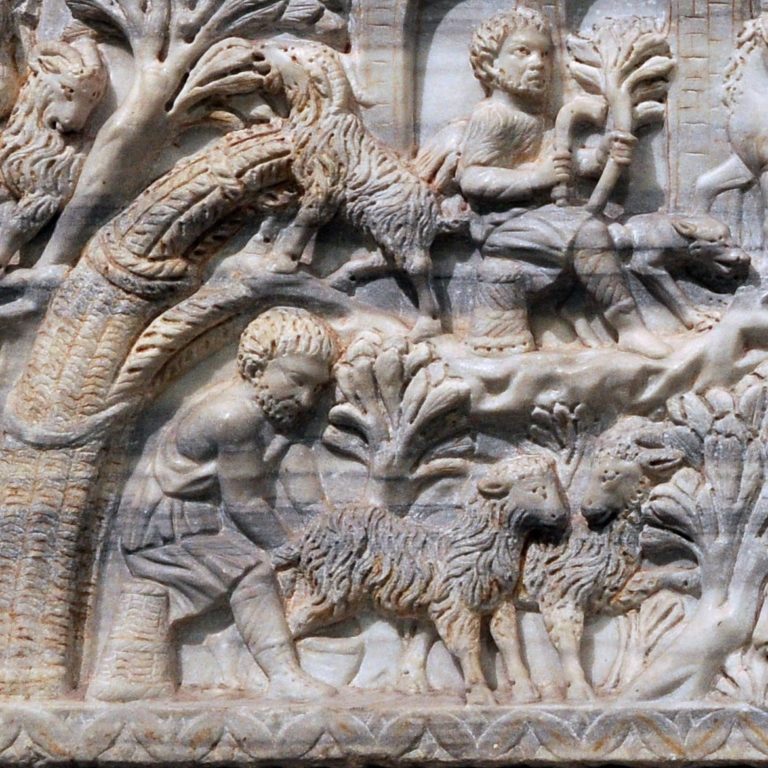
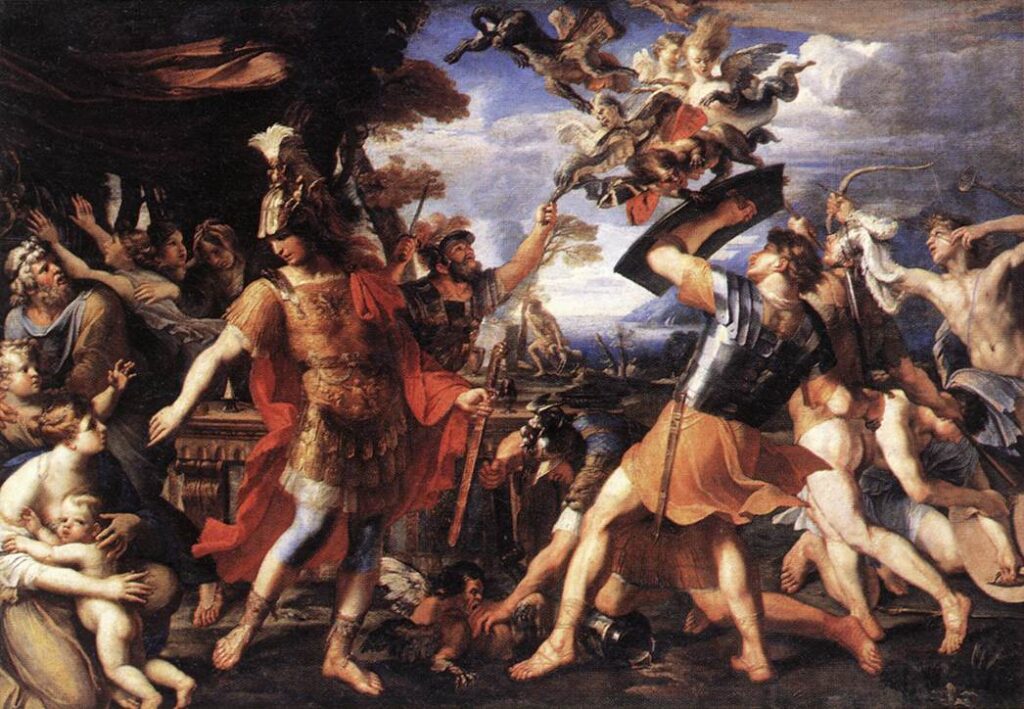
An episode with gastronomic overtones will lend a tragic hue to the trials awaiting the hero. During a stopover on the Strophades islands, which seem entirely deserted, the Trojans come across rich herds left to fend for themselves. Having slaughtered a number of beasts, and just as they are about to tuck into the meat they have grilled, they are attacked by Harpies, fabulous creatures with the body of a bird and the head of a young girl, who swoop down on them, talons out, interrupting their meal and fouling the food (no need to specify how).
One of them, Celaeno, delivers a terrifying prophecy to Aeneas:
Alone, on the summit of a rock, Celaeno has settled,
bird of misfortune, who lets these words burst from her breast:
“So it is war, descendants of Laomedon, on top of the slaughter of our oxen
and our felled heifers! You are preparing to wage war on us
and to drive the innocent Harpies from their ancestral kingdom?
Hear then, and fix in your hearts this prophecy,
made to Phoebus by almighty Jupiter, and to me by Phoebus Apollo;
I, eldest of the Furies, reveal it to you.
You are racing towards Italy, calling on the winds for help:
you shall go to Italy; you shall be allowed to enter its harbour.
But before you gird with walls the city granted to you,
an unbearable hunger and the unjust slaughter we have suffered
will drive you to seize in your jaws and devour your tables.”[2]
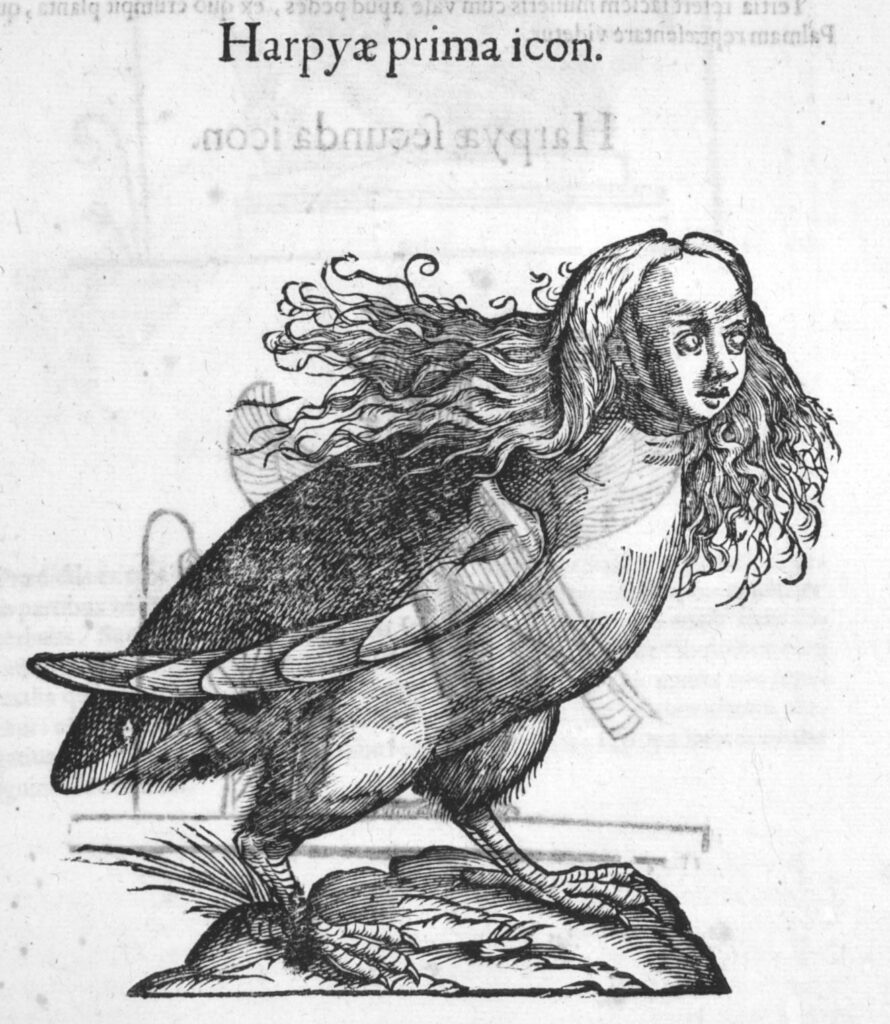
Bird of ill omen
Celaeno’s whole case reeks of bad faith:
Primo, the Trojans could not have known that the cattle they slaughtered on this apparently deserted island had owners. What is more, as is only proper, they shared their food with the gods, Jupiter first among them, by making ritual offerings[3], and the gods raised no objection.
Secundo, they are only passing through and have no intention of settling on the Strophades. If they took up arms, it was only as a second resort, purely to defend themselves against the Harpies’ brutal attack (they first tried to carry on with their disrupted meal under cover, taking refuge in a cave, where the goddesses, aggressive and stubborn, pursued them).
Tertio, Celaeno contradicts herself over the alleged “invasion” of the Harpies’ territory by the Trojans, admitting that she knows of the mission that bids Aeneas go to Italy, and even revealing that she knows perfectly well he will succeed in his quest: in short, in this most unwelcome prophetic outburst, one must know how to separate the wheat from the chaff.
Nevertheless, the Trojans, in shock, lose their appetite twice over: not only have the Harpies twice fouled their food with their filthy droppings, but on top of that, the prophecy they have just heard from the mouth of a goddess, a minor one, admittedly, but a goddess all the same, is enough to make the food stick in their throats. It is Aeneas who tells the story, and he is no chicken:
“Then a sudden terror freezes the blood in our veins; we feel our courage fail; no longer with weapons in hand, but with vows and prayers we resolve to sue for peace and to appease the Harpies, whether they be goddesses or baleful, foul birds.”[4]
The Trojans weigh anchor at once and sail towards more hospitable lands (and above all, towards calmer meals), but since revenge is a dish best served cold, Celaeno’s prediction remains nestled in the background, ready to ruffle feathers again.
Fatal dough
It will take four books, many trials and almost as many omens for the Harpy’s prophecy, which the reader has had ample time to forget, to come true, in circumstances that are unexpected to say the least.
And so, in Book VII, Aeneas and his companions reach Latium, or more precisely the mouth of the Tiber, but they do not yet know that they have at last reached their goal. Once ashore, they prepare a quick, frugal meal beneath the trees. And it is then that, as is only fitting, out of the mouth of a child comes the truth:
“Aeneas, the fair Iulus and the chief Trojan leaders first go to rest beneath the thick boughs of a tall tree. There food is prepared for them; and since wheaten cakes laid on the grass (so Jupiter had decreed) serve them as plates, they heap the tables of Ceres with wild fruit. All their food consumed, hunger forced them to bite into the cakes, to attack that fatal dough with bold hand and tooth, and not to spare its broad quarters. Then Iulus: ‘Oh! we are eating even our tables.’ This playful remark was the first to herald the end of their woes; swiftly Aeneas seized upon it and, struck by the divine meaning it held, stopped it on his son’s lips.”[5]
Just as Dad said!
For once, Virgil leaves the sublime register to give the reader a mischievous wink: what could be more natural, after all, than eating a “table of Ceres”, id est, a cereal flatbread, probably soaked in the juice of the wild fruit laid on it? The joke is on the Harpy, who had tried to terrify the Trojans with her baleful prophecy! Note in passing that the adjective fatal, in its proper sense, refers to what pertains to fate: Virgil speaks of fatalis crustum, the “flatbread of destiny”. Better still: Jupiter himself took a hand in the menu of this first meal eaten on Italian soil, just to make a mockery of the moulting goddess’s omens.
Aeneas, for his part, is not fooled and, while thanking fate for bringing him safely to harbour, reveals a piece of information his father Anchises had given him (Virgil, of course, carefully avoided any “spoiler” of this great, fatefully comic moment and breathed not a word of it in his account of the moving father-son reunion in the Underworld, in Book VI. As for the prophecy, it was Celaeno who uttered it in Book III, in the presence of Anchises himself: one of those inconsistencies that Virgil would no doubt have corrected had death, in 19 BCE, not prevented him from putting the finishing touches to the Aeneid):
“Hail, he cries at once, land owed to me by the fates; hail, guardian gods of Troy, faithful gods, hail: here is our home, here our homeland: Anchises, I remember it still, revealing to me the secrets of the fates, left these words in my mind: ‘My son, when, driven to an unknown shore, hunger forces you, your food consumed, to eat your tables, then you may hope for a safe refuge for your weary destinies; then remember to lay with your own hands the foundations of your new city, and to fortify it.’ So this is that much-dreaded hunger; so now the last oracles are fulfilled that promised an end to our misfortunes.”[6]
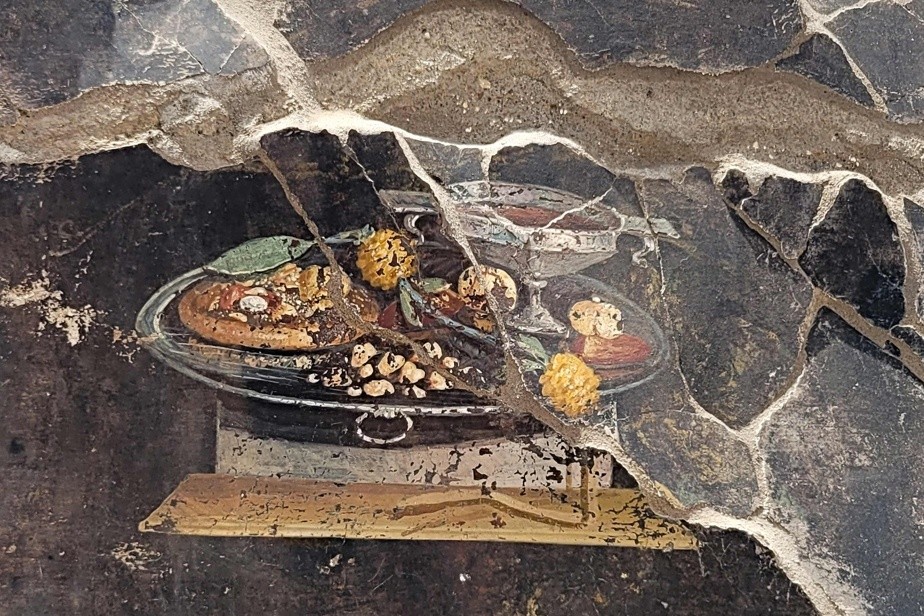
Flatbread or pizza: many a slip ’twixt cup and lip
The Pompeian fresco whose photos went round the world in 2023 in a way confirms the rudimentary nature of Ascanius Iulus’s “pizza”: the archaeologists of the Archaeological Park of Pompeii see in it a round flatbread bearing a pomegranate, a fruit resembling a date and probably spices or a kind of pesto, moretum:
“In this fresco we see a cup of wine, but also a kind of focaccia topped with spices, pomegranates and dates, which to a modern observer immediately brings to mind a pizza, especially here, in Neapolitan territory, explains Gabriel Zuchtriegel, director of the Pompeii site, on the website of Il Mattino. Of course it is not that, but it could be a distant ancestor of the dish.”
“Fruit instead of tomato: enough to set master pizzaioli’s teeth on edge, quips the Neapolitan daily, even if it all makes sense, since the tomato was only brought over from the Americas much later.”
A welcome gift
This archaeological find, however, takes us straight back to the Aeneid:
“According to the archaeologists, this kind of representation, known in antiquity by the Greek name ‘xenia’ [ξένια], is inspired by the ‘gifts of hospitality’ offered to guests in keeping with a Greek tradition dating back to the period from the third to the first century BCE.”
Gabriel Zuchtriegel also links these still lifes to a Hellenistic tradition taken up by authors of the imperial period, Virgil first among them.
What better welcome gift could Italy (and fate) have offered Aeneas to confirm that he had at last reached the land of his distant ancestors, he whose descendants, starting with his son Iulus (from whom the gens Iulia, that of Caesar and Augustus, claimed descent), would one day give Italy the city of Rome and its mighty empire?
And to cap it all, who could have foreseen that the ancestor of a humble peasant dish, once combining seasonal gathering with the fruit of human labour, would one day become one of the most popular foods in world cuisine, replacing military conquest with gastronomic seduction? Si qua Fata sinant…[7]
(GFR)
[1] Virgil, Aeneid, II, 293–295 (the shade of Hector addresses Aeneas):
sacra suosque tibi commendat Troia penatis; / hos cape fatorum comites, his moenia quaere / magna, pererrato statues quae denique ponto.
“Troy entrusts to you her sacred objects and her Penates; take them as companions of your destinies, seek for them the great walls you will at last found, after wandering the sea.”[2] Virgil, Aeneid, III, 245–257:
Una in praecelsa consedit rupe Celaeno, / infelix vates, rumpitque hanc pectore vocem: / “Bellum etiam pro caede boum stratisque iuvencis, / Laomedontiadae, bellumne inferre paratis / et patrio Harpyias insontis pellere regno? / Accipite ergo animis atque haec mea figite dicta, / quae Phoebo pater omnipotens, mihi Phoebus Apollo / praedixit, vobis Furiarum ego maxima pando. / Italiam cursu petitis ventisque vocatis: / ibitis Italiam portusque intrare licebit. / Sed non ante datam cingetis moenibus urbem / quam vos dira fames nostraeque iniuria caedis / ambesas subigat malis absumere mensas.”[3] Virgil, Aeneid, III, 222–224:
Inruimus ferro et divos ipsumque vocamus / in partem praedamque Iovem; tum litore curvo / exstruimusque toros dapibusque epulamur opimis.
“We rush upon them, sword in hand, and invite the gods, and Jupiter himself, to share the spoils; then, on the curving shore, we set up couches and feast on these rich dishes.”[4] Virgil, Aeneid, III, 259–262:
At sociis subita gelidus formidine sanguis / deriguit; cecidere animi, nec iam amplius armis, / sed votis precibusque iubent exposcere pacem, / sive deae seu sint dirae obscenaeque volucres.[5] Virgil, Aeneid, VII, 107–119:
Aeneas primique duces et pulcher Iulus / corpora sub ramis deponunt arboris altae, / instituuntque dapes et adorea liba per herbam / subiciunt epulis (sic Iuppiter ipse monebat) / et Cereale solum pomis agrestibus augent. / Consumptis hic forte aliis, ut vertere morsus / exiguam in Cererem penuria adegit edendi, / et violare manu malisque audacibus orbem / fatalis crusti patulis nec parcere quadris: / “Heus! etiam mensas consumimus?” inquit Iulus, / nec plura, adludens. Ea vox audita laborum / prima tulit finem, primamque loquentis ab ore / eripuit pater ac stupefactus numine pressit.
The adorea liba are flatbreads made of ador, spelt (the Romans’ far), rather than “wheat”; the quadrae are the quarters cut from the round flatbread (orbis). In Virgil, Iulus’s remark is a question: “Hey! are we eating even our tables?”[6] Virgil, Aeneid, VII, 120–129:
Continuo “Salve fatis mihi debita tellus / vosque” ait “o fidi Troiae salvete penates: / hic domus, haec patria est. Genitor mihi talia namque / (nunc repeto) Anchises fatorum arcana reliquit: / ‘Cum te, nate, fames ignota ad litora vectum / accisis coget dapibus consumere mensas, / tum sperare domos defessus, ibique memento / prima locare manu molirique aggere tecta.’ / Haec erat illa fames, haec nos suprema manebat / exitiis positura modum.”[7] Virgil, Aeneid, I, 17–18 (Juno and Carthage):
hic currus fuit; hoc regnum dea gentibus esse, / si qua fata sinant, iam tum tenditque fovetque.
“There was her chariot; that this city should rule over the nations, if the fates allow, the goddess already wishes and prepares.” Juno dreamt of world empire for Carthage: the fates decided otherwise.
Other articles in English from the Nunc est bibendum blog