Translated from French (please notify us of errors)
From the unification of the country around 3100 BCE to the death of Cleopatra in 30 BCE – over three thousand years of history – ancient Egyptian civilisation has not bequeathed to us a single cooking recipe. 𓂜𓈖 𓃹𓈖 – nn wn: ‘nothing’ in our language. No text sets out in precise detail the recipes or daily menus of the Egyptians.
Yet our knowledge of their diet is relatively rich, thanks to a convergence of archaeological, iconographic and textual sources. Wall paintings, funerary reliefs, miniature models placed in tombs, botanical and animal remains recovered from excavations, administrative papyri (rations, temple registers), together with the observations of ancient authors from other cultures such as Herodotus and Diodorus Siculus, allow us to reconstruct fairly precisely what the inhabitants of the Nile valley ate in the pharaonic period.
Bread and beer
The foundation of the Egyptian diet rested on two principal cereals: barley (Hordeum vulgare) and emmer wheat (Triticum dicoccum). From their processing came the two staple foods above all others: bread and beer.
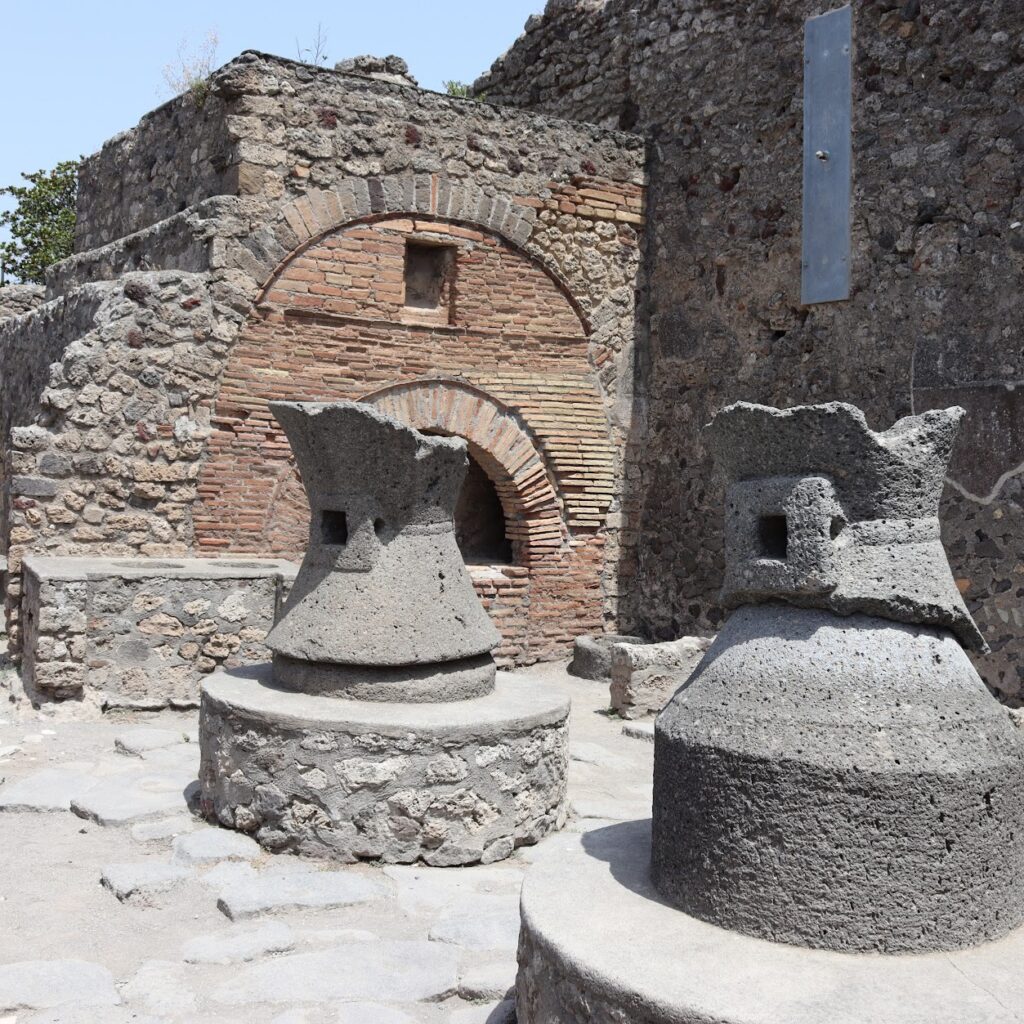
Bread was prepared from flours ground using stone querns; it could be baked in conical ceramic moulds (the bedja) or as flatbreads laid directly on the embers. Numerous varieties were produced, some enriched with seeds (sesame, coriander), spices or sweet purées. Other loaves contained milk, honey or dried fruit, or were leavened with natural sourdough. They could be flat, spherical, conical, or even shaped like fish or sacred animals. The most common bread remained a dense loaf made of water, flour and salt.
Flour was often mixed with impurities: sand, grit, organic debris. This wore down the teeth: Egyptian mummies frequently show extremely damaged dentition.
Beer was obtained by fermenting barley bread in water. It was filtered, sometimes flavoured with dates or herbs, and classified by colour: red beer (pale, light) and black beer (denser, stronger). Rich in calories, it was at once a drink, a food and an offering. It was brewed at home or in state breweries, such as those depicted in the tomb of Meketre.
Vegetables and sun-ripened fruit
Fresh vegetables made up a significant part of the diet: onions, garlic, leeks, lettuces, cucumbers, radishes, celery, parsley… These products of the Nile’s gardens were eaten raw, grilled or boiled, in soups or as side dishes. Lentils, broad beans and chickpeas, rich in vegetable protein, formed the basis of everyday dishes for the poorest, often mixed with flour into flatcakes.
Figs, dates, grapes, pomegranates, melons and berries were served as snacks, as desserts, or worked into dishes. One particularly interesting fruit, now extinct, once enriched Egyptian orchards: the persea. This plant of the sapodilla family unfortunately disappeared during antiquity, most likely as a result of the drying climate. It bore small stone fruits with yellow flesh, whose exact flavour we shall never know. Its name, inherited from Greek, means it is sometimes confused with the avocado tree – named Persea americana by botanists much later: a pure coincidence of nomenclature, the two trees being botanically unrelated.
Apples, plums, peaches and apricots were introduced later, in the Ptolemaic period. The Egyptian word for ‘apple’, depeh, is a Semitic loanword.
Marsh plants were also eaten: tiger nut sedge, papyrus, rushes… In the first century BCE, Diodorus Siculus claimed that the Nile marshes alone were enough to feed the poor and the sick[1]. Tiger nut, sweet and fragrant, was used to make cakes or flours. In the tomb of Rekhmire, a scene shows the preparation of tiger-nut cakes, probably served with a syrup of dates and honey.
Contrary to popular belief, the ancient Egyptians did not wait for the arrival of the Greeks to cultivate the vine and the olive. The production and consumption of wine are attested from the late 4th millennium BCE, well before the emergence of the pharaonic state. Wine jars were regularly among the grave goods found in pre-pharaonic royal tombs. Analysis of the seals stamped on these vessels makes it possible to identify the regions renowned for their quality wines, notably the oases of the Libyan desert. Likewise, although less widespread, olive cultivation is attested in the Nile valley from at least the early 2nd millennium BCE, before undergoing considerable expansion in the Hellenistic period.
Scarce meat, abundant poultry and fish
Meat consumption varied according to social class. Peasants and labourers ate little of it: meat was expensive, often reserved for offerings or religious festivals. Beef, sacrificed to the gods, was prized by the elite. Sheep and goats were kept for their milk as much as for their meat. Pork, although sometimes regarded as unclean, was eaten by the common classes. Herodotus, in the 5th century BCE, mentions a religious taboo[2], but notes that pork was nonetheless eaten once it had been sacrificed.
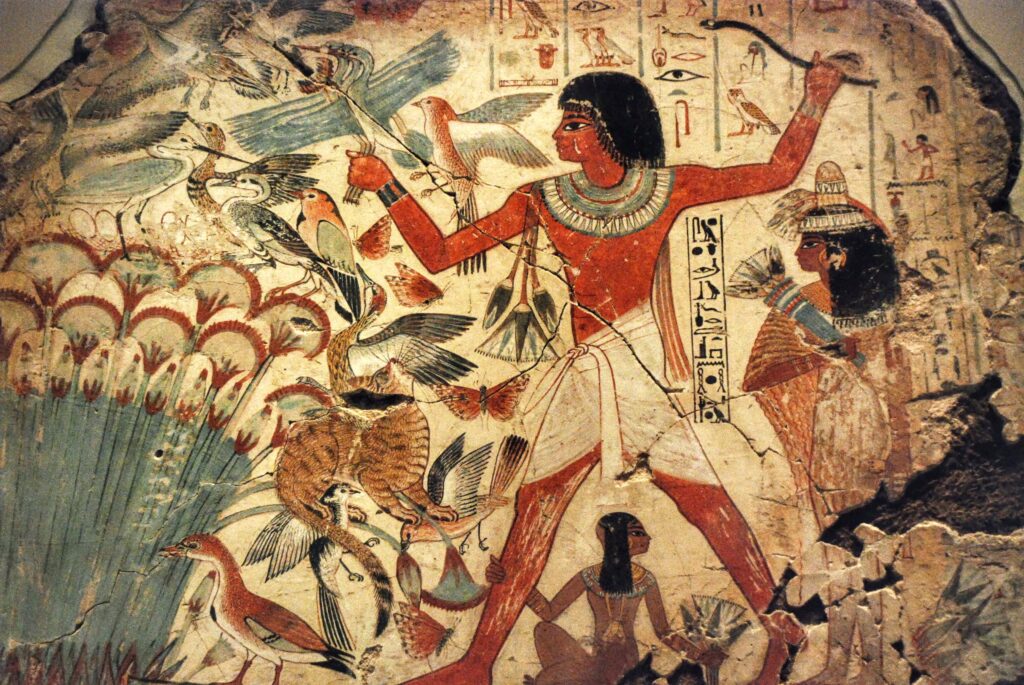
Poultry was a major source of protein: ducks, geese, cranes, pigeons, doves, even pelicans and ostriches. The latter were valued for their eggs, large in size and prized in flavour. The chicken appears only late in the Egyptian culinary landscape. Native to South Asia, its presence is attested only in a very limited way, as shown by an Egyptian ostracon dating from around 1350 BCE depicting a wild cockerel. While chickens and hens’ eggs were imported as exotic curiosities, large-scale poultry farming truly began only in the Ptolemaic period.
Fish were abundant in the Nile and its lakes: tilapia, catfish, perch, grey mullet, Nile ‘salmon’, carp, eel. They were often dried, salted or smoked. The medjed (or oxyrhynchus fish) was sacred in certain towns. The Egyptians excelled in the art of preserving food in various forms. Beyond traditional sun-drying and salting, they mastered sophisticated techniques such as making confits, slow-cooking meat and poultry in fat before sealing them in jars. More surprisingly still, they may even have invented a primitive form of caviar by salting the roe of grey mullet.
An inventive cuisine, sweet and spiced
Egyptian cooking drew on a wide variety of spices and aromatics: dill, coriander, cumin, fenugreek, fennel, parsley, thyme, oregano, mint, mustard, palm nuts, lotus flowers. Linseed, sesame, castor and balsam oils were used for cooking or seasoning.
Dishes were braised, boiled, roasted or stewed. Certain animals (birds, pigs, hyenas) were even fattened up. Small animals were stuffed with spices and minced meat. Hedgehogs were cooked in clay, the hardened shell then broken open to remove the spines.
Sweets were made from honey, dates, carob flour or tiger nut flour. Fruit cakes were reserved for festivals. Pastry-makers were sometimes called ‘date workers’. The paste obtained from pounded tiger nuts, as shown in the tomb of Rekhmire, had a texture close to ground almonds.
Eating to exist: the meal as a religious act
The morning meal held a fundamental place in the Egyptian day. It was meant to restore strength after the night’s fast and prepare the body for exertion. Generally consisting of bread, light beer and onions or vegetables, it offered labourers and elites alike a form of energetic renewal, seen as necessary to physical and vital balance. This first meal was often eaten quickly, but it was no less symbolic for that, in a culture where eating also meant staying alive.
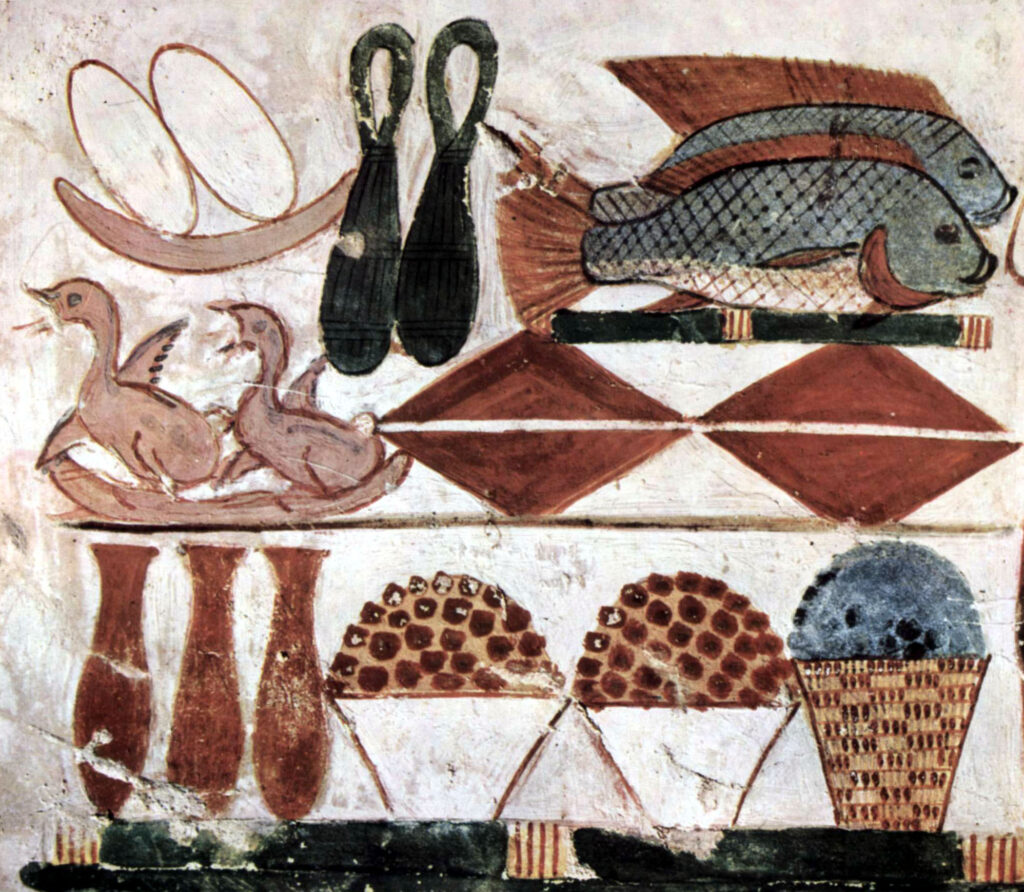
For the Egyptians, food did not serve merely to satisfy a physical need: it was also a means of renewing the body’s vitality. To eat was to regenerate oneself, to maintain the individual’s bodily and spiritual balance. Every foodstuff, in this view, helps sustain the body’s vital breath (ankh). Chewing, ingestion and assimilation were seen as processes that restored the strength of the living, exactly as the Nile’s waters fertilise the land each year. For the dead, the need for nourishment continued: the deceased had to be revivified through offerings, to stave off decay and oblivion. Food was thus a source of cosmic permanence, and every meal was, in a sense, an act of resistance against disintegration, for the living and the dead alike. This conception explains the importance of meals in funerary rites and in temples, where divine statues were fed to sustain their power. Stone offering tables received bread, beer, geese, and carved fish. Magical formulae were recited to activate the images. The water poured over these reliefs was symbolically charged with the substance of the food and ‘descended’ to nourish the dead.
Moderation, gluttony and the philosophy of the table
In the wisdom texts of the 1st millennium BCE (the Papyrus Kagemni, Ptahhotep, Insinger), eating to excess is a mark of immoderation and self-debasement. The ideal is moderation: the belly must not rule the heart. Satirical texts such as ‘The Dissolute Harpist’ also poke fun at gluttony: its hero Haroudja (a fictional glutton, created to raise a laugh at the expense of his appetite) is portrayed as a man starved and obsessed with meat, ready to leap up at the merest announcement of a rare dish.
Yet this austere morality is sometimes contradicted by hedonistic calls to enjoy the present moment, in the face of death’s imminence. Such is the Appeal to the Living of Eshu, a priest in the service of the temple of Thoth, carved in the tomb of Petosiris (4th century BCE):
‘Drink, feast, for none knows when it [death] will come.’
A Pastry for Eternity
Most of the cooking scenes depicted in Egyptian tombs show us snapshots: a baker shaping his bread, a roaster watching over his spit, a brewer filtering his beer. But at the heart of the Theban necropolis, a unique treasure presents itself to Egyptologists: a genuine pastry recipe told in pictures.
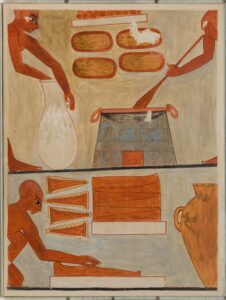
The tomb of the vizier Rekhmire, a high-ranking official of the mid-15th century BCE, holds on the south wall of its funerary chapel an exceptional scene that meticulously details the entire making of a tiger-nut cake, from the grinding of the tubers to the delivery of the finished product.
The tiger nut (Cyperus esculentus), a small marsh plant whose tuber is barely larger than a hazelnut, was particularly prized by the Egyptians for its lightly sweet flavour. Both a treat in its own right and a pastry ingredient, it featured in the composition of many sweetmeats.
The fresco first shows us two men bent over a vessel set on a tripod, at the far right of the scene. They are mixing tiger-nut flour –obtained by grinding the tubers– with emmer or barley flour. This addition of cereal is crucial: it supplies the gluten needed to give the dough elasticity, something tiger nut naturally lacks.
The next stage takes us to the heart of the baking. The dough is placed in wok-shaped metal vessels, themselves set upon brick hearths of high heat-retaining capacity. The intense heat sears the mixture quickly, requiring regular turning with long spatulas to stop the cake from burning.
A valuable detail appears in the hieroglyphs accompanying the scene: the addition of fat to the scorching vessel. This ‘white fat for cakes’, probably held in the tall white pot handled by a figure near the hearths, likely played the role of our modern butter or oil, stopping the dough from sticking to the sides.
Once baked, the cake, known as shat, takes on a triangular shape. This appearance, which might seem strange, may result from an Egyptian artistic convention aimed at showing an object from its most recognisable angle –here, the cake seen from above. The triangles are then left to cool, their shape touched up, before finally being stacked and handed to a carrier visible at the far left of the composition.
The vizier Rekhmire, by taking with him the detailed image of this preparation, was not merely adorning his final resting place: he was ensuring that, in the afterlife, he could go on enjoying his favourite treat.
[1] Diodorus Siculus, Bibliothèque historique, Livre I, 34, 3-5:
πραεῖαν δὲ τοῦ Νείλου τὴν ῥύσιν ποιουμένου, καὶ γῆν πολλὴν καὶ παντοδαπὴν καταφέροντος, ἔτι δὲ κατὰ τοὺς κοίλους τόπους λιμνάζοντος, ἕλη γίνεται πάμφορα. ῥίζαι γὰρ ἐν αὐτοῖς φύονται παντοδαπαὶ τῇ γεύσει καὶ καρπῶν καὶ καυλῶν ἰδιάζουσαι φύσεις, πολλὰ συμβαλλόμεναι τοῖς ἀπόροις τῶν ἀνθρώπων καὶ τοῖς ἀσθενέσι πρὸς αὐτάρκειαν. οὐ γὰρ μόνον τροφὰς παρέχονται ποικίλας καὶ πᾶσι τοῖς δεομένοις ἑτοίμας καὶ δαψιλεῖς […]
‘As the Nile has a gentle flow, and carries down a great quantity of soil of every kind, and also forms stagnant waters in the low-lying areas, marshes of every sort are created there. In them grow roots of varied flavour, together with particular kinds of fruits and stalked plants, which contribute greatly to the subsistence of the poor and the sick. For they provide varied foods, readily available and abundant, for all those in need of them […]’
[2] Herodotus, Histoires, II, 47, 1:
ὗν δὲ Αἰγύπτιοι μιαρὸν ἥγηνται θηρίον εἶναι, καὶ τοῦτο μὲν ἤν τις ψαύσῃ αὐτῶν παριὼν αὐτοῖσι τοῖσι ἱματίοισι ἀπ᾽ ὦν ἔβαψε ἑωυτὸν βὰς ἐς τὸν ποταμόν· τοῦτο δὲ οἱ συβῶται ἐόντες Αἰγύπτιοι ἐγγενέες ἐς ἱρὸν οὐδὲν τῶν ἐν Αἰγύπτῳ ἐσέρχονται μοῦνοι πάντων, οὐδέ σφι ἐκδίδοσθαι οὐδεὶς θυγατέρα ἐθέλει οὐδ᾽ ἄγεσθαι ἐξ αὐτῶν, ἀλλ᾽ ἐκδίδονταί τε οἱ συβῶται καὶ ἄγονται ἐξ ἀλλήλων.
τοῖσι μέν νυν ἄλλοισι θεοῖσι θύειν ὗς οὐ δικαιοῦσι Αἰγύπτιοι, Σελήνῃ δὲ καὶ Διονύσῳ μούνοισι τοῦ αὐτοῦ χρόνου, τῇ αὐτῇ πανσελήνῳ, [τοὺς] ὗς θύσαντες πατέονται τῶν κρεῶν. διότι δὲ τοὺς ὗς ἐν μὲν τῇσι ἄλλῃσι ὁρτῇσι ἀπεστυγήκασι ἐν δὲ ταύτῃ θύουσι, ἔστι μὲν λόγος περὶ αὐτοῦ ὑπ᾽ Αἰγυπτίων λεγόμενος, ἐμοὶ μέντοι ἐπισταμένῳ οὐκ εὐπρεπέστερος ἐστὶ λέγεσθαι.
‘The Egyptians consider the pig an unclean animal. If one of them touches a pig in passing, he goes down to the river and plunges in with his clothes still on. As for swineherds, although Egyptian by birth, they alone among all Egyptians may not enter any temple in Egypt; nor will anyone give a daughter of his in marriage to one of them, or take a wife from among them, so swineherds marry only among themselves.’
The Egyptians do not consider it lawful to sacrifice pigs to any other god; they sacrifice them only to Selene and Dionysus, at the same time, at the same full moon, and after sacrificing the pigs, they eat the meat. Why they hold pigs in abhorrence at other festivals yet sacrifice them at this one, the Egyptians have an explanation; I know it, but it would not be fitting to relate it.’
Sources
- Agut, Damien. Du Nil au désert, l’extraordinaire variété de la diète pharaonique, dans Histoire de l’alimentation, Paris, Belin, 2021.
- King, Arienne. Nourriture et Boissons dans l’Égypte Ancienne. Traduit par Babeth Étiève-Cartwright. World History Encyclopedia. Modifié le juillet 09, 2024.
Related article
Other articles in English from the Nunc est bibendum blog