Translated from french (please notify us of errors)
Vinegar and honey: the sharp-sweet mixture is enough to raise an eyebrow – it is almost a culinary oxymoron. The Greeks and Romans, however, saw no contradiction in it: they turned it, in turn, into a remedy for epilepsy, a sauce for pork, a brine for peaches and a seasoning for cabbage. From Hippocrates to Anthimus, oxymel runs through Antiquity and survives to this day.
“People have even gone so far as to mix honey with vinegar: what has man not tried?”[1], asks Pliny the Elder, before revealing the name of the mixture: oxymel. It owes its name to two Greek words joined together: oxys (ὀξύς), ‘sharp, pungent’, and meli (μέλι), ‘honey’. The result, oxymeli (ὀξύμελι), thus literally denotes a sharp honey.
The Hippocratic Corpus already treats it, between the 5th and 4th centuries BCE, in the treatise Regimen in Acute Diseases, as a medicine in its own right: “the drink called oxymel you will find useful in many cases in these diseases: it promotes expectoration and eases breathing”. The treatise takes care to note its limit: prepared too sharp, oxymel may “fail to bring up the phlegm, and instead make it more viscous, and do harm”[2].
The word, moreover, left medical treatises early on for everyday speech. In the 4th century BCE, the orator Lysias used it in a now-lost forensic speech, Against Theopompus for Assault: “I drink oxymel”[3]. The precise context of this line within the speech is unknown: the fragment has reached us only several centuries later, isolated and quoted by Athenaeus in his Deipnosophistae, not for its content but seemingly to justify the correct grammatical formation of compounds in oxy-.
This Greek medical and dietary vocabulary (oxymeli, but also coriandrum, cuminum or menta, for example) migrated unchanged into Latin: one sign, among others, of the debt Roman pharmacology owed to Greece.
Cato seasons his cabbage
In Cato the Elder’s treatise De agri cultura, in the 2nd century BCE, is found the oldest known Latin attestation of the word. In the interminable chapter he devotes to the virtues of cabbage, Cato recommends, against joint pain, eating chopped raw cabbage every morning on an empty stomach, sprinkled with rue, dried coriander, a little grated silphium, and “cabbage [seasoned] with honeyed vinegar and sprinkled with salt”[4]. The Roman peasant’s cabbage here doubles as medicine – the line between kitchen and pharmacy, in Antiquity, was never very firm.
The recipe itself, moreover, is not a Latin invention. In Greece, the Greek physician Mnesitheus of Cyzicus – whose testimony has reached us through the compiler Oribasius, in the 4th century CE – prescribed an almost identical chopped cabbage: “The cabbage must be cut with the sharpest knife, then washed and the water left to drain off, and chopped with enough coriander and rue; then sprinkled with oxymel, and a little silphium grated over it”[5].
From a sauce for suckling pig to peaches in a jar
If oxymel heals, it also seasons without any medical pretension. Columella, in the 1st century CE, explains how to preserve parsnip root (siser) in a jar; when serving, “it is taken out of the jar and drizzled with oxymel and a little oil”[6].
The physician Anthimus, who wrote a dietary treatise for a Frankish king in the 6th century, recommends serving suckling pig “dipped in plain oxymel”[7], a sauce prepared “with two parts honey to one part vinegar […] and cooked in an earthenware vessel”[8]. In their sweet-and-sour balance and concentrated character, some modern balsamic vinegars may recall, mutatis mutandis, this waterless oxymel.
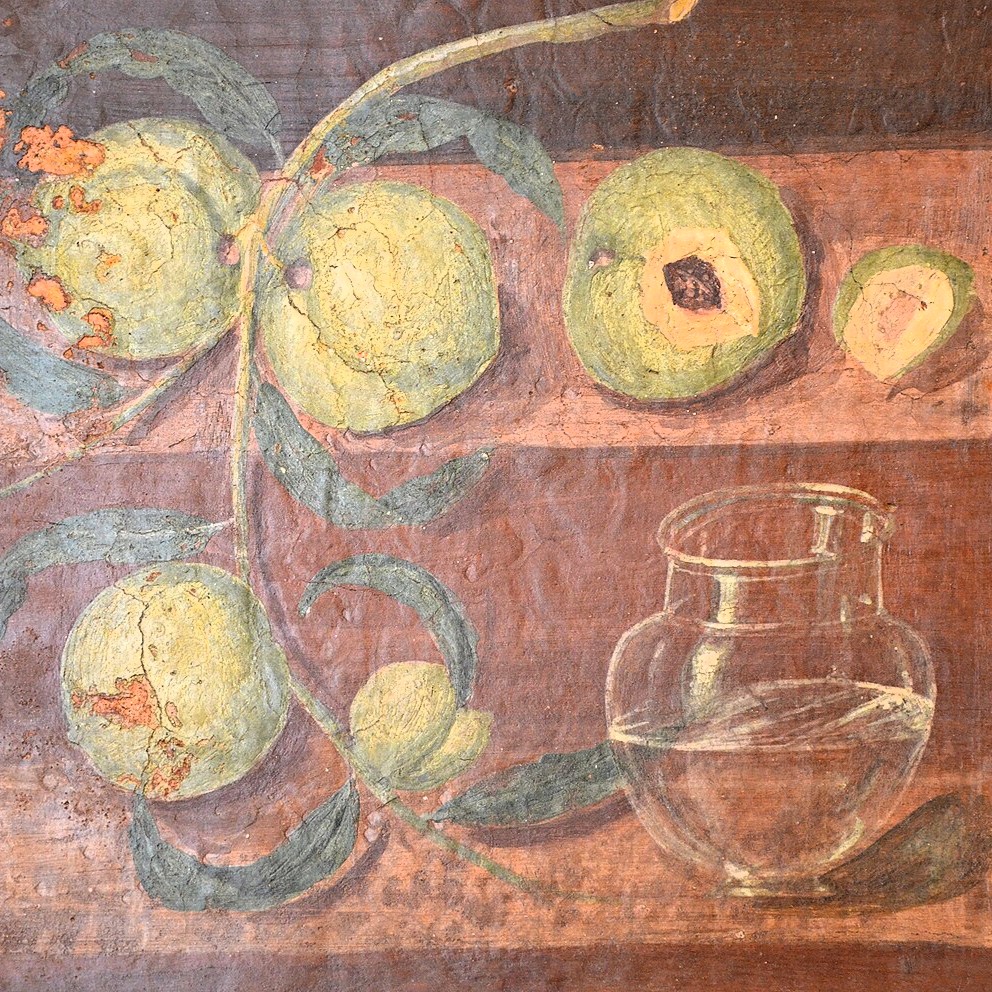
Finally, oxymel served for preservation. Pliny the Elder, in the 1st century CE, tells how Augustus, cured of an illness thanks to lettuces prescribed by his physician Musa, revived their fashion to the point that “a way was then discovered of preserving them, even beyond their season, in oxymel”[9]. The agronomist Gargilius Martialis, in the 3rd century CE, explains, for his part, that the peach “cannot be kept for long unless it is placed in a brine mixed with oxymel”[10]. Palladius, in late Antiquity, repeats Gargilius’s formula almost word for word: “clingstone peaches are kept in a brine mixed with oxymel”, before being sun-dried “in the manner of figs”[11].
A recipe that varied
One would search the whole of ancient literature in vain for a canonical recipe for oxymel. Dioscorides, in the 1st century CE, gives a precise one: five cotylae of vinegar, one mina of sea salt, ten minae of honey, ten cotylae of water, all boiled ten times then jarred once cooled[12] – useful, he specifies, against sciatica, arthritis, epilepsy, viper bites, the ingestion of poppy juice or mistletoe, and as a gargle against sore throats.
Pliny the Elder gives a similar but not identical formula: ten pounds of honey, five heminae of old vinegar, one pound of sea salt, five sextarii of rainwater, boiled ten times then decanted and left to age[13]. Elsewhere in his Natural History, he attributes to a certain Dieuches a third version: ten minae of honey, five heminae of vinegar, one and a quarter pounds of sea salt, five sextarii of water[14].
The physician Galen, in the 2nd century CE, explicitly rejects the idea of a single universal proportion. His method is to skim the finest honey over embers, add just enough vinegar that the mixture tastes “neither too sharp nor too sweet”, then, when serving, cut it all with water, “as is done with wine”[15].
The mixture, indeed, has survived down to us. Today one finds, from beekeepers and in health-food shops, oxymels sold as “one of the oldest known natural remedies”, most often mint-flavoured and presented as an ally of digestion and the immune system. The recipe has changed a little, but the sales pitch would not have been out of place with Dioscorides, Pliny or Galen.
Modern studies consulted
- Maciej Kokoszko, “Anthimus and His Work, or on Aromatics and Wildfowl in De observatione ciborum”, Symbolae Philologorum Posnaniensium Graecae et Latinae, 31/2, 2021.
- Dominika Budzanowska-Węglenda, “Cato the Elder on Human and Animal Diseases and Medicines for Them”, Classica Cracoviensia, 21, 2018.
[1] Pliny the Elder, Natural History, XIV, 114:
Quin et acetum melle temperabatur: adeo nihil intemptatum vitae fuit. oxymeli hoc vocarunt, mellis decem libris, aceti veteris heminis quinque, salis marini libra, aquae pluviae sextariis quinque suffervefactis deciens, mox elutriatis atque ita inveteratis.
“People have even gone so far as to mix honey with vinegar: what has man not tried? This drink was given the name oxymel; dose: ten pounds of honey, five heminae of old vinegar, one pound of sea salt, five sextarii of rainwater; the mixture is brought to the boil ten times, decanted, and left to age.”[2] Hippocrates [Hippocratic Corpus], De diaeta acutorum, 16 (ed. Littré):
Τὸ δὲ ὀξύμελι καλεύμενον ποτὸν πολλαχοῦ μὲν εὔχρηστον ἐν ταύτῃσι τῇσι νούσοισιν εὑρήσεις ἐόν· καὶ γὰρ πτυάλου ἀναγωγόν ἐστι, καὶ εὔπνοον. […] Ἔστι δ’ ὅτε τὸ κάρτα ὀξὺ οὐκ ἐκράτησε τῆς ἀναγωγῆς τοῦ πτυέλου, ἀλλὰ προσεγλίσχρηνέ τε καὶ ἔβλαψεν· μάλιστα δὲ τοῦτο πάσχουσιν οἵπερ καὶ ἄλλως ὀλέθριοί εἰσι, καὶ ἀδύνατοι βήσσειν τε καὶ ἀποχρέμπτεσθαι τὰ ἐνεχόμενα.
“The drink called oxymel you will find useful in many cases in these diseases: it promotes expectoration, and eases breathing. […] Sometimes the very sharp [drink] fails to bring up the phlegm, and instead makes it more viscous, and does harm; this happens above all to those who are otherwise near death, and unable to cough up and spit out what is obstructing them.”
[3] Lysias, fr. 111 Tur., ap. Athenaeus, Deipnosophistae, II, 76 (ed. Kaibel):
λεκτέον δὲ ὀξύγαρον διὰ τοῦ ῡ καὶ τὸ δεχόμενον αὐτὸ ἀγγεῖον ὀξύβαφον· ἐπεὶ καὶ Λυσίας ἐν τῷ κατὰ Θεοπόμπου αἰκίας εἴρηκεν· ἐγὼ δ’ ὀξύμελι πίνω. οὕτως οὖν ἐροῦμεν καὶ ὀξυρόδινον.
“One must say oxygaron with a [long] upsilon, and the vessel that holds it, oxybaphon; since Lysias too, in Against Theopompus for Assault, said: ‘I drink oxymel.’ So we shall likewise say oxyrhodinon.”
[4] Cato, De agri cultura, 157, 7:
brassicam ex aceto oxymeli et sale sparsam.
“cabbage seasoned with honeyed vinegar and sprinkled with salt”.
The Latin sentence may give pause: should we understand that Cato was adding two separate ingredients, vinegar (acetum) and oxymel? It is more likely an apposition: oxymeli specifies the nature of the acetum.
[5] Mnesitheus of Cyzicus, ap. Oribasius, Collectiones medicae, IV, 4, 1:
κράμβην χρὴ κατακόψαι ὡς ὀξυτάτῳ σιδηρίῳ, εἶτα ἀποπλῦναι καὶ τὸ ὕδωρ ἐᾶσαι ἀπηθηθῆναι καὶ συγκατακόψαι κορίου καὶ πηγάνου ὅσα ἱκανά· εἶτα ὀξυμέλιτι ῥάνον, καὶ ὅσον οὖν τι μικρὸν σιλφίου ἐπίξυσον.
“The cabbage must be cut with the sharpest knife, then washed and the water left to drain off, and chopped with enough coriander and rue; then sprinkled with oxymel, and a little silphium grated over it.”
[6] Columella, De re rustica, XII, 58, 3:
eximes de fidelia et oxymeli cum exiguo oleo superfunde.
“it is taken out of the jar and drizzled with oxymel and a little oil”
[7] Anthimus, De observatione ciborum, 10 (cited by M. Kokoszko, 2021, p. 62):
intingendo in oximelli simplici.
“dipped in plain oxymel”
[8] Anthimus, De observatione ciborum, 10, 7, 11-12 (cited by M. Kokoszko, 2021, p. 64):
duas partis de melle et una pars de aceto […] coquat in vas fictile.
“two parts honey and one part vinegar […] cooked in an earthenware vessel”
[9] Pliny the Elder, Natural History, XIX, 128:
ut servari etiam in alienos menses eas oxymeli tum repertum sit.
“a way was then discovered of preserving them, even beyond their season, in oxymel”.
[10] Gargilius Martialis, De arboribus pomiferis, II, De persicis, 12, 1 (ed. J. L. Zainaldin, 2020, p. 98):
Persici pomum, nisi conditum muria et oxymelle, asseruari diu non potest.
“The fruit of the peach tree cannot be kept for long unless it is placed in a brine mixed with oxymel.”
[11] Palladius, Opus agriculturae, XII, 7, 8 (ed. R. H. Rodgers, 1975):
Duracina seruantur condita muria et oxymelle uel detractis ossibus ficorum more in sole siccantur ac pendent. […] Item saepe uidi detractis ossibus duracina melle condiri et saporis esse iucundi.
“Clingstone peaches are kept in a brine mixed with oxymel; or else, once stoned, they are sun-dried in the manner of figs and hung up. […] I have also often seen clingstone peaches, once stoned, preserved in honey: they were pleasant in flavour.”
[12] Dioscorides, De materia medica, V, 14, 1 (ed. Wellmann):
<ὀξύμελι> σκευάζεται οὕτω· λαβὼν ὄξους κοτύλας πέντε καὶ ἁλὸς θαλασσίου μνᾶν μίαν, μέλιτος μνᾶς δέκα, ὕδατος κοτύλας δέκα, μείξας ἕψησον, ἄχρις οὗ ἂν δεκάκις ἀναβράσῃ, καὶ ψύξας κατάγγισον. δοκεῖ δὲ λαμβανόμενον πάχος ἄγειν, ὠφελοῦν ἰσχιαδικοὺς καὶ ἀρθριτικοὺς καὶ ἐπιλημπτικούς· ἀρήγει δὲ καὶ τοῖς ὑπὸ ἐχίδνης τῆς καλουμένης σηπὸς δηχθεῖσι καὶ τοῖς μηκώνιον ἢ ἰξίαν πιοῦσιν, ἀναγαργάρισμά τέ <ἐστι> συναγχικοῖς ὠφέλιμον.
“Oxymel is prepared thus: take five cotylae of vinegar, one mina of sea salt, ten minae of honey, ten cotylae of water; mix and boil until it has come to the boil ten times, then, once cooled, put it in a jar. Taken this way, it seems to purge thick humours, useful for sciatica, arthritis and epilepsy sufferers; it also aids those bitten by the viper called the seps, and those who have drunk poppy juice or mistletoe juice; as a gargle, it is useful for those with sore throats.”
[13] See note [1].
[14] Pliny the Elder, Natural History, XXIII, 60-61:
Oxymeli antiqui, ut Dieuches tradit, hoc modo temperabant: mellis minas X, aceti veteris heminas V, salis marini pondo libram quadrantem, aquae sextarios V pariter coquebant deciens defervescente cortina atque ita diffundebant inveterabantque.
“The ancients, according to Dieuches, prepared oxymel thus: ten minae of honey, five heminae of old vinegar, one and a quarter pounds of sea salt, five sextarii of water, all boiled together to ten risings of the boil, then jarred and left to age.”
[15] Galen, De sanitate tuenda, IV, 6 (ed. Kühn):
μέλι τὸ κάλλιστον ἐπ’ ἀνθράκων ἀπαφρίσαντες, ἐπεμβάλλειν αὐτῷ τοσοῦτον ὄξους, ὡς γευομένῳ μήτ’ ἄγαν ὀξὺ φαίνεσθαι, μήτε γλυκύ […] εἶτ’ ἀποθέμενον τούτῳ μιγνύειν ὕδωρ ἐπὶ τῆς χρήσεως, οὕτως κεραννύντας, ὡς οἶνον […] οὐ γὰρ ἐπαινῶ τοὺς κατὰ μίαν τινὰ συμμετρίαν σκευάζοντας αὐτό.
Title: Oxymel, a culinary oxymoron
“Having skimmed the finest honey over embers, one adds enough vinegar that the taste is neither too sharp nor too sweet […] then, having set it aside, one mixes in water at the time of use, cutting it thus as is done with wine […] for I do not commend those who prepare it according to a single fixed proportion.”
A note on measures
The recipes quoted freely mix Greek and Roman units. The Greek cotyle (κοτύλη) and the Roman hemina both denote roughly a quarter of a litre; the sextarius is twice that, or roughly half a litre. As for solids, the Greek mina (μνᾶ) weighs about 431 grams, the Roman libra (pound) about 329 grams.
Other articles in English from the Nunc est bibendum blog