Translated from French (please notify us of errors)

 Two, then three, and finally four: unlike humans, the fork does not lose its teeth with time. Contrary to popular belief, this utensil — now indispensable on our tables — is not a medieval or Renaissance invention. Its existence is attested in the Roman Empire, between the 1st and 5th centuries CE.
Although far less common than spoons, it can be found on display in numerous museums[1]. Latin, moreover, has words for the fork: fuscinula or furcula, which, as in French, are diminutives of the words for a pitchfork (or trident).
Although their exact use remains a mystery, these two- or three-pronged Roman forks probably served as meat picks at banquets held by the Roman elite, either for serving or as an alternative to the messier practice of using the right hand to bring food to the mouth. In any case, ordinary people rarely saw meat on their table, let alone a fork…
A mysterious disappearance
With the fall of the Western Roman Empire in the 5th century, the fork disappears from European tables — or at least from the written and archaeological record. The reasons for this eclipse remain poorly understood: it probably owes more to the simplicity of early medieval table habits, where a knife and fingers sufficed, than to any specific religious hostility. It is sometimes said that the object was shunned because its prongs recalled the devil’s pitchfork: no known medieval source, however, appears to make this connection[2]. Curiously, the oldest forks found in France, dated to the 15th century, resemble the model soon to arrive from the East less than they resemble certain third-century Gallo-Roman forks — which raises the question of whether the practice was really interrupted everywhere, or merely eclipsed in the surviving sources.

In Persia, by contrast, the fork thrives. From the 5th century, the Sasanian Empire adopts the utensil and gives it a distinctive shape, with a handle ending in a half-circle supporting two long, closely set prongs. It even survives the Arab conquest of the mid-7th century there, before disappearing in its turn — this time in Persia — during the 10th century, just as its design begins its migration towards the Byzantine Empire.
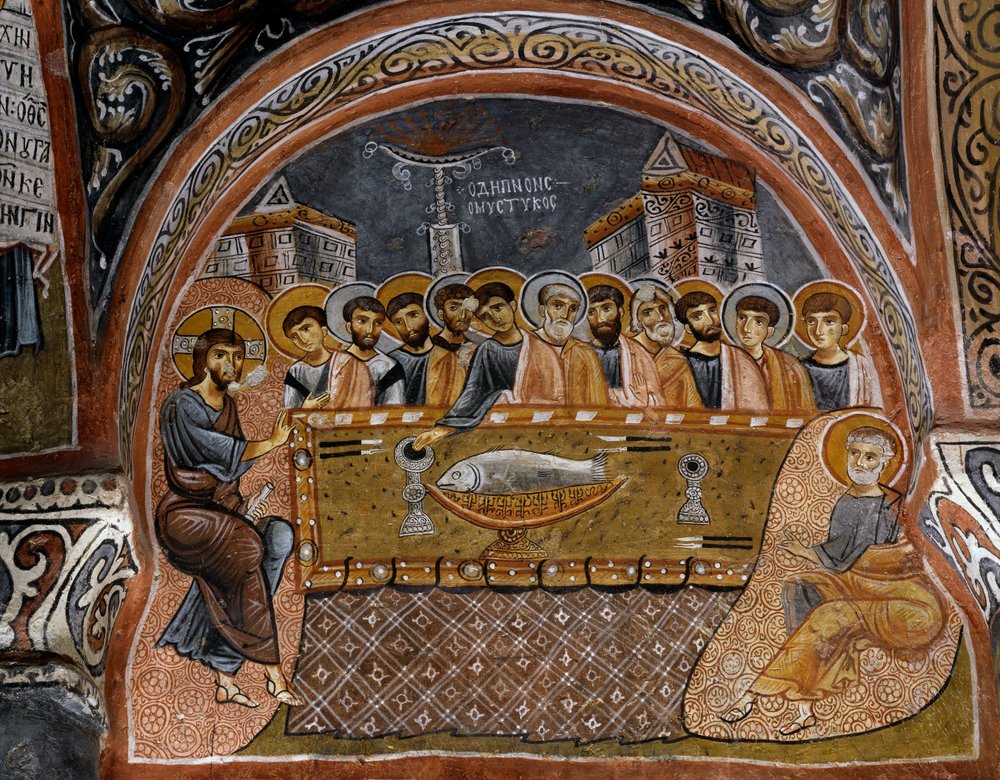
It is indeed from the 10th century that the Sasanian-style fork appears in the religious iconography of Cappadocia: it can notably be made out set on the table of a Last Supper at Ballı Kilise, in Soğanlı, and on that of the Wedding at Cana in the old Tokalı Kilise, at Göreme — two banqueting scenes, as if the object, still rare in the West, naturally found its place at these lavishly laid biblical tables. Other, slightly later, examples adorn the painted tables of Karanlık and Çarıklı Kilise, two rock-cut churches at the same Göreme site, now a UNESCO World Heritage Site. Karanlık Kilise — literally “the Dark Church” — owes its name to its few openings, which have paradoxically preserved the freshness of its colours for nearly a thousand years: in its Last Supper, two or three diners each have, beside their knife, a small two-pronged fork, faithful to the model that came from Persia. At Çarıklı Kilise, the utensil even appears outside the strictly eucharistic setting, on the painted table of the monastic refectory and in a scene of Abraham’s Hospitality — a sign that, in Cappadocia, the object is by then no longer an isolated case but a table accessory appearing across several types of scene[3].

In the 11th century it makes its appearance in southern Italy, a region under strong Byzantine influence, then spreads slowly northwards across Europe. It is also to this century that the most famous — and most distorted — anecdote in the entire history of the fork dates back: the reforming monk Peter Damian tells, as a moral example against luxury, the story of a Byzantine princess married to a Doge of Venice, so attached to refinement that she refused to touch her food with her fingers and had it cut into small pieces by her eunuchs, which she then brought to her mouth with a small two-pronged gold fork — a choice which, in Peter Damian’s edifying account, earns her an unappealable divine punishment. The Italian scholar Muratori would identify her in the 18th century as Maria Argyre, wife of Giovanni Orseolo, who died in Venice in 1007. Nothing in the original text states that she herself brought the fork from the East: this is a later inference, taken up and popularised over the following centuries — to the point that a chronologically impossible version, linking the anecdote to another princess born after Peter Damian’s death, is today the most widespread[2].
Legend has it that it was Catherine de’ Medici who introduced the fork to the French court in the 16th century — but written evidence of its use there already exists from the early 14th century, and archaeological evidence from the 15th.
Vade retro
Between the 17th and 18th centuries, the small two- or three-pronged fork becomes a prestige object with four prongs, a symbol of refinement and civilisation at the European table. Its adoption gradually becomes widespread, revolutionising table manners and food hygiene — without, this time, any need to see in it the exorcism of some diabolical connotation: it is, far more prosaically, comfort and table etiquette that gradually impose the fork at every level of society.
[1] “Fourchettes en bronze”, Lugdunum, Museum and Roman Theatres of Lyon.
[2] Pierre Leclercq, “L’étonnante histoire de la fourchette”, University of Liège, 18 November 2018.
[3] Maria G. Parani, “Byzantine Cutlery: An Overview”, Δελτίον της Χριστιανικής Αρχαιολογικής Εταιρείας 31, 2010, pp. 139–164.
Find out more
- “L’étonnante histoire de la fourchette”, interview with Pierre Leclercq, food historian, University of Liège, 18 November 2018.
Other articles in English from the Nunc est bibendum blog