Translated from french (please notify us of errors)
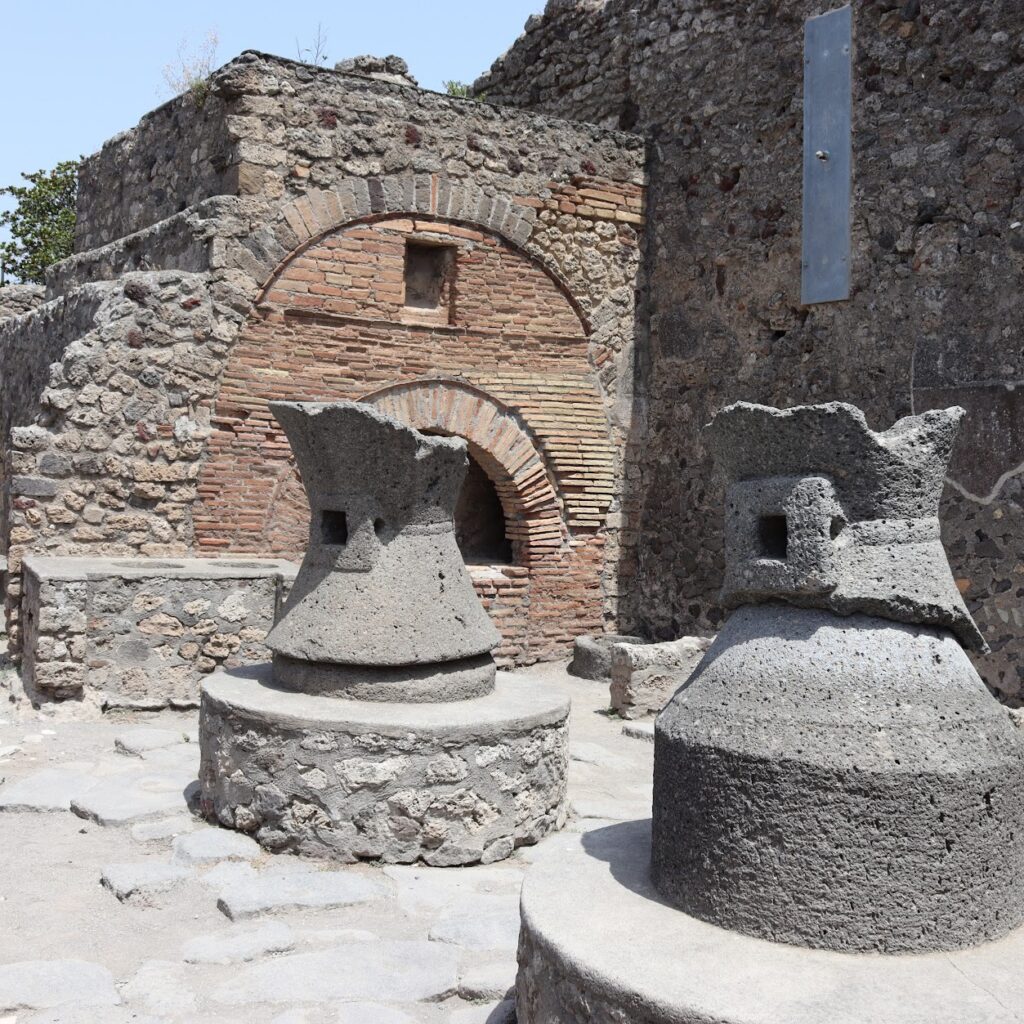
Roman towns teemed with establishments selling food and drink. In the excavated portion of Pompeii alone, archaeologists have identified some 160 of them. This is explained by the fact that only a very small fraction of the population could afford the luxury of a home with a kitchen and dining room. For the masses, then, meals were taken outside the home.
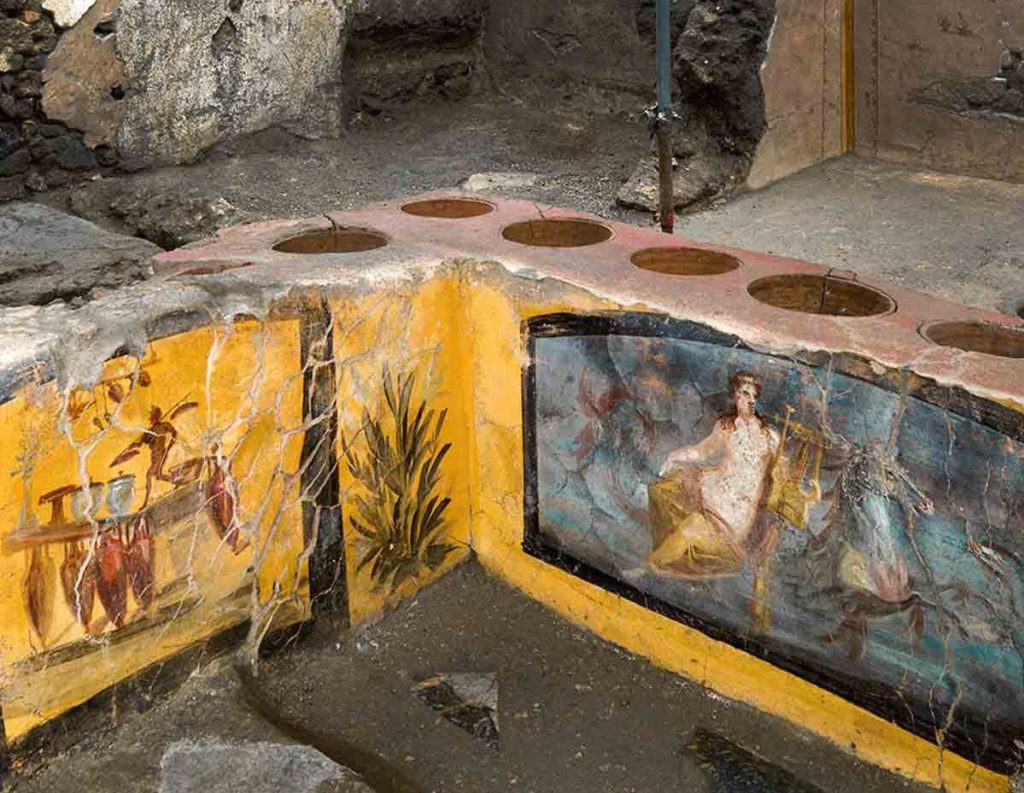
The sources use several terms whose boundaries are difficult to draw: the taberna, a retail shop for foodstuffs that rapidly also became a wine outlet; the caupona, a restaurant and sometimes an inn for travellers, particularly in the countryside; the popina, a small establishment selling food and drink, often quickly and cheaply – a sort of fast food, in other words. If it was truly low-end, the latter might earn the name ganea, a dive, one might say today. As for the term thermopolium, so widely used today, it appears only in Plautus and was probably his own invention.
In reality, the Romans seem to have used these various terms rather indiscriminately, and every possible combination of service and equipment probably existed: a simple L‑shaped counter fitted with large earthenware pots (dolia) containing food served for takeaway; a small room with tables for eating and gambling; modest triclinia reconstructed in masonry as a substitute for the dining rooms of the wealthy; a back room where one could retire to satisfy other appetites, for a fee…
A clientele judged by the elite
In the moralising and satirical literature of the elite, these establishments generally had a poor reputation, owing to the common and sometimes disreputable clientele attributed to them. At the beginning of the second century CE, the poet Juvenal, in one of his Satires, lists the clientele who frequented the popinae: murderers, sailors, thieves, runaway slaves, executioners, coffin-makers, and even a priest of Cybele[1].
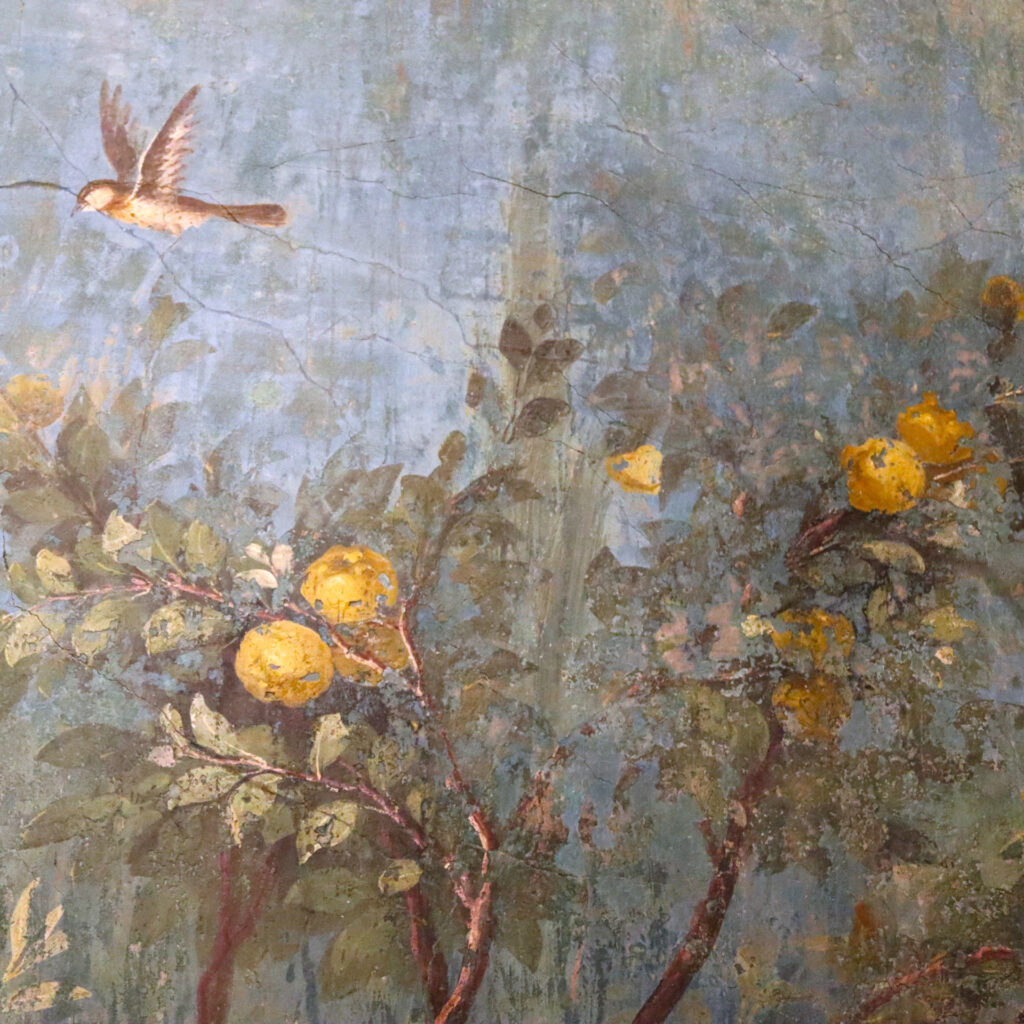
Some establishments were nevertheless decorated with frescoes of great quality, such as the so-called House of Vetutius Placidus in Pompeii, with its painted lararium placed under the joint patronage of Mercury, god of commerce, and Bacchus, god of wine. Or the establishment recently discovered in Regio V, which includes, among other things, a fine depiction of a Nereid – a sea nymph – riding a sea-horse.

Other frescoes offer information on what was on offer, such as one giving the price of wine in a shop in Herculaneum: one as for the poorest quality, two for a better one, and four asses for Falernian, a renowned vintage.
Finally, some illustrations also depict, in the manner of a comic strip, everyday scenes, as in the caupona of Salvius, also in Pompeii. In one scene, two customers are shown quarrelling to attract the attention of the waitress. In another, a game of dice between two men ends in a brawl, with the owner stepping in to throw them out.
Emperors against the bars
In Rome itself, the emperors repeatedly regulated the operation of food and drink outlets: Caligula (who reigned from 37 to 41) banned the sale of hot water and cooked dishes during the mourning period following the death of his sister Drusilla, and even had a man executed for breaking this ban[2]. Earlier, Tiberius (14–37) had prohibited the sale of pastries. Then Claudius (41–54) banned cooked meats and hot water. Nero (54–68) allowed only vegetables and garden produce. Finally, Vespasian (69–79) left nothing on the menu but pulses…
These imperial measures targeted establishments that catered to the poorest clientele, for whom they provided an important setting for sociability. They are therefore generally regarded as aimed at reducing the appeal of bars and restaurants in order to limit the risks associated with popular gatherings.
But these attempts seem to have remained confined to the city of Rome itself and to have had little effect.
[1] Juvenal, Satires, VIII, 172–177:
mitte Ostia, Caesar, mitte, sed in magna legatum quaere popina: inuenies aliquo cum percussore iacentem, permixtum nautis et furibus ac fugitiuis, inter carnifices et fabros sandapilarum et resupinati cessantia tympana galli.
‘Send him to Ostia, Caesar, send him, but look for your legate in some great cookshop instead: you will find him lying beside a cutthroat, mixed in with sailors and thieves and runaway slaves, among executioners and coffin-makers, and the silent tambourines of a Gallus priest sprawled on his back.’[2] Cassius Dio, Roman History, LIX, 11, 6:
πάρεστι δὲ ἐξ ἑνὸς πάντα τὰ τότε γενόμενα τεκμήρασθαι· τὸν γὰρ πωλήσαντα θερμὸν ὕδωρ ἀπέκτεινεν ὡς ἀσεβήσαντα.
‘A single example suffices to judge everything that happened then: he had a man put to death, on a charge of impiety, for having sold hot water.’
Further reading
- Jeremy Hartnett, Bars (taberna, popina, caupona, thermopolium), Oxford classical dictionary. Published online: 22 August 2017
- Marie-Adeline Le Guennec, Le Princeps et la popina. Une législation somptuaire d’un ordre nouveau au Haut-Empire?, Mélanges de l’Ecole française de Rome – Antiquité, École française de Rome, 2016, 128 (1)
Other articles in English from the Nunc est bibendum blog