Translated from French (please notify us of errors)
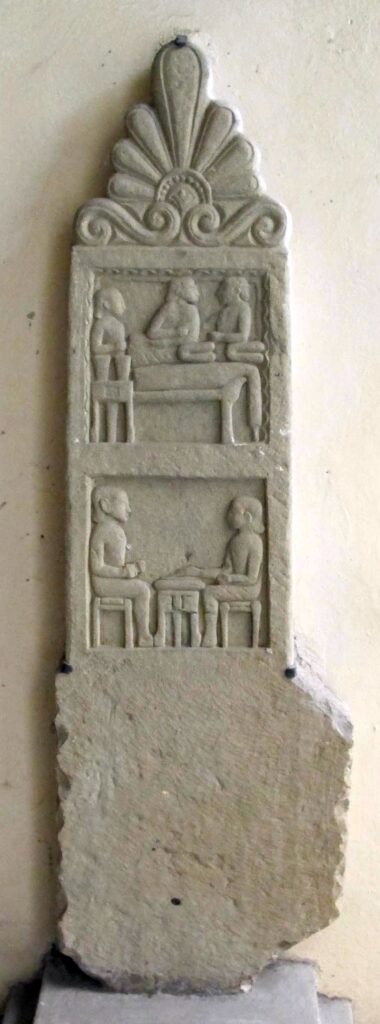
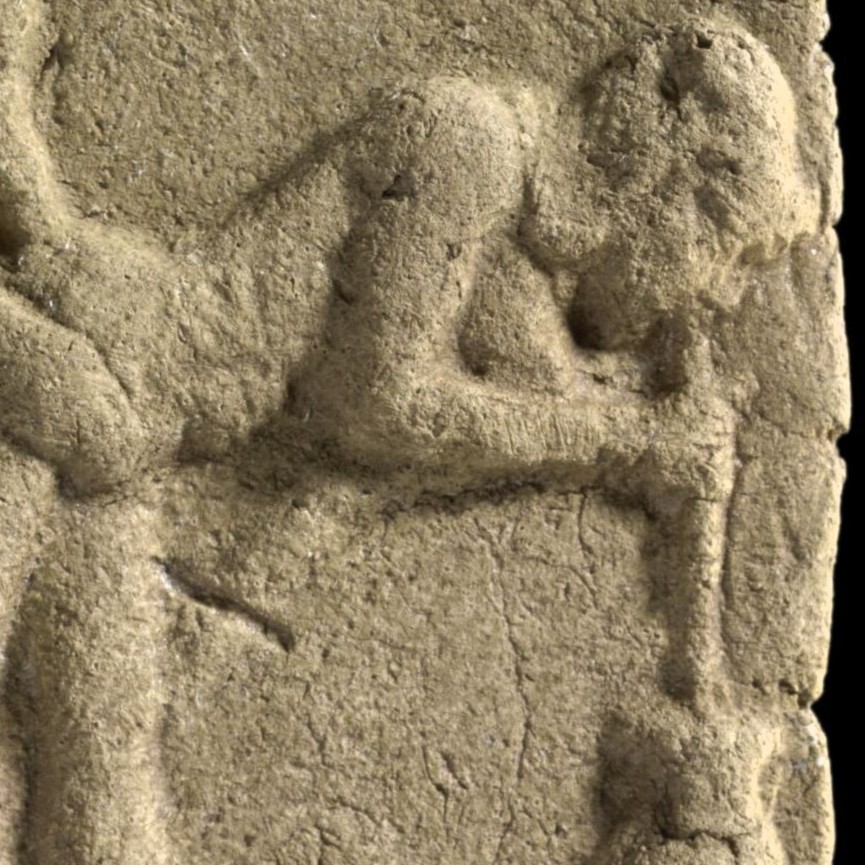
Two passions dear to Nunc est bibendum, dining and games, meet on a stone twenty-five centuries old: the Peruzzi stele, kept at the Villa Corsini a Castello, near Florence. Above, two men raise their cups. Below, two players face each other across a table, and one of them reaches out to make a move that will keep its secret.
Dated to the late sixth or early fifth century BCE, this funerary stele, 1.59 m high, is carved from a local grey sandstone, pietra serena, the very stone that the architects of the Florentine Renaissance would use two thousand years later. Known to scholars since 1824, it was long believed to come from Antella, south-east of Florence, whereas it actually comes from Varlungo, east of the city; the Peruzzi family, who owned it, sold it in 1893 to the Archaeological Museum of Florence. It belongs to the series of “Fiesolan stones”, some forty funerary stelae and cippi carved for prominent families of the territory of Fiesole, the Etruscan Vipsul, from Pistoia to the Mugello. Its trapezoidal surface, crowned with a palmette, is divided into two superimposed registers. On the other stones in the series, we see warriors, sometimes shaking hands, seated women or other banquets.
The banquet: hierarchy and conviviality
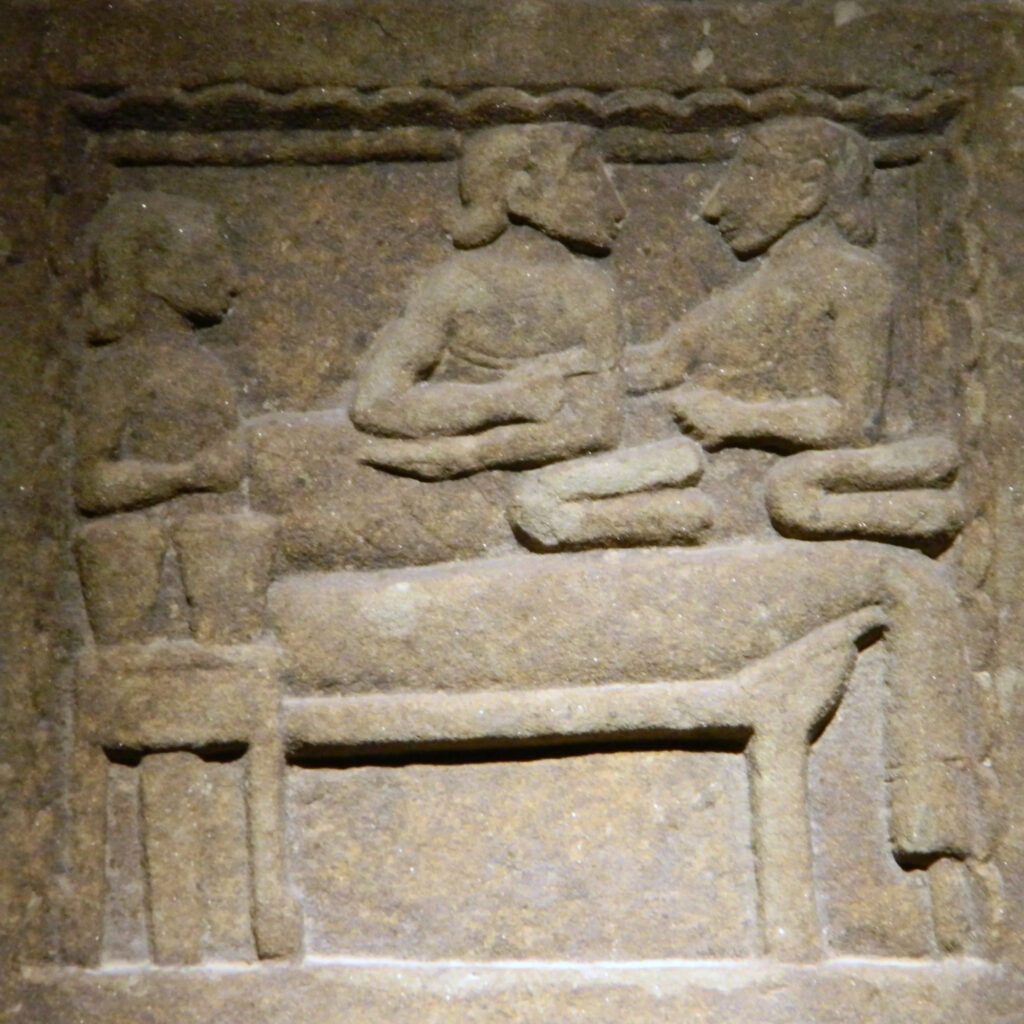
In the upper part, a banquet: two beardless young men, reclining side by side on a klinè, raise their cups while looking at each other. On the left, a cupbearer stands behind a three-legged table on which rest two wine buckets, known as situlae. This detail owes nothing to Greece, it is specific to Etruria. Drinking together, here, is far more than sharing a meal: it is a way of asserting one’s rank and celebrating membership of an elite.
This type of scene is common in Etruscan funerary art. It refers to the symposion, the Greek banquet, which the Etruscan aristocracies adopted while transforming it: their wives took their place alongside the men, as on the famous Sarcophagus of the Spouses from Cerveteri. The Greek historian Theopompus saw this as a scandal[1], for in his world the banquet was a men’s affair. The Fiesolan stones know both formulas. The Peruzzi stele shows two men alone, while on the Travignoli stele a woman, seated on her own chair beside the couch, strikes the dignified pose of the mistress of the house.
The player’s last move
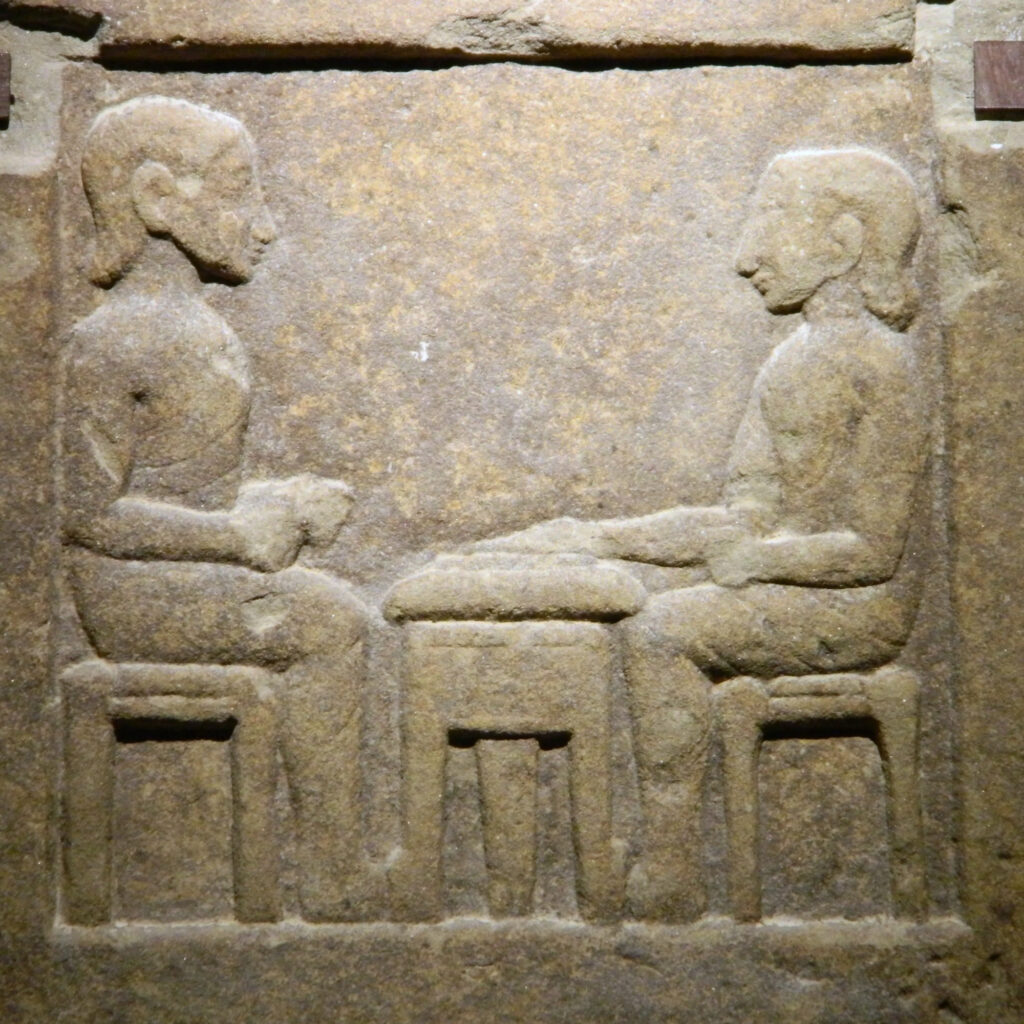
Below, a board game: two men seated on stools, facing each other on either side of a three-legged table on which lie a cushion and a tablet. The one on the right reaches out: to throw a die? To take a piece? The gesture remains enigmatic.
According to the archaeologist Petra Amann, this is the only known game scene among the forty or so Fiesolan stones. The player on the left, bearded and slightly taller, doubtless holds the higher rank. He may represent the deceased himself.
The scene is not unique in Etruria. Bucchero vases from Chiusi already show, around 550–525 BCE, two players leaning over a board with pieces. On an Attic amphora painted by Exekias and found at Vulci, Achilles and Ajax play their famous game, an image well known to Etruscan aristocrats, who were great buyers of Greek vases. Archaeology confirms the association of wine and games: near Bologna, an Etruscan tomb from the mid-fifth century, found intact at Casalecchio di Reno, contained, side by side, a wine service, the legs of a small table, 17 pieces and three dice.
The Greeks, moreover, linked games to the very origin of the Etruscans. According to Herodotus, the Lydians claimed to have invented dice, knucklebones and the ball, devised to beguile a long famine, before part of the people left to settle in Italy under the leadership of Tyrrhenus. Only draughts, they admitted, was not their invention[2].
Like the banquet, games signal leisure, the free time that only the rich could afford. On a funerary stele, however, the scene takes on a different light. The game seems suspended, as if the player, on the threshold of death, were playing his last move against fate. No text confirms this modern reading, but the image’s place on a tomb makes it tempting.
The Etruscan aristocratic ideal
On the Fiesolan stones, everything comes in pairs: two diners on the couch, two players at the table, elsewhere two warriors greeting each other or two notables seated face to face. The reliefs of Chiusi show large gatherings, whereas the elite of Fiesole chose to be depicted among peers. Seen from Rome, this shared leisure became caricature. In the Aeneid, the Etruscan king Tarchon reproaches his warriors for being slow in battle, yet always ready when it comes to waiting for the dishes and cups of a well-laden table[3].
Sources and references
- Petra Amann, Le pietre fiesolane: repertorio iconografico e strutture sociali, in Cippi, Stele, Statue–Stele e Semata. Testimonianze in Etruria, nel mondo italico ed in Magna Grecia dalla prima Età del ferro fino all’Ellenismo, ed. S. Steingräber, Pisa, ETS, 2018, pp. 63–79.
- Danza e banchetto sulle stele funerarie felsinee, in Studi Etruschi (2014).
- L’ombra degli Etruschi. Simboli di un popolo tra pianura e collina, ed. Paola Perazzi, Gabriella Poggesi, Susanna Sarti, Edifir, Florence, 2016.
[1] Theopompus, quoted by Athenaeus, Deipnosophists 12, 517d (FGrHist 115 F 204): δειπνεῖν δὲ αὐτὰς οὐ παρὰ τοῖς ἀνδράσι τοῖς ἑαυτῶν, ἀλλὰ παρ’ οἷς ἂν τύχωσι τῶν παρόντων, καὶ προπίνουσιν οἷς ἂν βουληθῶσιν· εἶναι δὲ καὶ πιεῖν δεινὰς καὶ τὰς ὄψεις πάνυ καλάς. “They do not dine beside their own husbands, but beside whichever of the guests they happen upon, and they drink toasts to whomever they please. They are, moreover, formidable drinkers, and very beautiful.”
[2] Herodotus, Histories 1, 94: ἐξευρεθῆναι δὴ ὦν τότε καὶ τῶν κύβων καὶ τῶν ἀστραγάλων καὶ τῆς σφαίρης καὶ τῶν ἀλλέων πασέων παιγνιέων τὰ εἴδεα, πλὴν πεσσῶν· τούτων γὰρ ὦν τὴν ἐξεύρεσιν οὐκ οἰκηιοῦνται Λυδοί. “It was then that the various games of dice, knucklebones and ball, and all the other kinds of games were invented, except draughts, the invention of which the Lydians do not claim.”
[3] Virgil, Aeneid 11, 736–739: at non in Venerem segnes nocturnaque bella, / aut ubi curva choros indixit tibia Bacchi. / exspectare dapes et plenae pocula mensae / (hic amor, hoc studium)… “But you are not slow for Venus and nocturnal battles, nor when the curved flute announces the choruses of Bacchus, nor to wait for the dishes and cups of a full table: this is your passion, this your zeal.”
Other articles in English from the Nunc est bibendum blog