Translated from French (please notify us of errors)
We come across Roman numerals on clock faces, building façades and the title pages of books. We can usually read Louis XIV or the twenty-first century. Faced with a date such as MDCCCLXXXVIII, however, we take a little longer. And when a clock face shows IIII instead of IV, the rules learnt at school suddenly seem less certain.
From 1 to 9999. The conversion updates as you type.
This converter turns a number into Roman numerals, and vice versa, then gives its Latin name, both cardinal and ordinal.
Roman numeration is still very much with us, but what we mostly know is a simplified version. Inscriptions and manuscripts show more varied practices, which changed with time and place. That is what makes reading them interesting: behind a string of signs, we also find the habits of those who wrote them.
Where the signs come from
Roman numerals owe a great deal to the signs used by the Etruscans. Before taking on the appearance of the letters we know, they had various forms, some of which can still be seen on ancient monuments and objects.
The signs I, V and X lend themselves easily to incision. Those for higher values changed more. For fifty, one finds in particular a form close to ᗐ, then to ⊥, before L prevailed. The sign for a hundred also had several forms; its resemblance to the initial of centum may have encouraged the adoption of C.
A thousand could be written ↀ or CIↃ, a stroke framed by two arcs. The form IↃ represented five hundred and contributed to the writing of D. The use of M as an ordinary numerical sign became established later, in the Middle Ages. The details of these developments are sometimes still debated: the history of the signs is less regular than their present-day table suggests.
How do you read a Roman numeral?
Standard modern notation uses seven signs:
| Sign | I | V | X | L | C | D | M |
| Value | 1 | 5 | 10 | 50 | 100 | 500 | 1,000 |
Values are generally added from left to right. CLXVI is thus 100 + 50 + 10 + 5 + 1, or 166. Some combinations involve subtraction: IV is five minus one, XC a hundred minus ten.
Modern usage accepts six subtractive pairs: IV, IX, XL, XC, CD and CM. I, X and C are not repeated more than three times in a row; V, L and D are not repeated at all. Forty-nine is therefore written XLIX, not IL.
To decipher a date, the simplest approach is to recognise the groups. MCMLXXXIV breaks down into M, CM, LXXX and IV: a thousand, nine hundred, eighty and four. That gives 1984. In the other direction, you simply break the number down, then put together the notation for each part.
Inscriptions take liberties
These modern conventions do not sum up ancient practice. Coins and inscriptions readily show IIII for four and VIIII for nine. XXXX for forty and DCCCC for nine hundred are also found.
The fully additive notation of 1984 is thus MDCCCCLXXXIIII. It is longer than MCMLXXXIV, but its value is identical.
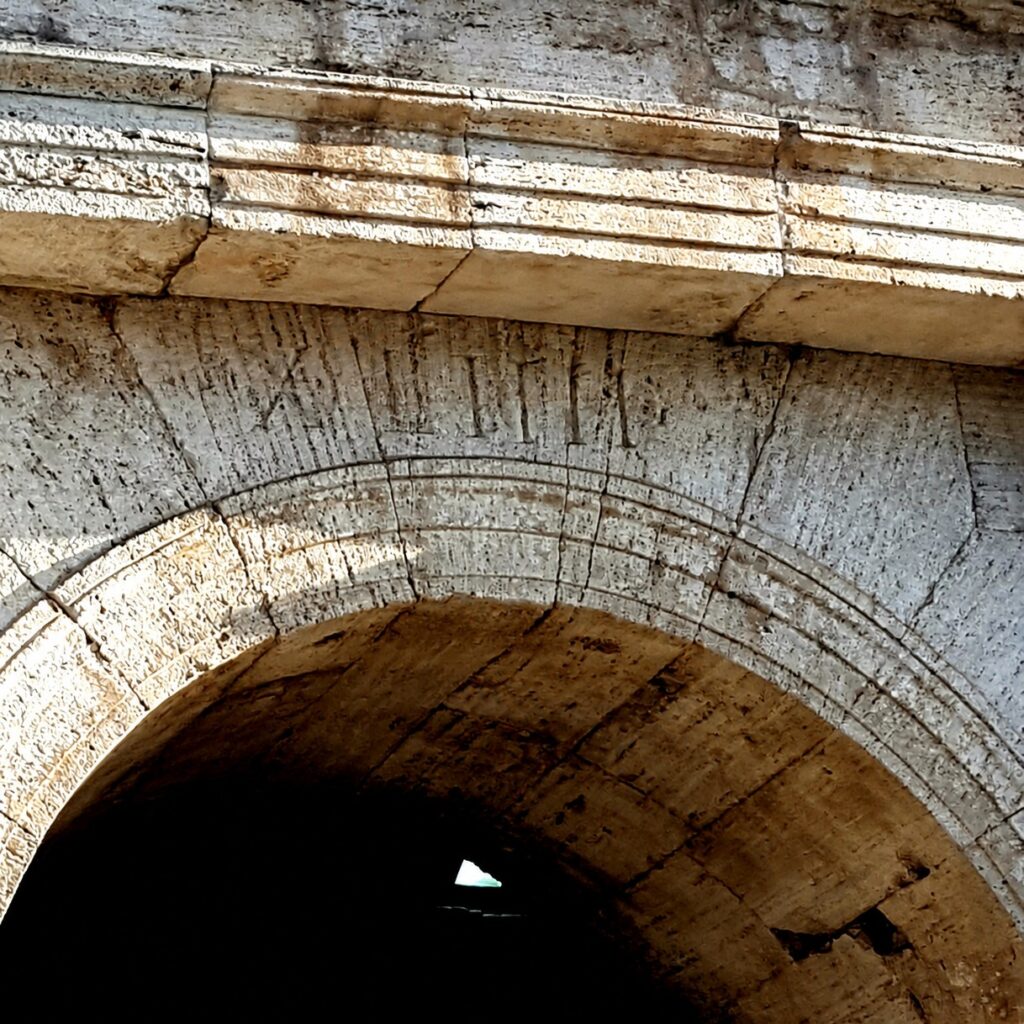
The two methods could be combined in a single number. At the Colosseum, gate 44 bears XLIIII: XL expresses forty by subtraction, IIII adds four units. This notation is therefore mixed, where we would now write XLIV.
Other variants go further. IIX can represent eight, that is, ten minus two. XIIX for eighteen is also found, notably in inscriptions relating to the Eighteenth Legion.
These examples explain why a converter may recognise a notation while flagging that it departs from usual modern writing. “Non-standard” does not necessarily mean “without historical precedent”. That does not, however, give licence to invent combinations freely: when faced with an inscription, context remains essential.
Beyond a thousand
School tables often stop at 3,999, written MMMCMXCIX. This limit stems from the convention adopted, not from the quantities the Romans were able to express.
Several methods were used to write large numbers. In the so-called apostrophus notation, arcs frame a stroke: CIↃ is a thousand, CCIↃↃ ten thousand and CCCIↃↃↃ a hundred thousand. The forms IↃ and IↃↃ represent five hundred and five thousand respectively.
Another solution is to place a bar above a sign or a group to multiply its value by a thousand. V̄ then stands for five thousand; IV with a bar above it stands for four thousand. The repetition MMMM can also represent this last value.
Strokes must nevertheless be examined with care. In some inscriptions, an overbar simply serves to distinguish a number from the letters of the text, without changing its value.
Counting without zero
The year 2026 is written MMXXVI: two thousands, two tens and six units. No hundreds appear, and no sign is needed to mark their absence.
Our decimal notation works differently. In 2026, the zero keeps the other digits in their place. Roman numeration, which does not use this positional principle, has no need for such a marker.
It is, however, less suited to our methods of written calculation. The Romans had other means, notably abacuses and counting boards on which they moved counters. The Latin word calculus, incidentally, means a small pebble.
Medieval tables used to calculate the date of Easter provide examples of a notation for a zero quantity. In 525, Dionysius Exiguus uses nulla. Around 725, Bede or one of his collaborators uses N in a table of epacts. These uses do not add an eighth numeral to the traditional series.
The Romans also represented fractions, often based on twelfths: a dot could indicate one twelfth and S a half.
Saying numbers in Latin
The Latin language also makes use of subtraction. Eighteen is duodeviginti, literally “two from twenty”, and nineteen undeviginti, “one from twenty”. The same method is found for twenty-eight, twenty-nine and other numbers ending in eight or nine.
The cardinal indicates a quantity; the ordinal, a rank. Tres means “three”, tertius “third”. Some forms vary according to their role in the sentence. Mille is normally invariable in the singular, whereas milia is a neuter plural noun: duo milia, two thousand; tria milia, three thousand.
The Convertite numeros! converter brings together these different ways of writing and saying a number. It gives its value, shows the modern and additive forms, breaks down the groups and gives the Latin names. It thus helps make sense of a familiar date as well as a notation found on stone.
Further reading
The Roman calendar
Understanding the months, festivals and dies fasti
Roman date calculator
Convert a date into Kalends, Nones and Ides
Roman hours
Follow the day from sunrise to sunset
Greek abacus
Calculate with counters like a Greek
Other articles in English from the Nunc est bibendum blog