Translated from french (please notify us of errors)
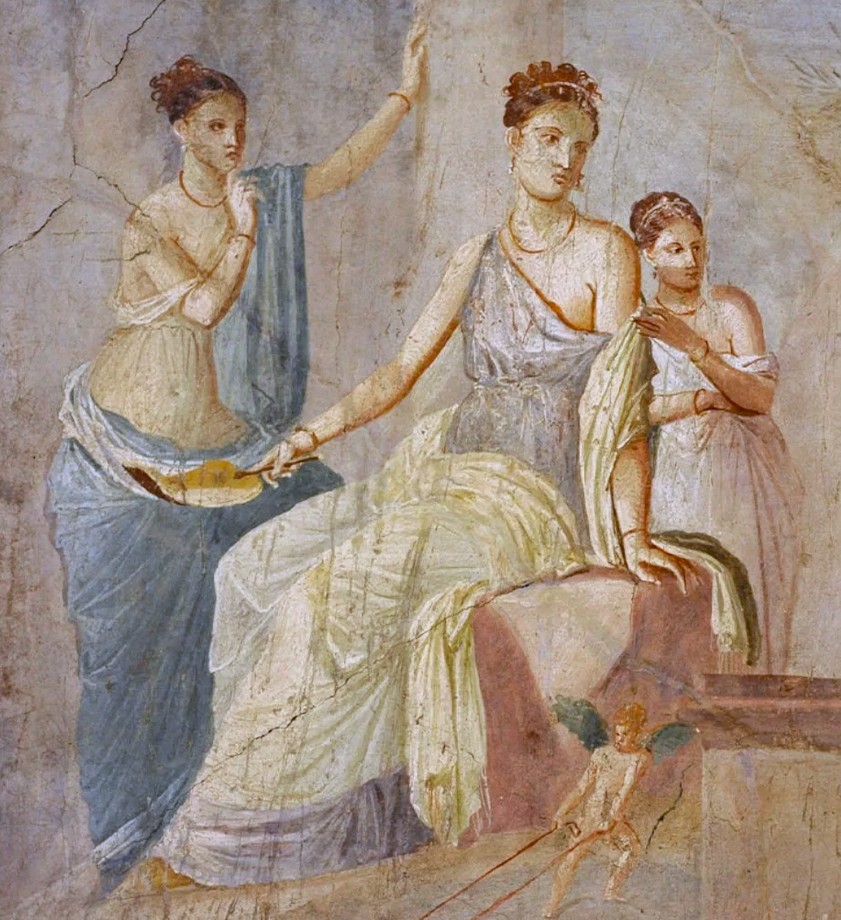
Roman women and men wore bright colours and always found some moralist ready to reproach them for it. Martial sketches the austere man who “likes cloaks in gloomy shades”, who judges cherry red and hyacinth violet vulgar, and who “thinks natural everything that grows pale” – yet whose “morals always have what he refuses to his clothes[1]”.
Since wool was, as we have seen, the basic material of almost all Roman clothing, Pliny judges any attempt to dye linen worthy of insania – sheer madness[2]. The poor, slaves and people of modest condition wore blacks (niger, ater), browns (fuscus), greys (pullus) and creams – the natural colour of untreated fleeces, which costs nothing to produce. These same dark tones were also those of mourning and humiliation: the accused person appearing in court wore a toga pulla, brown-black, to signify that he no longer cared about his appearance. Scipio Aemilianus astonished his contemporaries by refusing this convention and appearing dressed in dazzling white while he was under accusation[3].
White itself existed in two degrees. Albus was ordinary white. Candidus was a dazzling white, obtained through an active treatment: fullers whitened the fabric with root juice and sulphur burned beneath a wooden frame[4]. The result could yellow over time and smelled scarcely better than shellfish purple, but it was indispensable for anyone who wished to be noticed. It is in fact from candidus that our word “candidate” derives: the Roman politician on campaign wore a toga whitened with chalk to signal both his intentions and his purity. There were likewise two distinct blacks: ater, matt and dull, and niger, bright and lustrous.
For colours obtained by dyeing, Roman craftsmen had at their disposal a considerable plant-based arsenal, whose recipes were trade secrets handed down from father to son. Blues came from woad or dyer’s woad (Isatis tinctoria), a plant native to Europe, or from dwarf elder (Sambucus ebulus); Pliny also mentions heliotrope, bilberry and hyacinth as sources of blue. The generic term caeruleus – dark blue, the colour of the deep sea or the night sky – covered this whole range before the shades became more specialised. Indian indigo (indicum), extremely rare under the Republic, was imported from the Augustan period onwards. Pliny, who at first thought it was of mineral origin because it arrived from India in the form of dried blocks, reports that it produced “a wonderful mixture of purple and blue[5]”.
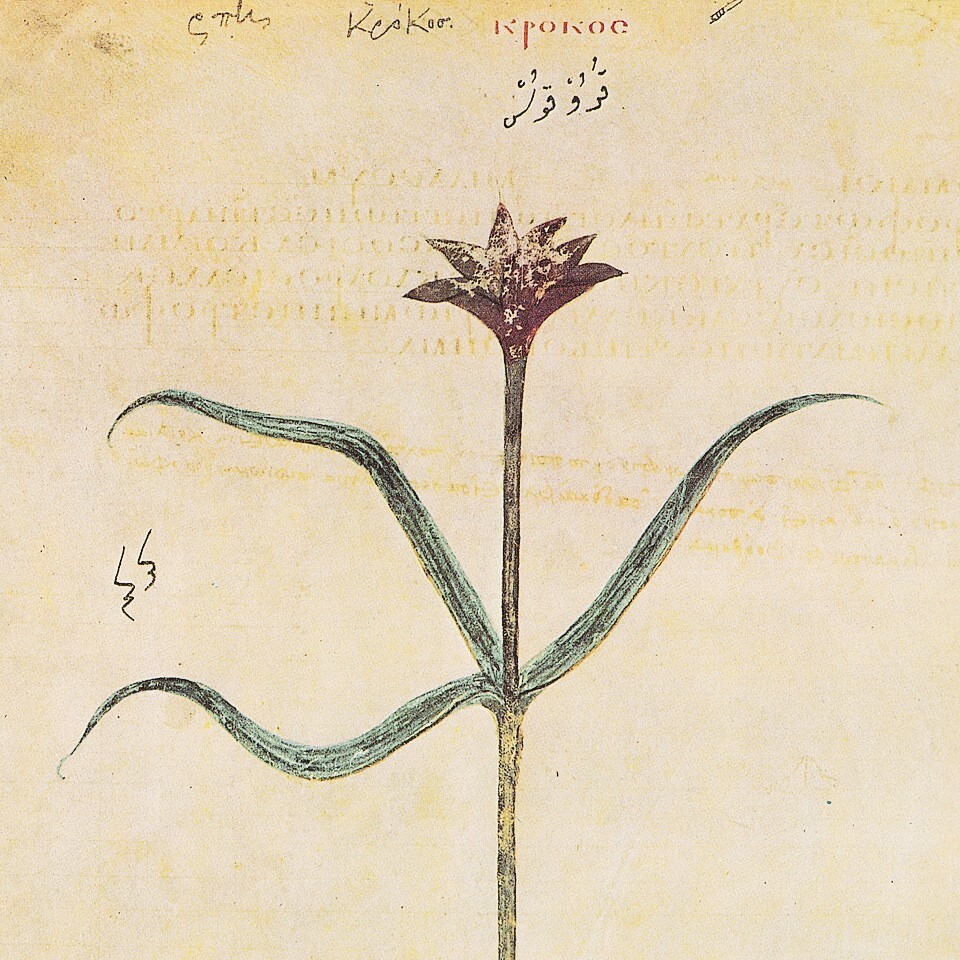
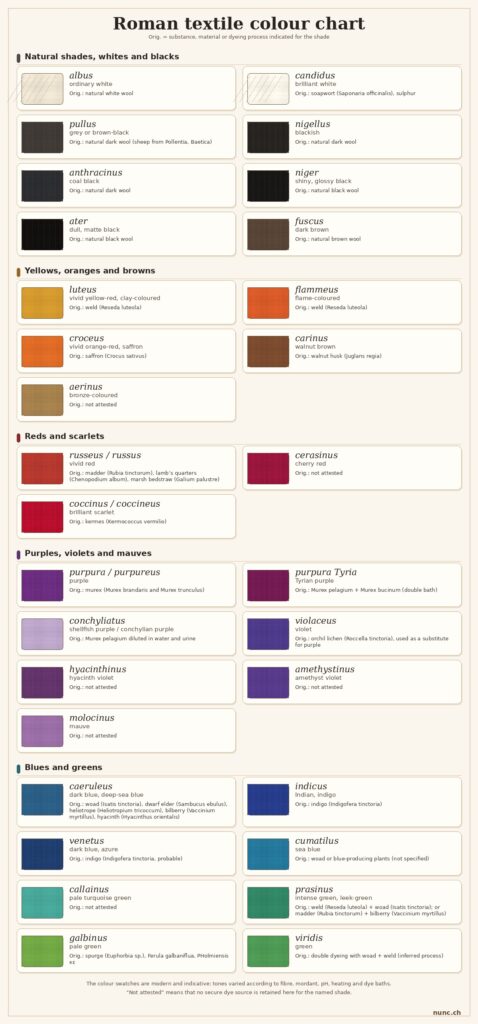 Yellows and reds came chiefly from madder (Rubia tinctorum), whose root yielded red by one process and yellow by another. Weld (Reseda luteola) gave a vivid yellow-red, luteus, which became the ritual colour of the bridal veil, the flammeum[6]. Saffron produced a vivid orange-red, croceus, the colour of Dawn’s robes in the poets. Greens were obtained by double dyeing, by combining yellow and blue in the vat. Black resulted from a bath of iron salts with tannic acid extracted from oak galls, a process which nevertheless weakened the fibres.
Dyers also had mordants to fix and modulate the shades: fermented urine, natron, potash, white alum for bright colours, black alum for darker tones[7]. One can imagine that it was painful work… When the dye ran in the wash or under the Mediterranean sun, the customer could turn to the offectores, craftsmen specialised in re-dyeing faded fabrics.
The division of labour had developed very early. Plautus lists the trades that besiege the door of a father of a family after his daughter’s wedding: the flammarii, orange-red dyers, the violarii, violet dyers, the carinarii, walnut-brown dyers, the molocinarii, mauve dyers, and also the infectores corcotarii, orange saffron dyers[8]. The satire sketches the whole Roman colour industry.
What colour said about you
In Rome there was no permanent legal ban on wearing one colour or another – except for purple by imperial decree. But informal codes of considerable power shaped the choice of shades according to occasion, sex, age and rank. Black was the colour of mourning, reserved for outer garments[9]. Luteus (yellow) was so closely linked to the wedding ceremony that no sensible woman wore it in ordinary times. White symbolised purity and virginity – unmarried girls and Vestals made it their colour of choice. Bright artificial colours, by contrast, were perceived as a women’s affair: under the Republic, they even constituted something close to a female privilege. A man who wore them exposed himself to ridicule.
Luxury colours: kermes, counterfeits and parvenus
Above ordinary plant dyes there existed a category of exceptional colourants, expensive because they were rare or imported from afar. Coccinus, a brilliant scarlet drawn from kermes – a parasitic insect (Kermococcus vermilio) living on the kermes oaks of the Near East, which the Romans took for a seed (coccus) –, was in the 1st century CE almost as prestigious as purple (which deserves an article of its own). It became the regulation colour of generals’ paludamenta[10]. Its production was a large-scale industry: in Lusitania, around Emerita, peasants collected the female insects from holm oaks and used this income to pay every other contribution to the imperial treasury[11]. Production centres also existed in Galatia, Cilicia, Gaul, Africa and Sardinia, the last providing the poorest quality.
Demand for these prestige shades was so strong that it generated a market in counterfeits. Gallic dyers managed to imitate with plants the purpura Tyria, the conchyliatus and, according to Pliny, “all the other colours[12]”.
One last luxury dye deserves mention: callainus, a pale green derived from the Greek kallainos (κάλλαϊνος), the name of a precious stone with blue-green reflections. It was found in the inaccessible and cold rocks beyond India, among the peoples of the Caucasus, with the best quality in Carmania[13]. Its prestige was such that an inscription from the sanctuary of Nemi, from the 1st century CE, mentions among the offerings made to Bubastis a silk robe dyed purpurea et callaina – in purple and turquoise green, a double luxury in a single fabric[14].
The colours of bad taste
In the 1st century CE, other costly colours acquired a reputation for ostentatious bad taste. Cerasinus – cherry red – owes its name to the cherry trees that Lucullus had imported from Pontus in 74 BCE. Prasinus, an intense green whose Greek name comes from the leek (prason), is a feminine colour – a man who wore it was considered effeminate, whatever his rank. Galbinus, a bright green whose name probably derives from galbanum (the aromatic ferula), was still more marked: Martial reserves it for the morals of his hypocritical moralist, and Petronius attributes it to the favourite (cinaedus) at his feast, while Fortunata parades in a galbina belt over a cherry-red tunic – a colour combination that respectable people regarded as the height of vulgarity[15]. Russeus, bright red, and venetus, dark blue, were the colours of the circus factions. These expensive and garish shades were prized by those whom the satirists class among the rich without culture.
Ovid, in his Art of Love, draws up a lyrical inventory of the shades available in the Augustan period: the colour of a cloudless sky, cumatile (from the Greek κῦμα, kuma, the wave) which imitates seawater, saffron, “the myrtles of Paphos”, “the violet amethyst”, “the paling roses”, “the crane of Thrace”… He concludes:
“As many flowers as the earth brings forth at its renewal, when the warmth of spring makes the vine buds emerge and drives away the winter that numbs all things, so many shades, or still more, can soak into wool[16].”
Each shade had to harmonise with the complexion: black suits a dazzlingly white complexion, white suits a very dark-haired woman, and stripes of bright colours revive a pale complexion.
Patterned, embroidered, woven with motifs
Colour was not enough: fabric could also be decorated with woven or embroidered motifs. The most skilful weavers produced entire scenes. “On the fabric unfold stories from ancient times”, writes Ovid, with divinities, temples, mythological battles, “all in brilliant colour”[17]. The workshops of Campania imitated the brocaded fabrics of Egypt and Cyprus – Ballio, the pimp in Plautus’ Pseudolus, threatens to flog his slaves until their sides are “as variegated as Campanian hangings” and even “Alexandrian carpets embroidered with beasts” would not have such fine colours[18].
Embroidery proper, inherited from Babylon or Alexandria, came in two types: one forming cross-stitch, reminiscent of tapestry; the other recalling line drawing. It chiefly adorned carpets and furnishing fabrics, but it was also found on official garments: the togas of triumphators, the ceremonial dress of emperors. The imperial toga could be adorned with small motifs made of gold plaques worked in repoussé and fixed to the fabric according to an eastern technique also known in Etruria. Alongside embroidery, braids and passementerie sewn in one or more rows – of purple or gold, an inheritance from the royal costumes of the East – completed a fabric which, by itself, told the fortune of the person who wore it.
Tertullian, hardly suspect of indulgence towards luxury, had summed up the absurdity of this whole system with a concision that Roman moralists had not attained: if God had wanted men to wear coloured clothing, he could have ordered purple and bronze-coloured sheep to be born. If he could do so, then he did not wish to[19].
Modern studies used
- Judith Lynn Sebesta, “The Colors and Textiles of Roman Costume”, in J. L. Sebesta & L. Bonfante (ed.), The World of Roman Costume, Madison, University of Wisconsin Press, 2001.
- Jean-Noël Robert, Les Romains et la mode, Paris, Les Belles Lettres, 2011.
- Alexandra Croom, Roman Clothing and Fashion, Amberley, 2012.
- Ursula Rothe, Dress and Cultural Identity in the Rhine-Moselle Region of the Roman Empire, chapter 11: colores – colour, dress style, and fashion, De Gruyter, 2023.
[1] Martial, Epigrams I, 96, 4-7: laudat Baianam, nigro quoque diligit ostro, / nec cerasina vult nec hyacinthina nati ; / naturale putat quidquid pallescit, at illi / semper habet mores, quod sibi veste negat.
[2] Pliny the Elder, HN XIX, 22: temptatum est tingui linum quoque, ut vestium insaniam acciperet – the attempt to dye linen so that it might “share in the madness of clothes” is presented as a novelty linked to Alexander’s fleets on the Indus.
[3] Aulus Gellius, Attic Nights III, 4, 1: eumque, cum esset reus, neque barbam desisse radi neque non candida veste uti neque fuisse cultu solito reorum. This refers to P. Scipio Aemilianus, son of Paullus Aemilius, prosecuted by the tribune Claudius Asellus after his censorship.
[4] Pliny the Elder, HN XIX, 18, 48: the radicula (Saponaria officinalis), whose juice is used to whiten wool before dyeing.
[5] Pliny the Elder, HN XXXV, 46: cum cernatur, nigrum, at in diluendo mixturam purpurae caeruleique mirabilem reddit.
[6] Catullus, Carmen 61, 8-10: flammeum cape, laetus huc / huc veni niveo gerens / luteum pede soccum.
[7] Pliny the Elder, HN XXXV, 52: distinction between white alum (album) for bright colours and black alum (nigrum) for darker tones.
[8] Plautus, Aulularia 509-510 and 514, 520: flammarii, violarii, carinarii… molocinarii… infectores corcotarii – list of the dyeing trades in Megadorus’ tirade on wedding expenses.
[9] Varro, De vita populi Romani F 411-412 Salvadore, cited by Rothe (2023): gradation of black shades for female mourning (pullus, nigellus, anthracinus).
[10] Pliny the Elder, HN XXII, 3: Lusitaniae grani coccum imperatoriis dicatum paludamentis.
[11] Pliny the Elder, HN XVI, 32: cusculium vocant. Pensionem alteram tributi pauperibus Hispaniae donat. – kermes (cusculium) from holm oaks enabled the poor of Spain to pay every other contribution.
[12] Pliny the Elder, HN XXII, 3: transalpina Gallia herbis Tyria atque conchylia tinguit et omnes alios colores.
[13] Pliny the Elder, HN XXXVII, 110: comitatur eam similitudine propior quam auctoritate callaina, e viridi pallens. Nascitur post aversa Indiae apud incolas Caucasi montis… sincerior praestantiorque multo in Carmania.
[14] CIL 14, 2215, v. 17, inscription from the sanctuary of Diana at Nemi, 1st century CE: Bubasto: vestem siricam purpuream et callainam – silk robe offered to Bubastis, dyed purple and callainus.
[15] Petronius, Satyricon 67, 4: venit ergo Fortunata galbino succincta cingillo, ita ut infra cerasina appareret tunica – Fortunata wore a galbina belt beneath which appeared a cherry-red tunic. On galbinus as bright green (and not yellow), see Rothe (2023) p. 431-432.
[16] Ovid, Ars amatoria III, 169-192: quot nova terra parit flores, cum vere tepenti / vitis agit gemmas incohatque nemus… / herbarum vivos tot licet esse color.
[17] Ovid, Metamorphoses VI, 70-128: in quo diversi niteant cum mille colores / transitus ipse tamen spectantia lumina fallit.
[18] Plautus, Pseudolus 145-146: ita ego uostra latera loris faciam ut ualide uaria sint, / ut ne peristromata quidem aeque picta sint Campanica / neque Alexandrina beluata tonsilia tappetia.
[19] Tertullian, De cultu feminarum I, 8, 2: non placet Deo quod non ipse produxit ; nisi si non potuit purpureas et aerinas oues nasci iubere. Si potuit, ergo iam noluit ; quod Deus noluit utique non licet fingi.
Other articles in English from the Nunc est bibendum blog