Translated from French (please notify us of errors)
Outside Troy, the Greek soldiers are bored and supplies are running short. To keep them from sinking into idleness, one of them, Palamedes, is said to have invented board games and dice. Ancient authors thus credit him with an odd military discovery – a war in miniature, fought around a board, where intelligence counts at least as much as luck.
The fighting has stopped for a while. In the Greek camp, the men wait, supplies dwindle and bad temper spreads through the ranks. A little distraction would do no harm. According to tradition, this is when Prince Palamedes, son of Nauplius, king of the island of Euboea, devised games with counters and dice.
Sophocles, in a tragedy now lost, presents him as the man who put an end to the famine and gave the soldiers “the most ingenious ways of passing the time: board games and dice, a pleasant cure for idleness”[1].
Palamedes is credited with other inventions too. Gorgias attributes to him the organisation of military formations, written laws, the letters of the alphabet, numbers and measures. Board games come at the end of this list, as a “pleasant, effortless pastime for hours of leisure”[2].
Not everyone agreed, however, on the origin of these inventions. Plato knew of another tradition, which credited the Egyptian god Theuth with inventing board games and dice, as well as writing.[3]
A board to keep the soldiers quiet
As for Palamedes, the legend does not always place the invention in the same spot. One tradition sets it at Aulis, where the Greeks were waiting to sail for Troy. Another links it to the hardships of the siege.
In the second century BCE, the scholar Polemon of Ilium reported that a stone was shown near Troy as the one on which the soldiers had played to forget their hunger. The testimony, handed down by a much later commentator, obviously does not allow us to identify this stone[4].
Euripides shows Palamedes himself engaged in this kind of pastime. In Iphigenia at Aulis, the women of the chorus catch sight of the Greek warriors as they wait to set sail. Seated side by side, Protesilaus and Palamedes are absorbed in the intricate moves of a board game. Nearby, other heroes practise throwing the discus or racing chariots.[5]
Battles on five lines
The Greeks knew various board games, referred to by the generic term petteia (πεττεία). One game, however, is better documented than the others: pente grammai (πέντε γραμμαί), or “five lines”.
Pollux, in the second century CE, explains that each of the two opponents had five counters on a board marked with five lines. The middle one was called the “sacred line”. He quotes a fragment of Sophocles that mentions “the counters of the five lines and the throws of dice”[6].
Chance therefore played a part in the game, but it did not necessarily decide the outcome on its own. The position of the counters and the player’s choices mattered too. For warriors who had left the battlefield for a while, the game offered another way of measuring themselves against an opponent.
Philostratus, in the third century CE, stresses that the game invented by Palamedes was “not a pastime for idlers, but an activity requiring shrewdness and seriousness”[7]. A Greek epigram even suggests that Palamedes’ bones deserved to be turned into gaming pieces (often made of bone), since he had invented “another war, a friendly one, on a wooden field”[8].
The full rules of this game have been lost. The matches that can be reconstructed today remain conjectures, based on fragmentary texts and a handful of archaeological objects.
The warriors’ game, a recurring theme
Greek painters left images precise enough for us to picture the players’ gestures.
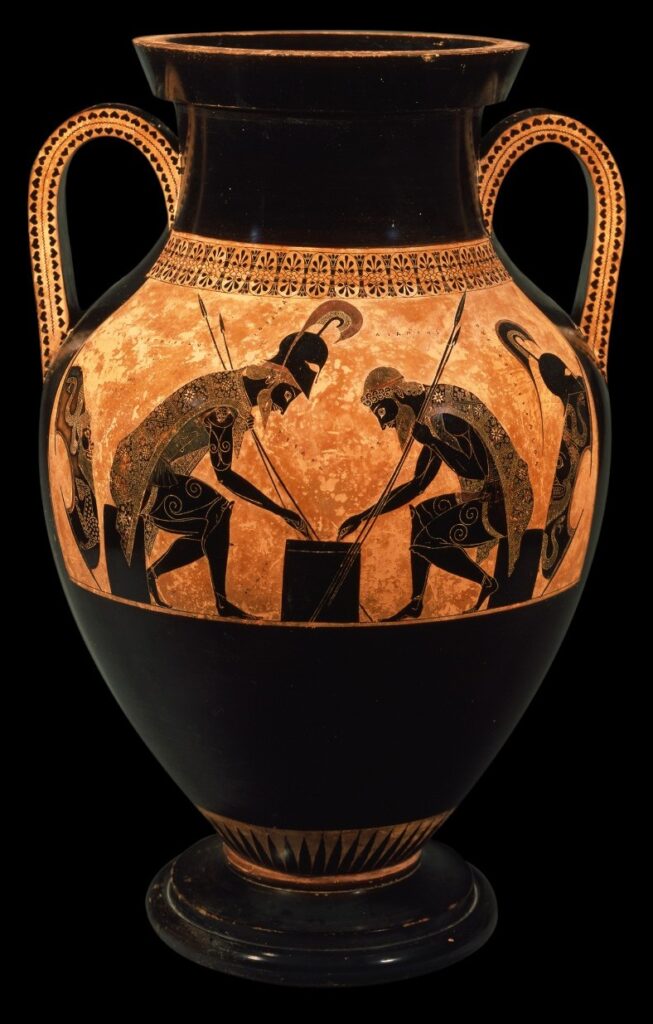
On an amphora painted by Exekias around 540 BCE, Achilles and Ajax sit facing each other, armed, leaning over a game. The inscriptions read “four” for Achilles and “three” for Ajax. The former seems to have the upper hand, but the game is not over… As they play, the two men lose none of their warrior’s vigilance; they keep their spears in hand.
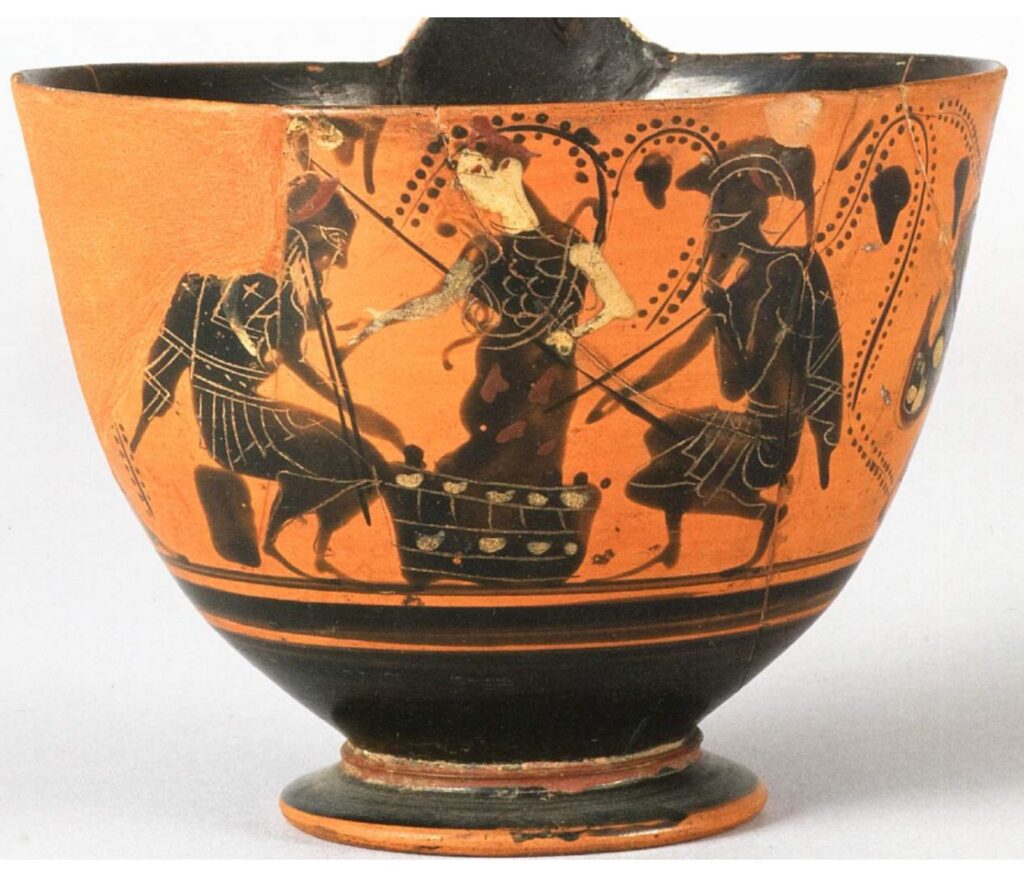
The theme proved hugely popular: more than 160 Attic vases depict warriors at play. On a small vase in Brussels, for instance, five lines and two sets of counters make it possible to identify the game described in the texts. When inscriptions name the players, they are always Achilles and Ajax. Curiously, neither Palamedes nor any other warrior is identified in the surviving inscriptions.
Board games also left traces in the Greek language. An old expression, “to move the counter from the sacred line”, meant resorting to an extreme measure when a situation seemed lost.
Theocritus uses it in the third century BCE. Galatea, wanting to catch Polyphemus’ attention, “moves the stone from the line”[9]. A player’s move that became an image for someone risking everything on a last throw.
The Greeks also associated dice with chance, personified by the goddess Tyche. Pausanias reports, with some reservation, that Palamedes dedicated the dice he had invented in her temple at Argos.[10] The same author describes a painting by Polygnotus at Delphi in which Palamedes goes on playing dice even in the world of the dead, in the company of Thersites, the soldier Odysseus had thrashed in the Iliad. The two Ajaxes look on. According to Pausanias, the painter deliberately brought together enemies of Odysseus.[11]
Palamedes’ last game
Indeed, Odysseus and Palamedes were hardly the best of friends, although both were renowned for their intelligence and cunning.
A famous episode, absent from Homer’s poems but reported by other ancient authors, explains their enmity. To escape the Trojan War, Odysseus had tried to pass himself off as mad. He had yoked a horse and an ox to a plough and set about ploughing his field haphazardly. Palamedes, who did not believe in his madness, is said to have placed the infant Telemachus in front of the team. Odysseus immediately swerved the plough to spare his son, thereby exposing the deception. Forced to join the expedition, he never forgave Palamedes for unmasking him.
Odysseus bided his time to take revenge.
According to one version of the myth, he had a letter forged, purportedly from Priam, king of Troy, and addressed to Palamedes. The message implied that Palamedes had agreed to betray the Greeks in exchange for a large sum of gold. To make the accusation credible, Odysseus secretly buried gold in his rival’s tent, then saw to it that the letter was found in the camp. Agamemnon, commander of the Greek army, read the message and ordered a search. The gold that was found seemed to confirm the treachery. Palamedes denied it in vain; he was handed over to the soldiers and stoned to death.[13]
Other accounts give the hero a different, but equally sordid, end. Pausanias reports that, according to the Cypria, an epic now lost, Odysseus and Diomedes drowned Palamedes when he had gone out fishing.[14]
None of this paints a very flattering picture of Odysseus. As for Palamedes, he ended up losing his last game of strategy. Inventor of letters, he fell victim to a forged document. Inventor of arithmetic, he was wrongly accused of greed.
And as if that were not enough, Odysseus even robbed him of his place in posterity. While the king of Ithaca is known to all and still triumphs at the box office today, Palamedes is entirely absent from Homer’s poems and forgotten by all. He invented strategy games, but it was Odysseus who won the game.
Modern studies consulted
- Bouvier, David and Dasen, Véronique (eds), Héraclite: le temps est un enfant qui joue, Presses universitaires de Liège, 2020. Contributions on board games, notably those by Marco Vespa and Ulrich Schädler.
- Clúa Serena, Josep Antoni, “Palamedes’s ἐφεῦρε πεσσοὺς κυβοὺς τε in Hellenistic Poetry and in John Malalas’s Chronographia”, Aitia, 14, 2024, published online 2025.
- Costanza, Salvatore, “Palamede πρῶτος εὑρετής di lettere, dadi, pedine”, Živa Antika, 70, 2020, pp. 35–60.
- Dasen, Véronique, “Achille et Ajax: quand l’agôn s’allie à l’alea”, Revue du MAUSS, 46, 2015, pp. 81–98.
- Létoublon, Françoise, “Palamedes and Letters. A Hero and Martyr in the Trojan War”, in Γέρα: Studies in Honor of Professor Menelaos Christopoulos, 2023.
[1] Sophocles, Palamedes, fragment 479 Radt, quoted by Eustathius, Commentary on the Iliad, II, 308–320:
οὐ λιμὸν οὗτος τῶνδ’ ἔπαυσε, σὺν θεῷ / εἰπεῖν, χρόνου τε διατριβὰς σοφωτάτας / ἐφηῦρε φλοίσβου μετὰ κόπον καθημένοις, / πεσσοὺς κύβους τε, τερπνὸν ἀργίας ἄκος;
“Was it not he who put an end to their famine – with the god’s help, so to speak – and who invented, for these men sitting down after the toils of the tumult, the most ingenious occupations, board games and dice, a pleasant cure for idleness?”[2] Gorgias, Defence of Palamedes, 30 (DK 82 B 11a):
φήσαιμι δ᾽ ἄν, καὶ φήσας οὐκ ἂν ψευσαίμην οὐδ᾽ ἂν ἐλεγχθείην, οὐ μόνον ἀναμάρτητος ἀλλὰ καὶ μέγας εὐεργέτης ὑμῶν καὶ τῶν Ἑλλήνων καὶ τῶν ἁπάντων ἀνθρώπων, οὐ μόνον τῶν νῦν ὄντων ἀλλὰ ‹καὶ› τῶν μελλόντων, εἶναι. τίς γὰρ ἂν ἐποίησε τὸν ἀνθρώπινον βίον πόριμον ἐξ ἀπόρου καὶ κεκοσμημένον ἐξ ἀκόσμου, τάξεις τε πολεμικὰς εὑρὼν μέγιστον εἰς πλεονεκτήματα, νόμους τε γραπτοὺς φύλακας [τε] τοῦ δικαίου, γράμματά τε μνήμης ὄργανον, μέτρα τε καὶ σταθμὰ συναλλαγῶν εὐπόρους διαλλαγάς, ἀριθμόν τε χρημάτων φύλακα, πυρσούς τε κρατίστους καὶ ταχίστους ἀγγέλους, πεσσούς τε σχολῆς ἄλυπον διατριβήν; τίνος οὖν ἕνεκα ταῦθ᾽ ὑμᾶς ὑπέμνησα;
“I could assert, without lying or risking refutation, that I am free of fault and have been a great benefactor to you, to the Greeks and to all mankind, those of today as well as those to come. Who, then, made human life workable when it was not, and ordered when it was without order? I invented military formations, which bring great advantages, written laws, guardians of justice, letters, instruments of memory, weights and measures, which make exchange easy, number, which allows goods to be kept in check, fire signals, the fastest and most effective messengers, and board games, an effortless pastime for leisure. Why have I reminded you of all this?”[3] Plato, Phaedrus, 274c–d:
Ἤκουσα τοίνυν περὶ Ναύκρατιν τῆς Αἰγύπτου γενέσθαι τῶν ἐκεῖ παλαιῶν τινα θεῶν, οὗ καὶ τὸ ὄρνεον ἱερὸν ὃ δὴ καλοῦσιν Ἶβιν· αὐτῷ δὲ ὄνομα τῷ δαίμονι εἶναι Θεύθ. τοῦτον δὴ πρῶτον ἀριθμόν τε καὶ λογισμὸν εὑρεῖν καὶ γεωμετρίαν καὶ ἀστρονομίαν, ἔτι δὲ πεττείας τε καὶ κυβείας, καὶ δὴ καὶ γράμματα.
“I have heard, then, that near Naucratis in Egypt there once lived one of the ancient gods of that country, the one to whom the bird called the ibis is sacred. This god was named Theuth. He is said to have been the first to invent number and calculation, geometry and astronomy, as well as board games, dice games and writing.”[4] Polemon of Ilium, fragment 32 Preller, quoted by Eustathius, Commentary on the Iliad, ed. van der Valk, I, p. 346:
Καινὸν δὲ οὐδὲν καὶ τοῦτον ἀνατεθῆναι λίθον ἐν τοῖς ἐκεῖ· ἐπεὶ τοι καὶ Παλαμήδους ἐπινοησαμένου κυβείαν καὶ πεττείαν ἐν Τροίᾳ εἰς παραμύθιον λιμοῦ κατασχόντος τὴν στρατιὰν λίθος ἐκεῖ ἐδείκνυτο, κατὰ Πολέμων ἱστορεῖ, ἐφ’ οὗ ἐπέσσευον.
“There is nothing surprising, then, in this stone too having been dedicated among the objects that were there. For when Palamedes had devised dice and board games at Troy to comfort the army stricken by famine, a stone was shown at that spot, according to Polemon’s account, on which the soldiers played with counters.”[5] Euripides, Iphigenia at Aulis, 192–199:
κατεῖδον δὲ δύ’ Αἴαντε συνέδρω, / τὸν Οἰλέως Τελαμῶνός τε γόνον, τὸν / Σαλαμῖνος στέφανον· Πρω- / τεσίλαόν τ’ ἐπὶ θάκοις / πεσσῶν ἡδομένους μορ- / φαῖσι πολυπλόκοις / Παλαμήδεά θ’, ὃν τέκε παῖς ὁ Ποσει- / δᾶνος, Διομήδεά θ’ ἡδο- / ναῖς δίσκου κεχαρημένον,
“I saw the two Ajaxes sitting together, the son of Oileus and the son of Telamon, the crown of Salamis; I also saw Protesilaus and Palamedes, descendant of Poseidon, seated and taking pleasure in the intricate moves of the counters, and Diomedes, who delighted in the pleasures of throwing the discus.”[6] Pollux, Onomasticon, IX, 97, quoting Sophocles, Nauplius, fragment 429 Radt:
ἐπεὶ δὲ ψῆφοι μέν εἰσιν οἱ πεττοί, πέντε δ’ ἑκάτερος τῶν παιζόντων εἶχεν ἐπὶ πέντε γραμμῶν, εἰκότως εἴρηται Σοφοκλεῖ· καὶ πεσσὰ πεντέγραμμα καὶ κύβων βολαί. τῶν δὲ πέντε τῶν ἑκατέρωθεν γραμμῶν μέση τις ἦν ἱερὰ καλουμένη γραμμή.
“Since the counters are pebbles, and each of the players had five of them, set out on five lines, Sophocles could rightly speak of the counters of the five lines and the throws of dice. Of the five lines, the middle one was called the sacred line.”[7] Philostratus, Heroicus, passage on the inventions of Palamedes, Kayser pagination 708:
ὄντων δὲ τῶν Ἀχαιῶν ἐν Αὐλίδι πεττοὺς εὗρεν οὐ ῥᾴθυμον παιδιάν, ἀλλ’ ἀγχίνουν τε καὶ ἔσω σπουδῆς.
“While the Achaeans were at Aulis, he invented board games, not as an idle amusement, but as an activity calling for shrewdness and seriousness.”[8] Greek Anthology, XV, 18:
Ὀστέα σου, Παλάμηδες, ἔδει πρισθέντα γενέσθαι / ὄργανα τῆς τέχνης τῆς ἀπὸ τοῦ πολέμου· / ἐν πολέμοις γὰρ ἐὼν ἕτερον πόλεμον κατέδειξας, / ἐν ξυλίνῳ σταδίῳ τὸν φιλικὸν πόλεμον.
“Your bones, Palamedes, ought to have been sawn up to become the pieces of this art born of war. For in the midst of battle you invented another war, a friendly war waged on a wooden field.”[9] Theocritus, Idylls, VI, 15–19:
ἁ δὲ καὶ αὐτόθε τοι διαθρύπτεται, ὡς ἀπ’ ἀκάνθας / ταὶ καπυραὶ χαῖται, τὸ καλὸν θέρος ἁνίκα φρύγει· / καὶ φεύγει φιλέοντα καὶ οὐ φιλέοντα διώκει, / καὶ τὸν ἀπὸ γραμμᾶς κινεῖ λίθον· ἦ γὰρ ἔρωτι / πολλάκις ὦ Πολύφαμε τὰ μὴ καλὰ καλὰ πέφανται.
“She is already making advances to you, even from afar, like the dry down of thistles when the fair summer scorches them. She flees the one who loves her and pursues the one who does not; she even moves the counter from the line. For in love, Polyphemus, what is not fair often seems fair.”[10] Pausanias, Description of Greece, II, 20, 3:
πέραν δὲ τοῦ Νεμείου Διὸς Τύχης ἐστὶν ἐκ παλαιοτάτου ναός, εἰ δὴ Παλαμήδης κύβους εὑρὼν ἀνέθηκεν ἐς τοῦτον τὸν ναόν.
“Beyond the sanctuary of Nemean Zeus stands a temple of Tyche, which must date from very ancient times, if indeed Palamedes dedicated in it the dice he had invented.”[11] Pausanias, Description of Greece, X, 31, 1–2:
εἰ δὲ ἀπίδοις πάλιν ἐς τὸ ἄνω τῆς γραφῆς, ἔστιν ἐφεξῆς τῷ Ἀκταίωνι Αἴας ὁ ἐκ Σαλαμῖνος, καὶ Παλαμήδης τε καὶ Θερσίτης κύβοις χρώμενοι παιδιᾷ, τοῦ Παλαμήδους τῷ εὑρήματι· Αἴας δὲ ὁ ἕτερος ἐς αὐτοὺς ὁρᾷ παίζοντας. τούτῳ τῷ Αἴαντι τὸ χρῶμά ἐστιν οἷον ἂν ἀνδρὶ ναυαγῷ γένοιτο ἐπανθούσης τῷ χρωτὶ ἔτι τῆς ἅλμης. ἐς δὲ τὸ αὐτὸ ἐπίτηδες τοῦ Ὀδυσσέως τοὺς ἐχθροὺς ἤγαγεν ὁ Πολύγνωτος· ἀφίκετο δὲ ἐς Ὀδυσσέως δυσμένειαν ὁ τοῦ Ὀιλέως Αἴας, ὅτι τοῖς Ἕλλησιν Ὀδυσσεὺς παρῄνει καταλιθῶσαι τὸν Αἴαντα ἐπὶ τῷ ἐς Κασσάνδραν τολμήματι·
“If you look up again towards the top of the painting, you see, next to Actaeon, Ajax of Salamis, then Palamedes and Thersites playing dice, the invention of Palamedes. The other Ajax watches them play. His complexion is that of a shipwrecked man whose skin still bears the traces of sea salt. Polygnotus deliberately brought together the enemies of Odysseus in the same place. Ajax, son of Oileus, had come to hate Odysseus because the latter had advised the Greeks to stone him for his crime against Cassandra.”[12] Hyginus, Fabulae, 95, Ulysses, 1–2:
Agamemnon et Menelaus Atrei filii cum ad Troiam oppugnandam coniuratos duces ducerent, in insulam Ithacam ad Ulixem Laertis filium venerunt, cui erat responsum, si ad Troiam isset, post vicesimum annum solum sociis perditis egentem domum rediturum.
Itaque cum sciret ad se oratores venturos, insaniam simulans pileum sumpsit et equum cum bove iunxit ad aratrum. Quem Palamedes ut vidit, sensit simulare atque Telemachum filium eius cunis sublatum aratro ei subiecit et ait, Simulatione deposita inter coniuratos veni. Tunc Ulixes fidem dedit se venturum; ex eo Palamedi infestus fuit.
“While Agamemnon and Menelaus, the sons of Atreus, were gathering the allied leaders to attack Troy, they went to the island of Ithaca to see Odysseus, son of Laertes. An oracle had told him that if he went to Troy, he would return home only after twenty years, alone, having lost his companions and reduced to poverty.
Knowing that envoys were coming to find him, Odysseus feigned madness. He put on a felt cap and yoked a horse and an ox together to a plough. On seeing him, Palamedes realised he was pretending. He took Telemachus, his son, from his cradle and placed him in front of the plough. Then he said to him: ‘Stop pretending and join the allied leaders.’ Odysseus then promised to go. From that moment on, he bore a deep hostility towards Palamedes.”[13] Pseudo-Apollodorus, Library, Epitome, III, 8.
ὅτι Ὀδυσσεὺς λαβὼν αἰχμάλωτον Φρύγα ἠνάγκασε γράψαι περὶ προδοσίας ὡς παρὰ Πριάμου πρὸς Παλαμήδην· καὶ χώσας ἐν ταῖς σκηναῖς αὐτοῦ χρυσὸν τὴν δέλτον ἔρριψεν ἐν τῷ στρατοπέδῳ. Ἀγαμέμνων δὲ ἀναγνοὺς καὶ εὑρὼν τὸν χρυσόν, τοῖς συμμάχοις αὐτὸν ὡς προδότην παρέδωκε καταλεῦσαι.
“Odysseus took a Phrygian prisoner and forced him to write a message about treason, as if it came from Priam and was addressed to Palamedes. Having buried gold in Palamedes’ tents, he dropped the tablet in the camp. Agamemnon read the message, found the gold and handed Palamedes over to the allies to be stoned as a traitor.”[14] Pausanias, Description of Greece, X, 31, 2.
Παλαμήδην δὲ ἀποπνιγῆναι προελθόντα ἐπὶ ἰχθύων θήραν, Διομήδην δὲ τὸν ἀποκτείναντα εἶναι καὶ Ὀδυσσέα ἐπιλεξάμενος ἐν ἔπεσιν οἶδα τοῖς Κυπρίοις.
“As for Palamedes, I know from reading it in the verses of the Cypria that he was drowned when he had gone out fishing, and that his killers were Diomedes and Odysseus.”
Other articles in English from the Nunc est bibendum blog