Translated from French (please notify us of errors)
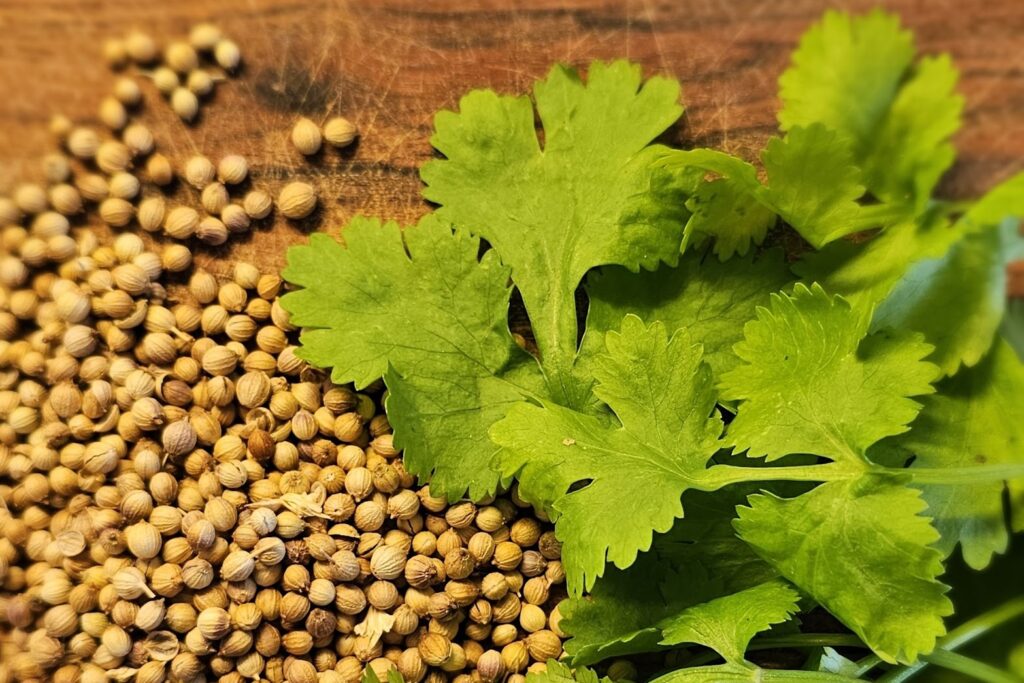
Coriander leaves no one indifferent. Its crushed leaves give off such a distinctive smell that the Greeks linked its shortened name (kórion) to kóris, “bedbug”. This is a folk etymology, however: the fuller forms (koríannon in Greek, coriandrum in Latin) probably have nothing to do with the insect.
Latin coriandrum is thought to derive not from classical Greek but from a much older form. In the Mycenaean tablets from Knossos, Pylos and Mycenae (fourteenth–thirteenth centuries BCE), coriander is already mentioned in the spellings ko-ri-ja-do-no and ko-ri-ja-da-na. For the Latinist Pierre Flobert, these forms directly account for Latin coriandrum, and the borrowing reveals early contacts between the Mycenaean world and Bronze Age Italy, long before the arrival of Greek colonists in the eighth century BCE.
The earliest archaeological evidence for the use of coriander comes from the Neolithic Near East. In Egypt it appears in the Ebers medical papyrus (sixteenth century BCE), and almost half a litre of seeds was found in the tomb of Tutankhamun (fourteenth century BCE). The Bible even compares manna to “coriander seed, white; and the taste of it was like wafers made with honey”[1]. In Gaul the plant appears as early as the La Tène period, then spreads widely in Roman times, as shown by seeds found at Metz, Troyes and Oedenburg (Biesheim-Kunheim), often preserved in wells and latrines.
Plautus mocks it, Apicius overdoes it
Coriander held a place of honour on Roman tables. In Plautus’s Pseudolus, a cook ridicules fellow cooks who serve up “seasoned meadows in dishes”, treat their guests like oxen and “put in coriander, fennel, garlic, alexanders…”[2]. Nearly six centuries later, the collection attributed to Apicius confirms how widely it was used: coriander appears in almost a hundred of its 477 recipes, roughly a fifth of the corpus. The collection distinguishes fresh leaves (coriandrum viride), dried leaves (coriandrum siccum), raw fruits (coriandri semen) and toasted fruits (coriandri semen frictum), considered more fragrant. It seasons lentils, fish sauces and poultry, and goes into the famous moretum, a herb and cheese paste of which Columella, the Appendix Vergiliana and Apicius give variants[3].
Surprising properties
In antiquity the line between cooking and medicine was thin, and coriander is a good example. Dioscorides, a Greek physician of the first century, describes it as a “cooling” plant: as a poultice with bread or barley meal it would treat erysipelas and creeping skin eruptions; with honey and raisins, pustules and inflammations of the testicles; the seed, drunk in small quantities in sweet wine, would expel intestinal worms[4]. Pliny the Elder, Roman encyclopaedist and contemporary of Dioscorides, credits the green plant with “great power to cool burning heats”: with honey or raisins it heals “creeping ulcers”, the testicles, burns and carbuncles; with a woman’s milk, discharges from the eyes; the seed, drunk with pomegranate juice and oil, expels intestinal worms[5]. Pliny does not stop there: he also reports a whole range of popular beliefs, some tinged with magic. He writes:
“Xenocrates reports an astonishing thing, if it is true: that menstruation is stopped for one day if women drink a single seed, for two days if two, and for as many days as the number of seeds they have taken.”[6]
It obviously does not work.
Galen, a physician of the second century, takes up the effects described by Dioscorides but criticises him for calling the plant simply “cooling”: in his view coriander combines opposing qualities, a bitter substance, a lukewarm moisture and a little astringency[7]. In the theory of humours inherited from Hippocratic medicine, calling a plant “cold” meant that it counterbalanced the excessive heat of an organ or a disease.
Dioscorides warns, however, that taken in larger amounts the seed “dangerously disturbs the mind”. One would have to swallow far more than is used in everyday cooking to risk such an “overdose”.
From ancient prestige to medieval neglect
In antiquity, then, coriander was a common spice, grown in gardens and widely traded. Its status changed in the Middle Ages: easy to produce, it lost prestige to rare spices from the East, such as cinnamon, cloves and nutmeg, which had become symbols of luxury. It did not disappear for all that: it is found in the cuisine of al-Andalus and in collections such as Taillevent’s Viandier (fourteenth century), where it flavours sauces and stews alongside ginger, cinnamon or pepper[8]. In the Renaissance, the Sienese physician Pietro Andrea Mattioli (1501–1577) published an Italian commentary on Dioscorides in 1544, followed in 1554 by his Latin Commentarii. On coriander, he stresses the unpleasant smell of the leaves, which he compares to that of bedbugs, a remark repeated in many later herbals and botanical treatises[9].
It was in the same period that coriander made its way to the New World. The Spanish and Portuguese introduced it to the Americas, where it became a staple of Mexican, Andean and Caribbean cooking.
When genetics explains disgust
Contemporary research, for its part, has helped explain why coriander divides opinion so sharply: a large genome-wide association study (Eriksson et al., 2012) showed that a variant (rs72921001, for specialists), located near a cluster of olfactory receptor genes, is linked to the “soapy” perception of coriander; within this region, the OR6A2 receptor, which is sensitive to several aldehydes characteristic of the plant, is a plausible candidate. This variant, however, explains only a small part of the differences between enthusiasts and refuseniks: the rest comes down to other genes, habit and culinary culture.
[1] Exodus 16:31 (Vulgate): appellavitque domus Israhel nomen eius man, quod erat quasi semen coriandri album, gustusque eius quasi similae cum melle. See also Numbers 11:7: erat autem man quasi semen coriandri, coloris bdellii.
[2] Plautus, Pseudolus 810–815: non ego item cenam condio ut alii coqui, qui mihi condita prata in patinis proferunt, boves qui convivas faciunt herbasque oggerunt, eas herbas herbis aliis porro condiunt: indunt coriandrum, feniculum, alium, atrum holus, apponunt rumicem, brassicam, betam, blitum…
[3] See the article: Pilon, herbes et fromage; le secret du moretum.
[4] Dioscorides, De materia medica III, 63: κόριον· ψυκτικὴν ἔχει δύναμιν, ὅθεν καταπλασσόμενον μετὰ ἄρτου ἢ ἀλφίτου ἐρυσιπέλατα καὶ ἕρπητας ἰᾶται, σὺν μέλιτι δὲ καὶ σταφίδι ἐπινυκτίδας καὶ διδύμων φλεγμονὰς καὶ ἄνθρακας θεραπεύει, μετὰ ἐρεγμοῦ δὲ χοιράδας καὶ φύματα διαλύει. τὸ δὲ σπέρμα ὀλίγον μὲν μετὰ γλυκέος ποθὲν ἕλμινθας ἐκβάλλει καὶ σπέρματός ἐστι γεννητικόν, πλεῖον δὲ ληφθὲν κινεῖ τὴν διάνοιαν ἐπικινδύνως, ὅθεν δεῖ φυλάσσεσθαι τὴν πλείονα καὶ συνεχῆ πόσιν αὐτοῦ. ὁ δὲ χυλὸς σὺν ψιμυθίῳ ἢ λιθαργύρῳ καὶ ὄξει καὶ ῥοδίνῳ καταχριόμενος ὠφελεῖ τὰς κατὰ τὴν ἐπιφάνειαν φλεγμονὰς τὰς πυρώδεις.
[5] Pliny the Elder, Naturalis Historia XX, 82 (217–218): vis magna ad refrigerandos ardores viridi. ulcera quoque, quae serpunt, sanat cum melle vel uva passa, item testes, ambusta, carbunculos, aures, cum lacte mulieris epiphoras oculorum […]. pellit animalia interaneorum cum mali punici suco et oleo semen potum.
[6] Pliny the Elder, Naturalis Historia XX, 82 (218): Xenocrates tradit rem miram, si vera est, menstrua contineri uno die, si unum granum biberint feminae, biduo, si duo, et totidem diebus quot grana sumpserint.
[7] Galen, De simplicium medicamentorum temperamentis ac facultatibus VII, 10, 43 (XII, 36 Kühn), Περὶ κοριάνου: ὥσπερ καὶ Διοσκορίδης ψυκτικὴν λέγων εἶναι τὴν πόαν οὐκ ὀρθῶς. σύγκειται γὰρ ἐξ ἐναντίων δυνάμεων πολὺ μὲν ἔχουσα πικρᾶς οὐσίας, ἥτις ἐδείκνυτο λεπτομερὴς ὑπάρχειν καὶ γεώδης, οὐκ ὀλίγον δὲ καὶ ὑδατώδους ὑγρότητος χλιαρᾶς κατὰ δύναμιν, ἔχει δέ τι καὶ στύψεως ὀλίγης.
[8] Taillevent (Guillaume Tirel), Le Viandier, ed. Jérôme Pichon, Paris, 1892, pp. 162–163 (sauce recipes with coriander).
[9] Pietro Andrea Mattioli, Commentarii in libros sex Pedacii Dioscoridis (Venice, 1554), ad loc. Coriandrum: Folia gravem odorem habent punicum, cimicum referentem (“The leaves have a strong smell reminiscent of bedbugs”).
Sources:
- Apicius, De re coquinaria, VII, 4.
- Pierre Flobert, “La coriandre: du mycénien au latin”, Revue de philologie, de littérature et d’histoire anciennes LXXXV, 2011/2, pp. 245–250.
- Nicholas Eriksson et al., “A genetic variant near olfactory receptor genes influences cilantro preference”, Flavour 1, 22 (2012), DOI: 10.1186/2044-7248-1-22.
- Ewen Callaway, “Soapy taste of coriander linked to genetic variants”, Nature (2012), DOI: 10.1038/nature.2012.11398.
On the same subject:
Other articles in English from the Nunc est bibendum blog