Translated from french (please notify us of errors)

Drops, lozenges, creams, syrups: propolis has regained, on the shelves of the “wellness” industry, a popularity it already enjoyed more than two thousand years ago. Modern pharmacology has confirmed an antibacterial activity, without thereby validating all the virtues attributed to it today. The Greeks and Romans, for their part, observed this substance from the hive and put it to medical use, but also to magical use.
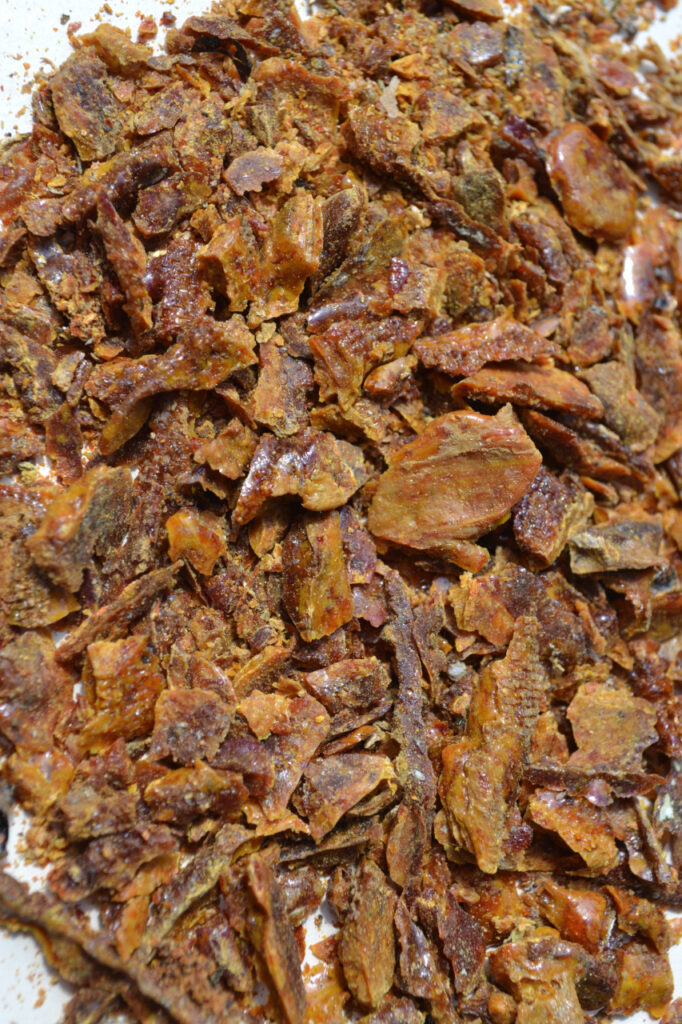
Propolis is the name given to the resinous substance that bees collect from buds and bark, mix with their wax and secretions, and then bring back to the hive to seal cracks and narrow the entrance. A colony harvests between one hundred and fifty and two hundred grams of it a year. When warm, it softens and becomes sticky; when cold, it becomes brittle. Its colour ranges from yellow to brown, red, or green. Propolis has no fixed composition: it depends on the resins available around the hive, the region, and the season.
The word itself is Greek. It has traditionally been read as a compound of pro (πρό), “before”, and polis (πόλις), “city”, meaning “that which stands before the city (or ensures its protection)”, the hive being seen as the city of the bees. Another etymology has also been proposed, linked to the verb promalássô (προμαλάσσω), “to soften by kneading”.
Born of the “Tears” of Trees
In the 4th century BCE, Aristotle was fascinated by bees. In his work, he devotes more space to them than to any other animal after man. On several occasions, he refers to the testimony of beekeepers, the melittourgoi (μελιττουργοί). It is from these professionals that he seems to have drawn most of his information.
In one passage, he describes a substance that bees bring back from the “tears” of trees. He calls it kêrôsis (κήρωσις), a term derived from kêros (κηρός), “wax”[1]. A little further on, the description becomes more precise: when given a clean hive, he says, bees bring to it substances drawn from flowers, but also the “tears” of willow, elm and other particularly sticky trees. They coat the bottom of the hive with it to protect themselves from other animals. Beekeepers call this operation kollêsis (κόλλησις), “gluing”[2].
Further on in the account, a substance named mitys (μίτυς) appears. This is applied around the opening of the hive; it is fairly black, says Aristotle, and its smell is pungent. He already describes a medical use, for treating bruises and suppurations.[3] Aristotle does not use the term propolis (πρόπολις), but the substances he describes have been linked to propolis. This is, at any rate, the view of many modern specialists.
With Varro, around 37 BCE, the word propolis finally appears. The Roman agronomist describes the substance with which bees build a protective barrier in front of the hive entrance, especially in summer. He notes that physicians use it, under the same name, in their plasters – and that, for this reason, it sells on the Via Sacra for more than honey[4]. He carefully distinguishes it from honeycomb, honey and a fourth substance, erithace, noting that bees do not gather all four from the same plants.
In Celsus, in the 1st century CE, propolis had passed into common use. It appears without comment in a list of simple remedies said to bring an abscess to a head and drain its pus, between galbanum and storax[5]. Dioscorides, for his part, gives advice to the buyer of propolis:
“one should choose the kind that is yellow or tawny, fragrant and reminiscent of storax in smell, that remains pliable […] and that stretches like mastic.”[6]
Still in the same period, the physician Scribonius Largus shows how it is worked. For the black plaster of the surgeon Aristus, against recent wounds and fractures, the recipe is not among the simplest: litharge is melted in oil, bitumen is added, then, once the mixture has reached the consistency of a soft cerate, pitch, wax and propolis together, and finally ammoniacum and alum[7]. Another recipe calls for propolis that is “pure and good, like that of Attica”[8] – proof that a market already existed, in which not all propolis was equal. Scribonius also knows a simpler way: against condylomata, he recommends propolis alone, kneaded and then applied as a plaster[9].
A Plaster Good for Everything
Pliny the Elder is the most exhaustive first-century author on the subject of propolis, compiling the information of his predecessors and contemporaries. He distinguishes three successive materials in the fitting-out of the hive: commosis, pissoceros and propolis; he distinguishes it from wax, traces it to the relatively soft gum of vines and poplars, and explains that bees use it to block every opening through which cold or a harmful intruder might enter. Its smell, he adds, is strong enough that many use it in place of galbanum[10]. He takes up Aristotle’s idea that propolis comes from the “tears” of certain trees, notably the poplar[11].
Finally, he sums up the medical virtues he attributes to propolis:
“[It] draws out stings and all foreign bodies lodged in the body; it reduces swellings, brings indurations to a head, soothes the pain of the nerves and closes by scarring even ulcers that had already been despaired of.”[12]
In the 2nd century, Galen carries on the tradition along the same lines[13], adding an anecdote. He recounts that, while travelling, he often found himself having to treat wounds without his usual medicines to hand. He tells of once treating a peasant’s wound with what he had at hand, leaven and propolis[14].
A Magical Figurine of Propolis
Medicine and magic are never very far apart in Antiquity. Thus propolis turns up in the Great Magical Papyrus of Paris, whose codex was copied between the late 3rd and early 4th century CE. It contains a ritual meant to ensure success and attract prosperity to a workshop or any other place of business. The procedure has a name: the “Little Beggar”. One must take propolis and shape a man whose right hand is held out like that of a beggar, holding in his left hand a bag and a staff, with a snake coiled around the staff[15]. There follow the inscriptions to be placed on the various parts of the figurine’s body, the sacrifices, and the words to be spoken.
The fascination with the work of bees and with the mysterious substance they produce has endured across the ages. Beyond its attested antibacterial properties, propolis has also given rise to all sorts of theories. One of them claims to go back to the earliest Antiquity: the Egyptians are said to have observed that bees wrap the corpses of intruders that die in the hive in propolis to prevent their putrefaction, and to have drawn inspiration from this to develop mummification. The story is appealing. But no known ancient text or artefact supports it.
Modern Studies Consulted
- Simon Byl, «Aristote et le monde de la Ruche», Revue belge de philologie et d’histoire, t. 56, fasc. 1, 1978, p. 15-28.
- L. Cilliers et F. P. Retief, «Bees, Honey and Health in Antiquity», Akroterion, 53, 2008, p. 7-19.
- Andrzej K. Kuropatnicki, Ewelina Szliszka et Wojciech Krol, «Historical Aspects of Propolis Research in Modern Times», Evidence-Based Complementary and Alternative Medicine, 2013, article 964149.
- Christina Papadaki, «Μύτις. Ανιχνεύοντας την ιστορία της πρόπολης μέσα από τις πηγές», Θέματα Αρχαιολογίας, 5/2, 2021, p. 236-253.
- Izabela Przybyłek et Tomasz M. Karpiński, «Antibacterial Properties of Propolis», Molecules, 24, 2019, 2047.
[1] Aristotle, Historia animalium, V, 22, 553b27-31:
Γίνεται δὲ κηρίον μὲν ἐξ ἀνθέων, κήρωσιν δὲ φέρουσιν ἀπὸ τοῦ δακρύου τῶν δένδρων (…).
“The comb comes from flowers; as for the kêrôsis, the bees bring it from the ‘tears’ of trees (…).”[2] Aristotle, Historia animalium, IX, 40, 623b29-624a17:
Ἐπειδὰν γὰρ παραδοθῇ αὐταῖς καθαρὸν τὸ σμῆνος, οἰκοδομοῦσι τὰ κηρία, φέρουσαι τῶν τ’ ἄλλων ἀνθέων καὶ ἀπὸ τῶν δένδρων τὰ δάκρυα, ἰτέας τε καὶ πτελέας καὶ ἄλλων τῶν κολλωδεστάτων. Τούτῳ δὲ καὶ τὸ ἔδαφος διαχρίουσι τῶν ἄλλων θηρίων ἕνεκεν· καλοῦσι δ’ οἱ μελιττουργοὶ τοῦτο κόλλησιν καὶ τὰς εἰσόδους δὲ παροικοδομοῦσιν, ἐὰν εὐρεῖαι ὦσιν.
“When given a clean hive, they build the combs, bringing produce from other flowers as well as the ‘tears’ of trees, particularly those of willow, elm and the other most gum-laden trees. They also coat the bottom with it, to protect themselves from other animals; beekeepers call this kollêsis. They also build along the sides of the entrances, when these are too wide.”[3] Aristotle, Historia animalium, IX, 40, 623b29-624a17:
Περὶ δὲ τὸ στόμα τοῦ σμήνους τὸ μὲν πρῶτον τῆς εἰσδύσεως περιαλήλιπται μίτυϊ· τοῦτο δ’ ἐστὶ μέλαν ἱκανῶς, ὥσπερ ἀποκάθαρμ’ αὐταῖς τοῦ κηροῦ, καὶ τὴν ὀσμὴν δριμύ, φάρμακον δ’ ἐστὶ τυμμάτων καὶ τῶν τοιούτων ἐμπυημάτων· ἡ δὲ συνεχὴς ἀλοιφὴ τούτῳ πισσόκηρος, ἀμβλύτερον καὶ ἧττον φαρμακῶδες τῆς μίτυος.
“Around the opening of the hive, the first part of the entrance is coated with mitys. This is fairly black, as though it were for the bees a kind of residue of the wax, and its smell is pungent; it serves as a remedy for bruises and for suppurations of this kind. The coating that comes immediately after is pissokêros, milder and less medicinal than mitys.”[4] Varro, Rerum rusticarum, III, 16, 23:
Propolim vocant, e quo faciunt ad foramen introitus protectum ante alvum maxime aestate. Quam rem etiam nomine eodem medici utuntur in emplastris, propter quam rem etiam carius in sacra via quam mel venit.
“They call propolis the substance with which they build, in front of the entrance of the hive, a kind of protective barrier, especially during summer. Physicians likewise use this substance, under the same name, in their plasters; for this reason it sells, on the Via Sacra, for even more than honey.”[5 ] Celsus, De medicina, V, 3:
Concoquunt et movent pus nardum, murra, costus, balsamum, galbanum, propolis, sturax, turis et fuligo et cortex, bitumen, pix, sulpur, resina, sebum, adeps, oleum.
“Bring pus to a head and make it flow: nard, myrrh, costus, balsam, galbanum, propolis, storax, frankincense soot and bark, bitumen, pitch, sulphur, resin, tallow, fat, oil.”
V, 12: Evocat et educit ladanum, alumen rotundum, hebennus, lini semen, omphacium, fel, chalcitis, bdellium, resina terebenthina et pinea, propolis, ficus arida decocta, stercus columbae, pumex, farina lolii, grossi in aqua cocti, elaterium, lauri bacae, nitrum, sal.
“Draw out and extract: ladanum, round alum, ebony, linseed, the juice of unripe grapes, gall, chalcitis, bdellium, turpentine and pine resin, propolis, dried cooked figs, pigeon dung, pumice, darnel flour, unripe figs cooked in water, elaterium, laurel berries, natron, salt.”[6] Dioscorides, De materia medica, II, 84:
πρόπολιν δὲ παραλημπτέον τὴν ξανθὴν καὶ εὐώδη καὶ στυρακίζουσαν, μαλακήν τε ἐν τῷ ὑπερξήρῳ καὶ μαστίχης τρό- πον ἐφελκομένην. ἔστι δὲ θερμαντικὴ ἄγαν καὶ ἐπισπαστικὴ καὶ σκολόπων ἑλκυστική· ἀρήγει δὲ καὶ βηξὶ παλαιαῖς ὑπο- θυμιωμένη, αἴρει δὲ καὶ λειχῆνας ἐπιτιθεμένη. εὑρίσκεται δὲ περὶ τοῖς στόμασι τῶν σμηνίων, φύσει κηροειδής.
“As for propolis, one should choose the kind that is yellow or tawny, fragrant and reminiscent of storax in smell, that remains pliable even when very dry and that stretches like mastic. It has a strongly warming and drawing action, and allows thorns or splinters to be drawn out of the body. Used as a fumigant, it is useful against long-standing coughs; applied locally, it clears up skin lesions. It is found around the openings of hives; by nature it has a wax-like consistency.”[7] Scribonius Largus, Compositiones, 209:
Emplastrum nigrum Aristi chirurgi facit ad omne recens vulnus mirifice, ad punctus nervorum et ad musculorum, item ad contusum, luxum, praecipue ad ossa fracta.
“The black plaster of the surgeon Aristus works remarkably well on every recent wound, on wounds affecting the nerves and muscles, as well as on bruises and dislocations, and particularly on fractures.”[8] Scribonius Largus, Compositiones, 214:
adicitur propolis malinae sincerae et bonae, qualis est Attica, pondo selibra…
“Half a pound of propolis is added […] pure and good, such as that of Attica.”
The word malinae, transmitted before sincerae, poses a textual difficulty and is not translated here.
For the black plaster of the surgeon Aristus and the malagma against chronic pains, see Compositiones, 209 and 262.[9] Scribonius Largus, Compositiones, 224:
item propolis per se subacta et more emplastri imposita.
“Likewise, propolis, kneaded on its own and applied like a plaster, is effective.”[10] Pliny the Elder, Naturalis historia, XI, 16:
Prima fundamenta commosin vocant periti, secunda pissoceron, tertia propolin, inter coria cerasque, magni ad medicamina usus. Commosis crusta est prima, saporis amari. Pissoceros super eam venit, picantium modo, ceu dilutior cera. E vitium populorumque mitiore cummi propolis, crassioris iam materiae additis floribus, nondum tamen cera, sed favorum stabilimentum, qua omnes frigoris aut iniuriae aditus obstruuntur, odore et ipsa etiamnum gravi, ut qua plerique pro galbano utantur.
“Experts call the first layer commosis, the second pissoceros, the third propolis – between the outer coverings and the wax – the last of these being of great use in medicine. Commosis is the first crust, bitter in taste. Pissoceros comes above it, like a kind of pitch, resembling a more diluted wax. Propolis comes from the relatively soft gum of vines and poplars; it is already a thicker substance, to which flowers are added; yet it is not wax, but rather a support for the combs, by which every opening that might let in cold or harm is blocked – itself still strong-smelling, to the point that many use it in place of galbanum.”[11] Pliny the Elder, Naturalis historia, XXIV, 47:
[Populus nigra] fundit illa et resinam exiguam, qua utuntur ad malagmata. […] Populi ferunt et in foliis guttam, ex qua apes propolim faciunt.
“[The black poplar] also exudes a small quantity of resin, used for soft plasters (malagmata). […] Poplars also bear on their leaves a ‘drop’, from which bees make propolis.”
The sentences neighbouring this passage are textually uncertain in the manuscript tradition (readings diverge between editions); only the sentence quoted here on the origin of propolis is stable.[12] Pliny the Elder, Naturalis historia, XXII, 107:
prima propolis alvorum, de qua diximus, aculeos et omnia infixa corpori extrahit, tubera discutit, dura concoquit, dolores nervorum mulcet ulceraque iam desperantia cicatricem cludit.
“First of all, the propolis of hives, which we have already discussed, draws out stings and everything lodged in the body; it disperses swellings, brings indurations to a head, soothes the pain of the nerves and closes by scarring even ulcers that had already been despaired of.”[13] Galen, De simplicium medicamentorum temperamentis ac facultatibus, VIII, 16, 36 (Kühn XII, p. 108):
Πρόπολις ῥυπτικῆς μέν ἐστιν οὐκ ἰσχυρᾶς δυνάμεως, ἑλκτικῆς δ’ ἱκανῶς ἰσχυρᾶς. ἔστι γὰρ λεπτομερὴς τὴν οὐσίαν. θερμαίνει δὲ κατὰ τὴν δευτέραν ἀπόστασιν ἤδη συμπληρουμένην καὶ τρίτην ἀρχομένην.
“Propolis has a detersive power that is not very strong, but a drawing power that is quite strong. This is because its substance is made up of fine particles. It warms to a degree corresponding to the end of the second degree and the beginning of the third.”[14] Galen, De compositione medicamentorum per genera, III, 2 (Kühn XIII):
πρόπολιν πρόσφατον, ὑγρὰν καὶ λιπαρὰν, ἣν ὁ γεωργὸς εἶχεν, ἐπιθέντα κατὰ τοῦ τραύματος καὶ ποτὲ ζύμην μόνην καὶ ποτὲ ἄμφω μίξαντα· χρὴ δὲ τὴν μὲν ζύμην ὅτι παλαιοτάτην εἶναι, τὴν πρόπολιν δὲ ἐναντίως ἔχειν αὐτῇ κατὰ χρόνον· εἰ δὲ εἴη παλαιοτέρα, μαλαττέσθω παρὰ τὸ πῦρ δι’ ἐλαίου ἢ ἐν ἡλίῳ.
“[I] applied to a wound fresh, moist and greasy propolis, which the peasant had, and sometimes leaven alone, and sometimes the two mixed together. The leaven should be as old as possible, whereas the propolis, conversely, should be as fresh as possible; if it is older, it should be softened near the fire with oil, or in the sun.”[15] Papyri Graecae Magicae, IV, 2373-2440 (Great Magical Papyrus of Paris, Bibliothèque nationale de France, Suppl. Grec 574):
λαβὼν κηρὸν ἄπυρον, τὸν λεγόμενον πρόπολιν, πλάσον ἄνθρωπον ἔχοντα τὴν δεξιὰν χεῖρα ἐπαιτοῦσαν…
“Take wax that has not been near fire, the kind called propolis, and shape a man with his right hand held out like that of a beggar…”
Other articles in English from the Nunc est bibendum blog