Translated from French (please notify us of errors)
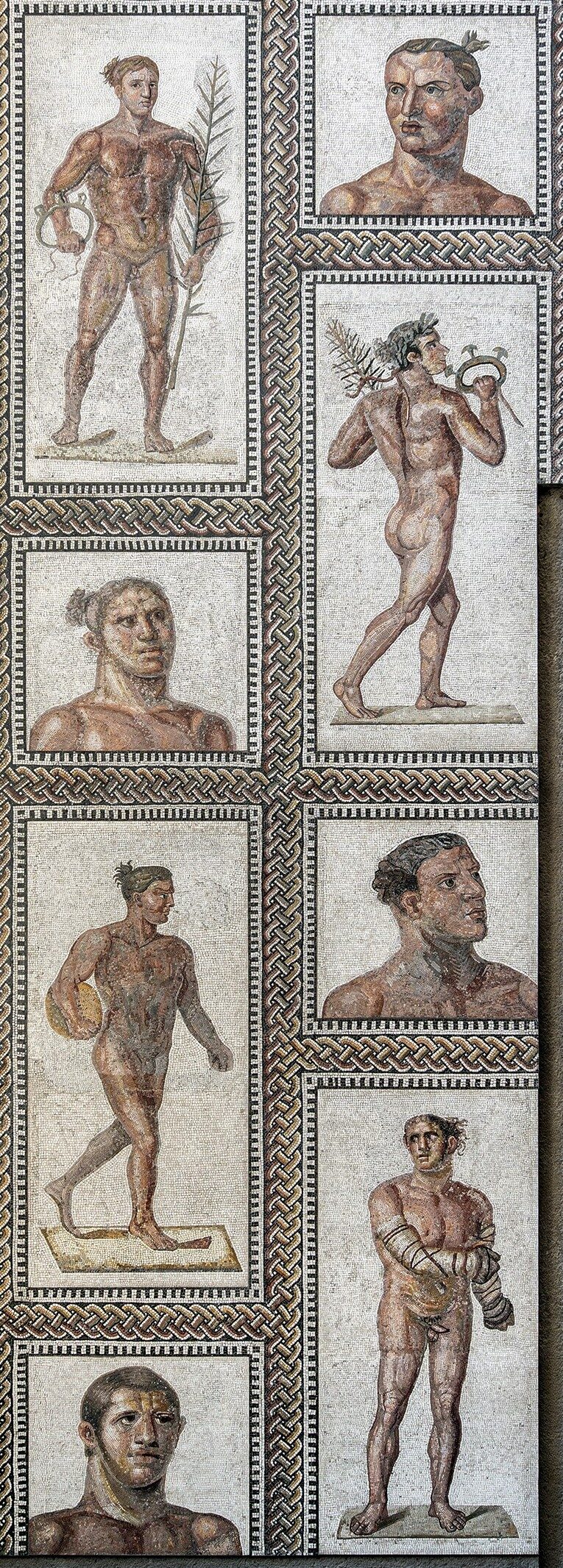
Pork for long bouts, wine controlled by the trainer, imposed meals and shortened nights: the diet of competitive athletes in the Greco-Roman world had nothing to do with a simple health regimen. It was a performance technique, adapted to each event, supervised by trainers, discussed by physicians… and widely criticised by philosophers.
In the 2nd century CE, Galen of Pergamon, imperial physician and a mind little inclined to indulgence, delivered a severe verdict on the lifestyle of professional athletes:
“Their way of life resembles the behaviour of pigs, except that pigs do not exhaust themselves excessively, nor do they eat under compulsion, whereas athletes submit to these excesses and sometimes also have their backs torn by rods of oleander.”[1]
Acid though the judgement may be, it touches on something real: the diet of competitive athletes in the Greco-Roman world formed a regime apart, remote from ordinary eating, conceived as a tool of performance and denounced as excess by almost every thinker who addressed it.
From the 1st to the 3rd century CE, Greek professional athletics enjoyed unprecedented prosperity under Roman rule. The dietary dossier connected with it reaches further back: from archaic traditions on the birth of the meat-based regimen to the medical and moral criticisms of the imperial period, the sources – medical, philosophical and literary – offer a picture that is both precise and contradictory.
From cheese to meat: an ancient revolution
Before examining the regimen of the imperial period, it is important to recall that it rested on an older break. Several ancient traditions contrast the meat-based diet of specialised athletes with a simpler diet made up of dried figs, fresh cheese and barley bread. This plant- and dairy-based regimen gradually disappeared from the 6th–5th century BCE onwards, in favour of a model centred on meat. Tradition attributes the initiative to Dromeus of Stymphalus, a dolichos runner – the Greek long-distance race, about twenty-four lengths of the stadium, or 4.8 km – and a two-time Olympic victor. Thus Pausanias, in the 2nd century CE, writes: “It is said that he [Dromeus] was the first to devise the eating of meat; until then, freshly drained cheese had been the food of athletes[2].” But a competing version attributes the change to Pythagoras of Samos, who is said to have advised the wrestler Eurymenes, also of Samos, to “feed daily on meat”, which “gave his body great strength[3]”. That the name of Pythagoras, associated in Antiquity with abstinence from meat, should also be linked to the introduction of a meat diet for athletes did not escape ancient authors: the contradiction was already feeding learned dinner-table conversation.
Whether this shift reflects a historical memory or a retrospective construction, it established a lasting model: to win, especially in the heavy events, training was no longer enough; one also had to eat according to a logic of mass, strength and endurance.
Anankophagia, or eating under compulsion
Greek vocabulary insists on this constraint. The verb anankophagein (ἀναγκοφαγεῖν) – “to eat out of necessity” – and its derivatives form a lexical family specific to the athletic field[4]. Aristotle in the Politics and the lexicographer Hesychius agree: it is the act of “feeding out of necessity, as athletes do”. What the term denotes is a deliberate practice of overfeeding, distinct in principle from any form of gluttony. Athletes, especially the heavy fighters – wrestlers, boxers and pankratiasts – had to absorb quantities that their appetite did not demand. Some got up in the middle of the night to swallow an additional meal. Food, here, was not a pleasure: it was training.
This regimen had two dimensions. The first was quantitative: the aim was to provide enough energy for daily sessions and, over time, to build a more massive physique. The second was qualitative: only certain foods were suitable. Pork occupied first place. Galen, in his treatise On the Properties of Foodstuffs, conducted what resembles, mutatis mutandis, a clinical trial: he compared the physical condition of young wrestlers subjected to different rations and concluded that pork flesh was “the most nourishing of all[5]”. The quality of the meat mattered as much as the species: pigs fed in woodland on cornelian cherries and acorns were preferable to those raised by the sea, whose flesh was supposedly “contaminated” by the shellfish and wild garlic they consumed[6].
The medical hierarchy of meats may be set out as follows, according to Hippocrates: beef is “strong and astringent, but difficult to digest”; goat meat, “lighter” and more digestible, is suitable for those who wish to keep the muscular system in good condition and recover from intense effort; pork, “difficult to corrupt and little inclined to disperse”, is the meat of long events – those in which the wrestler or pankratiast must hold out for hours[7]. Runners and pentathletes, for whom a light physique was an advantage, ate less and differently: Philostratus insists that preparation had to be modulated according to the discipline[8].
To pastries, cold water and wine taken according to one’s desire, trainers said no. Epictetus, towards the end of the 1st century, sums up the constraint in terms that have aged little:
“You will have to submit to strict discipline, eat according to orders, give up pastries. You will have to train on command and at the prescribed hour, whether it is hot or cold. You must drink neither cold water nor wine whenever you feel like it. In short, you must entrust yourself to your master as to a physician.”[9]
The comparison with the physician is not incidental: the trainer managed the body as a clinician manages a patient. And the two professions fiercely disputed the competence to know what was best for the body.
Table legends
Around this severe regimen, ancient culture built a pantheon of superhuman eaters. The most famous is Milo of Croton, the wrestler to whom tradition attributes six Olympic victories among the men, after a victory in the boys’ category, and whose career extended from 540 to 516 BCE. Athenaeus of Naucratis, compiling the sources, reports that he “ate twenty minas’ weight of meat, as much bread, and drank three choes of wine. At Olympia, he took upon his shoulders a three-year-old bull, carried it around the stadium; after which he had it cooked, and ate it alone on the same day[10].” Bouphagia (βουφαγία) – literally, “devouring an ox” – is the supreme dietary feat: in this heroic logic, the feat of eating brings Milo close to the Heraclean imaginary of the superhuman eater.
Are these stories credible? The ancients did not entirely believe them. Athenaeus reports them with the irony of a learned man who knows how to recognise a topos, a rhetorical commonplace. They function as hyperboles: they say something true by going beyond what is possible. What they indicate is the real distance between the athletic regimen and ordinary food – a distance that legend amplifies to the point of absurdity.
Physicians against trainers
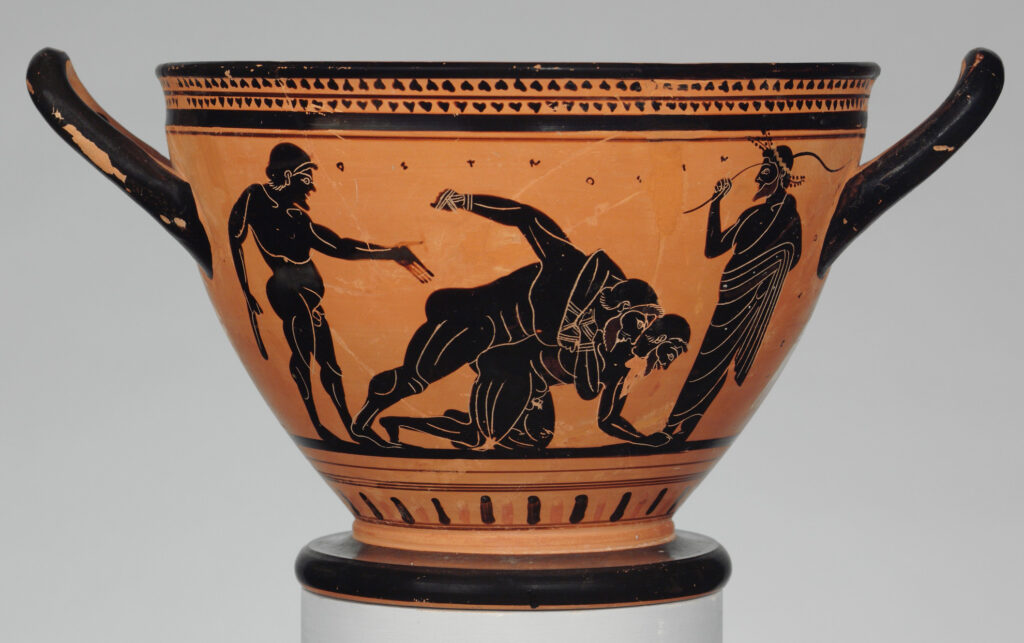
What unites ancient authors in their view of the athletic diet is disapproval. The tension is old: it goes back at least to Hippocrates, who, in his Aphorisms, states that “in athletes, a state of health pushed to the extreme is dangerous”[11]. Euexia (εὐεξία) – “good condition” – becomes, when applied to athletes, not an ideal but an unstable limit: what can only be at its peak can only decline.
Plato had opened fire two centuries before Galen: “Do you not see that people of this profession spend their lives sleeping, and that if they depart even slightly from the way of life prescribed for them, they fall dangerously ill?”[12] Philosophical criticism and medical criticism converge: the athletic diet produces a fictitious health, entirely dependent on a regimen that the slightest deviation is enough to ruin. Plutarch extends the argument: “It is by long sleep and constantly abundant food, by regulated exercise and rest, that athletes increase and preserve their corpulence; but the slightest excess, the slightest departure, at once exposes their health to considerable alteration. The person and the life of the athlete differ entirely from those of the soldier.”[13] A body optimised for the stadium is useless in the military camp.
Galen radicalises the criticism still further: overfeeding risks “bursting the vessels or suffocating the innate heat”. It deforms the body, destroys beauty (kallos), and makes the athlete unfit to serve as a general or administrator. Responsibility lies with the trainers, who “force athletes into excessive feeding”.
Philostratus formulates the same dissatisfaction from a different angle. Nostalgic for an athletic golden age, he blames medicine applied to the gymnasium – physicians, dieticians and medicalised trainers –, which in his view had corrupted the preparation of the champions of his own time: they feed their charges on “soft cakes sprinkled with poppy seed”, spend hours debating the proper kind of fish – those from muddy waters are fatty, those from cliffs soft, those from the open sea fleshy – and demand that pigs be fed on cornelian cherries and acorns rather than on shore-dwelling shellfish[14]. This is the paradox of the diet: in claiming to rationalise, it slips into sophistication and forgets the robustness of the ancients.
The quarrel between trainers and physicians was also a territorial dispute. The professional gymnastes, often a former champion himself, considered himself competent to manage the body of his athletes. The trainer Hippomachus was, according to Plutarch, able to “recognise his former pupils from afar simply by seeing them bringing meat back from the market”[15] – a sign that the regimen left a visible physical imprint, and that the trainer read the body as a physician reads a symptom.
An athlete’s health
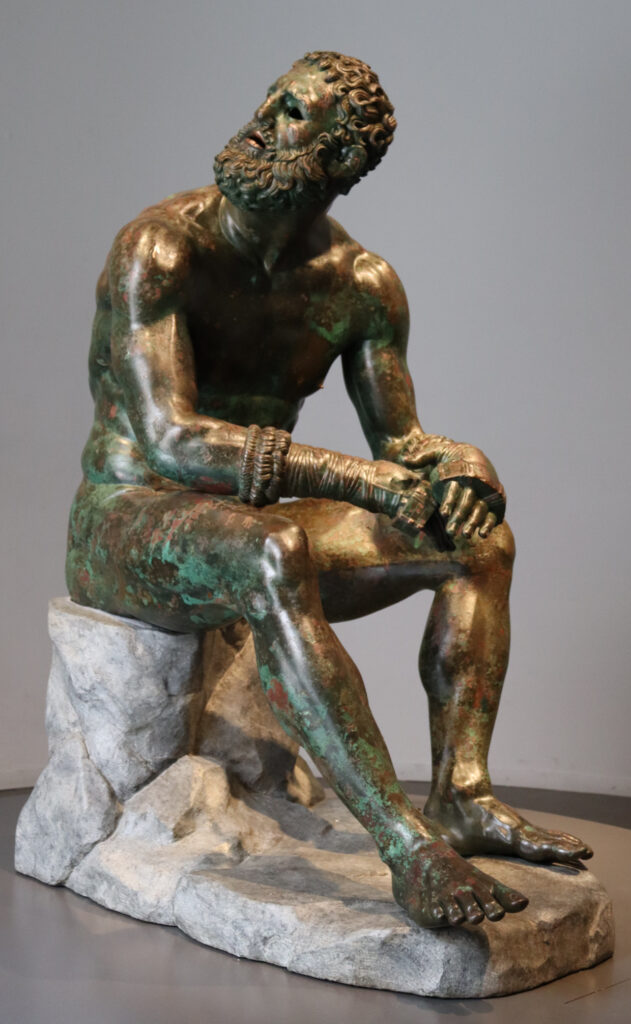
All this sketches a paradoxical portrait. The ancient athlete was overfed and subjected to iron discipline; he was at once too fat and too well trained; his health was both exceptional and precarious. To overfeeding was added, in the same logic of bodily economy, sexual continence: several champions went down in history for having taken a vow of abstinence during their preparation – Astylos of Croton, Ikkos of Tarentum, Cleitomachus of Thebes. Diet and mastery of impulses formed a coherent system, governed by the same principle: to expend energy only in the direction of performance.
This spectacular body was also, at least since Cicero, a suspect body. In De senectute, he describes an aged Milo of Croton contemplating his weakened muscles. Cicero notes that his glory had never rested on anything but the power of his limbs, not on what constitutes a man’s true worth[16]. In the Tusculan Disputations, he adds that a single day of deprivation is enough to make the athlete implore Jupiter: a body shaped by habit, not by endurance in all circumstances[17].
The theme becomes sharper in the imperial period. Plutarch directly contrasts the body of the athlete with that of the soldier. The former is built in regularity: abundant sleep, plentiful food, a regulated alternation of exercise and rest. The latter, by contrast, must face marching, hunger, fatigue and the unforeseen. In support of this idea, Plutarch relates that Philopoemen, military leader of the Achaean League at the turn of the 3rd and 2nd centuries BCE, eventually excluded athletics from the training of his troops: he saw it as a discipline capable of producing powerful bodies, but ones poorly adapted to war[18].
In Seneca, the over-cultivated body becomes an obstacle: even if the muscles grow, he writes, one will never equal the strength of a well-fed ox, and the soul, crushed by this heavy bodily burden, becomes less agile[19]. Epictetus agrees: the athlete is the very example of an entirely specialised life: victorious in his own field, incapable of being at the same time philosopher, soldier or citizen – and after all this discipline, this hunger, these wounds and this swallowed dust, he still retains the possibility of being defeated[20].
Galen, finally, poses the question bluntly: “This strength, in the name of the gods, what is it for?” Neither for agriculture nor for war. And Milo of Croton, who carried a bull on his shoulders? The physician turns the example around: the bull itself, while alive, carried that weight much more easily… and could run[21]. Galen even considers that excessive athletic training ruins intelligence:
“By constantly accumulating a mass of flesh and blood, they have their soul suffocated as in thick mire, incapable of conceiving anything with precision, without intellect like irrational beasts.”[21]
But the stadiums were full, portraits of champions adorned the cities, and Olympic victors returned home with privileges for life. The disapproval of the learned never prevented the spectacle from thriving.
Modern studies used
- Harris, H. A., “The diet of Greek athletes”, Proceedings of the Nutrition Society, 25, 1966, p. 87–90.
- Pateraki, K., “The Diet of Classical Athletes and the Opinions of Ancient Writers, Philosophers, and Doctors Concerning It”, in M. Bentz – M. Heinzelmann (eds), Archaeology and Economy in the Ancient World, 55, Heidelberg, Propylaeum, 2023, p. 449–452.
- Roubineau, J.-M., “Le mode de vie athlétique: manger, dormir, s’abstenir, s’exercer”, Actualités des études anciennes (reainfo.hypotheses.org), 22 May 2024.
- Stavridis, I. and Matalas, A.-L., “Food for the Olympic Athlete: Experts’ Opinion and Practices in Antiquity”, International Journal of Food, Nutrition and Public Health, 11, 1/2, 2019.
- Van Limbergen, D., “What Romans ate and how much they ate of it. Old and new research on eating habits and dietary proportions in classical antiquity”, Revue belge de philologie et d’histoire, 96, 3, 2018, p. 1049–1092.
[1] Galen, Protreptic (Protrepticus / Adhortatio ad artes addiscendas), XI, trans. V. Boudon (ed. Kaibel, Berlin, Weidmann, 1894).
[2] Pausanias, Description of Greece, VI, 7, 10. Λέγεται δὲ, ὡς καὶ κρέας ἐσθίειν ἐπινοήσειε· τέως δὲ τοῖς ἀθληταῖς σιτία τυρὸν ἐκ τῶν ταλάρων εἶναι.
[3] Porphyry, Life of Pythagoras, 15. The same tradition appears in Diogenes Laertius, Lives and Opinions of Eminent Philosophers, VIII, 12.
[4] Aristotle, Politics, 1338 b–1339 a; Hesychius, s.v. ἀναγκοφαγεῖν: “to feed out of necessity, as athletes do”. Epictetus uses the verb ἀναγκοφαγεῖν in the Discourses, III, 15, 2; the Enchiridion, XXIX, 2, transmits a closely related form, ἀναγκοτροφεῖν, according to the editions. On this variant, see the Schenkl edition (Leipzig, 1916).
[5] Galen, On the Properties of Foodstuffs (De alimentorum facultatibus), III, 661 (ed. Kühn).
[6] Philostratus, On Gymnastics (Gymnasticus), 44.
[7] Hippocrates, On Regimen (De diaeta), II, 46. Βόεια κρέα ἰσχυρὰ καὶ στάσιμα καὶ δύσπεπτα τῇσι κοιλίῃσι […] Τὰ δὲ αἴγεια κρέα κουφότερα τουτέων καὶ διαχωρέει μᾶλλον. Τὰ δὲ ὕεια ἰσχὺν μὲν τῷ σώματι ἐμποιέει μᾶλλον τουτέων, διαχωρέει δὲ ἱκανῶς διότι λεπτὰς τὰς φλέβας ἔχει καὶ ὀλιγαίμους, σάρκα δὲ πολλήν. “Beef is strong, contracting and difficult for the stomachs to digest […] Goat meat is lighter and more evacuating. Pork gives the body more strength than the previous meats, and it evacuates sufficiently, because the pig has thin veins and little blood, but much flesh.”
[8] Philostratus, On Gymnastics, 31. Ὁ δὲ ἄριστα δολιχοδρομήσων, τοὺς μὲν ὤμους καὶ τὸν αὐχένα κεκρατύνθω παραπλησίως πεντάθλῳ, σκελῶν δὲ λεπτῶς ἐχέτω καὶ κούφως, ὥσπερ οἱ τοῦ σταδίου δρομεῖς. “To become a good dolichos runner, one must have shoulders and neck made strong, like the athlete who competes in the pentathlon, and legs that are thin and light, like those of stadium runners.”
[9] Epictetus, Enchiridion, XXIX, 2, and Discourses, III, 15, 2–5. The passage quoted here is that of the Enchiridion. δεῖ σ’ εὐτακτεῖν, ἀναγκοτροφεῖν, ἀπέχεσθαι πεμμάτων, γυμνάζεσθαι πρὸς ἀνάγκην, ἐν ὥρᾳ τεταγμένῃ, ἐν καύματι, ἐν ψύχει, μὴ ψυχρὸν πίνειν, μὴ οἶνον, ὡς ἔτυχεν, ἁπλῶς ὡς ἰατρῷ παραδεδωκέναι σεαυτὸν τῷ ἐπιστάτῃ. On the variant ἀναγκοτροφεῖν / ἀναγκοφαγεῖν, see note [4].
[10] Athenaeus, The Deipnosophists, X, 412 e–f. Μίλων δ’ὁ Κροτωνιάτης, ὥς φησιν ὁ Ἱεραπολίτης Θεόδωρος ἐν τοῖς περὶ ἀγώνων, ἤσθιε μνᾶς κρεῶν εἴκοσι καὶ τοσαύτας ἄρτων οἴνου τε τρεῖς χοᾶς ἔπινεν. Ἐν δὲ Ὀλυμπίᾳ ταῦρον ἀναθέμενος τοῖς ὤμοις τετραέτη καὶ τοῦτον περιενέγκας τὸ στάδιον μετὰ ταῦτα δαιτρεύσας μόνος αὐτὸν κατέφαγεν ἐν μιᾷ ἡμέρᾳ.
[11] Hippocrates, Aphorisms, I, 3. Ἐν τοῖσι γυμναστικοῖσιν αἱ ἐπ´ ἄκρον εὐεξίαι σφαλεραί.
[12] Plato, Republic, III, 404 a. Ἢ οὐχ ὁρᾷς ὅτι καθεύδουσί τε τὸν βίον καί, ἐὰν σμικρὰ ἐκβῶσιν τῆς τεταγμένης διαίτης, μεγάλα καὶ σφόδρα νοσοῦσιν οὗτοι οἱ ἀσκηταί;
[13] Plutarch, Life of Philopoemen, 3, 2–4. τῶν μὲν ὕπνῳ τε πολλῷ καὶ πλησμοναῖς ἐνδελεχέσι καὶ κινήσεσί τε τεταγμέναις καὶ ἡσυχίαις αὐξόντων τε καὶ διαφυλαττόντων τὴν ἕξιν, ὑπὸ πάσης ῥοπῆς καὶ παρεκβάσεως τοῦ συνήθους ἀκροσφαλῆ πρὸς μεταβολὴν οὖσαν – and ἀθλητικὸν στρατιωτικοῦ σῶμα καὶ βίον διαφέρειν τοῖς πᾶσι.
[14] Philostratus, On Gymnastics, 43–44.
[15] Plutarch, Life of Dion, 1, 4. ὡς Ἱππόμαχος ὁ ἀλείπτης ἔλεγε τοὺς γεγυμνασμένους παρ’ αὐτῷ κἂν κρέας ἐξ ἀγορᾶς ἰδὼν φέροντας ἐπιγνῶναι πόρρωθεν. Plutarch uses this example as a rhetorical comparison: just as the trainer recognises his pupils by their gait even in an ordinary gesture, the disciples of the same school reveal their training in all their actions.
[16] Cicero, De senectute, IX, 27. Quae enim vox potest esse contemptior quam Milonis Crotoniatae? qui, cum iam senex esset athletasque se exercentes in curriculo videret, aspexisse lacertos suos dicitur inlacrimansque dixisse: «At hi quidem mortui iam sunt.» Non vero tam isti quam tu ipse, nugator; neque enim ex te umquam es nobilitatus, sed ex lateribus et lacertis tuis. “What utterance could be more contemptible than that of Milo of Croton? When he was already old and saw athletes exercising on the track, he is said to have looked at his arms and, weeping, said: ‘These muscles are now dead.’ No, it is not so much they who are dead as you yourself, you trifler; for you never became famous through yourself, but through your flanks and your arms.”
[17] Cicero, Tusculan Disputations, II, 40. Subduc cibum unum diem athletae: Iovem Olympium, eum ipsum cui se exercebit, implorabit, ferre non posse clamabit. Consuetudinis magna vis est. “Withhold food from an athlete for a single day: he will implore Olympian Jupiter, the very one for whom he trains, and will cry that he cannot bear it. Such is the great power of habit.”
[18] Plutarch, Life of Philopoemen, 3, 2–4: ἀλλὰ καὶ στρατηγῶν ὕστερον ἀτιμίαις καὶ προπηλακισμοῖς, ὅσον ἦν ἐπ᾽ αὐτῷ, πᾶσαν ἄθλησιν ἐξέβαλλεν, ὡς τὰ χρησιμώτατα τῶν σωμάτων εἰς τοὺς ἀναγκαίους ἀγῶνας ἄχρηστα ποιοῦσαν. “Later, when he was general, he banished all athletic practice as far as he could, through marks of disgrace and humiliations, because it made the most useful bodies useless for the necessary combats.”
[19] Seneca, Letters to Lucilius, XV, 2–3. Stulta est enim, mi Lucili, et minime conveniens litterato viro occupatio exercendi lacertos et dilatandi cervicem ac latera firmandi; cum tibi feliciter sagina cesserit et tori creverint, nec vires umquam opimi bovis nec pondus aequabis. Adice nunc quod maiore corporis sarcina animus eliditur et minus agilis est. Itaque quantum potes circumscribe corpus tuum et animo locum laxa. “It is a foolish occupation, my dear Lucilius, and wholly unsuited to a man of letters, to exercise the arms, broaden the neck and strengthen the flanks; even if fattening succeeds for you and your muscles grow, you will never equal either the strength or the weight of a well-fed ox. Add now that the mind is crushed by a greater bodily burden and becomes less agile. Therefore, as far as you can, confine your body and make room for the mind.”
[20] Epictetus, Discourses (Dissertationes), III, 15, 2–5. δεῖ σε εὐτακτεῖν, ἀναγκοφαγεῖν, ἀπέχεσθαι πεμμάτων, γυμνάζεσθαι πρὸς ἀνάγκην, ὥρᾳ τεταγμένῃ, ἐν καύματι, ἐν ψύχει· μὴ ψυχρὸν πίνειν, μὴ οἶνον ὅτ᾽ ἔτυχεν· ἁπλῶς ὡς ἰατρῷ παραδεδωκέναι σεαυτὸν τῷ ἐπιστάτῃ· εἶτα ἐν τῷ ἀγῶνι παρορύσσεσθαι, ἔστιν ὅτε χεῖρα ἐκβαλεῖν, σφυρὸν στρέψαι, πολλὴν ἁφὴν καταπιεῖν, μαστιγωθῆναι· καὶ μετὰ τούτων πάντων ἔσθ᾽ ὅτε νικηθῆναι. “You must submit to discipline, eat under compulsion, abstain from delicacies, train out of necessity, at a fixed hour, in heat, in cold; not drink cold water, nor wine whenever the occasion arises; in short, hand yourself over to your trainer as to a physician. Then, in the contest, be thrown into the dust, sometimes dislocate your hand, twist your ankle, swallow much sand, be whipped; and after all this, sometimes be defeated.” On the variant ἀναγκοφαγεῖν / ἀναγκοτροφεῖν between the Discourses and the Enchiridion, see note [4] and the Schenkl edition (Leipzig, 1916).
[21] Galen, Protreptic (Protrepticus), XI–XIII (ed. Kaibel, Berlin, Weidmann, 1894). On the uselessness of athletic strength: ποίας, ὦ πρὸς θεῶν, ἰσχύος καὶ ποῦ χρησίμης; πότερον τῆς εἰς τὰ γεωργικὰ τῶν ἔργων; […] ἀλλ’ ἴσως τῆς εἰς τὰ πολεμικά; “What kind of strength, in the name of the gods, and useful for what? Useful for agricultural work? […] Useful perhaps for war?” On health after the career: ἔνιοι μὲν γὰρ μετ’ ὀλίγον ἀποθνῄσκουσιν, ἔνιοι δὲ ἐπὶ πλέον μὲν ἥκουσιν ἡλικίας, ἀλλ’ οὐδ’ αὐτοὶ γηρῶσιν. “Some die shortly afterwards; others reach a more advanced age, but they themselves do not truly grow old.” On the soul suffocated by flesh (XI): σαρκῶν γὰρ ἀεὶ καὶ αἵματος ἀθροίζοντες πλῆθος ὡς ἐν βορβόρῳ πολλῷ τὴν ψυχὴν ἑαυτῶν ἔχουσι κατεσβεσμένην. “By constantly accumulating a mass of flesh and blood, they have their soul suffocated as in thick mire.”
Other articles in English from the Nunc est bibendum blog