Translated from french (please notify us of errors)
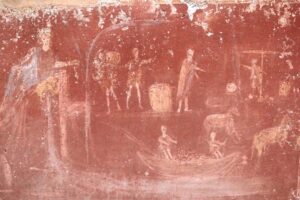
A food prized by the masses yet scorned by the elite, a universal remedy yet a contested one, an aphrodisiac that nonetheless gives repellent breath, an object of mockery or a venerated deity: the onion accumulates paradoxes in ancient culture. Beneath its concentric tunics lies a food that reveals the social fractures, medical debates and religious tensions of the Graeco-Roman world.
In ancient Greek or Roman society, the onion belonged first and foremost to popular cuisine. Texts consistently present it as a food of the common people, alongside garlic and leek.
At the beginning of the fourth century BCE, Xenophon reports a delightful exchange in his Symposium. Niceratus, one of the characters known to be a young husband, reports that Homer supposedly said that nothing goes better with wine than the onion. This rash assertion provokes a jest from another character, Charmides:
‘Niceratus wants to go home breathing the smell of onion, so that his wife will believe that no woman has even thought of kissing him’[1].
The onion’s property of altering human breath is the most obvious one, though – as we shall see further on – it is far from the only one. Its persistent odour classes it among vulgar foods, incompatible with the refinements of the elite. It formed part of the daily diet of the peasant, the soldier and the slave. Aristophanes evokes ‘the smell of an onion-eater’s belch’, typical of the soldier[2]. Further on, the chorus celebrates the end of military life in these terms: ‘I rejoice, yes, I rejoice at being rid of helmet, cheese and onions!’[3]
Some centuries later, the Latin poet Petronius pushes mockery as far as insult in his Satyricon. The passage opens with an ill-timed burst of laughter from Giton, an effeminate young slave-companion of the narrator Encolpius. He draws the wrath of another character:
‘And you too,’ he said, ‘are you laughing, you curly onion?’[4]
The expression is unique and was certainly invented by Petronius. It thus combines aesthetic mockery with class contempt. There follows a tirade of further insults, each more fanciful and unhinged than the last, typical of the Satyricon.
Despite this poor reputation, Apicius, cook to the elite, mentions the onion in more than eighty recipes[5]. Of course, for him it was not a matter of biting into fresh bulbs. No recipe has onion as its principal ingredient. Onion, fresh or dried, features in complex preparations, as a condiment skilfully combined with others such as lovage, rue, oregano or savory.
That land where the gods grow in kitchen gardens
The Latins also mocked the Egyptians, who, according to Pliny, supposedly venerated the onion as a deity: ‘Egypt honours garlic and onions as gods in its oaths’[6]. Juvenal, in his Satires, continues the mockery:
‘There, cats are worshipped; here, a river fish; elsewhere still, whole cities adore a dog. No one honours Diana. It is sacrilege to violate or bite a leek or an onion – o sacred peoples, for whom such divinities grow in kitchen gardens!’[7]
The criticism was even taken up by Christian authors. Prudentius, in the fourth century, denounces those who ‘dare to place among the gods of the clouds the leek and the onion, and set garlic and Serapis above the stars of heaven’[8].
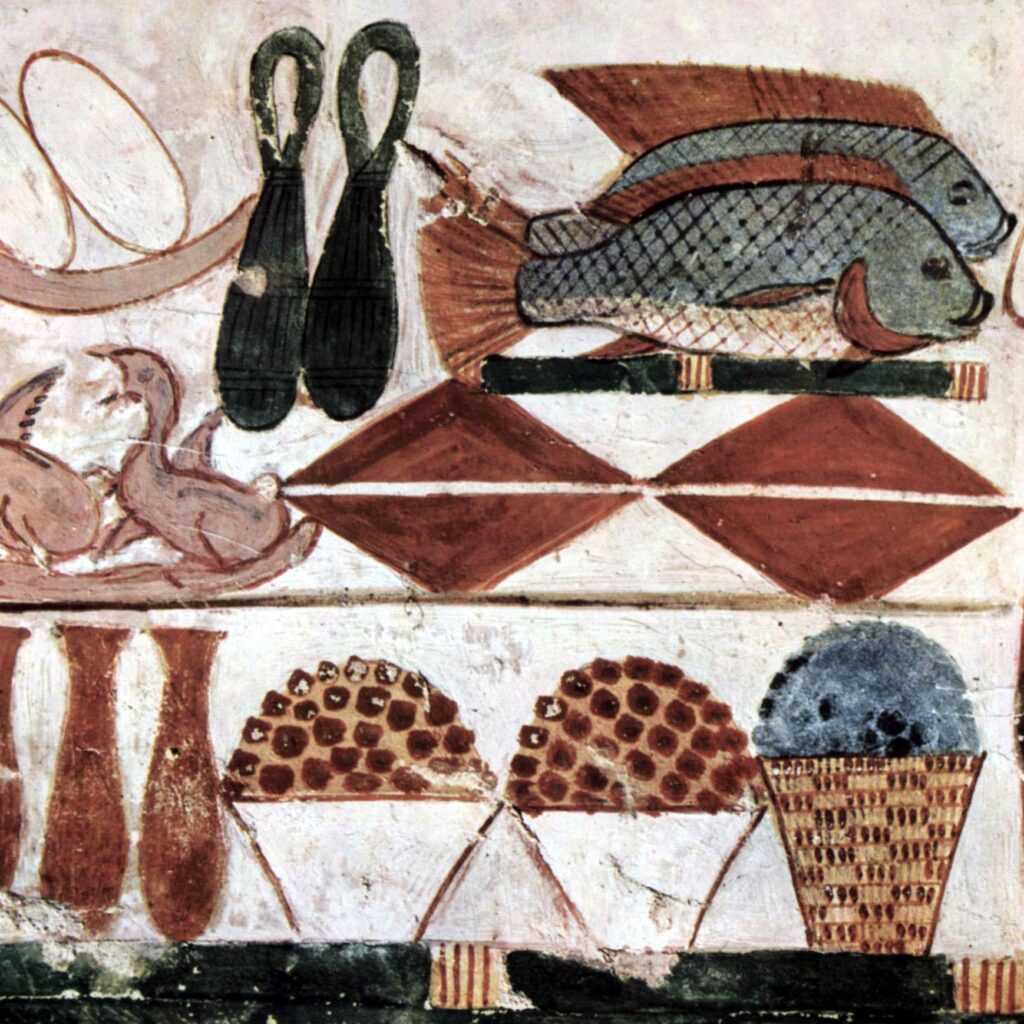
In reality, pharaonic Egypt did not venerate vegetables as deities in themselves. These were offerings or attributes used as symbols of fertility, growth or health. Latin authors conflate ritual use with veneration in order to discredit a foreign culture. The bad faith is evident, since associations between deities and natural produce existed just as much in the Graeco-Latin world. Athenaeus reports the tradition according to which ‘Latona (Leto), pregnant with Apollo, developed a fondness for the gethyllis (onion or a plant of the same family); this is why this plant obtained such veneration’[9]. The author alludes to the Theoxenia of Delphi, a ritual in which the gods were symbolically invited to a banquet. Whoever brought an onion of particularly imposing size as an offering could have the considerable honour of sharing the table of the gods.
In the ancient world, one could also dream of eating onions in great quantity, and this was not without significance. Artemidorus of Daldis, in his Oneirocritica, proposes a sophisticated dream interpretation: ‘If someone dreams that he eats many onions and he is ill, he will recover. But if he eats few, he will die. For those who die shed few tears’[10]. The logic rests on a symbolic association between the tears provoked by the onion and vitality: the more the onion makes one weep, the more it testifies to a life force capable of resisting illness.
The paradoxes of medical use
The onion’s medical virtues were not merely symbolic. But here too ambivalence was the rule.
Pliny the Elder devotes several chapters of his Natural History to the therapeutic virtues of the bulb: ‘Cultivated onions, by their smell alone and their capacity to make one weep, dispel disorders of the sight – even more so if the eyes are anointed with their juice’[11]. The author then lists a long series of applications: mouth ulcers, dog bites, wounds of all kinds, deafness, alopecia.
But Pliny also notes the medical controversies: ‘On this subject, physicians are in profound disagreement. The most recent say that the onion is bad for the chest and digestion, that it causes flatulence and gives thirst. The school of Asclepiades, on the other hand, holds that it improves the complexion, and that, eaten daily on an empty stomach, it ensures good health’[12].
Pliny even recommends using the onion as a suppository to relieve haemorrhoids.
The bulb was also held to be a stimulant, giving strength and vigour. In the continuation of the Xenophon text already cited, the author has Socrates say: ‘For one preparing for battle, it is good to nibble a little onion, just as some feed garlic to their fighting cocks before sending them into the arena.’[13]
The onion as aphrodisiac
For Latin authors, this invigorating property of the onion extended to carnal pleasures too. If the smell repels, the effect excites. Ovid, in his Remedies for Love, expressly recommends avoiding it:
‘Whether it be from Daunia, from the shores of Libya, or whether it comes from Megara, the onion will be harmful in every case. It is just as fitting to avoid arousing rocket, and anything else that excites bodies to Venus’[14].
This aphrodisiac reputation explains why certain priests and the Pythagoreans abstained from it.
The bulb embodies the generative force of nature, which justifies its role in nuptial rituals. Athenaeus reports that in Thrace, at the wedding of the general Iphicrates to the daughter of King Cotys, ‘among the other wedding gifts’ was ‘a chest twelve cubits long full of onions’, alongside, among other things, a pot of snow and a pot of lentils[15].
At the next wedding, then, you will know what to give.
Sowing, growing, preserving
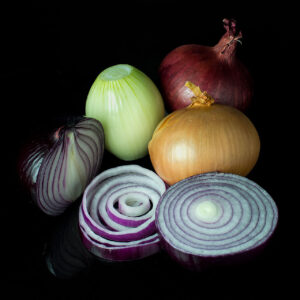
Antiquity did not know a single onion, but a whole palette of varieties with evocative names. The Greeks carefully distinguished the onion of Sardis from that of Samothrace, the Alsidenian from the Cnidian. The latter, incidentally, had the reputation of being the least tear-inducing. The Cypriot onion, by contrast, made one weep copiously.
Rome further enriched this geographical diversity. Pliny the Elder (Natural History, XIX, 101–116) lists the regional specialities with precision: the African onion, reputed for its pungency, the Gallic, the Tusculan with its milder taste, and the Ascalonian, from that city in the Near East which gave its name to the modern shallot. Each had its own qualities: round ones were preferred to elongated ones, red ones sharper than white.
From unio to onion
Columella (De re rustica, X, 123) mentions a variety that farmers called unio (unionem in the accusative). This ‘solitary’ bulb, which unlike garlic produces no lateral offsets, takes its name from the Latin unus (one alone). The word gave ‘oignon’ in French and ‘onion’ in English, while most Romance languages have retained the memory of the classical Latin caepa/cepa, as in Italian cipolla.
Growing onions in Antiquity called for genuine expertise. Roman agronomists distinguished two main categories: condiment onions, sown in spring between March and May, and storage onions, planted after the autumn equinox.
Pliny’s advice reveals an already sophisticated agriculture. The ground was to be dug over three times and meticulously weeded. It was recommended to add savory to the sowing, since this companion plant favoured growth. Hoeing was carried out up to four times in the season: ‘the more one hoes, the bigger the onion grows’, he noted.
Preservation posed a major challenge in a world without refrigeration. Columella gives a precise recipe for his Pompeian onions: after drying in the sun and cooling in the shade, they were laid on a bed of thyme in earthenware jars, covered with a brine made of three parts vinegar to one of salt.
Other techniques existed. Pliny recommended rubbing the bulbs with warm salt water to prolong their keeping, or hanging them above embers to prevent germination. Varro, cited by Pliny, advised pounding them with salt and vinegar before drying them: this preparation resisted worms.
The Ancients had understood that the onion, like garlic, continues to live after harvesting. They noted that it could sprout even off the ground, a phenomenon that fascinated as much as it complicated storage.
[1] Xenophon, Symposium, 8: Ὦ ἄνδρες, ὁ Νικήρατος κρομμύων ὄζων ἐπιθυμεῖ οἴκαδε ἐλθεῖν, ἵν᾽ ἡ γυνὴ αὐτοῦ πιστεύῃ μηδὲ διανοηθῆναι μηδένα ἂν φιλῆσαι αὐτόν.
[2] Aristophanes, Peace, 360: τοῦ μὲν γὰρ ὄζει κρομμυοξυρεγμίας.
[3] Aristophanes, Peace, 392: ἥδομαί γ᾽ ἥδομαι / κράνους ἀπηλλαγμένος / τυροῦ τε καὶ κρομμύων.
[4] Petronius, Satyricon, 58: Tu autem, inquit, etiam tu rides, caepa cirrata?
[5] Apicius, De re coquinaria: see the occurrences of cepa, cepae, cepam, cepas.
[6] Pliny the Elder, Natural History, XIX, 101 : Alium cepasque inter deos in iureiurando habet Aegyptus.
[7] Juvenal, Satires, XV, 7-10 : illic aeluros, hic piscem fluminis, illic / oppida tota canem uenerantur, nemo Dianam. / porrum et caepe nefas uiolare et frangere morsu / (o sanctas gentes, quibus haec nascuntur in hortis numina!).
[8] Prudentius, Against Symmachus, II, 865: Porrum et cæpe Deos imponere nubibus ausi / Alliaque et Serapin coeli super astra locare.
[9] Athenaeus of Naucratis, Deipnosophistae, IV, 372a-b : ἱστοροῦσι δὲ τὴν Λητὼ κύουσαν τὸν Ἀπόλλωνα κιττῆσαι γηθυλλίδος· διὸ δὴ τῆς τιμῆς τετυχηκέναι ταύτης (…) διατέτακται παρὰ Δελφοῖς τῇ θυσίᾳ τῶν Θεοξενίων, ὃς ἂν κομίσῃ γηθυλλίδα μεγίστην τῇ Λητοῖ, λαμβάνειν μοῖραν ἀπὸ τῆς τραπέζης· ἑώρακα δὲ καὶ αὐτὸς οὐκ ἐλάττω γηθυλλίδα γογγυλίδος καὶ τῆς στρογγύλης ῥαφανῖδος..
[10] Artemidorus of Daldis, Oneirocritica, I, 69
[11] Pliny the Elder, Natural History, XX, 39 : sativae olfactu ipso et delacrimatione caligini medentur, magis vero suci inunctione.
[12] Pliny the Elder, Natural History, XX, 42 : reliqua inter medicos mira diversitas. proximi inutiles esse praecordiis et concoctioni inflationemque et sitim facere dixerunt. Asclepiadis schola ad colorem quoque validum profici hoc cibo et, si ieiuni cotidie edant, firmitatem valetudinis custodiri, stomacho utiles esse, spiritus agitatione ventrem mollire, haemorrhoidas aperire subditas pro balanis.
[13] Xenophon, Symposium, 9: Εἰς μὲν γὰρ μάχην ὁρμωμένῳ καλῶς ἔχει κρόμμυον ὑποτρώγειν, ἡμεῖς δὲ ἴσως βουλευόμεθα ὅπως φιλήσομέν τινα μᾶλλον ἢ μαχούμεθα.
[14] Ovid, Remedies for Love, 797-799 : Daunius, an Libycis bulbus tibi missus ab oris, / an veniat Megaris, noxius omnis erit. / Nec minus erucas aptum vitare salaces, / et quicquid Veneri corpora nostra parat.
[15] Athenaeus of Naucratis, Deipnosophistae, IV, 131 : βολβῶν τε σιρὸν δωδεκάπηχυν.
Other articles in English from the Nunc est bibendum blog