Translated from french (please notify us of errors)
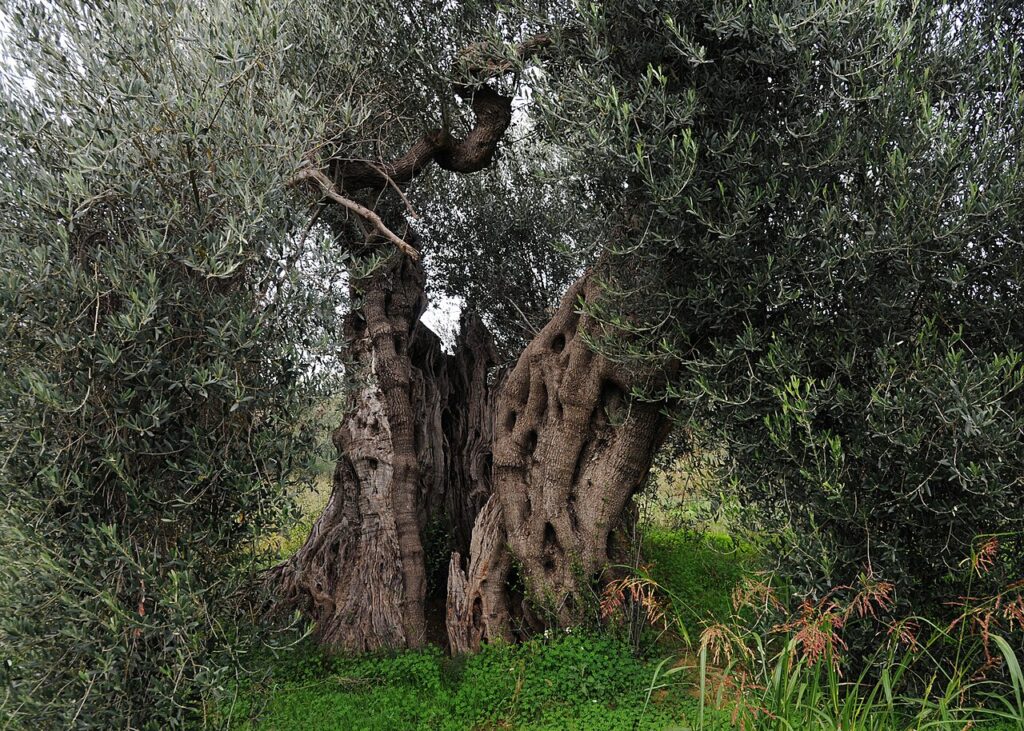
It is tempting to assume that Italian olive cultivation began with the Romans – or at least with the Greeks, who supposedly handed down the press, the amphora, and the know-how. A study published in January 2026 in the American Journal of Archaeology by archaeologist Emlyn Dodd[1] overturns this comfortable chronology.
Reassessing all available archaeological and palaeoenvironmental data for Italy, from prehistory to the end of the Empire, Dodd shows that the olive tree has been cultivated there for more than six thousand years, and that the first oil production may date back some four thousand years – long before Rome became a Mediterranean power.
Pollen before the press
Everything begins well before agriculture. Pollen analyses show that the wild olive (Olea europaea ssp. oleaster) was already present in Italy during the Pleistocene. During the Last Glacial Maximum, the species survived in a few sheltered areas before gradually recolonising new territories as the climate warmed.
But the presence of a tree does not mean it was exploited by humans. To establish that, other traces must be sought.
The first appear in the Mesolithic. Olive charcoal – a sign of human use – has been found in layers dated to around 6600–6100 BCE at the Grotta dell’Uzzo in Sicily, and at Terragne in Apulia. Further north, the Arene Candide cave in Liguria yielded olive charcoal dated to 5740–5590 BCE, associated with millstones and sickle blades. These may be the traces of a rudimentary gathering and processing of wild olives.
Neolithic evidence then becomes more abundant. The tree appears to have been valued first for its wood, dense and durable, before its fruit was exploited more systematically. The earliest identified olive stones appear in the Middle Neolithic in a funerary context at Carpignano Salentino in Apulia. For this period, however, no solid evidence of oil production has yet been uncovered in Italy.

The Bronze Age turning point
The first possible traces of oil appear in the Bronze Age.
An analysis of organic residues carried out on a large storage vessel (pithos) found at Castelluccio in Sicily detected vegetable lipids consistent with olive oil around 2000 BCE. The interpretation remains cautious: current techniques still struggle to distinguish the various vegetable oils with certainty, and Mediterranean preservation conditions frequently complicate the analysis.
More convincing evidence subsequently emerges from southern Italy. At Broglio di Trebisacce in Calabria, and at Roca Vecchia in Apulia, several large pithoi dated to around 1200–1000 BCE contained residues clearly associated with olive oil. These discoveries suggest the existence of local production well before the Roman period.
An already well-established olive culture
In the Iron Age, contacts with the Greeks, the Phoenicians, and the Etruscans accelerated agricultural transformations. But, contrary to a long-held assumption, they do not appear to have introduced olive cultivation to Italy.
Dodd’s argument is clear: these contacts rather amplified an already existing tradition. Technical knowledge from outside combined with local practices, producing new forms of exploitation.
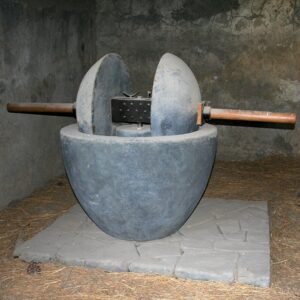
A particularly interesting clue comes from Incoronata in Basilicata. A fragment of a rotary olive mill dating to the 7th century BCE was discovered there. If the interpretation is confirmed, it may be one of the oldest known examples of the trapetum, the specialised mill designed to crush olives.
This technological innovation did not become widespread across the peninsula, however, until the 2nd century BCE. Operated by two people or by animals, the trapetum allowed far more efficient grinding than the older methods, which used stones, pestles, or rollers.
The Roman expansion
It is with Rome that the scale truly changes.
The archaeological installations bear witness to a massive and organised production. Some agricultural villas possessed several presses. The villa at Vacone in northern Latium had at least four. In Apulia, an establishment operating from the 1st century BCE had a cella olearia containing up to 47 enormous dolia, capable of storing between 25,000 and 35,000 litres of oil.
At the other end of the spectrum, archaeology also reveals more modest operations. The site of Case Nuove in Tuscany shows a small-scale transformation carried out in the open air: a basin, a work surface, and a rudimentary press were sufficient to produce oil for a local farm.
At the beginning of the Empire, the hinterland of Rome alone may have been capable of producing nearly 9.7 million litres of oil per year.
Waste not
The olive tree did not serve solely to produce oil.
Its wood, very dense, was used for tools, construction, and fuel. The pomace – the solid residue from pressing – made an excellent fuel, burning slowly and with little smoke. As for the amurca, the bitter liquid produced during decantation, Roman agronomists attributed all manner of uses to it: pesticide, veterinary medicine, or waterproofing agent for ceramics – Cato, Columella, and Virgil all mention it.
A history far older than Rome
For a long time it was assumed that Italian olive cultivation had begun with the Greeks or the Phoenicians. The archaeological evidence tells a different story.
Long before the arrival of Mediterranean colonists, the peoples of the peninsula were already exploiting the wild olive. Over the course of millennia, this relationship was transformed into a genuine agricultural culture.
By the time Rome began to build its empire, the olive tree had long been at home in Italy.
[1] Lecturer at the Institute of Classical Studies, University of London.
Source
Emlyn Dodd, “The Archaeology of Olive Oil Production in Roman and Pre-Roman Italy”, American Journal of Archaeology 130.1 (2026), p. 115–151, DOI: 10.1086/737823
Other articles in English from the Nunc est bibendum blog