Article en français / Versione in italiano
Translated from French with DeepL & ChatGPT (please notify us of errors)
Among the roughly five hundred Roman recipes that have miraculously come down to us thanks to the medieval manuscript tradition of the cookery book attributed to Apicius, the one we are talking about here is rather innocuous in appearance. But did it in fact have an extraordinary destiny?
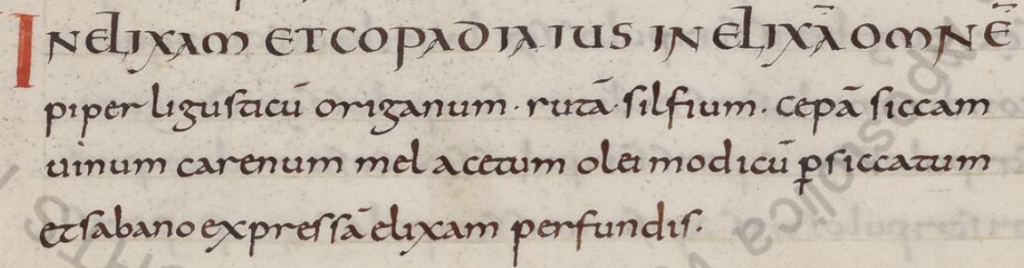
The recipe appears in chapter VII, entitled Polyteles, which – in ancient Greek – means ‘sumptuous’ in the sense of ‘who does not hesitate to spend’. It is in this chapter that we find a series of original recipes that do not necessarily excite our modern taste buds: stuffed sow’s womb or pig’s stomach, grilled teats… There are also other preparations that are still markers of culinary luxury: foie gras and truffle skewers.
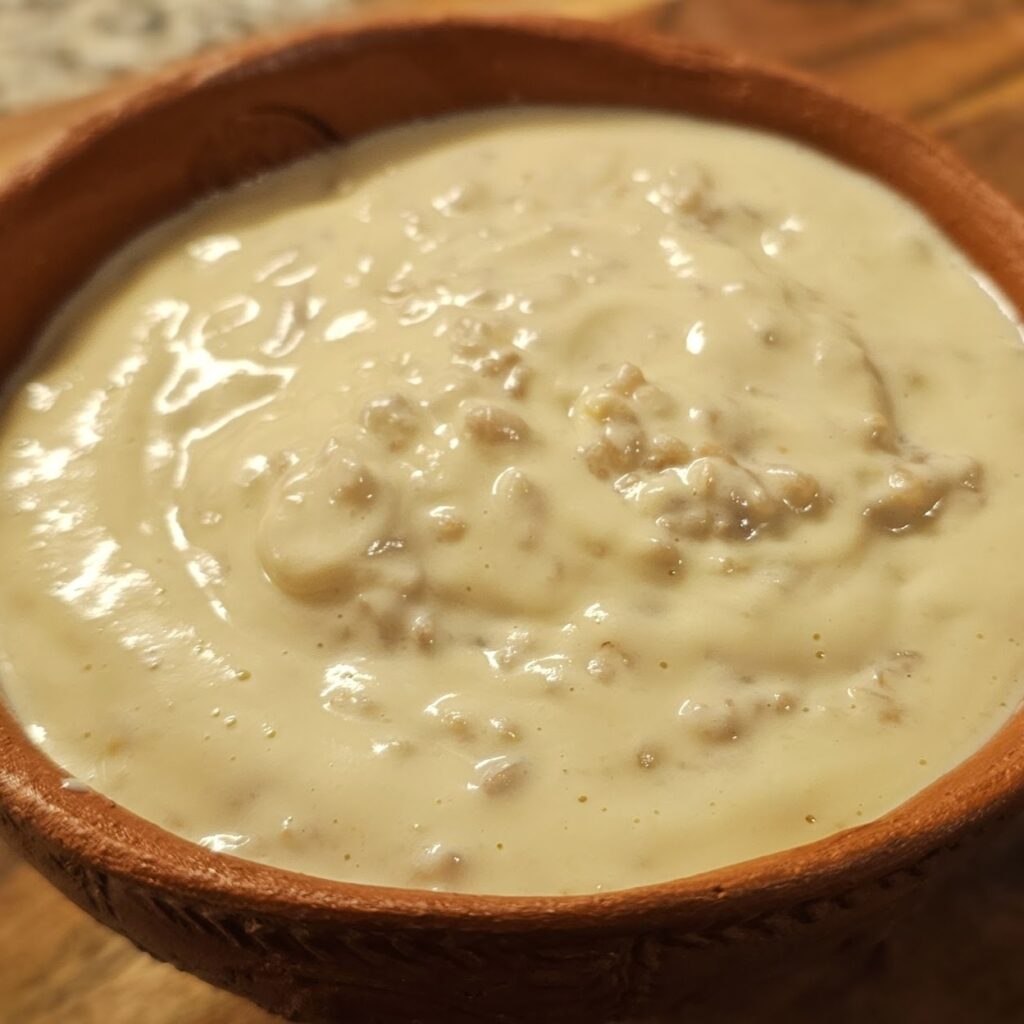
Our recipe is simpler. It is a sauce for all boiled foods –ius in elixam omnem[1]. The end of the text specifies the use: “Boil the meat, dry it well, drain it in a cloth and pour the sauce over it”.
Between the title and these practical indications, the text delivers the recipe itself, a list of eleven ingredients, without any indication of quantity, except for the olive oil to be used in moderation (olei modicum). In addition to the latter, the list includes:
- aromatic herbs: oregano, lovage and rue. While the first is well known, the other two are much less so. However, they are making a comeback on the shelves of garden centres[2];
- exotic spices: Indian pepper[3] and Cyrenaica silphium[4];
- products derived from the vine: wine, vinegar and caroenum, the latter being a must reduced by one third by boiling;
- dried onions;
- and honey, an essential ingredient in Roman cuisine.
This mixture thus produced a sauce for meat that we no longer know, unless…
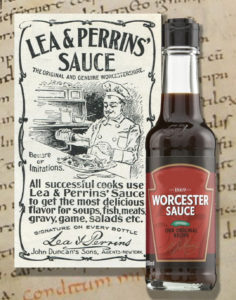
At the beginning of the 19th century, two English chemists by the name of John Lea and William Perrins “invented” a sauce that could accompany anything, especially meat and fish. It is salty and sweet at the same time, with a spicy taste due to the vinegar. They named it after the town where they lived. Thus Worcester (or Worcestershire) sauce was born in 1837.
Although Lea and Perrins’ recipe is still partly secret, it has many similarities with the recipe of Apicius. Only the use of anchovies stands out, as if the British chemists had made a mix with another famous Roman sauce, garum[5].
But the most intriguing point is that Worcestershire sauce may not be a true invention, but rather an adaptation. According to a tradition reported by the brand, Lea and Perrins are said to have developed their version at the request of a lord returning from India, sometimes presented as a former governor of Bengal. Deeply nostalgic for his favourite Indian sauce, the colonial administrator supposedly asked the two chemists to reproduce a facsimile of it. The Indian original most likely did not contain anchovies, but only asafoetida –the substitute for silphium already used by the Romans, whose use has endured in the Indian subcontinent.
We can therefore indulge in a reverie that is perhaps not so far from reality: what if Apicius’ sauce ‘for all meats’ had travelled as far as India under the influence of the Roman Empire, before returning to the West almost two millennia later in the luggage of the British Empire?
[1] Apicius, De re coquinaria, Liber VII Polyteles, VI. In elixam et copadia (273): Ius in elixam omnem: piper, ligusticum, origanum, rutam, silphium, cepam siccam, vinum, caroenum, mel, acetum, olei modicum. Persiccatam et sabano expressam elixam perfundis
[2] See the page Dans le jardin d’Apicius, les plantes aromatiques
[3] See the article Petite histoire piquante du poivre
[4] See the article Le silphium, première victime de la surexploitation
[5] See the article Gare au garum!
Other articles in English from the Nunc est bibendum blog