Translated from French (please notify us of errors)
For more than a thousand years, Greeks and Romans regarded beer as a drink of foreigners and barbarians: Thracians, Egyptians, Gauls, Germans. They associated it with rot, poverty and a lack of virility. They even turned it into an insult hurled at an emperor. Yet, behind this open contempt, beer was very much present in the Greco-Roman world.
In 365 CE, the emperor Valens laid siege to Chalcedon, on the Asian shore of the Bosporus. From the top of the walls, the besieged insulted him: “Sabaiarius!”. Which might be translated as “beer-drinker”. The historian Ammianus Marcellinus, who recorded the anecdote, saw fit to explain the word: “sabaia is a drink of the poor in Illyria, made of barley or wheat turned into liquid”[1]. Valens came from Pannonia, a Roman province in central Europe, and Ammianus elsewhere describes him as an uncultivated man.
The insult was not new. More than 1,000 years before Valens, the Greek and later the Roman elites had made beer a despised drink, typical of barbarian peoples.
Sip or suck
The first Greek mention of beer is found in the poet Archilochus of Paros, in the seventh century BCE, and it has little to do with gastronomy. Archilochus knew the Thracians, a people of the Balkan peninsula, to the north-east of Greece. He had fought them when the Greeks were colonising Thasos. Two lines of a poem by Archilochus have been preserved by Athenaeus:
“…as a Thracian or a Phrygian sucks his beer through a straw; and she, bent forward, was hard at work”[2].
Commentators read it as a sexual scene, which we shall leave to the reader’s imagination.
The word for the tube, aulos (αὐλός), also refers to the reed wind instrument that accompanied banquets, and Greek also used it jokingly for the male member.
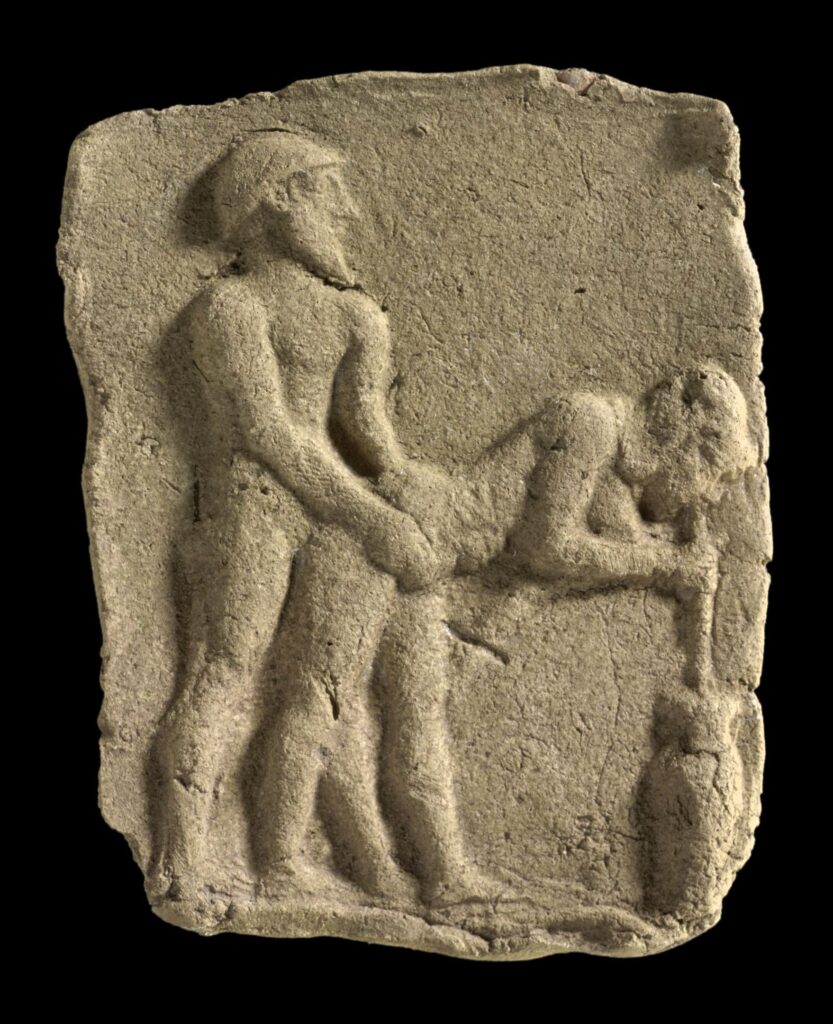
A variant of the practice described by Archilochus, combining sexual intercourse with drinking beer through a straw, also recurs in Mesopotamian iconography more than 1,000 years earlier. It is depicted on numerous mould-made terracotta plaques, several examples of which have been found at different sites.
In the minds of Greco-Roman banqueters, then, the world was divided in two. On one side, those who suckle a whitish liquid through a straw – infants, women and barbarians; on the other, those who sip the noble fruit of the vine…
Athenian theatre took up the theme. In Aeschylus’ Suppliants (first half of the fifth century BCE), the king of Argos, Pelasgus, protects the fifty daughters of Danaus from their Egyptian cousins, who want to marry them by force. When their herald wishes victory to the males, Pelasgus retorts: “You will find that the inhabitants of this land are men, who do not drink wine made from barley”[3]. The retort may contain an obscene pun: krithê (κριθή), barley, could also designate the male member. The “barley brew” would then allude to oral sex. Even without this double meaning, Pelasgus mocks the Egyptians’ virility by presenting them as beer-drinkers.
Glossary of beer in antiquity
In Greek
– bryton (βρῦτον): beer of the Thracians, Phrygians and Paeonians. The oldest Greek word for beer: Archilochus, in Athenaeus 10, 447b.
– zythos (ζῦθος): Egyptian beer in Theophrastus, On the Causes of Plants 6, 11, 2, later a general term, used for example for the beer of the Gauls in Diodorus 5, 26, 2.
– oinos krithinos (οἶνος κρίθινος): “barley wine”, a periphrasis. Xenophon, Anabasis 4, 5, 26.
– pinon (πῖνον): barley drink which, according to Aristotle, makes people fall flat on their backs. Athenaeus 10, 447a.
– korma (κόρμα) or kourmi (κοῦρμι): Gaulish wheat beer, sometimes with honey. Posidonius, in Athenaeus 4, 152c. Dioscorides 2, 88.
– parabiê (παραβίη): millet drink of the Paeonians, whose nature remains uncertain. Hecataeus, in Athenaeus 10, 447d.
In Latin
– zythum: Egyptian beer, from the Greek zythos. Pliny 22, 164; Columella 10, 116.
– cervesia: beer of Gaul and other provinces, the ancestor of French “cervoise”. Pliny 22, 164; Diocletian’s Edict 2, 11.
– caelia (celia): wheat beer of Hispania. Pliny 22, 164; Orosius 5, 7, 13.
– cerea (ceria): another name from Hispania, found only in Pliny (22, 164).
– camum: barley beer of Pannonia. Ulpian, Digest 33, 6, 9; Diocletian’s Edict 2, 11.
– sabaia: “drink of the poor” of Illyria. Ammianus Marcellinus 26, 8, 2.
Not all Greek authors, however, passed such crude judgement on beer. Around 500 BCE, Hecataeus of Miletus simply reported that the Egyptians ground barley to make a drink, while the Paeonians, neighbours of the Thracians, drank barley bryton (βρῦτον) and another preparation made from millet, called parabiê (παραβίη).
Herodotus also describes Egyptian customs, but explains them by a supposed absence of vines: “They use a wine made from barley, for there are no vines in their country”[4]. He is wrong, since viticulture was indeed practised in Egypt, and he himself mentions Egyptian grape wine elsewhere. But his remark reveals the Greek mindset: if people drink beer, it must be because they lack wine.
Aristotle also notes that beer produces a peculiar kind of drunkenness. Athenaeus has preserved his explanation:
“A peculiar thing happens, however, with barley drinks, and particularly with the one called ‘pinon’. Those who get drunk on other intoxicating drinks fall in every direction: to the left, to the right, on their faces or on their backs. Only those made drunk by ‘pinon’ fall backwards and stay lying on their backs”[5].
The Greek who liked beer
There is, however, the testimony of a Greek, and not the least known, who enjoyed beer. In the winter of 401–400 BCE, the Athenian Xenophon was making his way towards the Black Sea with the Ten Thousand, pursued by the Persians. In an Armenian village, the soldiers were well received and served “barley wine”:
“The barley grains themselves floated level with the brim, and reeds had been planted in it, some larger, some smaller, without joints. When you were thirsty, you had to take one into your mouth and suck. It was very strong if you poured no water in, and it was a very pleasant drink once you got used to it”[6].
Beer appears to have been an often thick drink, which could be diluted like wine and was drunk through a straw. Xenophon’s description is clearly addressed to an audience unfamiliar with it.
The Greeks had still other reasons for suspicion. Theophrastus, Aristotle’s successor, classed beer among denatured products:
“Other plant substances are transformed, diverted from their natural state and subjected to incipient decomposition to obtain drinkable liquids: this is how barley or wheat wines are made, or the drink called ‘zythos’ in Egypt.”[7].
Zythos (ζῦθος), whose Greek name probably evokes boiling and fermentation, was to him spoiled grain. According to ancient medical theories, wine was generally thought to warm the body, while Galen attributed cold properties to certain beers. This opposition could also evoke that between the masculine, associated with heat, and the feminine, associated with cold.
In Gaul, a drink of the poor?
At the beginning of the first century BCE, the Greek philosopher Posidonius described Gaul, which he had visited. He observed that what people drank varied with their wealth: “Among the rich, wine is drunk, brought from Italy and the territory of Massalia. […] Among the less well-off, it is a wheat beer prepared with honey; among most people, it is drunk plain. It is called korma”[8]. Korma (κόρμα) is probably related to the kourmi (κοῦρμι) that the physician Dioscorides, a century and a half later, says is made from barley.
The Gauls’ passion for Italian wine delighted the merchants, who shipped it by river and by cart: “For an amphora of wine they receive a slave, trading the drink for the cupbearer”[9]. Excavations have confirmed this trade: hundreds of thousands of fragments of Italian amphorae litter the south of France.
Beer was not, however, reserved for the poor. Polybius describes the palace of an Iberian king whose silver and gold kraters were filled with “barley wine”[10]. In Hispania, it also accompanied warriors. In 133 BCE, the defenders of Numantia, besieged by the Romans, are said to have drunk large quantities of caelia, a wheat beer, before attempting a final sortie. The historian Orosius even describes how it was made: the grains were moistened, heated, dried, then ground and left to ferment[11].
Beer under the Roman eagles
As they extended their rule, the Romans brought into their empire peoples who had been brewing and drinking beer for centuries. In the first century CE, Pliny the Elder drew up a map of these drinks: zythum in Egypt, caelia and cerea in Hispania, cervesia in Gaul. He notes that certain Spanish beers could be aged and that the froth of fermentation served as leaven for Gaulish bakers. But he makes no secret of his low opinion of them: “Oh, the astonishing ingenuity of vice! A way has been found to make even water intoxicating!”[12]
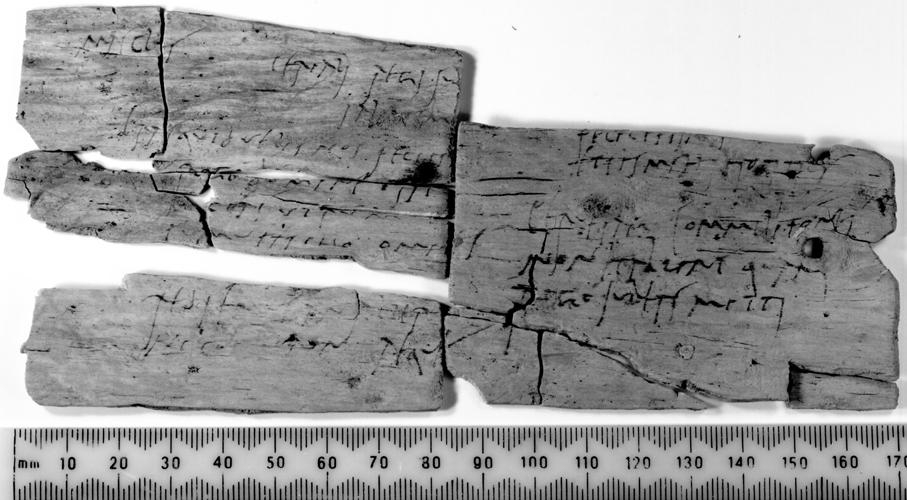
The contempt of Roman writers contrasted with the habits of their soldiers. Around 100 CE, at the fort of Vindolanda in the north of Roman Britain, the decurion Masclus wrote to his commander: “My comrades have no beer: please order some to be sent”[13]. Other tablets mention a brewer and beer accounts. The Batavian and Tungrian auxiliaries serving Rome had not given up the drink of their home regions.
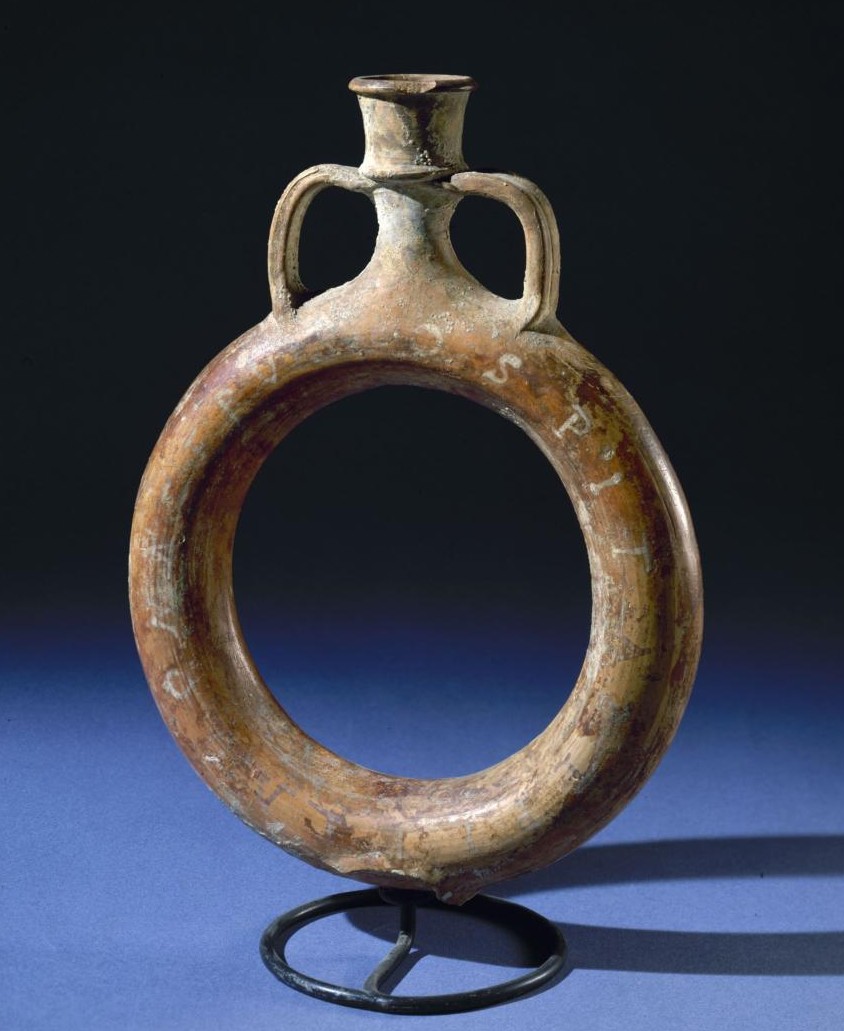
In the northern provinces, beer had become a well-established commercial activity. Inscriptions mention brewers and merchants. On a beaker found in Mainz, dated to the fourth century, one can read this invitation: “Fill the jug with beer, hostess, serve!”. In Paris, a flask calls for beer on one side and spiced wine on the other. The two drinks sat side by side even on tableware[14].
The last word to Dionysus
The opposition between wine and beer was not one-sided, though. Caesar reports that the Nervii, in Gallia Belgica, refused to allow wine to be imported, convinced that it softened men and weakened their courage[15]. Where the Greeks saw beer as an unmanly drink, some northern peoples distrusted wine for the same reason.
The Greco-Roman prejudice nevertheless died hard. In the fourth century, the emperor Julian devoted a mocking epigram to the beer of the Celts. Addressing the drink as if it were Dionysus, he declares:
“By the true Bacchus, I do not recognise you: I know only the son of Zeus. He smells of nectar, you of billy goat. Is it that the Celts, for lack of grapes, made you from ears of grain?”[16]
Then he renames the drink Demetrios, after Demeter, goddess of cereals, as if to deny it any kinship with the god of wine.
But inscriptions and archaeological remains show that, despite the contempt of classical authors, beer was widely drunk in the Roman provinces, even in the Empire’s garrisons.
Modern studies consulted
- André, Jacques, L’Alimentation et la cuisine à Rome, Paris, Les Belles Lettres, 2nd edn, 1981.
- Auberger, Janick, Manger en Grèce classique. La nourriture, ses plaisirs et ses contraintes, Québec, Presses de l’Université Laval, 2010.
- Nelson, Max, “The Cultural Construction of Beer among Greeks and Romans”, Syllecta Classica 14, 2003, pp. 101–120.
- Nelson, Max, The Barbarian’s Beverage. A History of Beer in Ancient Europe, London – New York, Routledge, 2005.
- Nelson, Max, “Did Ancient Greeks Drink Beer?”, Phoenix 68, 2014, pp. 27–46.
- Romney, Jessica M., “Sip, don’t suck: defining ‘Greek’ and ‘male’ via beer, wine and sex”, The Journal of Hellenic Studies 145, 2025, pp. 84–99.
[1] Ammianus Marcellinus, History 26, 8, 2 (ed. Seyfarth): cuius e muris probra in eum iaciebantur et irrisive compellabatur ut Sabaiarius. est autem sabaia ex ordeo vel frumento in liquorem conversis paupertinus in Illyrico potus. “From its walls insults were hurled at him, and he was mockingly addressed as Sabaiarius. For sabaia is a drink of the poor in Illyria, made of barley or wheat turned into liquid.”
[2] Archilochus, fr. 42 West, quoted by Athenaeus, Deipnosophists 10, 447b: ὥσπερ αὐλῷ βρῦτον ἢ Θρέϊξ ἀνὴρ / ἢ Φρὺξ ἔβρυζε· κύβδα δ’ ἦν πονεομένη. “…as a Thracian or a Phrygian sucks his beer through a tube; and she, bent forward, was hard at work.”.
[3] Aeschylus, Suppliants 952–953: ἀλλ’ ἄρσενάς τοι τῆσδε γῆς οἰκήτορας / εὑρήσετ’, οὐ πίνοντας ἐκ κριθῶν μέθυ. “You will find the inhabitants of this land to be males, and men who do not drink the brew made from barley.”
[4] Herodotus, Histories 2, 77, 4: οἴνῳ δὲ ἐκ κριθέων πεποιημένῳ διαχρέωνται· οὐ γάρ σφι εἰσι ἐν τῇ χώρῃ ἄμπελοι. “They use a wine made from barley, for there are no vines in their country.”
[5] Aristotle, On Drunkenness, fr. 106 Rose, quoted by Athenaeus, Deipnosophists 10, 447a–b (ed. Kaibel): πλὴν ἴδιόν τι συμβαίνει περὶ τὰς τῶν κριθῶν, τὸ καλούμενον πῖνον. ὑπὸ μὲν γὰρ τῶν λοιπῶν τε καὶ μεθυστικῶν οἱ μεθυσθέντες ἐπὶ πάντα τὰ μέρη πίπτουσι· καὶ γὰρ ἐπὶ τὰ ἀριστερὰ καὶ δεξιὰ καὶ πρηνεῖς καὶ ὕπτιοι. μόνοι δὲ οἱ τῷ πίνῳ μεθυσθέντες εἰς τοὐπίσω καὶ ὕπτιοι κλίνονται. “A peculiar thing happens, however, with barley drinks, with the one called pinon. With other intoxicating drinks, those who are drunk fall in every direction: to the left, to the right, on their faces or on their backs. Only those made drunk by pinon fall backwards, lying on their backs.”
[6] Xenophon, Anabasis 4, 5, 26–27: ἦσαν δὲ καὶ πυροὶ καὶ κριθαὶ καὶ ὄσπρια καὶ οἶνος κρίθινος ἐν κρατῆρσιν. ἐνῆσαν δὲ καὶ αὐταὶ αἱ κριθαὶ ἰσοχειλεῖς, καὶ κάλαμοι ἐνέκειντο, οἱ μὲν μείζους οἱ δὲ ἐλάττους, γόνατα οὐκ ἔχοντες· τούτους ἔδει ὁπότε τις διψῴη λαβόντα εἰς τὸ στόμα μύζειν. καὶ πάνυ ἄκρατος ἦν, εἰ μή τις ὕδωρ ἐπιχέοι· καὶ πάνυ ἡδὺ συμμαθόντι τὸ πῶμα ἦν. “There were also wheat, barley, pulses and barley wine in kraters. The barley grains themselves floated level with the brim, and reeds had been planted in it, some larger, some smaller, without joints. When you were thirsty, you had to take one into your mouth and suck. It was very strong if you poured no water in, and it was a very pleasant drink once you got used to it.”
[7] Theophrastus, On the Causes of Plants 6, 11, 2: τοὺς δὲ καὶ ἐξίσταντες τῆς φύσεως καὶ ὑποσήποντες εἰς χυλοὺς ἄγουσι ποτίμους, οἷον ὡς οἱ τοὺς οἴνους ποιοῦντες ἐκ τῶν κριθῶν καὶ τῶν πυρῶν καὶ τὸ ἐν Αἰγύπτῳ καλούμενον ζῦθος. “Other plant substances are transformed, diverted from their natural state and subjected to incipient decomposition to obtain drinkable liquids: this is how barley or wheat wines are made, or the drink called zythos in Egypt.” The passage belongs to a discussion of the extraction and transformation of plant juices.
[8] Posidonius, quoted by Athenaeus, Deipnosophists 4, 152c: τὸ δὲ πινόμενόν ἐστι παρὰ μὲν τοῖς πλουτοῦσιν οἶνος ἐξ Ἰταλίας καὶ τῆς Μασσαλιητῶν χώρας παρακομιζόμενος, ἄκρατος δ’ οὗτος· ἐνίοτε δὲ ὀλίγον ὕδωρ παραμίγνυται· παρὰ δὲ τοῖς ὑποδεεστέροις ζύθος πύρινον μετὰ μέλιτος ἐσκευασμένον, παρὰ δὲ τοῖς πολλοῖς καθ’ αὑτό· καλεῖται δὲ κόρμα. “Among the rich, wine is drunk, brought from Italy and the territory of Massalia; it is drunk neat, and sometimes a little water is mixed in. Among the less well-off, it is a wheat beer prepared with honey; among most people, it is drunk plain. It is called korma.”
[9] Diodorus Siculus, Library of History 5, 26, 2–3: διόπερ τῶν Γαλατῶν οἱ τούτων τῶν καρπῶν στερισκόμενοι πόμα κατασκευάζουσιν ἐκ τῆς κριθῆς τὸ προσαγορευόμενον ζῦθος, καὶ τὰ κηρία πλύνοντες τῷ τούτων ἀποπλύματι χρῶνται. […] διδόντες γὰρ οἴνου κεράμιον ἀντιλαμβάνουσι παῖδα, τοῦ πόματος διάκονον ἀμειβόμενοι. “That is why the Gauls, deprived of these fruits, make from barley a drink called zythos, and they wash honeycombs and use the rinsing water. […] For an amphora of wine they receive a slave, trading the drink for the cupbearer.”
[10] Polybius, Histories 34, 9, 14–15, quoted by Athenaeus, Deipnosophists 1, 16c: Πολύβιος Ἴβηρός τινος βασιλέως οἰκίαν, ὃν καὶ ἐζηλωκέναι λέγει τὴν τῶν Φαιάκων τρυφὴν πλὴν τοῦ τοὺς κρατῆρας ἐν μέσῳ τῆς οἰκίας ἑστάναι πλήρεις οἴνου κριθίνου, ἀργυροῦς ὄντας καὶ χρυσοῦς. “Polybius describes the house of an Iberian king who, he says, rivalled the luxury of the Phaeacians, except that the silver and gold kraters standing in the middle of the house were filled with barley wine.”
[11] Florus, Epitome of Roman History 1, 34, 12 (= 2, 18, 12): cum se prius epulis quasi inferiis implevissent carnis semicrudae et celiae; sic vocant indigenam ex frumento potionem. “After first gorging themselves, as if at a funeral feast, on half-raw meat and celia – that is what they call a local drink made from wheat.” Orosius, History against the Pagans 5, 7, 13–14: suscitatur enim igne illa vis germinis madefactae frugis ac deinde siccatur et post in farinam redacta molli suco admiscetur; quo fermentato sapor austeritatis et calor ebrietatis adicitur. “The germinating power of the moistened grain is awakened by fire, then it is dried, ground into flour and mixed with a mild liquid; as it ferments, it acquires a harsh taste and the warmth of drunkenness.”
[12] Pliny the Elder, Natural History 14, 149: Hispaniae iam et vetustatem ferre ea genera docuerunt. […] heu mira vitiorum sollertia! inventum est quem ad modum aquae quoque inebriarent. “The Spanish provinces have even shown that these drinks can be aged. […] Oh, the astonishing ingenuity of vice! A way has been found to make even water intoxicating.” – 22, 164: ex iisdem fiunt et potus, zythum in Aegypto, caelia et cerea in Hispania, cervesia et plura genera in Gallia aliisque provinciis. “From these same cereals drinks are also made: zythum in Egypt, caelia and cerea in Hispania, cervesia and several other kinds in Gaul and other provinces.” – 18, 68: Galliae et Hispaniae, frumento in potum resoluto quibus diximus generibus, spuma ita concreta pro fermento utuntur, qua de causa levior illis quam ceteris panis est. “The Gallic and Spanish provinces use as leaven the froth produced when making their cereal drinks; this is why their bread is lighter than that of other peoples.”
[13] Vindolanda Tablets III, 628, column II, lines 4–6: ceruesam commilitones / non habunt quam / rogó iubeas mitti. “My comrades have no beer: please order some to be sent.” Letter from the decurion Masclus to the prefect Flavius Cerialis, dated to 97–105 CE.
[14] Mainz beaker, fourth century: imple (h)ospita ol(l)a(m) de cervesa da. “Fill the jug with beer, hostess, serve!” Flask found in Paris, CIL XIII, 10018, 7a: (h)ospita, reple lagona(m) cervesa. “Hostess, fill the flask with beer!”.
[15] Caesar, Gallic War 2, 15, 4: nihil pati vini reliquarumque rerum inferri, quod eis rebus relanguescere animos eorum et remitti virtutem existimarent. “They [the Nervii] would not allow wine or any other luxury goods to be imported, convinced that these things weakened their spirits and sapped their courage.”
[16] Julian, On Barley Wine, Palatine Anthology 9, 368: τίς πόθεν εἶς, Διόνυσε; μὰ γὰρ τὸν ἀληθέα Βάκχον, / οὔ σ’ ἐπιγιγνώσκω· τὸν Διὸς οἶδα μόνον. / κεῖνος νέκταρ ὄδωδε, σὺ δὲ τράγον· ἦ ῥά σε Κελτοί / τῇ πενίῃ βοτρύων τεῦξαν ἀπ’ ἀσταχύων; / τῷ σε χρὴ καλέειν Δημήτριον, οὐ Διόνυσον, / πυρογενῆ μᾶλλον καὶ Βρόμον, οὐ Βρόμιον. “Who are you, Dionysus, and where do you come from? By the true Bacchus, I do not recognise you: I know only the son of Zeus. He smells of nectar, you of billy goat. Is it that the Celts, for lack of grapes, made you from ears of grain? So you should be called Demetrios, not Dionysus, born of wheat rather than born of fire, Bromos and not Bromios.”. Dionysus and Bacchus are the same god: Julian ironically addresses beer as a false Dionysus. The final lines pile up puns on Demeter, goddess of cereals, on the birth of Dionysus and on bromos (βρόμος, “oats”), set against Bromios, an epithet of the god.
Other articles in English from the Nunc est bibendum blog