Translated from french (please notify us of errors)

Lucian has a caustic tongue and a biting satire. Born around 120-125 CE in Samosata, on the banks of the Euphrates in present-day southeastern Turkey, he is today readily presented as one of the great figures of critical thought. His trajectory is striking: coming from a modest family of Greek culture, he climbed the ranks of imperial society to the point that a tradition – based on a few allusions scattered throughout his own writings – attributes to him, at the end of his life, a well-paid administrative position in Egypt, under the reigns of Marcus Aurelius or Commodus.
In his dialogue The Saturnalia, Lucian offers a satirical reflection on this Roman festival celebrated from December 17 to 23 in honor of Saturn. During these few days, the social order seems to be inverted: masters serve their slaves, freedom of speech is total, gifts are exchanged and feasting is unrestrained. Through fictional exchanges, Lucian highlights the social paradoxes that accompany this ritual parenthesis. Rich and poor, masters and slaves, are at the center of a sharp questioning of the inequalities and ethical values concealed behind the festivities.
A dialogue between Saturn and Cronosolon
The dialogue stages three voices: that of the priest Cronosolon, spokesman for the poor, that of Saturn in the position of a powerless arbiter, and that of the rich entrenched in their privileges.
From the opening, Cronosolon addresses the god directly. His plea is straightforward: he demands the restoration of the bygone golden age, that of Saturn’s reign. With Jupiter at the helm, everything goes wrong:
“If sometimes he grants the wishes of a mortal and bestows wealth upon him, he acts without discernment; he scorns virtuous and wise people, to enrich scoundrels, fools, androgynes who deserve the whip.”
Cronosolon depicts with nostalgia Saturn’s mythical epoch:
“Everything grew then without care or cultivation: no ears of grain, but bread already prepared and meats already cooked; wine flowed in streams; there were fountains of milk and honey; everyone was good and made of gold.”
The priest insists on the unbearable contrast between the opulence of some and the precariousness of others:
“We find it unbearable that a man, lying on purple carpets, overflowing with delights and proclaimed blessed by his intimates, spends his life in perpetual festivity, while my fellows and I think, even in our rest and in our dreams, of ways to earn four obols to make ourselves a supper of bread, porridge seasoned with cress, leek, thyme or onions, before going to bed.”
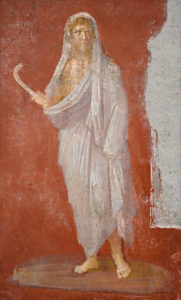
But the golden age now belongs to the past. Saturn, powerless before Jupiter, can only reign during the few days of the Saturnalia, when hierarchies are suspended and excesses encouraged. Beyond that, he can do nothing. Or almost nothing. He consents to write to the rich:
“The poor wrote to me recently to accuse you of not sharing with them what you possess, and they ask me to put all goods in common, so that each may have an equal portion.”
However, Saturn immediately reduces the scope of this demand. Nostalgic for his bygone reign, he can only symbolically adjust the Jovian order he disapproves of. His call for sharing is limited to “small gifts” that do not affect the structure of inequalities. He demands only a symbolic sharing, sufficient to calm frustrations:
“[The poor] promise that, if you act thus, they will not contest your goods before Jupiter; otherwise, they threaten to demand a new distribution of wealth at the first audience Jupiter grants. (…) Therefore arrange that henceforth the poor have no more cause to complain of you, but that they honor and love you for these small gifts, whose expense will be scarcely felt by you, and which, given opportunely, will earn you eternal gratitude.”
Lucian makes him a figure of compromise, perhaps in the image of those intellectuals of his time who, like him, move between social criticism and insertion into the imperial order.
The scathing response of the rich
The rich, offended, reject these demands with contempt:
“Do you then believe, Saturn, that it is only to you alone that the poor have written such nonsense?”
A scathing argument follows. First, the rich already give a little of their surplus. No one has serious grounds to complain. Going further would risk, according to them, feeding the ingratitude and debauchery of the poor. Invited to banquets, the latter, they accuse, behave badly:
“After having vomited throughout the hall, they rail against us, and go everywhere saying that we have starved and parched them.”
They continue:
“You [Saturn] will have no more reproach to address to us, as soon as they themselves are willing to fulfill their duties.”
Reversal of blame. Curtain on the good conscience of the rich.
The wealthy here deploy a classic rhetoric of justification for inequalities: they present themselves as generous donors already sufficiently virtuous, accuse the beneficiaries of ingratitude, and imply that poverty is a form of moral failing. This discourse, Lucian knows it well: it resonates throughout ancient literature, from Stoic philosophers to Roman moralists. By staging it with such crudity, the satirist reveals its entire mechanism.
In his dialogue, Lucian insists on the ephemeral character of the “freedom” offered to the oppressed during the Saturnalia. He suggests that the generosity of the rich during these days is merely a means of masking their usual greed and exploitation. A social safety valve that only perpetuates the unequal order of things.
Beware the blow of the sickle!

But beware, warns Lucian, Saturn is not just a benign symbol. The character created by Lucian, Cronosolon, is charged as Saturn’s priest with enacting the laws that apply during the Saturnalia. Transgressors expose themselves to the anger of the deity who, contrary to the representations of painters and poets, is not a weakened old man, Lucian specifies. He is a vigorous man, who holds in his hand a well-sharpened sickle, the very one he used to castrate his father Uranus. So beware! Here is the first of the laws:
“No one, during the festival, shall occupy himself with political or private affairs, except those that have for their purpose games, good cheer and pleasures: cooks alone and pastry-makers shall have work.
Equality for all, slaves or free, poor or rich.
Absolute prohibition against getting angry, losing one’s temper, making threats. No administrative accounts during the Saturnalia.
Let no one demand back from anyone either money or clothes. No writing during the festival. Closure of gymnasiums during the Saturnalia; no exercises or oratorical declamations, except witty, cheerful speeches, seasoned with mockery and banter.”
These laws sketch a temporary utopia: a few days of controlled license, façade equality and liberated speech. But it is precisely their limited character that makes Lucian’s pen grate.
A satire without illusions
Through this caustic dialogue, Lucian dismantles the mechanisms of a festival that claims to abolish hierarchies while reproducing them. The Saturnalia appears as a parenthesis necessary for maintaining social order: a few days suffice to appease tensions without changing anything fundamentally. The criticism is all the more biting as it emanates from a man who has himself climbed the ranks of this unequal society.
Lucian proposes no revolution. He observes, with the irony of the satirist, that Saturn’s golden age will forever remain a literary nostalgia, and that Jupiter reigns supreme over a world where the laws of the festival change nothing in the laws of fortune. Saturn’s sickle frightens for the duration of a banquet, but it cuts nothing essential.
Source
- Lucian of Samosata, The Saturnalia, full text in French translation. Greek text.
- Greek text of the first law: νόμοι πρῶτοι μηδένα μηδὲν μήτε ἀγοραῖον μήτε ἴδιον πράττειν ἐντὸς τῆς ἑορτῆς ἢ ὅσα ἐς παιδιὰν καὶ τρυφὴν καὶ θυμηδίαν, ὀψοποιοὶ μόνοι καὶ πεμματουργοὶ ἐνεργοὶ ἔστωσαν. ἰσοτιμία πᾶσιν ἔστω καὶ δούλοις καὶ ἐλευθέροις καὶ πένησι καὶ πλουσίοις. ὀργίζεσθαι ἢ ἀγανακτεῖν ἢ ἀπειλεῖν μηδενὶ ἐξέστω. λογισμοὺς παρὰ τῶν ἐπιμελουμένων Κρονίοις λαμβάνειν μηδὲ τοῦτο ἐξέστω. μηδεὶς τὸν ἄργυρον ἢ τὴν ἐσθῆτα ἐξεταζέτω μηδὲ ἀναγραφέτω ἐν τῇ ἑορτῇ μηδὲ γυμναζέσθω Κρονίοις μηδὲ λόγους ἀσκεῖν ἢ ἐπιδείκνυσθαι, πλὴν εἴ τινες ἀστεῖοι καὶ φαιδροὶ σκῶμμα καὶ παιδιὰν ἐμφαίνοντες.
See also
December 2025.
Other articles in English from the Nunc est bibendum blog