Translated from french (please notify us of errors)
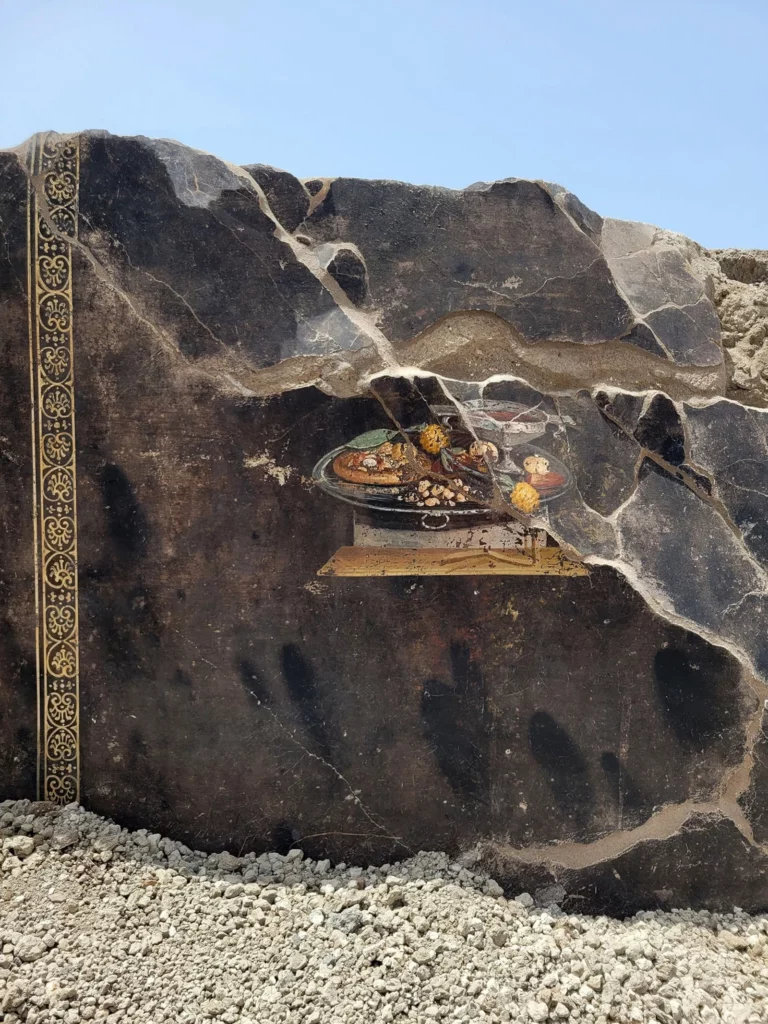
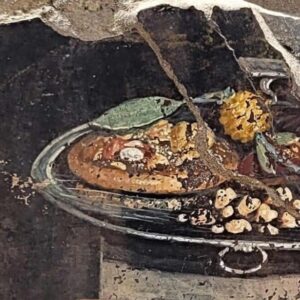
In 2023, the discovery of a fresco in Pompeii caused a sensation. On a small table, next to fruit and a cup of wine, one can make out something that looks very much like a pizza. The news of the discovery of the “ancestor of pizza” travelled around the world, much to the pride of the Neapolitans, who are behind this emblematic dish of Italian cuisine. Yet it is obviously not a pizza in the modern sense.
First, because tomato is an essential component, and this fruit originates from Mexico – and was therefore unknown in the West during Antiquity.
Secondly, because the topping seems to consist mainly of fruit, pomegranate seeds and dates, which is not the case for modern pizzas – except for the much-maligned “Hawaiian” variant among lovers of authentic Italian cuisine.
False pizza, real culinary curiosity
So, if it is not a pizza that is depicted, what is it? Beneath the topping, one can make out a round base, slightly raised at the edges and brown in colour. Some commentators have identified a terracotta dish or a basket. That is entirely possible… But what if it were in fact a bread? Among the very many Roman varieties, which one could it be?
Its round and flat shape has led researchers to a bread known in Latin as artolaganus. This term is mentioned only very rarely in Latin texts.
The first to mention this particular bread is Cicero. In a letter dated to 46 BCE, he addresses his old friend L. Papirius Paetus, a Roman knight living in Campania. Cicero announces his forthcoming visit, explaining that, after long opposing the Epicureans, he has now become one himself, determined to enjoy fully the pleasures of life:
“Prepare yourself, then! You are dealing with a genuine gourmand, but also with a man who is beginning to understand certain things (and you know how insufferable new initiates to knowledge can be). You will have to give up your ‘sportellae’ and your ‘artolagus’!”[1]
The sportellae are small baskets used to hold cold foods, and artolagus refers to our flat bread, which does not appear to have been particularly appreciated.
A delicacy, according to Pliny
Around a century later, Pliny the Elder takes a very different view. In a chapter of his Natural History devoted to cereals, he briefly mentions the different kinds of bread made by the Romans:
“It seems superfluous to review the various kinds of bread: some are named after the dishes with which they are eaten, such as the ‘ostrearii’, others because of their refinement, such as the ‘artolagani’, and others again because of the speed with which they are prepared, such as the ‘speustici’.”[2]
So we learn that the artolagani were particularly delicious. But there is no indication of how they were made, since Pliny considers it superfluous to tell us.
At last, a recipe… incomplete
To get at last something more substantial to sink one’s teeth into, one must turn to a Roman author who wrote in Greek. Readers of Greek will already have noticed: the word artolaganus derives from that language. Artos (ἄρτος) means wheat bread, and laganon (λάγανον) a kind of honey cake made with layers of pastry. This is what Athenaeus of Naucratis writes in the 2nd century CE, in a chapter of the Deipnosophists in which he details the different kinds of bread. He quotes a treatise on baking by another Greek author, Chrysippus of Tyana:
“In what is called ‘artolaganon’, a little wine, pepper, milk, a little oil or fat are added.”[3]
This, at least, is the beginning of a recipe. But since these are ingredients that are added, there must certainly have been a common base shared by the different breads. That base is not given in the preceding passage of Athenaeus. Everyone is therefore free to try to recreate the Pompeian “pizza” with a certain latitude of interpretation.
One final word on “pizza”, by way of conclusion. In fact, the Neapolitan pizella is first mentioned in the Neapolitan tale collection Lo Cunto de li cunti by Giambattista Basile, published in 1634, that is to say before the newly discovered tomato had come into use in European cooking. The toppings of this primitive pizza were therefore very different from what we know today. After all, it is not impossible that there may be a distant line of descent between the image in the Pompeian fresco and the Neapolitan dish.
To find out more
- E-Journal degli Scavi di Pompei, Una natura morta con xenia dallo scavo della casa IX 10,1 a Pompei.
[1] Cicero, Letter to Paetus, 9.20.2: Proinde te para; cum homine et edaci tibi res est et qui iam aliquid intellegat (ὀψιμαθεῖς autem homines scis quam insolentes sint); dediscendae tibi sunt sportellae et artologam tui.
[2] Pliny the Elder, Natural History, 18, 105: supervacuum videtur, alias ab opsoniis appellati, ut ostrearii, alias a deliciis, ut artolagani, alias a festinatione, ut speustici.
[3] Athenaeus of Naucratis, Deipnosophists, 3.79: εἰς δὲ τὸ καλούμενον ἀρτολάγανον ἐμβάλλεται οἰνάριον ὀλίγον καὶ πέπερι γάλα τε καὶ ἔλαιον ὀλίγον ἢ στέαρ. The treatise on baking by Chrysippus of Tyana has not survived.
Other articles in English from the Nunc est bibendum blog