Translated from French (please notify us of errors)
Roman food tells a story of conquest and cultural intermingling. Between Etruscan heritage, Greek influence, and innovations that were distinctly Roman, the table evolved in step with the social and territorial transformations of the Empire.

In Plautus’ theatre, Romans appear to Greek eyes as “porridge eaters” (pultiphagi)[1]. This mockery is not without foundation. Before the emergence of bread-making cereal species, Romans consumed their grain mainly in the form of porridge, puls.
Pliny the Elder’s continued interest in this preparation shows that, in the 1st century AD, cereal porridge still retained a certain importance[2], especially in traditional religious rites, which continued throughout the imperial period.
From a culinary perspective, basic porridge could be enriched with chopped vegetables, pieces of meat, cheese or herbs to produce dishes comparable to modern risotto. A more elaborate recipe, attributed to Caesar’s legions, combined spelt, minced meats, aromatics (pepper, lovage, fennel) and stale bread, all bound together with a reduction of wine. This “Julian stew” (Pultes Iulianae[3]) symbolised the very essence of Roman cuisine.
At the base: cereals and legumes
Cereals and legumes thus formed the basis of the diet, providing more than two-thirds of the population’s daily energy intake. Grains included several varieties of wheat – emmer (far), einkorn and spelt – as well as the less desirable barley, millet and oats.
Legumes included lentils, chickpeas, bitter vetch, broad beans, garden peas and grass peas. Pliny mentions various cultivated varieties, including a pea known as the “pea of Venus”[4]. Virgil, like Martial, praises in his verses lentils imported from Pelusium[5], a port in the eastern Nile delta.
The alternation of legumes and cereals allowed soils to be regenerated, while also constituting strategic reserves against shortages. Although usually regarded as a modest dish, legumes also appear among the foods served at banquets.
Bread appeared relatively late in Rome, in the 3rd century BC. Urban populations and the army preferred to consume grain in this form. The lower classes ate coarse brown bread made from emmer or barley. Fine white loaves were leavened using wild yeasts and sourdough cultures. The beer-drinking Celts of Spain and Gaul were renowned for the quality of their brewer’s-yeast-leavened breads.[6]
Maintaining a bread oven required considerable labour and space, so apartment dwellers probably prepared their dough at home and then took it to be baked in a communal oven. Mills and commercial ovens, generally combined in a bakery complex, were considered so vital to Rome’s well-being that several religious festivals honoured the deities who favoured these processes, and even the donkeys that laboured in the mills. Vesta, the goddess of the hearth, was seen as complementary to Ceres, the goddess of grain. During the Festival of Vesta, donkeys were adorned with garlands and allowed a period of rest. The link between hearth and grain also appears in the Fornacalia, celebrated in February. This festival honoured Fornax, goddess of bread ovens.
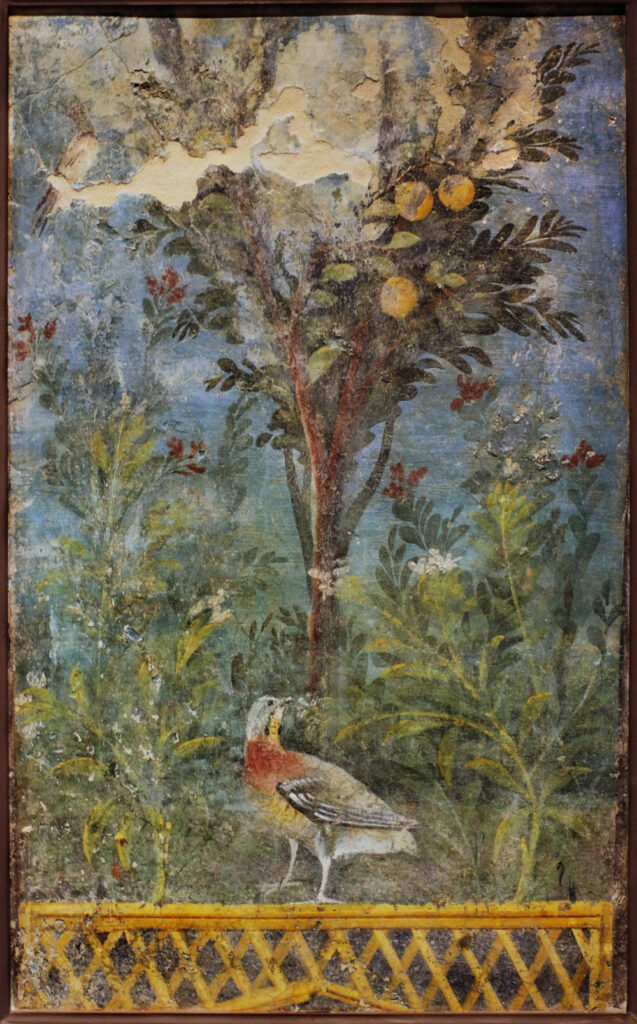
The garden, an ideal of frugality and self-sufficiency
Because of the importance of landownership in the formation of the Roman cultural elite, Romans idealised agriculture and rural life. Green vegetables and herbs were eaten raw, as salads, dressed with vinegar and sometimes oil. Cooked vegetables, such as beets, leeks or squashes, were prepared with sauces and served either at the beginning of the meal (gustatio) or as simple accompaniments to bread.
Ancient literary and archaeological sources attest the consumption of more than twenty varieties of vegetables and greens. Olives, fresh or preserved, were available in a wide range of qualities, including for modest social groups. As for truffles and wild mushrooms, while not everyday foods, they appear to have been gathered and eaten regularly.
Cabbage (brassica), praised by Cato the Elder for its dietary and medicinal virtues, as well as turnips (napus) and radishes (rapa), were among the most appreciated vegetables. Legumes, especially broad beans (fabae), occupied an important place in the diet of working and modest populations.
In the Roman imagination, the exemplary citizen feeds on the produce grown in his own garden: this highly idealised image refers to an agrarian morality that values frugality and self-sufficiency. Products from fields and kitchen gardens were thus perceived as the most “civilised” foods, in contrast to those associated with hunting.
The supply of vegetables to the city of Rome relied both on nearby countryside and on regions renowned for specific productions: Ostia was associated with leeks, Ravenna with asparagus, Punic Africa with various specialised market-garden crops. Some emperors themselves displayed a marked taste for vegetables, such as Tiberius for cucumbers – which he had grown year-round – or Nero for leeks.
The provinces exported regional dried fruits, such as figs from Caria and dates from Thebes, and fruit trees from the East gradually spread throughout the western Empire: the cherry from Pontus; the peach (persica) from Persia; citron and other citrus fruits then known; the Armenian apricot; the so-called “Damascene” plum; and finally what Romans called the “Punic apple”, that is, the North African pomegranate.
Ancient sources also attest the consumption of blackberries, currants, elderberries, quinces, melons, grapes, apples and pears.
The most widely consumed and most emblematic fruit of the Roman diet was the fig. Ancient authors distinguished forty-four different varieties. Fresh, it was not eaten as a dessert in the modern sense, but rather as an accompaniment to bread or as a supplementary food during the meal.
Berries were either cultivated or gathered wild. Among the most common nuts were almonds, hazelnuts, walnuts, pistachios, pine nuts and chestnuts. Agronomic sources also attest that fruit and nut trees could be grafted to produce several varieties on a single trunk.
The ambiguous status of meat
Although some eminent Romans discouraged or disdained the consumption of meat – such as the emperors Didius Julianus and Septimius Severus – Roman butchers offered a wide range of fresh meats, notably pork, beef, mutton or lamb, as well as poultry, especially chicken.
In the absence of refrigeration, various preservation techniques were developed. No part of the animal was needlessly wasted, which explains the production of blood sausages, meatballs (isicia), sausages and stews. Rural populations salted ham and bacon, while certain regional specialities – such as salted hams from Gaul – were widely traded. Lucanian sausages were made from minced meats, herbs and sometimes dried fruits, bound with eggs and smoked.
Modest social groups also consumed meat, but most often of inferior quality and in processed forms. It was prepared in stews, in meatballs (isicia) or cut into small pieces (ofellae).
The Stoic philosopher Musonius Rufus, who advocated a vegetarian diet, considered meat-eaters not only less civilised, but also “slower of mind”[7]. In Roman discourse, “barbarians” are frequently stereotyped as voracious carnivores. Thus Maximinus I the Thracian, the first emperor born of two parents described as barbarians and who reigned from AD 235 to 238, is portrayed as devouring enormous quantities of meat[8].

Fish as a social marker, and garum as a universal condiment
Romans attached great importance to products of the sea. Fish consumption was not merely dietary, but also constituted a social marker, making it possible to assert one’s rank and lifestyle. In Plautus’ comedies, characters display a marked taste for fish and shellfish, often associated with luxury, expense and the pleasures of the table[9].
From the end of the Republic onwards, specialised installations – fish ponds (piscinae) and oyster parks – were established, mainly on elite estates, in order to ensure a regular supply of marine products.
Large fish could reach considerable prices: Pliny the Elder thus reports sums of 5,000 to 8,000 sesterces for large red mullet, cited as examples of excessive luxury[10]. Crustaceans – lobsters, shrimps, spiny lobsters – were also highly prized, as were shellfish and sea urchins. Oysters were among the most sought-after products; they were shipped far from their places of production, as far as the northern provinces, notably Germania and the Alpine regions.
Romans also consumed preserved fish, most often salted or pickled. These products came from many provinces of the Empire – from southern Spain to Sicily and as far as Pontus – and testify to the extent of commercial networks linked to maritime resources.
Salt constituted the fundamental seasoning of Roman cuisine. Pliny the Elder emphasised its crucial importance[11], to the point that the Latin term sal came, by extension, to designate wit, sharpness or a clever remark.
An essential trade product, pure salt nevertheless remained relatively expensive. The most commonly used salty condiment was garum, a fermented fish sauce that provided an intense flavour corresponding to what is today described as “umami”. The main centres of production and export of garum were located in the provinces of Spain.
Seasonings available locally included garden herbs, cumin, coriander and juniper berries. Pepper held such importance in Roman cuisine that specific containers, sometimes richly decorated – the piperatoria – were designed to store it. Piper longum was imported from India, as was nard, a highly prized aromatic used notably to perfume refined dishes such as feathered game or sea urchins.
Among other imported spices were saffron, cinnamon and silphium from Cyrenaica, a plant overexploited to the point of disappearing under the reign of Nero[12]. It was then replaced by laser or laserpicium, generally identified with asafoetida, imported from eastern regions.
This taste for eastern products was not without economic consequences. Pliny estimated that Romans spent nearly 100 million sesterces each year on luxury products – spices, aromatics and perfumes – imported from India, Arabia and the regions known as those of the Seres (the Far East associated with silk production)[13].
Sweeteners were essentially limited to honey and grape-must syrup (defrutum). Cane sugar, an exotic product imported in very small quantities, was not used as a common sweetener: it served rather as an occasional garnish, a flavouring agent, or was included in medicinal remedies.
The use of vinegar in Roman cuisine was general and constant. In regions where wine was lacking, vinegar was prepared from other fruits, notably figs, pears or peaches. In addition to “ordinary” vinegar, Romans also produced more complex preparations, such as oxygarum – a mixture of vinegar, garum and spices – oxymeli, composed of honey and vinegar, or oxyporium, obtained by macerating spices in vinegar.
Olive oil and dairy products
Olive oil was fundamental not only for cooking, but more broadly for the Roman way of life, since, as in Greece, it was also used for lighting, as well as for body care, bathing and grooming. Various crushing and grinding devices were used to prepare olives for oil extraction, notably the trapetum – a rotary mill whose earliest examples are attested in Italy and the Aegean at sites predating Roman domination.
The olive groves of Roman Africa attracted major investment and stood out for abundant production, described by ancient authors as particularly vigorous. Large lever presses were developed there to improve extraction efficiency. Spain was also a major centre of olive-oil export, although Romans considered oil from central Italy to be the finest. Specialised preparations were made from imported oils: Liburnian oil (oleum Liburnicum) was thus flavoured with elecampane, nut-grass root, bay laurel and salt.
Butter, which keeps poorly in a Mediterranean climate, was generally little appreciated by Romans. Ancient authors present it mainly as a characteristic product of northern peoples, especially the Gauls, and not as a central element of Roman cuisine. Lard, by contrast, was well used, notably for cooking certain pastries and for seasoning specific dishes.
Fresh milk was used in medical and cosmetic preparations and, more occasionally, in cooking. Goat’s or sheep’s milk is the most frequently mentioned in the sources and constitutes the only milk explicitly cited in the Edict of Diocletian[14]. It was generally regarded as superior to cow’s milk, considered less digestible[15]. Cheese, by contrast, kept and travelled more easily, making it a common product on markets. Ancient literary sources describe its manufacture in detail, whether fresh or aged cheeses, regional specialities or smoked cheeses.
In Roman representation, milk – an unprocessed food – tends to be associated with so-called barbarian peoples. However, ancient authors also describe the earliest Romans, as well as peasants of their own time, as consumers of milk, which nuances this ideological opposition.
In cooking, milk entered into various preparations called lactentia, such as porridges or patinae – a term that designates both the shallow dish and the type of dish prepared in it. Nothing indicates that Romans knew processes comparable to those of modern cooked-curd cheeses. Milk was curdled and drained using simple techniques.
Sources describe the use of different milks in cheese-making, without establishing an exclusive hierarchy. Columella notably mentions the use of salt in the preparation of goat cheese[16]. Cheese preservation relied on several processes – salting, smoking and drying. Among smoked cheeses, Martial praises those of the Velabrum for their flavour[17].

Agriculture and markets
Roman authorities paid sustained attention to agricultural production, insofar as it conditioned the supply of cities and social stability. The production of foodstuffs thus occupied a central place in land exploitation, alongside other crops such as vines and olive trees.
Large estates (latifundia) sometimes achieved a form of economy of scale that helped sustain urban life and a more specialised division of labour, while coexisting with a dense fabric of small and medium-sized farms. The Empire’s transport network, roads and maritime routes, facilitated the circulation of produce and enabled small farmers to access local and regional markets of cities and commercial centres.
Ancient agronomic treatises attest the dissemination of empirical agricultural techniques, such as crop rotation and the reasoned selection of seeds. They also show that certain cultivated plants circulated from one province to another with conquests and exchanges, contributing to a gradual diversification of regional production.
Beyond permanent urban markets, a dense network of fairs punctuated economic life. The most common cycle was that of the nundinae, organised every nine days. At Pompeii, archaeologists have uncovered an inscription providing the calendar of regional fairs of Campania, allowing inhabitants to travel to Nuceria, Atella, Cumae or Capua depending on the days[18].
Some fairs took place only once a year, on the occasion of religious festivals, such as that of Cremona in northern Italy, whose reputation extended beyond the local framework.
In order to organise and control commercial activities linked to perishable goods, Roman authorities established specialised spaces inspired by Greek commercial agoras: the macella. In Rome as in provincial cities, meats, fish, cheeses, processed products, olive oil, spices and the ubiquitous garum were sold there, alongside market squares and other urban distribution circuits.
Bread and games: the annona
By the end of the Republic, ensuring an affordable food supply for the city of Rome had become a major political issue. The state then implemented public distributions of grain (annona) intended for registered citizens. The system concerned around 200,000 to 250,000 adult male beneficiaries and was based on the regular delivery of a ration of about five modii of grain per person.
Supplying the annona mobilised vast Mediterranean networks, primarily Sicily, North Africa and, from the imperial period onwards, Egypt. The required volumes, estimated at tens of thousands of tonnes per year, represented a considerable logistical and financial burden and made the annona one of the main components of Roman public action.
Beyond its food function, the annona played an important social and economic role. It improved the living conditions of modest urban groups and contributed to social stability. By guaranteeing an essential part of subsistence, it also enabled beneficiaries to devote a greater share of their income to other products, notably wine and olive oil.
The allocation of grain also possessed strong symbolic value: it affirmed the emperor as a universal benefactor and consecrated the right of citizens to benefit from the fruits of conquest. This policy, associated with public facilities and spectacles, was nevertheless criticised by certain authors. Juvenal saw in it the sign of civic decline, summarised by the formula panem et circenses[19], according to which the people would have traded their political responsibilities for bread and games.
Under the reign of Aurelian, the system evolved: the state began to provide baked bread from public bakeries and added other foodstuffs, such as olive oil, wine and pork.

Wine and beverages
Romans produced and consumed several types of wine, among them passum, made from dried grapes, and mulsum, wine mixed with honey. Alongside wine proper, they also drank posca, a beverage made of vinegar and water, common among modest and military circles. Wine was most often consumed mixed with water, cold or hot, and rarely drunk neat.
Ordinary wine was abundant and relatively inexpensive, thanks to the importance of Italian vineyards and a widely distributed provincial production. Some regions nevertheless produced renowned wines, sought after for their quality, among them the crus of Alba, Caecuban and above all Falernian.
The city of Rome was supplied mainly by the western coast of Italy, southern Gaul, Tarraconensian Hispania and Crete. Alexandria, the second city of the Empire, imported wine notably from Laodicea in Syria and from the Aegean region. At retail level, wine was sold in taverns and specialised shops (vinaria), by the jug, to take away or to be consumed on the premises, with prices varying according to quality.
Wine also occupied a central place in religious practices. Libations were offered daily to household gods before meals, and during funerary visits wine was poured for the dead, sometimes by means of conduits arranged in tombs.
Although wine was widely appreciated, drunkenness was morally condemned. Drinking pure wine (merum) was perceived as excessive behaviour, often attributed to barbarians. Roman authors thus associate the Gauls with an immoderate taste for wine and with the consumption of beer, a drink considered foreign to Roman customs.
For Pliny, this was entirely incomprehensible: while nature provides clear water, which all other animals are content with, humans toil to produce wine, a poison “which alters the human mind and engenders frenzy, responsible for thousands of crimes, and endowed with such sweetness that many consider there to be no other reward in life.”[20]
Selected bibliography
- André, Jacques. L’alimentation et la cuisine à Rome. Paris : Les Belles Lettres, coll. « Études anciennes », 1961 (rééd. ultérieures).
- Badel, Christophe. « La nourriture romaine au quotidien ». In Histoire de l’alimentation. De la Préhistoire à nos jours, sous la direction de Florent Quellier, p. 265–285. Paris : Belin, 2012.
- Chantal, Laure de (éd.). À la table des Anciens. Guide de cuisine antique. Paris : Les Belles Lettres, coll. « Signets », t. 2, 2014.
- Tilloi-D’Ambrosi, Dimitri. L’Empire romain par le menu. Paris : Arkhê, 2017.
[1] Plautus, Mostellaria 828 (pultiphagus) and Poenulus 54 (Pultiphagonides). These two terms, formed from puls (porridge) and the Greek φάγω (to eat), humorously designate the Romans in Plautus’ comic theatre.
[2] Pliny, Naturalis Historia 18, 83-84.
[3] Apicius, 5.1.1.
[4] Pliny, Naturalis Historia 18, 124.
[5] Virgil, Georgics I.226–228 / Martial, Epigrams XIII.9.
[6] Pliny, Naturalis Historia 18, 68
[7] Musonius Rufus, Fragmenta XVIII.
[8] Historia Augusta, Didius Julianus 9, 5 ; Septimius Severus 19, 3 ; Maximinus Thrax 2, 5–6.
[9] Plautus, Captivi 848–850; Pseudolus 814–820; Mostellaria 945–948.
[10] Pliny, Naturalis Historia 9, 66–67.
[11] Pliny, Naturalis Historia 31.88
[12] Pliny, Naturalis Historia 19, 39 ; 22, 99–101
[13] Pliny, Naturalis Historia 12, 84–87
[14] Edict of Diocletian, Edictum de pretiis rerum venalium XX.6.
[15] Pliny, Naturalis Historia 11, 239–241.
[16] Columella, De re rustica VII.8–9.
[17] Martial, Epigrams XIII.31.
[18] CIL IV, 138.
[19] Juvenal, Satires X.77–81.
[20] Pliny, Naturalis Historia 14, 137: …quod hominis mentem mutet ac furorem gignat, milibus scelerum ob id editis, tanta dulcedine, ut magna pars non aliud vitae praemium intellegat.