Translated from French (please notify us of errors)
Ancient Rome, at the height of its power, maintained commercial and political relations with distant territories, from sub-Saharan Africa to India. This vast reach of influence allowed the Romans to discover animals unknown in their Mediterranean environment. These encounters with exotic fauna crystallised in the Latin language through a rich zoological terminology, often derived from Greek. This lexicographical study offers a reasoned inventory of the Latin names for exotic animals, as attested in classical authors.
I. Large African and Asian mammals

The elephant: an emblematic colossus
The elephant, an emblematic animal that left a deep impression on the Romans during the Punic Wars, is distinguished by a threefold denomination:
- Elephantus, i (m./f.): attested in Cicero (De Natura Deorum 2, 151). In the feminine, it specifically denotes the female according to Plautus (Stichus 168). By metonymy, this term also denotes ivory in Virgil (Georgics 3, 26). Pliny the Elder also mentions a sea monster of the same name (9, 10).
- Elephas/Elephans, antis (m.): a direct borrowing from the Greek ἐλέφας, used by Horace (Epistles 2, 1, 196), Lucan (6, 208) and Seneca (Letters 85, 41).
- Barrus, i (m.): rare term, probably of Indian origin, referring to the elephant (Horace, Epodes, 12, 1). The word survives in Romance languages, notably French barrir and Italian barrire.
- Bos Luca, bovis Lucae (m.): “Lucanian ox”, a name given to the elephant by the Romans after encountering it during the war against Pyrrhus, because they had first seen it in Lucania (Pliny the Elder, Natural History, 8, 16).
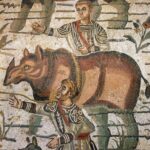
The rhinoceros: an armoured unicorn
- Rhinoceros, otis (m.): from the Greek ῥινόκερως (“nose-horn”), this pachyderm is described by Pliny (8, 71) and mentioned by Quintus Curtius in his account of Alexander’s conquests (9, 1, 5).
The hippopotamus: horse of the Nile
- Hippopotamus, i (m.): literally “river horse” (from the Greek ἱπποπόταμος), this amphibious mammal appears in Pliny (5, 10) and Ammianus Marcellinus (22, 15).
- Hippopotamios, ii (m.): a spelling variant attested in Varro (De Lingua Latina 5, 78) and the geographer Pomponius Mela (1, 52).
Camelids: ships of the desert
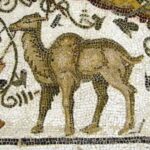
The camel
- Camelus, i (m./f.): from the Greek κάμηλος, mentioned by Cicero (De Natura Deorum 2, 123) and Livy (37, 40, 12). Pliny uses it in the feminine (8, 67; 11, 164), as does Paulinus of Nola (Epistulae 29, 2).
- Camela, ae (f.): a specific feminine form for the she-camel (Trebellius Pollio, Claudius 14).
- Camellus: a spelling variant cited by Pomponius (112).
The giraffe
- Camelopardalis, is (f.) or -lus, i (m.) or -pardus, i (m.): from the Greek καμηλοπάρδαλις (“camel-leopard”), this long-necked ruminant is mentioned by Varro (De Lingua Latina 5, 100), Vopiscus (Aurelian 33) and Isidore of Seville (Origines 12, 2, 19).
- Ovis fera (f.): “Wild sheep”, a name also given to the giraffe because of its appearance (Pliny the Elder, Natural History, 8, 69).
II. Felines and carnivores
Large felines
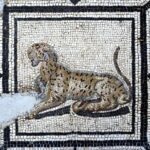
The panther
- Panthera, ae (f.): from the Greek πάνθηρ, this spotted feline appears in Cicero (Letters to Friends 2, 11, 2), Ovid (Metamorphoses 3, 669) and Pliny (8, 62).
- Pantheris, is (f.): a specific term for the female according to Varro (De Lingua Latina 5, 100).
- Pardalis, is (f.): a synonym of Greek origin (πάρδαλις) used by Quintus Curtius (5, 1, 21).
The tiger
- Tigris, is/idis: from the Greek τίγρις, this striped feline is generally masculine in prose and feminine in poetry. It is found in Virgil (Georgics 2, 151), Suetonius (Augustus 43) and Pliny (6, 73).
The hyena: a nocturnal predator
- Hyaena, ae (f.): from the Greek ὕαινα, this carnivore is described by Pliny (8, 105), who uses the same term to denote a flatfish (32, 154).
- Belbus, i (m.): an alternative name attested in Capitolinus (The Three Gordians 3, 33, 1).
- Crocottas, ae (m.): an animal of Ethiopia according to Pliny (8, 72), probably a variety of hyena.
III. Primates
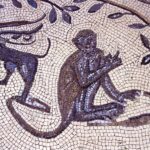
The terminological richness surrounding monkeys testifies to the Roman fascination with these animals and their almost human behaviour:
- Pithecus, i (m.): from the Greek πίθηκος, a generic term attested in the Tironian Notes (p. 176).
- Simia, ae (f.): derived from simus (“snub-nosed”, flat-nosed), cited by Cicero (De Divinatione 1, 76; 2, 69).
- Simius, ii (m.): the masculine form used by Phaedrus (1, 10, 6) and Martial (14, 202, 1).
- Sphingion, ii (n.): from the Greek σφιγγίον, denoting a particular species according to Pliny (6, 173; 10, 199).
- Cephus, i (m.): a specific variety mentioned by Pliny (8, 70).
- Cercolopis: a bushy-tailed monkey according to Festus (54, 13).
- Cercopithecus, i (m.): from the Greek κερκοπίθηκος (“tailed monkey”), attested in Juvenal (15, 4) and Pliny (8, 72).
- Cercops, opis (m.): from the Greek κέρκωψ, another term for the long-tailed monkey according to Manilius (4, 668).
IV. Antelopes and gazelles
- Oryx, ygis (m.): from the Greek ὄρυξ, this desert ruminant is mentioned by Columella (De Re Rustica 9, 1, 1) and Pliny (2, 107).
- Pygargos/Pygargus, i (m.): from the Greek πύγαργος (“white-rumped”), denoting both an eagle (Pliny 10, 7) and a species of gazelle (Juvenal 11, 138; Pliny 8, 214).
- Strepsiceros, otis (m./f.): from the Greek στρεψίκερως (“twisted-horned”), a spiral-horned antelope described by Pliny (8, 214).
V. Reptiles
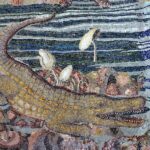
The Nile crocodile
- Crocodilus, i (m.): from the Greek κροκόδειλος, this fearsome reptile is described by Pliny (8, 89) and Quintus Curtius (9, 1, 5).
- Corcodilus, i (m.): a spelling variant attested in Phaedrus (1, 25, 4).
The chameleon
- Chamaeleon, onis/ontis (m.): from the Greek χαμαιλέων (“earth lion”), this colour-changing lizard is mentioned by Aulus Gellius (10, 12, 1).
VI. Exotic birds
The ostrich
- Struthio, onis (m.): from the Greek στρουθίων, this large flightless bird is described by Isidore of Seville (Origines 12, 7, 1).
- Struthiocamelus/Struthocamelus, i (m./f.): from the Greek στρουθοκάμηλος (“sparrow-camel”), a compound term attested in Pliny (10, 1) and Petronius (137).
- Passer marinus: literally “sea sparrow”, used by Ausonius (Epistles 11, 24) and sometimes simply passer (CIL 10, 3704).

The flamingo
- Phoenicopterus, i (m.): from the Greek φοινικόπτερος (“purple wing”), this wading bird is mentioned by Suetonius (Vitellius 13), Seneca (Letters 110, 12) and Pliny (10, 133).
VII. Fabulous or misidentified creatures
The distant and little-known world also inspired descriptions of composite or imaginary animals:
- Hippocamelus, i (m.): from the Greek ἱπποκάμηλος, a fabulous animal half-horse, half-camel according to Ausonius (Epistles 70, 9).
- Pantherocamelus, i (m.): a creature mentioned by Lucilius (Satires 1126), probably an alternative description of the giraffe.
- Taurelephans, antis (m.): from the Greek ταυρελέφας, an Indian animal partaking of both bull and elephant according to Julius Valerius (3, 19).
- Leucrocota/Leucrocuta (f.): an unidentified Indian quadruped described by Pliny (8, 72) and Solinus (52, 34).
Conclusion
This lexical overview of exotic animals in Latin literature reveals several essential characteristics of Roman zoology:
- Predominance of Greek loanwords: the majority of terms derive from Greek, testifying to Hellenistic influence on Roman knowledge of natural science.
- Analogical formation: many names are constructed by analogy with familiar animals (camelopardalis, struthiocamelus), reflecting a descriptive method grounded in comparison.
- Diversity of sources: these exotic animals are mentioned by a wide range of authors, from naturalists such as Pliny to poets such as Virgil, revealing their integration into Roman culture beyond specialist literature.
- Taxonomic uncertainties: the confusions and occasionally imprecise descriptions testify to the limits of ancient zoological knowledge, dependent as it was on indirect testimony and on observations often confined to isolated specimens displayed in triumphs or in the arena.
This zoological terminology thus stands as a valuable record of Rome’s encounter with the faunal otherness of the territories it conquered or explored, and of how the Latin language adapted to name and describe these creatures from elsewhere.