Translated from french (please notify us of errors)
Why does the year begin on January 1st? The answer lies in a reform carried out at full speed by Julius Caesar.
At the end of the Republic, the Roman calendar had become a real headache. Heir to a very ancient organization, originally based on only ten months*, then enriched and reworked over the centuries, it now rested on lunar months and intercalations decided by the pontiffs. This system, intended to reconcile the cycle of the moon and the solar year, struggled to remain in phase with the seasons. The equinoxes drifted, the months slipped, and civil time no longer truly corresponded either to the rhythm of nature or to the needs of the State.
In 46 BCE, Julius Caesar undertook to restore order to this disrupted mechanism. Advised by the astronomer Sosigenes of Alexandria, he implemented a solar calendar based on a year of 365 days, supplemented by an intercalary day every four years: the principle of the leap year. To enable this transition, the year 46 BCE was exceptionally lengthened: with 445 days, it served to realign civil time with the solar cycle before the new system came into effect on January 1st, 45 BCE.
This choice of January 1st as the beginning of the year did not, however, constitute a radical invention. Since 153 BCE, the consular year –the one that structured Roman political life– already began on this date, in order to allow magistrates to take up their duties earlier. The Caesarian reform therefore did not create January 1st: it permanently fixed it within a calendar that was now regular and predictable.
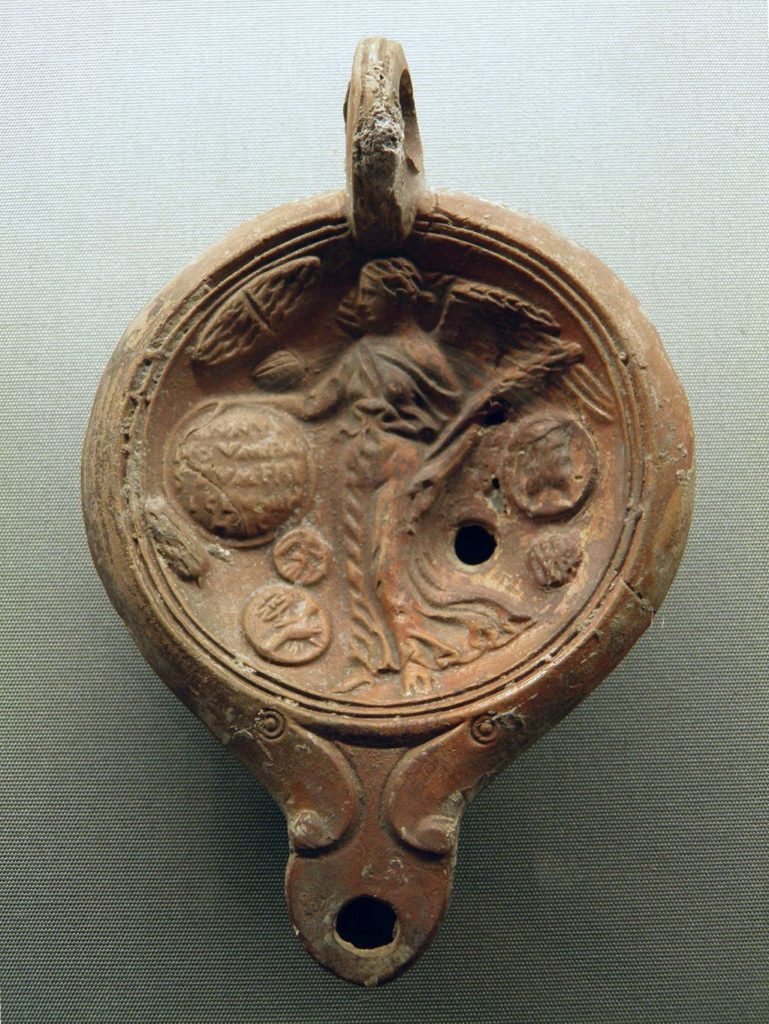
This date was not neutral on a symbolic level. The month of January was placed under the protection of Janus, god of thresholds, passages and beginnings, facing both the past and the future. January 1st thus naturally lent itself to wishes and propitiatory gestures. In Rome, people exchanged gifts (strenae) to wish happiness and prosperity for the opening year –a practice whose echo still resonates in our modern traditions.
Some ancient inscriptions and wish formulas preserve traces of this attention paid to the new time. One sometimes reads the ritual formula:
ANNUM NOVUM FAUSTUM FELICEM
(a happy and favorable new year)
* Our months of September (seventh), October (eighth), November (ninth) and December (tenth) have retained traces of their former rank. As for January, it is the month of Janus!
To learn more
- Le calendrier des Romains
- Calculateur de date romaine
- Quelques formules de vœux en latin et en grec sur le site de l’association Arrête ton char!
- L. Chrzanovski, Flamboyantes étrennes romaines, in Artpassions 4 (2005), pp. 73-81
Other articles in English from the Nunc est bibendum blog