Translated from french (please notify us of errors)
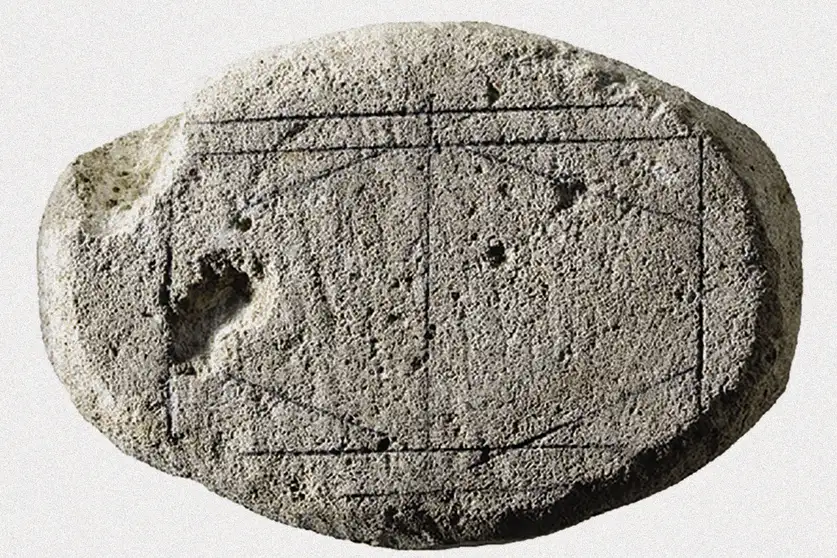
A piece of engraved limestone, found in the Netherlands at the turn of the 20th century, has kept its secret until today. The object, from the Roman site of Coriovallum (present-day Heerlen), bore a geometric pattern that did not match any known game. By combining the analysis of microscopic wear traces with artificial intelligence simulations, a team of researchers has succeeded in reconstructing the rules of what may be the earliest European example of a type of blockade game.
Archaeologist Walter Crist discovered the object in 2020, during a visit to the Roman Museum of Heerlen. The white limestone slab, measuring 21 by 14.5 centimetres, bears on its smooth surface a rectangle crossed by four diagonal lines and one straight line. ‘The appearance of the stone, combined with the visible wear, strongly suggested a game, but I did not recognise the pattern among the ancient games I know’[1], explains Crist, now a visiting professor at Leiden University.
The material tells a story. It is Jurassic limestone from Norroy, originating from north-eastern France, typically used by the Romans for large decorative architectural elements. But this object is small, probably salvaged from debris (spolia) and recut during the late Roman period (c. 250–476 AD), when Coriovallum was transformed into a fortified settlement.
The object remained in the museum’s collections without a precise archaeological context. Coriovallum was a prosperous Roman town in the province of Germania Inferior, founded under the reign of Emperor Augustus and inhabited until the fall of the Western Roman Empire.
Telltale traces under the microscope
Microtopographic analysis revealed a pattern of differential wear. Some incised lines show marked abrasion, with a smoothed surface along their path, whilst others display few traces. Microscopic examination confirms that the rock grains are levelled and smooth, consistent with an abrasive action applied by an object of greater hardness.
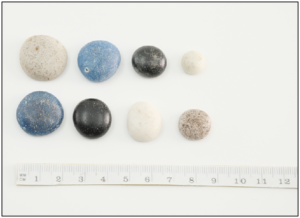
Roman game pieces found at Coriovallum —glass or stone counters, dome- or disc-shaped— match this type of wear. The most ergonomic way to move them is to slide them along the lines of the board, producing abrasion on the soft limestone.
130 configurations tested by artificial intelligence
To determine which rules could have produced these wear patterns, the researchers used Ludii, a system developed at Maastricht University. Two AI agents played 1,000 games for each set of rules, using different configurations drawn from historically documented European games.
The team tested 130 configurations, combining various starting rules, movement rules and end-of-game conditions. The configurations included blockade games (such as the Scandinavian haretavl and similar games from Italy, Spain and Greece) and alignment games. ‘The greatest challenge was designing the methodology; research on games in archaeology is relatively rare, and no one had tried using AI to identify a game that would reproduce the wear’, confides Walter Crist[2].
Nine configurations produced results consistent with the observed wear traces. ‘And they were all variations of the same type of blockade game’, the researcher emphasises. In these games, the objective is to prevent the opponent from moving rather than to capture pieces. The most likely version involves one player placing four pieces against two opposing pieces.
A discovery that pushes back the history of blockade games
Well-known Roman games such as ludus latrunculorum (‘the game of soldiers’) or duodecim scripta (associated with backgammon) belong to other categories: capture or race games. Pure blockade games had no clear material precedent in classical Antiquity.
This type of game had only been documented in Europe from the Middle Ages onwards. Objects bearing the distinctive haretavl board have been found in Latvia in the 14th century and in early medieval Dublin (10th–11th century). Similar games from France, Italy and Greece have geometries that can be found in board graffiti in Rome and Turkey (Didyma and Aphrodisias), suggesting a longer history than that attested by textual sources.
The team named the game Ludus Coriovalli, ‘the game of Coriovallum’. The discovery pushes the presence of this type of game back by several centuries and demonstrates that this ludic concept was already circulating on the north-western fringes of the Roman Empire.
This research marks the first time that AI simulations have been combined with archaeological analysis to identify the rules of an ancient game. ‘Understanding how ancient games may have been played can lead us to new perspectives on how people in the past enjoyed their lives’, comments Walter Crist[3].
The approach developed could transform the study of ancient games. Games often leave few traces: many boards were carved into the ground or into wood. By combining wear trace analysis with artificial intelligence, it becomes possible to identify game boards and reconstruct playable rule sets, even in the absence of written evidence.
For the Romans of Coriovallum, their leisure time becomes a little less abstract. We can now picture them sitting at a table, sliding glass beads across the limestone, trying to outwit a friend. Whether on a limestone slab or a smartphone screen, the urge to play remains the same.
How to play Ludus Coriovalli
The researchers identified that the most likely version of the game is played with four pieces against two, in an asymmetric blockade game of the ‘hounds and hares’ type.
Equipment needed:
- A board with the reconstructed pattern (a rectangle crossed by four diagonals and one straight line)
- 4 pieces of one colour (the ‘hounds’)
- 2 pieces of another colour (the ‘hares’)
Rules:
- The four ‘hounds’ (black pieces) start on the four points on the right side of the board
- The two ‘hares’ (white pieces) start on the two outer points on the left side
- Players take turns moving one piece to an adjacent empty point along the marked lines
- The objective of the ‘hounds’ is to completely block the ‘hares’ so that they can no longer move
- The objective of the ‘hares’ is to avoid being blocked for as long as possible
- The player who holds out longest as the ‘hares’ wins the game
Players may swap roles after each game to determine who is the better strategist.
The game is available free of charge on the Digital Ludeme Project website: Play online.
Main source
- Walter Crist, Éric Piette, Karen Jeneson, Dennis J.N.J. Soemers, Matthew Stephenson, Luk van Goor, Cameron Browne, Ludus Coriovalli: using artificial intelligence-driven simulations to identify rules for an ancient board game, Published online by Cambridge University Press: 11 February 2026
[1] [3] C. Simms, ‘Rules of mysterious ancient Roman board game decoded by AI’, Scientific American, 10 February 2026.
[2] T. Puiu, ‘AI Just Cracked the Rules of a Lost Roman Board Game, and It’s Unlike Anything We Expected’, ZME Science, 10 February 2026.
Other articles in English from the Nunc est bibendum blog