The five-line abacus is a basic calculating instrument, depictions of which appear on several ancient Greek reliefs. This page offers a simulation of it, based on the work of V. Dasen and J. Gavin, allowing visitors to understand how it works.
Preferably use a computer or tablet (a smartphone screen is too small!).
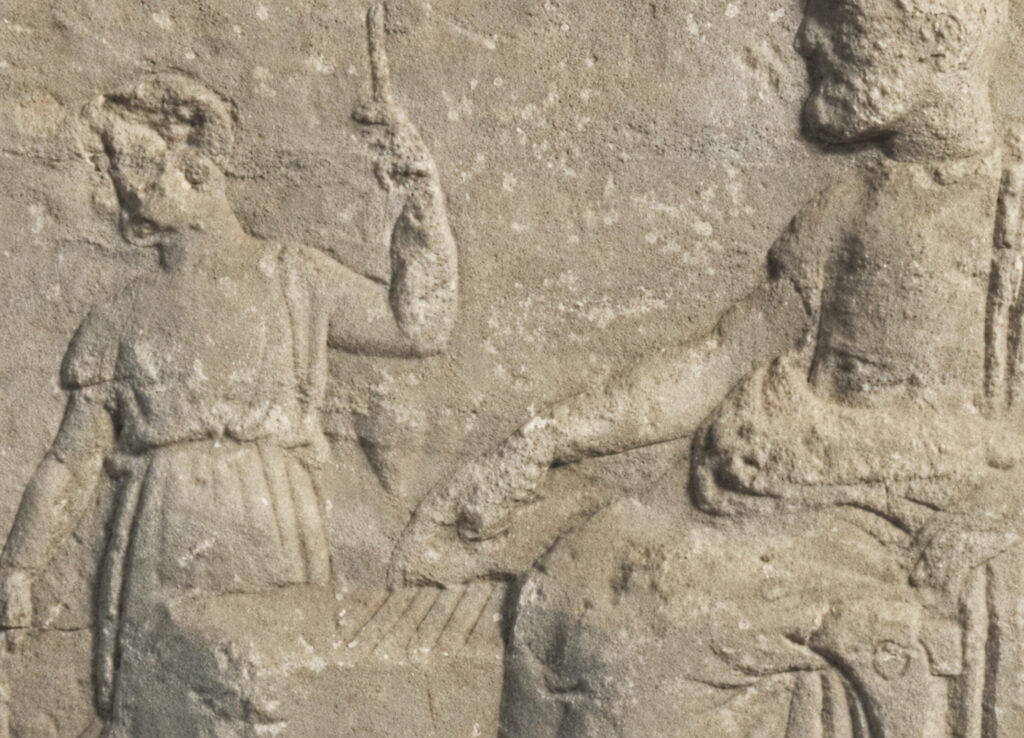
The Greek abacus is a reckoning board on which small pebbles, the psephoi, or counters are moved to carry out arithmetical operations. The board is divided into horizontal lines representing the five main units of Greek numeration: units, tens, hundreds, thousands and myriads (tens of thousands). A counter placed on a line is worth once the value of that line; placed between two lines, it is worth five times the value of the line below – which limits the number of counters required and speeds up calculations.
To add two numbers, they are arranged on either side of the board, and the counters are then brought together line by line, with the surplus grouped and carried up to the line above. Subtraction, multiplication and division were carried out through successive movements following procedures that experienced calculators performed with speed.
The abacus was the ordinary tool of merchants, bankers and administrators. But its structure – five horizontal lines – was identical to that of the board used for the game of Five Lines (pente grammai), and the same Greek words, abax, psephoi, referred equally to the objects of the game and of the calculation. Photius sums it up bluntly: on the small abacus, ‘they played dice and did their sums’. Schoolmasters made use of this: according to Plato, mathematics was to be taught to children in a playful manner, and a calculation lesson could very well end in a game.
A teaching tool today
The Greek abacus can still be useful for teaching the basics of calculation. Its principle is simple: a number is seen and handled. The counters that are moved make it possible to grasp concretely what carrying means in addition or what borrowing means in subtraction.
The abacus also helps in understanding the logic of decimal calculation: a counter changes value depending on the line it sits on. It allows the four basic operations to be carried out without first passing through written notation, which can help some pupils. Finally, it forces one to slow down and follow each step of the calculation, rather than simply giving the result as a calculator would.
It is also a gateway to the history of science: it shows how calculations were done before Arabic numerals and before the use of zero.
Further reading
- Dasen, Véronique and Gavin, Jérôme. “Game Board or Abacus? Greek Counter Culture Revisited.” Board Game Studies Journal, 16, 1, 2022, pp. 251-307.
- Dasen, Véronique. «Chapitre VI. Jeu ou abaque ?». Le Jeu comme métaphore, Presses universitaires de Liège, 2024.
- Science et Avenir, ‘Voici la plus ancienne représentation d’une leçon de maths datant de la Grèce antique (et vous allez tout comprendre !)’, 6 May 2022.
- O. Lapirot, ‘La plus vieille leçon de maths’, Interview with V. Dasen and J. Gavin, Sciences et Vie Junior, 399, 2022, 38-41.