Translated from french (please notify us of errors)
Nourish, heal, protect, bewitch, kill: in Greek and Roman antiquity, plants do all of this at once. The boundary between cookery, medicine, religion and magic does not exist — or at least not where we would draw it today. A single plant may appear in a recipe, a medical prescription and a bewitchment ritual.
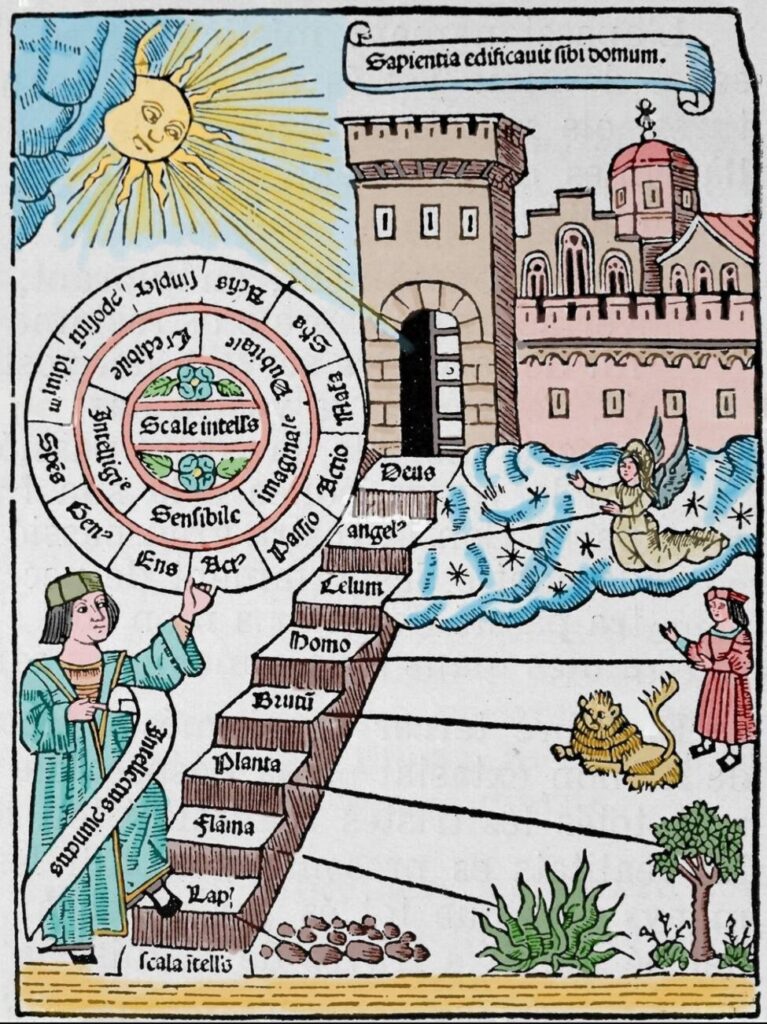
In this conception of the world, plants are not mere resources to be exploited. They occupy a place in the order of the cosmos, maintaining invisible relationships with the forces that govern it. They bear in their morphology the signs of their powers. One must still know how to use them — and how to approach them.
For the Ancients, a plant’s name was not arbitrary. It often revealed its nature. As for the very existence of many plants, it was explained by myth.
The narcissus, for example, received its name “because it blunts the nerves and induces narcotic heaviness (narkōdeis)”, explains Plutarch in his Table Talk.[1] That young Narkissos, enamoured of his own reflection, should grow numb with longing to the point of wasting away is therefore no accident: at the place of his death grows a plant whose narcotic effects are entirely real.
Beloved of Aphrodite, Adonis is mortally wounded by a boar whilst hunting. From his blood is born the anemone, a fragile and ephemeral flower whose name evokes the wind (anemos) that carries it away.
Hyakinthos, finally, lends his name to the hyacinth: Apollo, overwhelmed with grief at having killed his beloved with a discus whose trajectory, according to some versions, the wind Zephyr had deflected out of jealousy, transforms him into a flower.
In Greek and Roman antiquity, the plant kingdom is not separate from the world of gods, men and invisible forces: it is a fully integral part of it. Greek philosophers pondered at length the origin of plants, their reproduction, their place in the hierarchy of living beings, their properties, their powers, their soul and their will.
The plant, an inverted animal
Aristotle framed the problem with a clarity that shaped all ancient thought on the subject. For him:
“Nature passes little by little from inanimate beings to living ones, in such a way that this continuity prevents one from perceiving the boundary that separates them, and one does not know to which side the intermediate form belongs.”[2]
The plant certainly occupies the lower rungs of the hierarchy of living things, but within a continuous scale, with no sharp break. Aristotle elaborates thus:
“Furthermore, when the upward-driving heat diminishes and the earthy element increases, the bodies of animals become smaller and possessed of many feet; and in the end they become footless and stretched along the ground.
Advancing thus little by little, they come also to have their vital principle below, and the part corresponding to the head finally becomes immobile and insensible; the being then becomes a plant, with the upper parts below and the lower parts above.
For in plants, the roots perform the function of mouth and head, whilst the seed is at the opposite end: it forms above, at the tips of the branches.”[3]
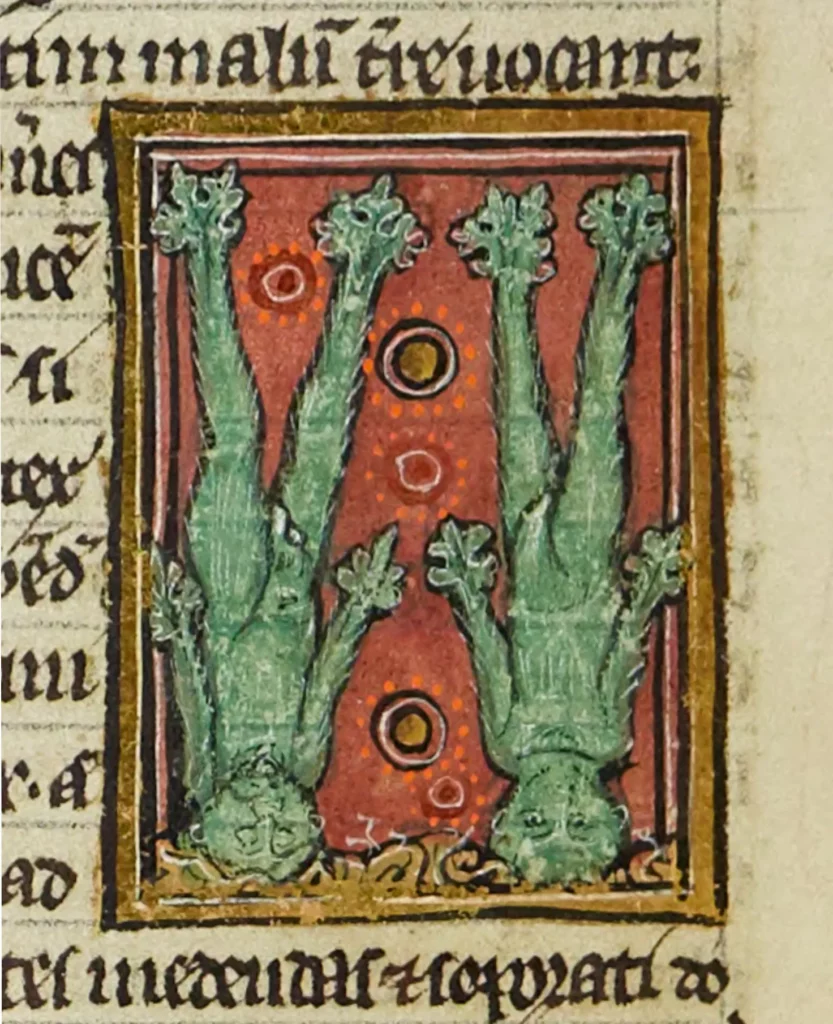
The plant is an inverted creature, its head in the earth. According to this conception, the plant stands at the crossroads of the subterranean world and the world of light.
It is precisely there, in this in-between, that magicians perceived a source of powers.
But whence do these powers come? For the Ancients, the properties of plants do not originate from within themselves: they are conferred from without — by gods, stars, the forces of the cosmos. The plant is a receptacle. It is a living, animate being, in relation with one or more divinities, possibly inhabited by a daimôn — a “spirit”, as we might say. The magician’s task consists in compelling these forces to yield what they have deposited within the plant.
Three laws for acting upon the world
How to explain that certain plants heal, bewitch or protect? The Ancients did not theorise these mechanisms in any systematic fashion, but the sociologist Marcel Mauss, at the beginning of the 20th century, identified a posteriori the principles underlying them — the “dominant laws of magic”, in his own phrase.[4]
The first is the law of contagion: the properties of a being are transmitted through contact, spreading from one to the next. Travellers need only carry a sprig of chaste tree in their hand or at their belt to prevent chafing — without the plant even being brought into direct contact with the part to be protected. Most plant amulets function on this principle.
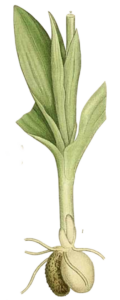
The second is the law of similarity: like acts upon like. The roots of eruthrodanon, whose red colour evokes that of blood, were held to possess emmenagogic properties; the everlasting flower (helichrysus), whose yellow blooms recall the colour of urine, was reputed diuretic. Shape plays the same role as colour. The orchis, whose bulbous, paired root evokes the form of the testicles, is associated with sexuality.
The third is the law of opposition: the contrary drives out its contrary. It was probably on account of its golden flowers that the chrusolachanum had the reputation of curing jaundice sufferers who wore it as an amulet “in such a manner that they could see it”; the red seeds of the peony were said to “arrest red menstruation”. As for the fruits of lithospermon, hard as stone, they had “acquired the reputation of breaking up and expelling kidney stones” — and Pliny notes that “no other plant, by its appearance alone, indicates more plainly the remedy for which it is fitted.”[5]
These three principles are often combined. They serve sometimes to guide the search for a plant’s properties, sometimes to justify a posteriori properties already known through empirical experience — which is not quite the same thing.
Harvesting as ritual
These convictions have immediate practical consequences: gathering is not a mundane act. It is a hazardous undertaking — an assault upon a living being presumed capable of hearing, seeing and even defending itself against those who approach, even if it cannot flee. It demands meticulous preparation on the part of the gatherer.
Sexual abstinence is among the most frequently prescribed requirements: Pliny reports that those who harvest iris must be in a state of continence[6], and that the harvesting of frankincense in Arabia requires that the families involved “forbid themselves, as a pollution, all contact with women or funeral processions.”[7] Abstinence from food may be added to this: even for couch-grass (gramen) — “the most common of all herbs”, Pliny notes — the gatherer must be fasting.[8]
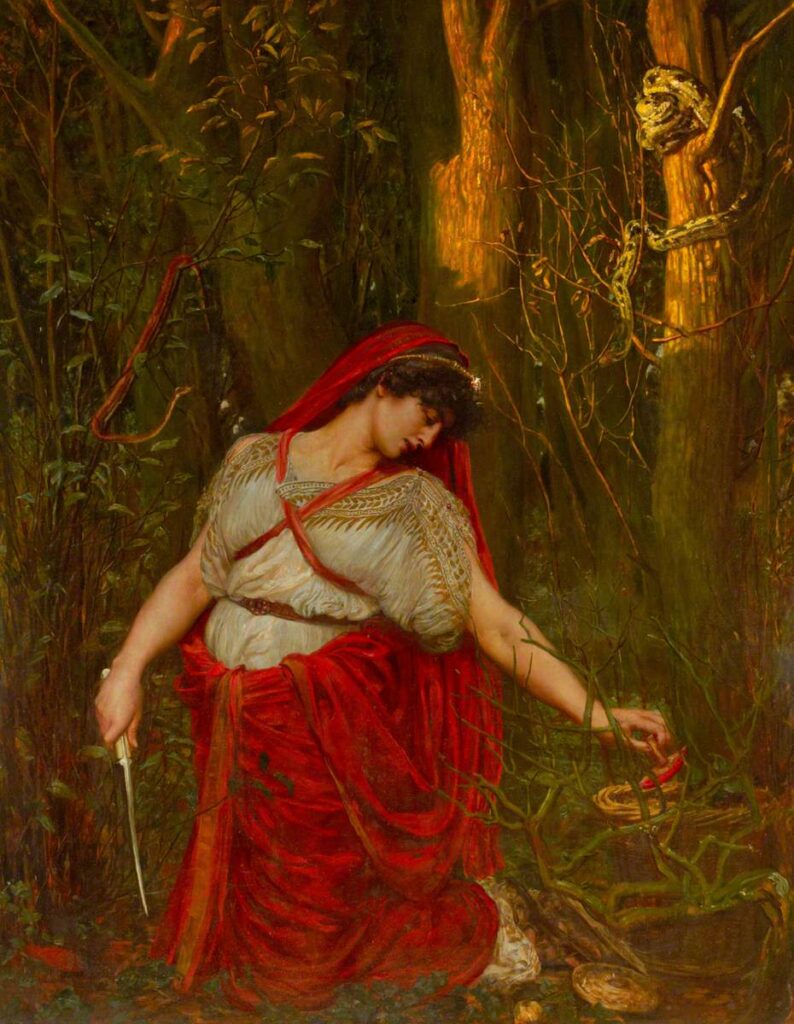
Dress is subject to varied and sometimes contradictory prescriptions. Sophocles’ Medea gathers her plants entirely naked, “screaming and howling”, with bronze sickles.[9] Ovid depicts her differently: “leaving her dwelling, clad in an ungirt robe, her feet bare, her hair loose upon her naked shoulders.”[10] For the gathering of selago, Pliny prescribes white garments; Medea in Apollonius of Rhodes chooses dark clothing.
On one point, however, the sources are unanimous: it is imperative to abstain from all ties, laces, ribbons or knots — in the hair as in the clothing. Such fastenings might, by sympathy, “bind” the magical force of the plant, its dunamis, rendering it ineffective, and sever communication with the daimôn that inhabits it.
Silence and solitude are likewise mandatory. Ovid, describing Medea in the midst of a nocturnal harvest, composes a tableau of absolute isolation:
“And she directs her wandering steps, unaccompanied, through the mute silences of the heart of night; deep rest had released men, birds, and wild beasts; no hedge murmurs, the unmoving leaves are silent, the moist air is still; only the stars shine…”[11]
Solitude preserves the secrecy of the operation; silence allows the plant to be taken by surprise.
The plant strikes back
For the plant is not without defences. Some emit vapours capable of blinding or stupefying those who approach without due care: regarding the mandrake, Pliny warns that “those who go to gather it take care not to face the wind”; white hellebore “goes sharply to the head”, so much so that it is advisable to eat garlic beforehand and to dig without delay.[12]
Other plants are believed to have concluded a defensive alliance with a bird charged with watching over their surroundings: the peony is placed under the protection of the woodpecker — whoever picks its fruit in the bird’s presence risks losing their sight; the kentauris is associated with a sparrowhawk; and for black hellebore, Theophrastus, Dioscorides and Pliny all agree in recommending that the sky be scanned before approaching, for the sight of an eagle in flight is an omen of the gatherer’s imminent death.[13]
Three circles are better than one
In certain cases, the gatherer must also trace one or more circles around the plant before uprooting it. Pliny describes the prescription for iris thus:
“with the point of a sword, [those who must uproot it] trace three circles around the iris, and as soon as they have gathered it, they raise it towards the sky.”[14]
The circle delineates a magically enclosed space: it prevents the plant from fleeing (!), confines the daimôn that inhabits it, protects the operation from external influences and shields the gatherer. The number three is not incidental: it combines a cathartic — purifying — value with an apotropaic one, capable of warding off evil.
The direction in which one faces at the moment of uprooting is equally regulated. The east, the direction of the rising sun, is considered auspicious: black hellebore must be uprooted whilst facing east and praying to the gods to permit the operation. The mandrake, plant of darkness and the underworld, requires on the contrary that one turn towards the west.[15]
The instruments themselves are chosen with care. The sword — commonly used to trace the circles — also serves an apotropaic function: it keeps demons and spells at bay. Medea’s bronze sickle evokes the crescent moon. For sideritis, a nail must be used; for knotgrass, a gold ring; the uprooting of henbane requires the bone of a dead animal.[16] Each instrument brings with it its own symbolic charge.
The act of gathering is often accompanied by fumigations, prayers, ritual dances and magical incantations. Every advantage must be seized!
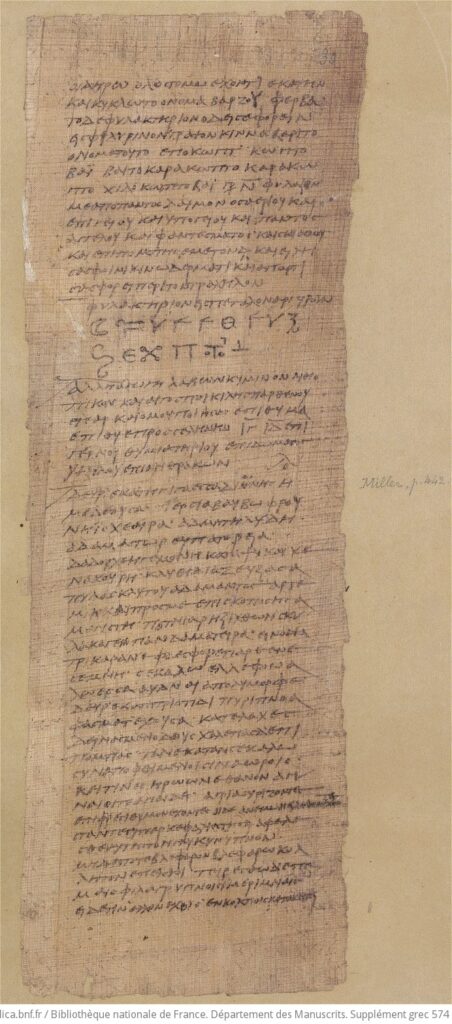
A Greek magical papyrus preserves an invocation intended to accompany the gathering of any plant:
“You were sown by Cronus; you were conceived by Hera; you were preserved by Ammon; you were brought forth by Isis […] You are the dew of all the gods; you are the heart of Hermes.”[17]
At the close of a long enumeration indicating the divine chain from which it proceeds, the plant is commanded to yield its powers to whoever uproots it.
Credulous — a little? A great deal?
This portrait would be incomplete without a qualification that the sources themselves invite us to make. The ancient naturalists and physicians — Theophrastus, Dioscorides, Pliny the Elder — report beliefs and magical rites, but frequently keep their distance. Pliny multiplies his reservations: “it is said that…”, “some believe that…”. Theophrastus, commenting on the ritual prescriptions surrounding the gathering of plants, writes that “to recite prayers whilst cutting plants is perhaps not at all absurd; but if they add yet something else…”[18] The tradition is transmitted; it is not necessarily endorsed.
As for Roman law, it adopts a pragmatic attitude that is revealing. From as early as the Law of the Twelve Tables in the 5th century BCE, certain magical practices were condemned — not as beliefs, but as acts deemed harmful: philtres injurious to others, drugs causing the death of the patient, spells disturbing public order. The Lex Cornelia de sicariis et veneficis, promulgated in the 1st century BCE and applied until the 6th century, prosecuted suppliers of love philtres and abortifacients, practitioners of binding spells, and preparers of drugs that had caused death. Magic was not persecuted as such — beliefs circulated freely. In fact, the limit set by the Romans is not so far removed from that which our own societies set today in the face of the markets of credulity: vast and flourishing, then as now.
[1] Plutarch, Quaestiones convivales (Table Talk), III, 1, 647B: τὸν νάρκισσον ὡς ἀμβλύνοντα τὰ νεῦρα καὶ βαρύτητας ἐμποιοῦντα ναρκώδεις.
[2] Aristotle, Historia animalium, VIII, 1, 588b: Οὕτω δ’ ἐκ τῶν ἀψύχων εἰς τὰ ζῷα μεταβαίνει κατὰ μικρὸν ἡ φύσις, ὥστε τῇ συνεχείᾳ λανθάνειν τὸ μεθόριον αὐτῶν καὶ τὸ μέσον ποτέρων ἐστίν.
[3] Aristotle, De partibus animalium, IV, 10, 686b: Ἔτι δʼ ἐλάττονος γινομένης τῆς αἰρούσης θερμότητος καὶ τοῦ γεώδους πλείονος, τά τε σώματα ἐλάττονα τῶν ζῴων ἐστὶ καὶ πολύποδα, τέλος δʼ ἄποδα γίνεται καὶτεταμένα πρὸς τὴν γῆν. Μικρὸν δʼ οὕτω προβαίνοντα καὶ τὴν ἀρχὴν ἔχουσι κάτω, καὶ τὸ κατὰ τὴν κεφαλὴν μόριον τέλος ἀκίνητόν ἐστι καὶ ἀναίσθητον, καὶ γίνεται φυτόν, ἔχον τὰ μὲν ἄνω κάτω, τὰ δὲ κάτω ἄνω· Αἱ γὰρ ῥίζαι τοῖς φυτοῖς στόματος καὶ κεφαλῆς ἔχουσι δύναμιν, τὸ δὲ σπέρμα τοὐναντίον· ἄνω γὰρ καὶ ἐπʼ ἄκροις γίνεται τοῖς πτόρθοις.
[4] Cited in Ducourthial, Flore magique et astrologique de l’Antiquité, Belin, 2003, chapter VI.
[5] Pliny the Elder, Historia Naturalis, XXVII, 74: neque in alia herbarum fides est certior, ad quam medicinam nata sit.
[6] Pliny the Elder, Historia Naturalis, XXI, 42: praecipitur ante omnia, ut casti legant.
[7] Pliny the Elder, Historia Naturalis, XII, 54: nec ullo congressu feminarum funerumque […] pollui.
[8] Pliny the Elder, Historia Naturalis, XXIV, 181: jejunum esse debere qui colligat.
[9] Sophocles, Rhizotomoi (“The Root-Cutters”), fr. 534 Radt, cited in the scholium to Apollonius of Rhodes, Argonautica IV, 51–52, cited in Ducourthial, op. cit., ch. V.
[10] Ovid, Metamorphoses, VII, 182–183: egreditur tectis vestes induta recinctas, / nuda pedem, nudos umeris infusa capillos.
[11] Ovid, Metamorphoses, VII, 184–188: fertque vagos mediae per muta silentia noctis / incomitata gradus: homines volucresque ferasque / solverat alta quies, nullo cum murmure saepes, / inmotaeque silent frondes, silet umidus aer, / sidera sola micant.
[12] Pliny the Elder, Natural History, XXV, 148–150 for the mandrake; for hellebore, see also Theophrastus, Historia Plantarum IX, 8, 7.
[13] Theophrastus, Historia Plantarum IX, 8, 7–8; Pliny the Elder, Natural History XXV, 29 (peony), XXV, 69 (centauris), and XXV, 50 for black hellebore and the eagle.
[14] Pliny the Elder, Historia Naturalis, XXI, 42: circumscriptam mucrone gladii orbe triplici cum legerunt, protinus in caelum adtollunt.
[15] Theophrastus, Historia Plantarum, IX, 8, 8: περιγράφειν δὲ καὶ τὸν μανδραγόραν εἰς τρὶς ξίφει, τέμνειν δὲ πρὸς ἑσπέραν βλέποντα. […] περιγράφειν δὲ καὶ τὸν ἐλλέβορον τὸν μέλανα καὶ τέμνειν ἱστάμενον πρὸς ἕω καὶ κατευχόμενον·
[16] Nail for sideritis: Pliny, H. N. XXVI, 24; gold ring for knotgrass: pseudo-Apuleius, Herbarius XVIII; bone of a dead animal for henbane: cited in Ducourthial, op. cit., chapter V.
[17] Papyri Graecae Magicae IV, 286–295 (Grand Papyrus Magique de Paris, BnF, suppl. gr. 574).
[18] Theophrastus, Historia Plantarum, IX, 8, 7: τὸ δ᾽ ἐπευχόμενον τέμνειν οὐθὲν ἴσως ἄτοπον· ἀλλ᾽ εἴ τι καὶ ἄλλο προστιθέασιν.
Other articles in English from the Nunc est bibendum blog