Translated from french (please notify us of errors)

For the Greeks, and later the Romans, ostriches belonged to the world of fantastical creatures inhabiting mysterious Africa, alongside crocodiles, camels and elephants.
Herodotus, in the 5th century BCE, is the first to mention the bird in a list of Libyan creatures. He calls it the «bird that lives on the ground» (strouthoi katagaioi, στρουθοὶ κατάγαιοι), thereby highlighting its inability to fly.[1] Yet he makes no mention of its size, even though the word strouthos more commonly refers to the sparrow…
Aristotle, a century later, provides a more precise description. The ostrich appears to him as a dual creature, half bird, half quadruped: “Insofar as this bird is not a quadruped, it has wings; insofar as it is not a bird, it does not fly by rising into the air; and it has wings that are of no use for flying, and that are rather like hairs.” He further notes that the animal has eyelashes on its upper eyelids and that it “is bald on the head and on the crown”.[2]
With this description, there is little risk of confusion should one encounter the creature in the arid lands of the southern and eastern Mediterranean. At the time, the ostrich was plentiful across North Africa and as far as the Middle East. Its decline began with Roman capture, before accelerating in the 20th century under the impact of modern hunting. Today, only two of the dozen or so species once recorded survive, and the bird has vanished from the Mediterranean region.
Portrait of a hybrid
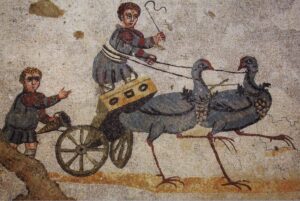
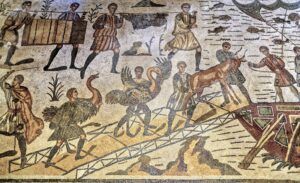
Exotic yet (relatively) approachable, the ostrich fired the ancient imagination. An Athenian skyphos of the 5th century BCE depicts a procession of six young riders mounted on ostriches, to the sound of the aulos. Eight centuries later, at the Roman Villa del Casale in Sicily, a mosaic shows children racing chariots, one of which is drawn by ostriches. Another fresco in the villa depicts ostriches and other African animals being loaded onto a ship, a reminder of the large-scale importation of exotic fauna for the venationes (hunting spectacles) in Roman amphitheatres.
When Pliny the Elder, in the 1st century CE, set down the knowledge of his time, the ostrich was well known. He calls it struthocamelus, “camel-bird”, and describes it too as a hybrid. He devotes the opening chapter of his book on birds to the ostrich. They exceed in height a rider mounted on his horse and surpass him in speed, he says. They are incapable of flight and have hooves like deer. These they use to fight, and even to hurl stones at their pursuers.
A reputation two thousand years in the making
Pliny goes on to enumerate the characteristics of the struthocameli, who possess:
“a remarkable capacity to digest indiscriminately everything they swallow. But their stupidity is no less remarkable: given the great size of the rest of their body, when they have hidden their neck in a bush, they believe themselves to be entirely concealed.”[3]
And there it is — the bird’s reputation sealed: it has stuck to its feathers for two thousand years.
Pliny further notes that the eggs, on account of their size, can serve as vessels, and that the feathers make fine ornaments for crests and helmets. He makes no mention, however, of any culinary use.
From shell to table: cooking the ostrich
That, however, is precisely what Apicius proposes in his De re coquinaria. Two sauce recipes accompany boiled ostrich (In struthione elixo), with no further detail on the preparation of the meat.[4]
The first calls for pepper, mint, roasted cumin, celery seeds, dates, honey, vinegar, raisin wine, garum and a little olive oil. The mixture is brought to the boil in a pot, thickened with starch, then poured over pieces of ostrich arranged on a dish and finished with a dusting of pepper.
The second sauce offers a variation of seasonings with pepper, lovage, thyme or savory, honey, mustard, vinegar, garum and oil.
The ostrich appears moreover to have acquired a certain value in ancient Rome, as illustrated by a passage in Petronius’s Satyricon.[5] A character who has killed a sacred goose promises, by way of atonement, to replace it with a struthocamelus, indicating that the ostrich was regarded as a prized animal, far superior to a mere goose.
But it is Heliogabalus, the short-lived and despised emperor of the early 3rd century, who takes the prize for excess. According to the author of the Historia Augusta, admittedly known for his exaggerations, “he had six hundred ostrich heads served at the various courses of a single banquet, so that their brains might be eaten”.[6] One can readily picture the absurd carnage that such extravagance required — the brain not being the organ in which the ostrich is most generously endowed.
[1] Herodotus, Histories, Book IV, Melpomene, 192.2: Καὶ βασσάρια καὶ ὕαιναι καὶ ὕστριχες καὶ κριοὶ ἄγριοι καὶ δίκτυες καὶ θῶες καὶ πάνθηρες καὶ βόρυες, καὶ κροκόδειλοι ὅσον τε τριπήχεες χερσαῖοι, τῇσι σαύρῃσι ἐμφερέστατοι, καὶ στρουθοὶ κατάγαιοι, καὶ ὄφιες μικροί, κέρας ἓν ἕκαστος ἔχοντες.
[2] Aristotle, On the Parts of Animals and On the Gait of Animals, Vol. II, XIV.
[3] Pliny the Elder, Natural History, Book X, 1–2: Sequitur natura avium, quarum grandissimi et paene bestiarum generis struthocameli Africi vel Aethiopici altitudinem equitis insidentis equo excedunt, celeritatem vincunt, ad hoc demum datis pinnis, ut currentem adiuvent. Cetero non sunt volucres nec a terra attolluntur. Ungulae iis cervinis similes, quibus dimicant, bisulcae et conprehendendis lapidibus utiles, quos in fuga contra sequentes ingerunt pedibus.
Concoquendi sine dilectu devorata mira natura, sed non minus stoliditas in tanta reliqui corporis altitudine, cum colla frutice occultaverint, latere sese existimantium. Praemia ex iis ova, propter amplitudinem pro quibusdam habita vasis, conosque bellicos et galeas adornantes pinnae.[4] Apicius, De re coquinaria, VI, I, 1: In struthione elixo: piper, mentam, cuminum assum, apii semen, dactilos vel caryotas, mel, acetum, passum, liquamen et oleum modice. Et in caccabo facies ut bulliat. amulo obligas, et sic partes struthionis in lance perfundis, et desuper piper aspargis. Si autem in condituram coquere volueris, alicam addis.
- Aliter ‹in› struthione elixo: piper, ligusticum, thymum aut satureiam, mel, sinape, acetum, liquamen et oleum.
[5] Petronius, Satyricon, CXXXVII.
[6] Historia Augusta, Antoninus Heliogabalus, 30.
Other articles in English from the Nunc est bibendum blog