Translated from french (please notify us of errors)
In Greece today, Lagana (Λαγάνα) is a light, crispy bread, generously topped with sesame seeds, prepared specially for Clean Monday (Καθαρά Δευτέρα), which marks the beginning of the Orthodox Lenten fast. It is certainly a descendant of the laganon (λάγανον) of the ancient Greeks. Having become laganum in Latin, both the thing and the word had a twofold posterity: it is in all likelihood the ancestor of lagane, pasta in wide strips, and of lasagne!
But where the noodle gets tangled, is that the laganon/laganum already did not represent a single reality for the Ancients. From the beginning of our era, the word denotes several distinct preparations.
Athenaeus of Naucratis, a Greek scholar of the late 2nd century AD, is the best witness to this polysemy: in his Deipnosophistae he compiles the views of numerous authors who preceded him, and cites the laganon (plural: lagana) in six passages of his work.
One word, manifold realities
In Book III, Athenaeus places the laganon in a list of different kinds of bread[1]. It is “light and not very nourishing,” he says. He calls upon two older authors to support his explanation. Aristophanes, who in his Assembly of Women would have written simply “lagana are being baked”[2] –swithout further detail. It should be noted, however, that the word used in the original text of Aristophanes, which is also preserved, is not laganon but popanon, a small round votive loaf made specifically to be offered to the gods during sacrifices. It is therefore Athenaeus who substitutes the first word for the second: a sign that in his time the laganon also had a ritual dimension? Athenaeus also cites Diocles of Carystus, a physician of the 4th century BC, who takes the laganon as a benchmark for softness: it would be even softer than the apanthrakis, another bread baked on the embers, on which one could already not break one’s teeth[3].
In another book, Athenaeus reflects on the etymology of laganon. The word derives, in his view, from laptein (λάπτειν), a verb that “means to digest food and, in emptying itself, to become slack; hence, from lagaros (‘slack’), the word lagōn (the flank of an animal), just as laganon.”[4]
A bread for broken jaws
The writings of Celsus, a Roman physician of the 1st century, confirm the characteristic softness of the food.
In his De Medicina, he treats fractures of the jaw with pragmatism. When the bones begin to knit, he writes, “one must keep to laganum and similar foods until the callus has entirely consolidated the jaw”[5].
In another passage, he places laganum among “soothing” (lenes) foods: “Soothing, on the other hand, are: thin broth, light porridge, laganum, starch, barley water, fatty meat, and any substance that is glutinous.”[6].
In the form of bread, the laganon thus took 2,000 years to become crispy!
Its ancient softness, however, leads us semantically from bread to dougha shift that might also be accompanied by a move from Greece to Rome, as we shall see further on.
A lettuce fritter
Let us return to Athenaeus. In a preparation he attributes to Artemidorus, an author whose work is lost, the laganon takes on yet another function. The recipe concerns young birds… We shall not dwell on it so as not to turn the reader’s stomach. But what is interesting here is that the laganon is crumbled into the sauce to thicken it.[7]
In Book XIV, he cites a recipe presented as Roman, the catillus ornatus, literally “garnished little dish.” It is a fritter comprising crushed lettuce, wine, pepper, a little pork fat and fine wheat flour. The dough thus formed is, according to the text, “stretched into a laganon,” then smoothed, cut into pieces and fried in oil.[8]
Athenaeus also describes the making of a small Cretan cake called gastris. First, a paste of walnuts and almonds is made, mixed with pepper, honey and poppy seeds. The dark preparation thus obtained is flattened and shaped into a square. Then white sesame is finely ground and worked with cooked honey until it forms a supple dough. From this mass, two thin sheets, called lagania, are stretched out. One is placed underneath, the other on top, so as to enclose the dark filling in the centre.[9]
The evolution is clear: in these passages, laganon no longer denotes a bread, but a rolled-out dough of varying composition.
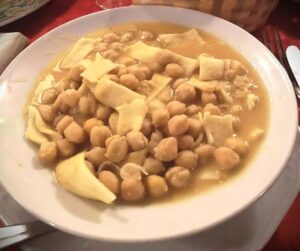
In the 1st century BC, the poet Horace already attests to the evolution of the recipe in Roman Italy. In a passage from the Satires, he extols the merits of his simple, independent life –he strolls about, watches the fortune-tellers, enquires about the price of vegetables, then goes home to dinner.
“From there I return home to a bowl of leeks, chickpeas and laganum“[11]
Three ingredients for a single catinum, a single bowl. One dish, in which the pasta is cooked with the vegetables –a kind of minestrone before the word existed.
This dish has not disappeared. In central and southern Italy, lagane –pasta made from durum wheat semolina in wide stripsare– still cooked with chickpeas: lagane e ceci in Basilicata, lagane e cicire in Calabria, ceci e laganelle in Campania.
The laganum in layers
It remains to cover the last stretch of road to arrive at lasagne.
The coincidence has it that, six lines earlier in the same passage, Horace had mentioned the lasanum –from the Greek λάσανον–, a word denoting a chamber pot[12]. The praetor Tillius has himself followed through the streets by five slaves carrying, among other things, this lasanum: all the ridiculous pomp of the great man, set against the freedom of Horace returning alone to eat his chickpeas. This proximity of six lines between lasanum and laganum helped to muddle the two words in medieval manuscript transmission.
But beyond this rather piquant semantic confusion, the collection of Apicius already confirms the use of sheets of pasta arranged in layers. In two successive recipes one finds this instruction:
“However many lagana you have placed, so many ladlefuls of filling you will add on top.”[13]
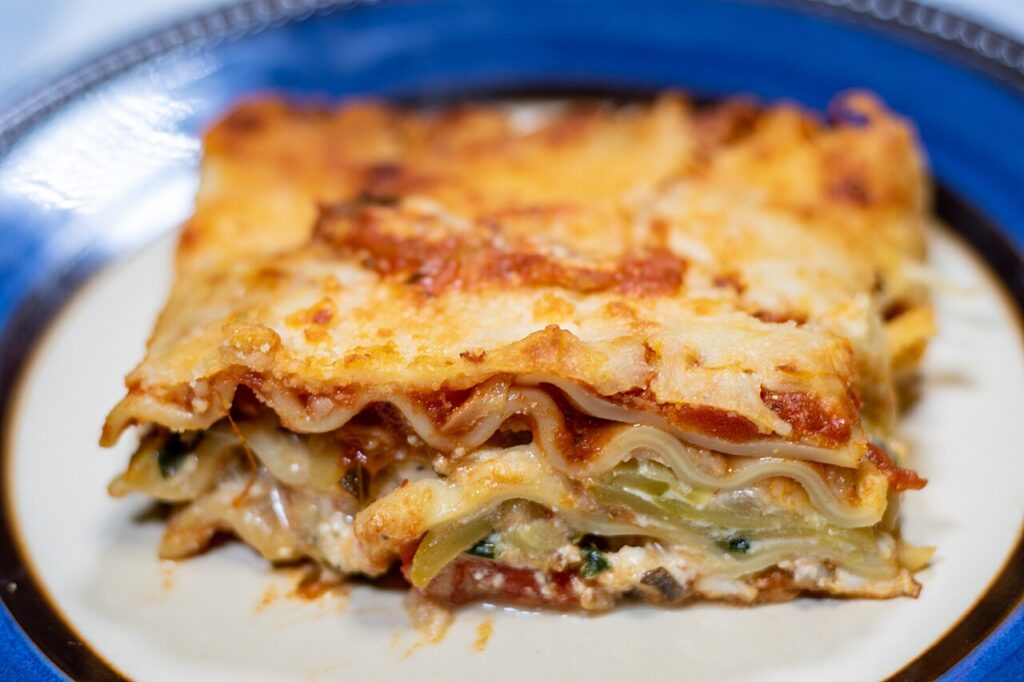
From the light bread evoked by Athenaeus to the superimposed sheets of pasta in Apicius, the laganon will have undergone multiple metamorphoses. In the kitchens of Basilicata where lagane e ceci are still prepared, in dishes of lasagne al forno, or in the sesame lagana of Greek Clean Monday, a discreet legacy of Antiquity survives.
[1] Athenaeus, Deipnosophistae III, §74: ΛΑΓΑΝΟΝ. τοῦτο ἐλαφρόν τʼ ἐστὶ καὶ ἄτροφον, καὶ μᾶλλον αὐτοῦ ἔτι ἡ ΕΠΑΝΘΡΑΚΙΣ καλουμένη. μνημονεύει δὲ τοῦ μὲν Ἀριστοφάνης ἐν Ἐκκλησιαζούσαις φάσκων· λάγανα πέττεται, τῆς δʼ ἀπανθρακίδος Διοκλῆς ὁ Καρύστιος ἐν αʹ Ὑγιεινῶν οὑτωσὶ λέγων· ἡ δʼ ἀπανθρακίς ἐστι τῶν λαγάνων ἁπαλωτέρα.
[2] Aristophanes, The Assembly of Women (Ἐκκλησιάζουσαι / Ekklêsiázousai) v. 843: πόπανα πέττεται.
[3] Athenaeus, Deipnosophistae III, §74: «ἡ δʼ ἀπανθρακίς ἐστι τῶν λαγάνων ἁπαλωτέρα» (Dioclès de Caryste, Hygiène I).
[4] Athenaeus, Deipnosophistae VIII, §64: λάπτειν δὲ τὸ τὴν τροφὴν ἐκπέττειν καὶ κενούμενον λαγαρὸν γίγνεσθαι· ὅθεν ἀπὸ μὲν τοῦ λαγαροῦ ἡ λαγών, ὥσπερ καὶ λάγανον.
[5] Celsus, De Medicina VIII, 7, 6: atque etiam, quum tempus processit, in lagano similibusque aliis perseverandum est, donec ex toto maxillam callus firmarit.
[6] Celsus, De Medicina II, 22: Lenes autem sunt sorbitio, pulticula, laganum, amylum, ptisana, pinguis caro, et quaecumque glutinosa est.
[7] Athenaeus, Deipnosophistae XIV, §84: εἶθʼ οὕτως τὸ λάγανον κατάθρυπτε.
[8] Athenaeus, Deipnosophistae XIV, §57: […] ἕλκυσον λάγανον καὶ λειάνας ἐκτεμὼν κατάτεμνε καὶ ἕψε εἰς ἔλαιον θερμότατον εἰς ἠθμὸν βαλὼν τὰ κατακεκομμένα.
[9] Athenaeus, Deipnosophistae XIV, §57: ἕλκυσον λαγάνια δύο καὶ ἓν θὲς ὑποκάτω καὶ τὸ ἄλλο ἐπάνω, ἵνα τὸ μέλαν εἰς μέσον γένηται.
[11] Horace, Satires I, 6, 114–115: Inde domum me / ad porri et ciceris refero laganique catinum.
[12] Horace, Satires I, 6, 109–111: obiciet nemo sordis mihi, quas tibi, Tilli, / cum Tiburte via praetorem quinque secuntur / te pueri, lasanum portantes oenophorumque.
[13] Apicius, De re coquinaria IV, 2, 14: quotquot lagana posueris, tot trullas impensae desuper adicies. The same formula is repeated in IV, 2, 15.
Modern studies
- L. Ullman, «Horace Serm. I. 6. 115 and the History of the Word Laganum», Classical Philology VII, 4, 1912, p. 442–449
- Gowers, Horace, Satires Book I, Cambridge University Press, 2012 – F. Villeneuve (éd. et trad.), Horace, Satires, Paris, Les Belles Lettres, 1932
Other articles in English from the Nunc est bibendum blog