Translated from french (please notify us of errors)
It is the most celebrated plant of antiquity, and the most elusive: moly (μῶλυ). Black root, milk-white flower, uprooted by gods alone. Homer made it the absolute antidote to Circe’s sorcery. Generations of scholars have attempted to identify it. Without incontestable result. But without giving up either.
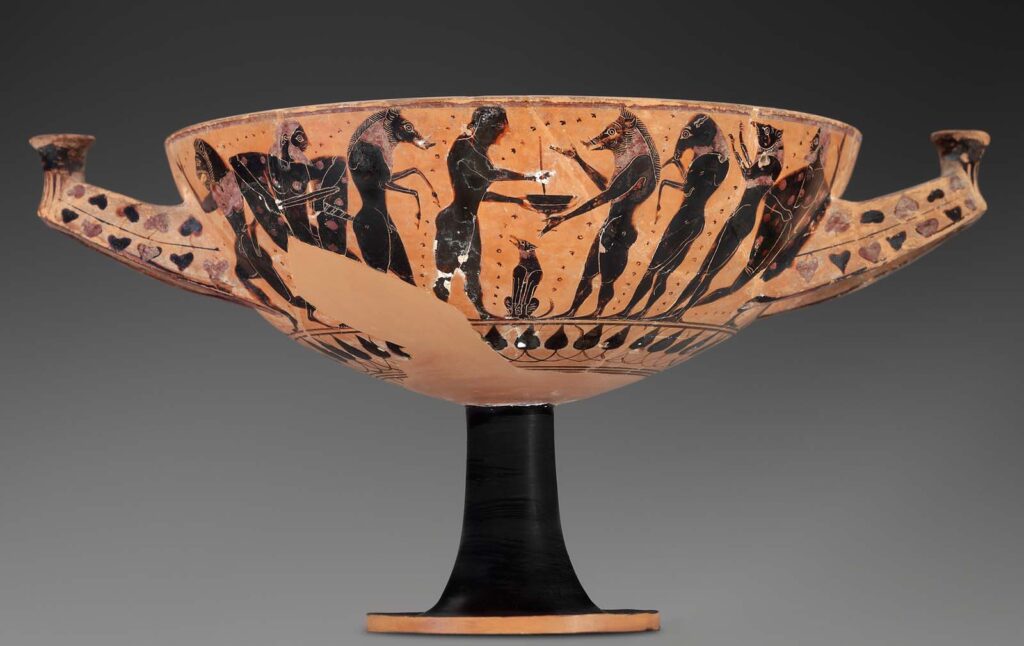
The story begins thus: after the Trojan War, Odysseus and his companions set out on a voyage that will last ten years. Only the hero will return. But at the moment the action takes place, Odysseus still has companions. Having landed on the island of Aeaea, they hear a woman singing and draw near…
“Circe came out and opened the shining doors, and invited them in; all followed together, without suspicion. Only Eurylochus held back, sensing a trap. Having led them inside, she seated them on chairs and thrones, then served them a mixture of cheese, barley, and fresh honey, which she blended with Pramnian wine. But into this drink she mixed baneful drugs, so that they might forget their homeland entirely.”[1]
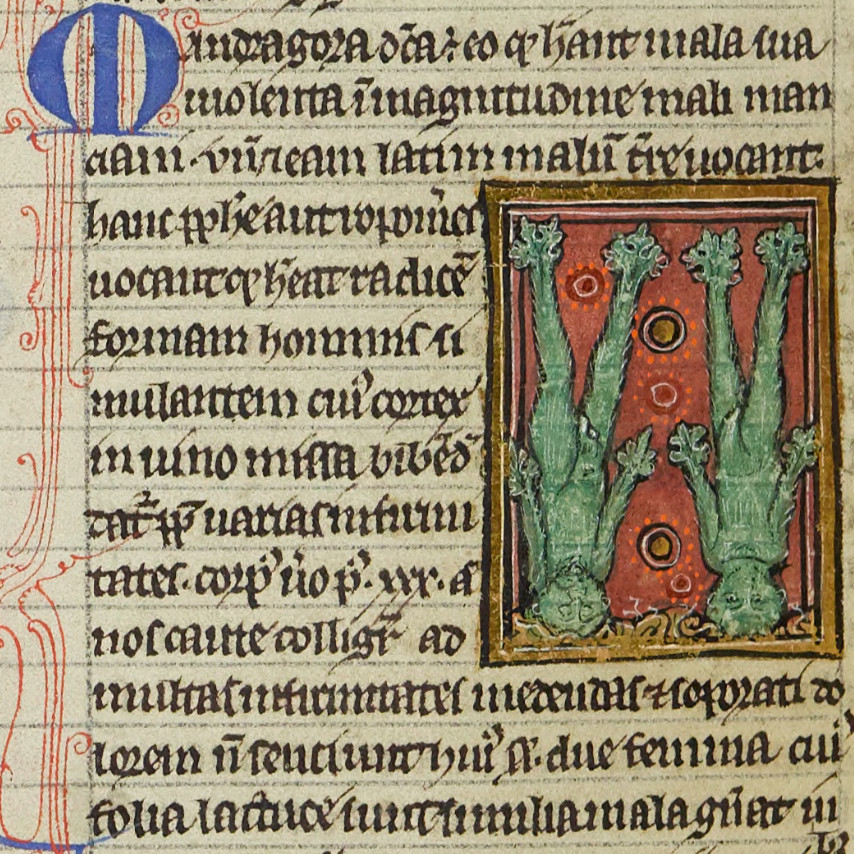
Barley, wine, cheese, and honey: this is a kykeon, a fortifying drink that it is perfectly natural to offer to exhausted travellers. But Circe has mixed into it pharmaka lugra: baneful drugs, perhaps mandrake, a plant with hallucinogenic effects. Pliny himself records that “some call the mandrake Circaeon” — Circe’s plant.[2]
The tale continues:
“When she had given them this drink and they had swallowed it, she at once struck them with her wand and penned them in the sties. They had the heads of swine, the voices of swine, the bristles of swine, and the bodies of swine. But their minds remained intact, as before. Thus were they penned, weeping.”[3]
Hermes’ intervention
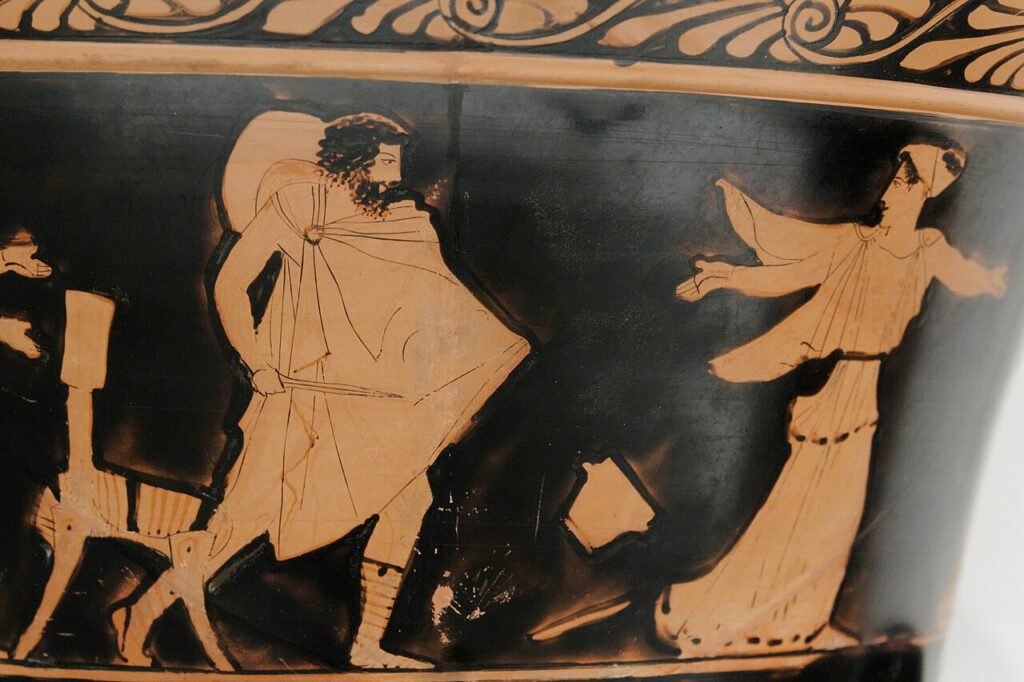
Alerted by the cautious Eurylochus, Odysseus prepares to confront the sorceress. Hermes intercepts him to hand over an antidote, explaining how to use it:
“When Circe strikes you with her long wand, draw your sharp sword from your thigh and rush at her, as though you were burning to kill her. Seized with fear, she will invite you to share her bed; then do not refuse the goddess’s couch, so that she may free your companions and care for you. But bid her swear the great oath of the Blessed Ones, that she will plot no other baneful scheme against you — lest, once you are naked, she make you faint-hearted and unmanned.”[4]
Hermes warns him, however: the moly will neutralise the most formidable effects of the drug — aphasia, amnesia, hallucinations. But the text does not say that all effects will be cancelled. The subsequent episode, which leads Odysseus into Circe’s bed, suggests that the aphrodisiac power of the potion — which the ancients also attributed to mandrake — persists. Hence the necessity of the oath the hero must demand of Circe before yielding to her charms.
Finally, Hermes reveals the nature of the promised antidote:
“Having spoken thus, the Slayer of Argus gave me the remedy. He pulled it from the earth and showed me its nature. Its root was black, and its flower like milk. The gods call it moly; it is hard to dig up for mortal men, but the gods can do all things.”[5]
Five lines, three morphological features, one name: Homer says no more. That has been enough to occupy botanists, philologists, and pharmacologists for twenty-five centuries.
A name that declares its function
The word itself is a clue. Suzanne Amigues and the linguist Charles de Lamberterie showed that moly (μῶλυ) is the neuter substantive of the adjective molys (μῶλυς), which qualifies “that which blunts, that which renders inoperative”.[6] The name says exactly what the plant does: it blunts Circe’s drugs. The same root appears in Cleanthes the Stoic, who makes moly the emblem of the logos, Reason, “by which instincts and passions are blunted”.[7]
Cautious ancient naturalists
This famous moly did not fail to intrigue the naturalists of antiquity, yet none claimed to identify the Homeric plant with certainty.
Theophrastus, in the 4th century BC, contents himself with reporting what others told him: a plant grows “in the region of Pheneus and on Mount Cyllene” in Arcadia, and it is said to resemble Homer’s moly, “with a round root like an onion and a leaf similar to squill. It is used for antidotes and magical practices. It is not, however, difficult to dig up, as Homer says.”[8] Theophrastus exercises considerable restraint. He notes the resemblance, but also records what contradicts Homer’s description.
Dioscorides, in the 1st century AD, gives a more precise botanical description: drooping leaves resembling couch grass, milky flowers, a slender stem four cubits tall, a top “like garlic”, a small bulbous root — all without even mentioning Homer.[9] He further notes that in Cappadocia and among the Galatians of Asia, the name moly is also given to wild rue (peganon agrion) “because it resembles moly to a certain extent, its root being black and its flower white”.[10]
Pliny, for his part, lists several plants bearing this name, including one with a colossal root (“thirty feet long, and even then it was not complete”), and notes that Greek authors give it a yellow flower where Homer describes it as white.[11]
In search of moly
The precise identification of Homer’s moly does not therefore seem to have been an obsession for the ancients, whereas it has fascinated modern scholars. Three approaches have structured the research.
The first is botanical.
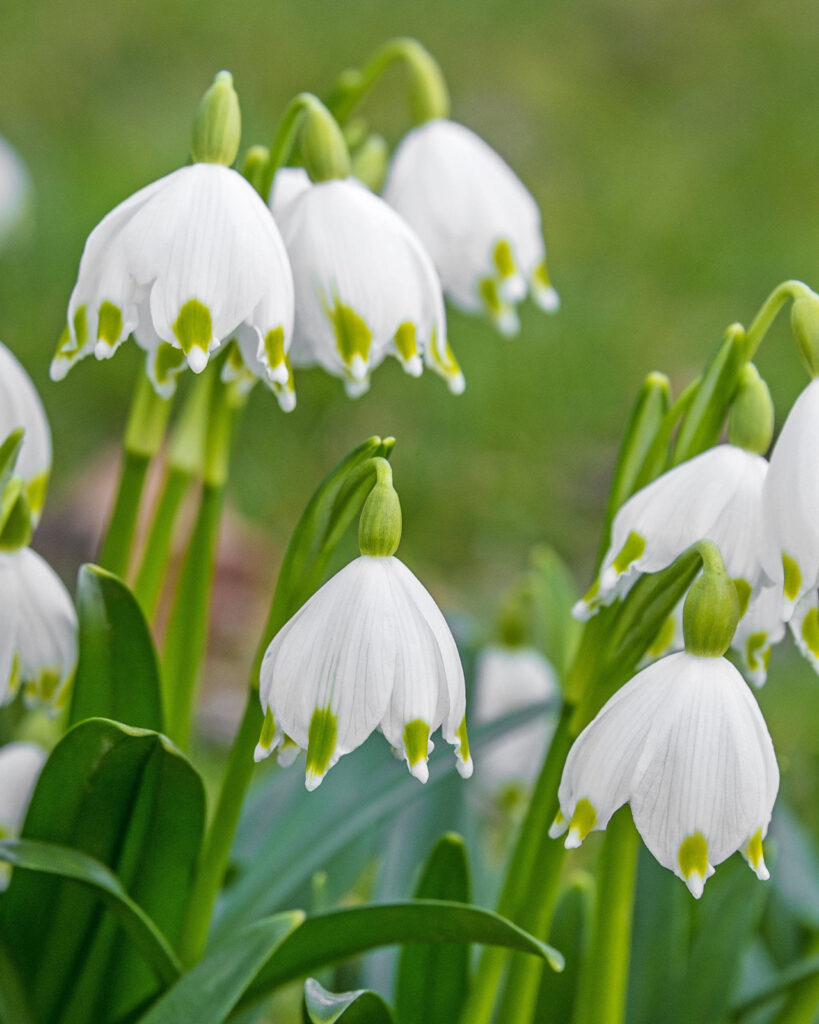
Suzanne Amigues, in 1995, systematically cross-referenced all the ancient descriptions to reconstruct the portrait of a real plant: a bulb with a dark tunic, drooping linear leaves, a pure white flower, a slender stem bearing a spathe reminiscent of garlic. In her view, this portrait points to a single candidate: the summer snowflake (Leucojum aestivum L.), today exceedingly rare in Greece, but still present in the marshy meadows of northern Arcadia, near ancient Pheneus — precisely where Theophrastus located the moly. This is fitting: the very name moly appears to be an archaic Arcadian dialectal form.[12]
Other scholars have judged it more sensible to abandon the search for moly in nature.
Guy Ducourthial observes that Homer’s description is not a naturalistic portrait but a binary construction pushed “to the point of symbolic caricature”.[13] The white of the flower — aerial part, luminous world, benevolent magic — is opposed to the black of the root — chthonic world, malevolent magic. The difficulty of uprooting for mortals contrasts with the omnipotence of the gods. The moly is set within a sequence of rigorously paired oppositions: Circe’s wand (rabdos) against Hermes’ golden wand (chrusorrapis), the sorceress’s pharmaka lugra (baneful drugs) against the god’s pharmakon esthlon (beneficent remedy). The moly would thus be not a botanical specimen, but the terrestrial relay of Hermes’ power — not merely a plant among others in Homer’s garden, but the magical plant par excellence.
The pharmacological approach
Between precise identification and symbol, there exists, however, a third path, opened by pharmacological analysis.
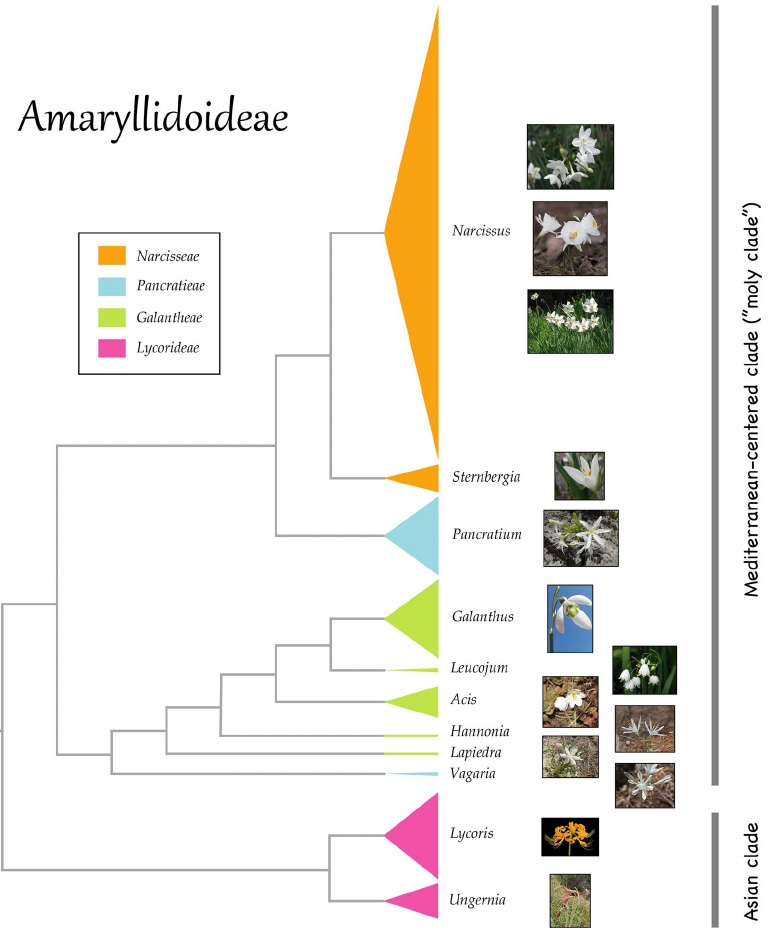
In 1983, Plaitakis and Duvoisin proposed identifying moly with the snowdrop (Galanthus nivalis), whose bulbs contain galanthamine, theoretically capable of countering an intoxication by Circe’s plants — mandrake, henbane. In 2024, Molina-Venegas and Verano broadened this hypothesis: rather than a single species, moly would designate an ethnobotanical complex — that is, several related Mediterranean species sharing white flowers, dark-tunicked bulbs, and acetylcholinesterase-inhibiting alkaloids: substances capable of countering intoxication by narcotic plants.[14] Among them, sea lilies (Pancratium spp.) are abundant throughout the Mediterranean and already represented in Minoan and Mycenaean art. Their contractile roots drive the bulb up to 160 cm into the ground, which might concretely explain the difficulty of uprooting that Homer describes. Indeed, the summer snowflake identified by Amigues belongs precisely to this group.
In fact, the various readings do not exclude one another. Like the Homeric Styx — at once the icy waterfall of the Mavronero in Arcadia and the infernal river of the dead — moly may be all of this simultaneously: real plants endowed with anti-narcotic properties, and a poetic construction that makes of them the archetype of the magical plant. It is doubtless this superimposition of levels that accounts for the millennial fascination with Homer’s moly.
[1] Homer, Odyssey, X, 233–236: εἷσεν δʼ εἰσαγαγοῦσα κατὰ κλισμούς τε θρόνους τε / ἐν δέ σφιν τυρόν τε καὶ ἄλφιτα καὶ μέλι χλωρὸν / οἴνῳ Πραμνείῳ ἐκύκα· ἀνέμισγε δὲ σίτῳ / φάρμακα λύγρʼ, ἵνα πάγχυ λαθοίατο πατρίδος αἴης.
[2] Pliny the Elder, Historia Naturalis, XXV, 147: Mandragoran alii Circaeon vocant.
[3] Homer, Odyssey, X, 237–241: αὐτὰρ ἐπεὶ δῶκέν τε καὶ ἔκπιον, αὐτίκʼ ἔπειτα / ῥάβδῳ πεπληγυῖα κατὰ συφεοῖσιν ἐέργνυ· / οἱ δὲ συῶν μὲν ἔχον κεφαλὰς φωνήν τε τρίχας τε / καὶ δέμας, αὐτὰρ νοῦς ἦν ἔμπεδος, ὡς τὸ πάρος περ· / ὣς οἱ μὲν κλαίοντες ἐέρχατο.
[4] Homer, Odyssey, X, 293–301: ὁππότε κεν Κίρκη σʼ ἐλάσῃ περιμήκεϊ ῥάβδῳ, / δὴ τότε σὺ ξίφος ὀξὺ ἐρυσσάμενος παρὰ μηροῦ / Κίρκῃ ἐπαῖξαι, ὥς τε κτάμεναι μενεαίνων· / ἡ δέ σʼ ὑποδείσασα κελήσεται εὐνηθῆναι· / ἔνθα σὺ μηκέτʼ ἔπειτʼ ἀπανήνασθαι θεοῦ εὐνήν, / ὄφρα κέ τοι λύσῃ θʼ ἑτάρους αὐτόν τε κομίσσῃ· / ἀλλὰ κέλεσθαί μιν μακάρων μέγαν ὅρκον ὀμόσσαι, / μή τί τοι αὐτῷ πῆμα κακὸν βουλευσέμεν ἄλλο, / μή σʼ ἀπογυμνωθέντα κακὸν καὶ ἀνήνορα θήῃ.
[5] Homer, Odyssey, X, 302–306: ὣς ἄρα φωνήσας πόρε φάρμακον ἀργεϊφόντης / ἐκ γαίης ἐρύσας, καί μοι φύσιν αὐτοῦ ἔδειξε· / ῥίζῃ μὲν μέλαν ἔσκε, γάλακτι δὲ εἴκελον ἄνθος· / μῶλυ δέ μιν καλέουσι θεοί· χαλεπὸν δέ τʼ ὀρύσσειν / ἀνδράσι γε θνητοῖσι, θεοὶ δέ τε πάντα δύνανται.
[6] Suzanne Amigues, “Des plantes nommées moly”, Journal des savants, 1995, pp. 3–29; Ch. de Lamberterie, “Grec homérique μῶλυ: étymologie et poétique”, LALIES 6 (1988), pp. 129–138.
[7] Cleanthes, fr. 526 von Arnim, ap. Apollonius the Sophist, Lexicon Homericum, s.v. Moly; cited by S. Amigues, op. cit., p. 14.
[8] Theophrastus, Historia Plantarum, IX, 15, 7: τὸ δὲ μῶλυ περὶ Φενεὸν καὶ ἐν τῇ Κυλλήνῃ. φασὶ δ’ εἶναι καὶ ὅμοιον ᾧ ὁ Ὅμηρος εἴρηκε […] οὐ μὴν ὀρύττειν γ’ εἶναι χαλεπόν, ὡς Ὅμηρός φησι.
[9] Dioscorides, De Materia Medica, III, 47: μῶλυ· τὰ μὲν φύλλα ἔχει ἀγρώστει ὅμοια, πλατύτερα δέ, ἐπὶ γῆν κλώμενα, ἄνθη λευκοΐοις παραπλήσια, γαλακτόχροα […] ῥίζα δὲ μικρά, βολβοειδής.
[10] Dioscorides, De Materia Medica, III, 46.
[11] Pliny the Elder, Historia Naturalis, XXV, 26–27: Clarissima herbarum et fere poetis sola celebrata auctore Homero est […] Florem galbanum pinxere Graeci, Homerus candidum.
[12] S. Amigues, op. cit., pp. 21–22.
[13] Guy Ducourthial, Flore magique et astrologique de l’Antiquité, Belin, 2003, chap. IV.
[14] R. Molina-Venegas and J. Verano, “The quest for Homer’s moly: exploring the potential of an early ethnobotanical complex”, Journal of Ethnobiology and Ethnomedicine 20 (2024), 11. For the earlier argument: A. Plaitakis and R. C. Duvoisin, “Homer’s Moly Identified as Galanthus nivalis L.”, Clinical Neuropharmacology 6 (1983), pp. 1–5.
Other articles in English from the Nunc est bibendum blog