Translated from french (please notify us of errors)
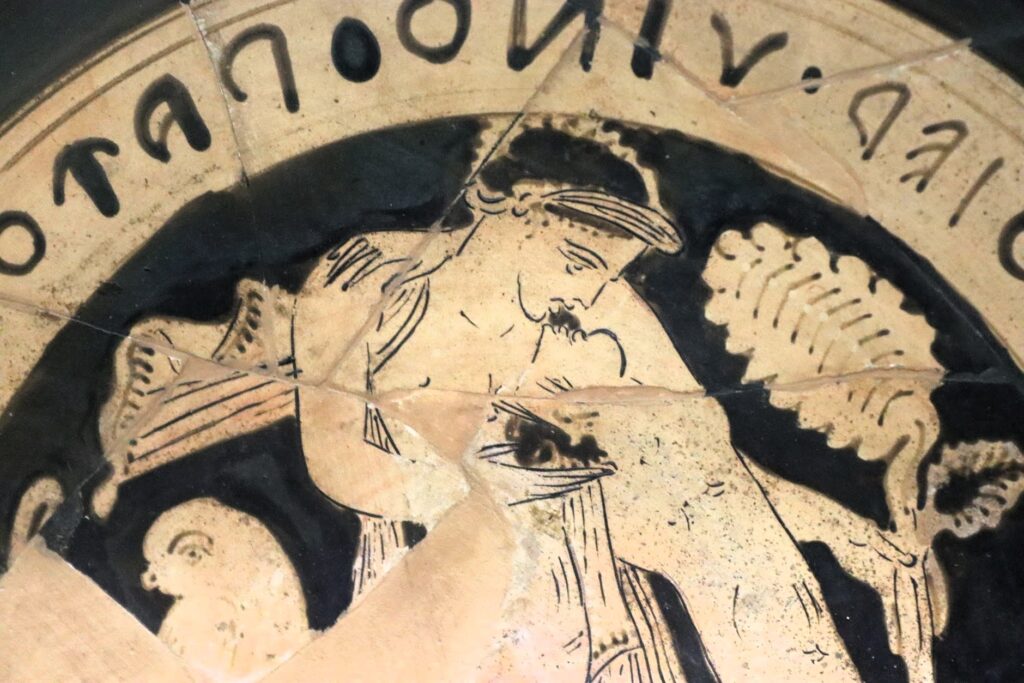
Two drinking cups found in a tomb at the Penna necropolis, in Falerii Veteres, bear a message of disarming simplicity. The inscription, over 2,300 years old, is written neither in Latin nor in Etruscan, but in another ancient language, far less well known: Faliscan.
The Faliscan people were settled in the south-east of Etruria, in the Tiber valley, around their capital Falerii – present-day Civita Castellana. Alongside the Etruscans, they resisted for a time the expansion of their restless neighbour fifty kilometres to the south: Rome. Their language, attested by some 355 inscriptions dating from the 7th to the 2nd century BC, belonged to the Latino-Faliscan branch of the Italic languages: a close relative of Latin, but one that followed its own path of development. It probably survived, increasingly permeated by Latin, at least until the 2nd century BC.
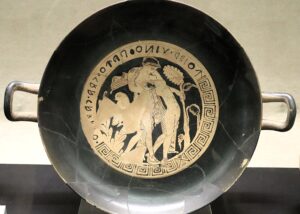
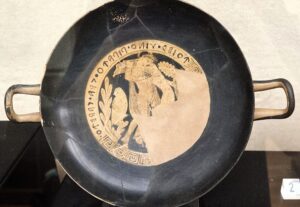
The two kylikes – Greek-style drinking cups – come from tomb 4 (CXXVIII) of the Penna necropolis. They formed part of a funerary assemblage comprising ceramic and bronze vessels, dated to the mid-4th century BC. Both are now held at the National Etruscan Museum at Villa Giulia, in Rome[1]. The discovery of a third, identical but uninscribed example at Civita Castellana confirms that these were mass-produced items, attributed by modern scholarship to the “Foied Painter”, active around the mid-4th century BC at Falerii.
The motif in the central tondo, in red figures on a black ground, is identical on both cups: a young man embraces a naked woman who stretches her arms towards her lover’s neck. A dove perched on a branch can also be made out.
A Faliscan proverb
The inscription, to be read from right to left, was designed in harmony with the decoration: it is set within the meander frieze that frames the figures of the tondo. It shows a slight difference from one cup to the other.
On the kylix bearing inventory number 1675, whose inscription is fully preserved, one reads:
foied vino pipafo, cra carefo
On its twin, number 1674, a slightly different version:
foied vino pafo, cra carefo
The difference between the two versions has drawn the attention of specialists. According to some scholars, pafo is a copyist’s error for the correct form pipafo, made by a craftsman who did not fully command the script. The form pipafo corresponds to a future tense of the verb “to drink”, parallel to Classical Latin bibam. The future in -fo also appears in carefo (“I shall lack”), a characteristic feature of the Faliscan verbal system. The Classical Latin equivalent is transparent: hodie vinum bibam, cras carebo, which translates as: “Today I shall drink wine, tomorrow I shall be deprived of it.”
Dionysus and Ariadne, or love fulfilled
With the meaning of the text established, let us return to the illustration in the tondo. The young man holds a thyrsus – a staff entwined with ivy and topped with a pine cone – which allows him to be identified with certainty as the god Dionysus.
Most commentators identify the woman as Ariadne, daughter of King Minos of Crete, who enabled Theseus to overcome the Minotaur by providing him with the thread to find his way out of the Labyrinth. The dove, for its part, evokes Aphrodite.
The rest of the myth is cruel. As the price of her help, Theseus abandoned Ariadne on the island of Naxos. It was there that Dionysus discovered her, consoled her and took her as his wife — a love match, founded on mutual consent alone, which would earn Ariadne the immortality granted by Zeus. As Hesiod writes in his Theogony: “Golden-haired Dionysus took fair-haired Ariadne, daughter of Minos, as his blooming bride, and the son of Kronos made her deathless and ageless for ever.”[2]
Over the centuries, the divine couple became a model of true love, freely chosen beyond family arrangements. Vase painters made it a favoured motif on drinking cups, from the Attic black-figure kylikes of the 6th century BC onwards.
But as Claude Vatin has shown, the artists of central Italy – Etruscan and Faliscan – heightened the erotic dimension of the theme. On the cup from Falerii, a naked Ariadne, “thrown back to the point of losing her balance, one arm draped over Dionysus’s neck, offers him her lips”; the god, “arched and firmly planted on his spread legs, tilts his head to receive the kiss”.[3] The Faliscan inscription and the image complement each other: “As much as of their bodies, Ariadne and Dionysus savour the euphoria of wine; the two pleasures are inseparable.”
More than a simple exhortation to drink, the inscription is probably a proverb urging its reader to enjoy the fleeting pleasures of youth: wine and sex.
Two cups, a sensual kiss between Dionysus and Ariadne, and a maxim traced around the rim: the Faliscan craftsmen of Falerii left behind, on banqueting ware, one of the earliest known calls to seize the present moment. Three centuries later, Horace would distil the same intuition into two words that became famous: carpe diem[4].
[1] Museo Nazionale Etrusco di Villa Giulia, “Kylix a figure rosse da Falerii Veteres”, section ETRU a casa – Agro falisco e capenate, 2020.
[2] Hesiod, Theogony, ll. 947–949. Greek: Χρυσοκόμης δὲ Διώνυσος ξανθὴν Ἀριάδνην, / κούρην Μίνωος, θαλερὴν ποιήσατ’ ἄκοιτιν· / τὴν δέ οἱ ἀθάνατον καὶ ἀγήρω θῆκε Κρονίων.
[3] Claude Vatin, Ariane et Dionysos. Un mythe de l’amour conjugal, Paris, Presses de l’École normale supérieure, 2004, pp. 58–59.
[4] Horace, Odes, I, 11: carpe diem, quam minimum credula postero — “seize the day, and trust as little as possible in tomorrow.”
Other articles in English from the Nunc est bibendum blog