Translated from french (please notify us of errors)
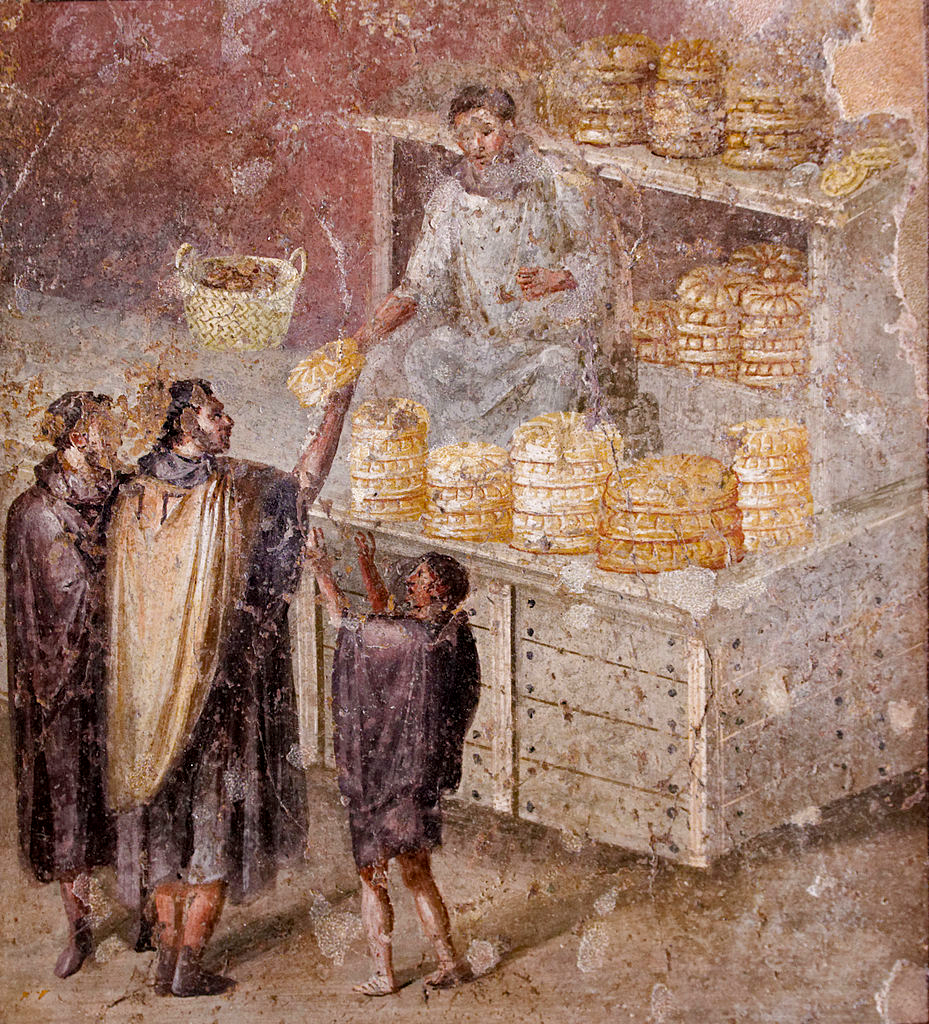
Among everything the lava of Vesuvius seized in an instant in 79 CE were eighty-one round loaves, carbonised in the oven of Modestus’s bakery on the Via degli Augustali. They remained buried until 1861, when the archaeologist Giuseppe Fiorelli drew them from the ashes and recorded them in his excavation reports[1]. Since then, researchers, food historians, and bakers have been trying to determine what these loaves were made of. And can a credible recreation be attempted? The recipe still holds part of its mystery.
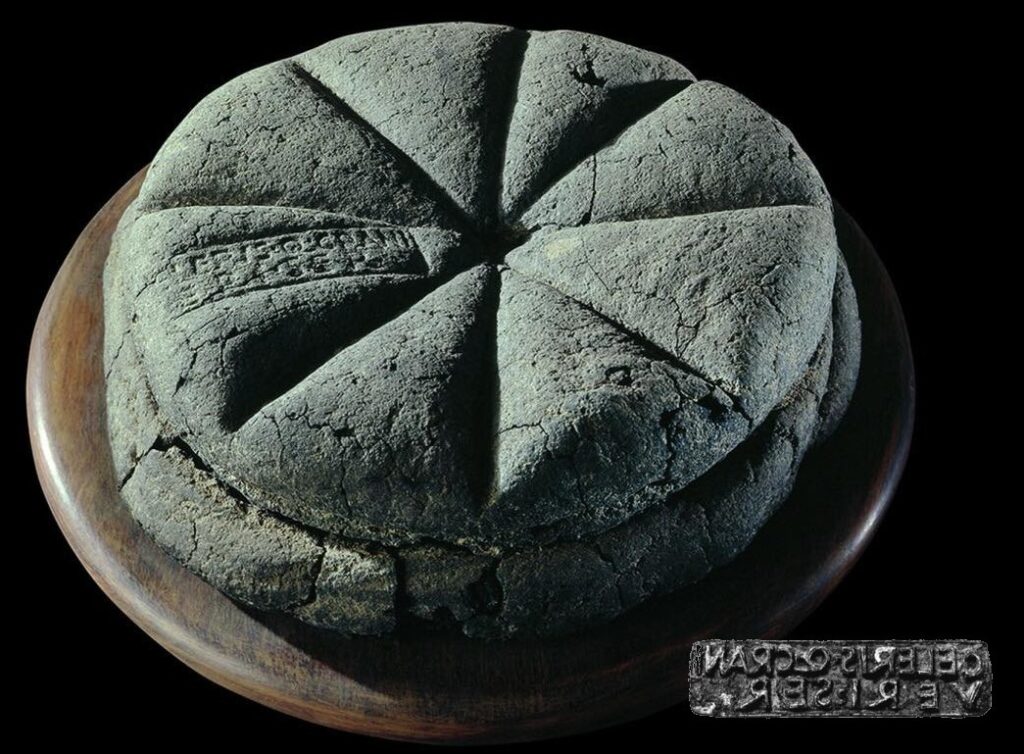
The surviving loaves are circular, with an average diameter of around twenty centimetres – some reaching thirty – and a height of approximately ten centimetres. Their upper surface is divided into six or eight segments by radiating incisions – the quadrae that give the loaf its name, panis quadratus[2] – and a horizontal groove runs along the side. Some bore a signaculum, a stamp identifying the craftsman.
The flour, the first mystery
Pliny the Elder, who would die in the very eruption of Vesuvius, is our principal source on the baking of his time. He classifies wheats by weight and origin, and notes that none can rival Italian wheat for whiteness and weight[3]. For bread, the most prized grains were far (emmer) and the various kinds of wheat (triticum), with siligo (soft wheat) being the variety of choice. It is this that yields the finest bread and the most celebrated bakery products. Pliny particularly recommends blending Campanian siligo with that of Pisa, the former being more russet, the latter whiter and heavier[4].
Archaeobotany partly confirms this picture. Systematic analysis of an entire city block in Pompeii (Regio VI, Insula 1) shows a clear predominance of naked wheats (T. aestivum/durum) over hulled wheats, with wheat surpassing barley in a ratio of approximately nine to one – emmer and millet being present but secondary. This shift towards naked wheats, under way since the late Republic, reflects a well-documented agronomic evolution[5].
The same study notes that bakers most likely received their grain already husked from rural suppliers: the near-total absence of cereal chaff in urban domestic contexts makes this clear. The collection of the Museo Archeologico Nazionale di Napoli (MANN), which gathers the botanical remains recovered from the Vesuvian sites since 1750, contains, by contrast, 47 lots of emmer against only 2 lots of soft wheat – a discrepancy that is doubtless explained by biases in preservation and early collection practices, rather than by the reality of consumption.
In the absence of any tissue analysis of the surviving loaves, it is not known with certainty what the panis quadratus contained: the exact proportions, and even the dominant cereal, remain unknown.
What the sources agree in confirming is that Pompeiian flour bore no resemblance to what is found today. Ground on basalt millstones – examples of which have been recovered from the bakeries – it incorporated the endosperm, the bran, the germ, and a not inconsiderable proportion of stone dust: particles produced by the erosion of the millstones, and sand from the small stones left in inadequately cleaned grain. A flour less rich in gluten, more perishable because of the germ it retained, and one that absorbed less water than a modern flour. Pliny further notes that bean flour (called lomentum) was commonly used to add weight to bread destined for sale[6]. What bakers actually put into their dough was not always what they declared.
The string and the groove
It is not only the composition of the bread that remains mysterious – its shape has also fuelled debate. The panis quadratus is recognisable above all others by its two distinctive marks: the radiating incisions dividing its upper surface into quadrae, and the horizontal groove running along the side. How was the latter produced? The most widespread recreation, popularised notably by the British Museum during its exhibition “Life and death in Pompeii and Herculaneum” in 2013, involves tying a string around the dough before baking[7]. The image is appealing… and probably wrong.
A recent interdisciplinary study (cf. infra), bringing together archaeologists and bakers, subjected this hypothesis to three objections. First, had a string been baked with the loaf, it would have left carbonised fibres or impressions in the crust: yet the Pompeii loaves show no such trace. Next, experiments conducted with a string removed before baking produce a wide, shallow groove, bearing no resemblance to the clean furrow of the originals. Finally, the very name of the bread makes no reference to this groove: quadratus denotes the upper segments, the quadrae, not the lateral furrow, which would then be a consequence of the shaping rather than a deliberate effect. It has also been suggested that the string served to carry the loaves or to hang them up to protect them from rodents. But no surviving representation in Pompeii shows a rope associated with bread, whether for production, transport, or storage.
The most plausible explanation comes from living Mediterranean baking traditions. These traditions show that a firm, lightly hydrated dough, worked with precise gestures, naturally produces a horizontal groove without any tool being required. The baker presses the edge of his hand into the dough to give it a “diabolo” shape, then turns it over and flattens it with the palm: the compression mechanically creates this characteristic furrow. The firmer the dough, the cleaner and deeper the groove – which corresponds exactly to the Pompeiian originals. Two pieces of dough placed one on top of the other produce the same result: a marked groove at the junction, without a string. Spanish Candeal breads, the Norman pain brié, and the Italian pane gramolato are shaped according to these principles and display grooves identical to those of the panis quadratus.
Firm dough or soft dough?
Modern recreations generally use highly hydrated doughs – between 55% and 80% water according to the recipes surveyed – and contemporary kneading techniques (autolyse, successive folding). The result is an airy loaf with a brown crust, in which the incisions and stamp impressions are poorly defined, blurred by the softness of the dough. Yet Pliny himself sets water absorption as a criterion of quality: the best wheat is that which, once kneaded, absorbs the most water[8]. What this formulation implies, reading between the lines, is that ordinary flours – such as Pompeiian flours, ground on basalt millstones, mixed with bran and milling residues – absorbed considerably less. The resulting dough was firm, compact, and fermented slowly.
Ancient flour thus called for a lightly hydrated dough, around 40%, compared with the 58–80% of modern recreations. This consistency extends to the kneading machines found in Pompeiian bakeries: deep troughs of rough volcanic stone. A highly hydrated dough would have stuck to them irretrievably; a firm dough came away cleanly.
As for the stamps and incisions adorning certain loaves, these too presuppose a dough sufficiently rigid not to deform during baking. A loaf from Herculaneum provides the proof: its signaculum remains perfectly legible after two thousand years of carbonisation: “[bread] of Celer, slave of Quintus Granius Verus”[9].
In the ashes of the oven
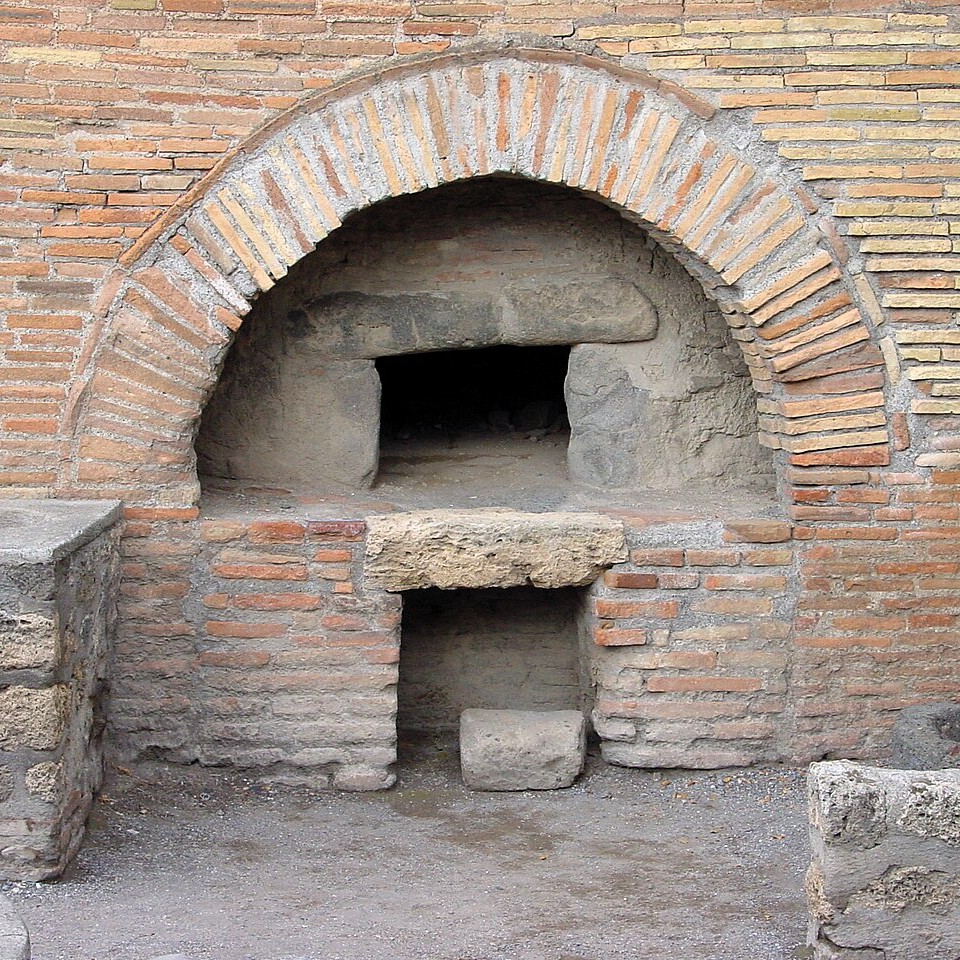
Pompeiian ovens, built of basalt and sand, had remarkable thermal properties: the high conductivity of basalt and the low conductivity of sand allowed intense heat to be accumulated and released slowly. According to the anthracological analyses carried out in the bakeries, the fuel used was beech, oak, hornbeam, and above all – by far the most represented combustible material – olive stones, a by-product of oil production. The chamber reached its baking temperature after two to three hours, and maintained itself at 180–220°C for almost the entire day. The oven was “ready” when the soot had disappeared from the walls and the vault had whitened.
The frescoes depict the panis quadratus in pale yellow, not dark brown. A lightly hydrated dough in a hot oven does not require long baking: 25 to 30 minutes would suffice, against the 40 to 60 minutes of modern recipes. Long baking is precisely what a water-laden dough demands, so that its moisture can evaporate: nothing of the sort applies here.
We have seen that one question remains that the sources do not resolve: which cereal, exactly? We know what the Pompeiians ate in general – the naked wheats dominate the archaeobotanical data. We do not know what the baker Modestus and his Pompeiian colleagues used. No tissue analysis of the surviving loaves has yet been conducted. No electron microscopy, no tomography, no molecular biology. Only six loaves survive from the eighty-one discovered in the 19th century; they wait in their display cases for the tools that science may one day bring to bear on them.
The bread of Pompeii can therefore be recreated… to a degree: hard wheat or soft wheat, coarse milling, firm dough (at around 40% hydration), shaped by hand without a string, divided into eight quadrae and stamped if one is mindful of baking honesty, baked for around thirty minutes in a hot oven.
What will be harder to achieve is a flour close to the original: lower gluten content, germ and bran included, milling impurities – like that which Celer was kneading, a few hours before the eruption.
Sources
- M. Cardenas, I. Yarza, V. Matterne, A. Arranz-Otaegui, “Disentangling the production of the panis quadratus from Pompeii: A new interdisciplinary perspective“, International Journal of Gastronomy and Food Science 32 (2023), 100729
- C. Murphy, G. Thompson, D. Q. Fuller, “Roman food refuse: urban archaeobotany in Pompeii, Regio VI, Insula 1“, Vegetation History and Archaeobotany 22 (2013), pp. 409–419
- A. D’Auria, G. Di Pasquale, “The unknown archaeobotany: The great ‘Collezione dei Commestibili e degli Avanzi Organici’ of the National Archaeological Museum of Naples“, Quaternary International 725–726 (2025), 109745
[1] G. Fiorelli, Gli scavi di Pompei dal 1861 al 1872, Napoli, 1873, pp. 16–17, 172. The bakery is catalogued under the reference VII 1, 36–37; its entrance opens onto the Via degli Augustali.
[2] Athenaeus, Deipnosophistae 114e: βλωμιαίους τε ἄρτους ὀνομάζεσθαι λέγει τοὺς ἔχοντας ἐντομάς, οὓς Ῥωμαῖοι κοδράτους λέγουσι (“the loaves that have incisions are called blômiaioi, which the Romans call quadrati“); Horace, Epist. I, 17, 49: qui dicit, clamat: “Victum date!”; succinit alter: “Et mihi”; diuiduo findetur munere quadra (“one cries: ‘Give me something to live on!’; the other echoes: ‘And me!’; the quadra will be shared between them”); Seneca, De Beneficiis IV, 29, 2: quis beneficium dixit quadram panis aut stipem aeris abiecti aut ignis accendendi factam potestatem? (“who has ever called a quadra of bread, a coin thrown in alms, or permission to light one’s fire a benefit?”).
[3] Pliny the Elder, Natural History, 18.63: Tritici genera plura, quae fecere gentes. Italico nullum equidem comparaverim candore ac pondere, quo maxime decernitur.
[4] Pliny the Elder, Natural History, 18.86: e siligine lautissimus panis pistrinarumque opera laudatissima. praecellit in Italia, si Campana Pisis natae misceatur.
[5] On this shift from hulled to naked wheats in Roman diet, see our article: When Wheat Sheds Its Husk, Roman Dough Begins to Rise.
[6] Pliny the Elder, Natural History, 18.117: bean flour (lomentum) used to increase the weight of bread sold.
[7] British Museum, “Making 2,000-year-old Roman bread“, 23 July 2020 (republication of a recreation carried out by chef Giorgio Locatelli for the 2013 exhibition). The recipe calls for wholemeal flour and spelt – two choices not attested for the Pompeiian panis quadratus – along with a hydration of approximately 50%, considerably higher than what ancient flours ground on stone millstones would have permitted.
[8] Pliny the Elder, Natural History, 18.67: lex certa naturae, ut in quocumque genere […] optimum frumentum esse, quod in subactum congium aquae capiat.
[9] CIL X, 8058, 18: cEleris Q(uinti) Grani / Veri ser(vi).
Other articles in English from the Nunc est bibendum blog