Translated from french (please notify us of errors)

“October 24, 79”: this is what the first results show today when searching for the date of Vesuvius’ eruption on the internet. For centuries, however, historians and archaeologists accepted August 24, the date transmitted by Pliny the Younger. In 2018, the discovery at Pompeii of a charcoal inscription mentioning October 17 reignited the debate. But does this new dating rest on solid foundations? An article published in December 2024 by Gabriel Zuchtriegel, director of the Archaeological Park of Pompeii, sheds new light on this controversy.
The only ancient source that indicates a precise date for the eruption is Pliny the Younger. In his letter to the historian Tacitus, written more than twenty-five years after the events, he mentions “nonum kal. Septembres”[1], that is, the ninth day before the calends of September, meaning August 24, 79 CE. The oldest manuscripts, dating from the 9th century, unanimously report this date. Some texts present a gap in place of the month, but the manuscript tradition remains consistent.
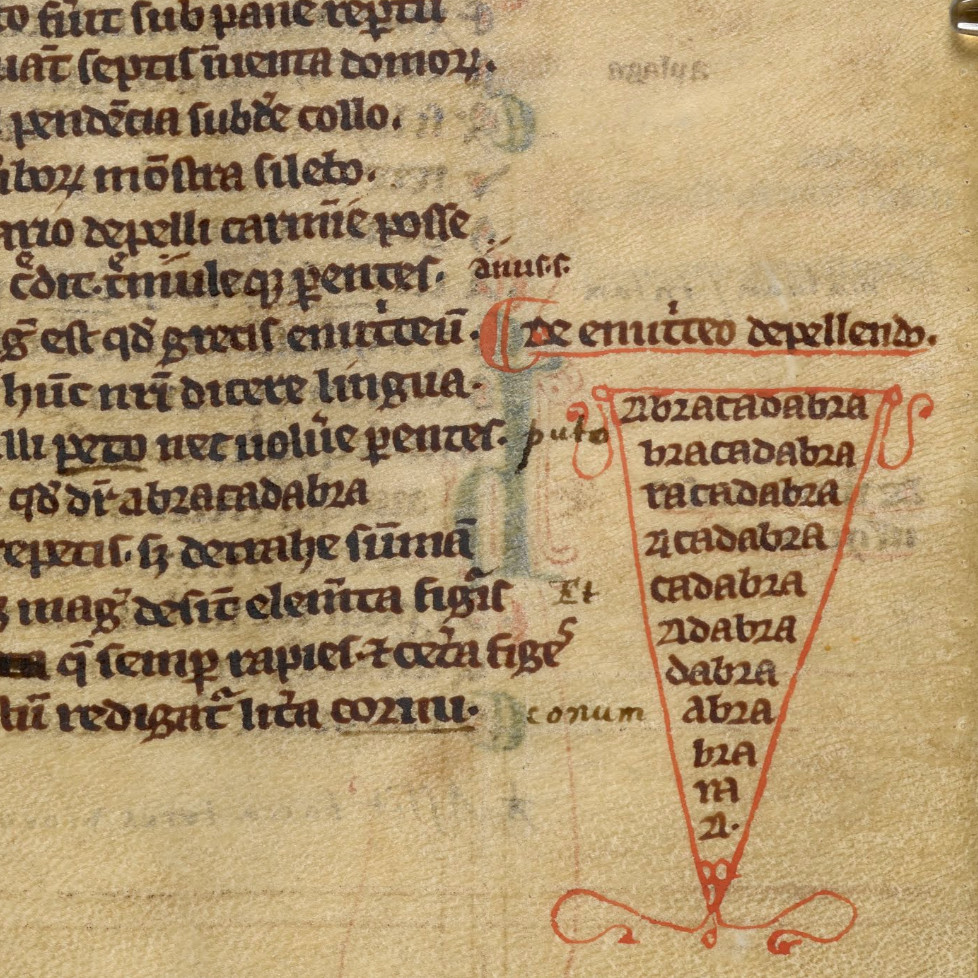
The question becomes complicated by the fact that the difference between “n” and “v” is not always clear in medieval writing. Thus, some manuscripts bear “novum”, “novu” or “nov/nou”. From this arises a first misunderstanding: “nov” is integrated as novembres or novembribus, that is, November. Thus emerges the unfounded hypothesis of November 1 (kalendis novembribus).
A methodological error
In 1929, Giovanni Battista Alfano and Immanuel Friedlaender published a work in which they supported the date of October 24. Their error is methodological: they maintain “non.” for the “ninth day of the calends” while adding as the month “nov(embres)”, whereas “nov.” and “non.” are simply two readings—one of which is erroneous—of the same word in the manuscripts.
Pedar Foss, professor of classical studies at DePauw University (Indiana, USA), demonstrated in his 2022 work that all proposed dates, except for August 24, are recent inventions without any basis in the manuscript tradition. That of October 24 dates back barely a century. Foss systematically collated all manuscripts and early printed editions of Pliny’s letters—work never done before. In 95% of Plinian manuscripts containing the letters about Vesuvius, the date of August 24 appears consistently.
A unique date in the manuscript tradition
The tradition is therefore not “multiple” as was long believed. It is univocal. It remains to be known whether Pliny himself was mistaken, because as Gabriel Zuchtriegel specifies, “this does not mean that August 24 is necessarily the correct date. Pliny the Younger could have been wrong”.
Cassius Dio mentions that the eruption took place “kat’ auto to phthinóporon” (κατ´ αὐτὸ τὸ φθινόπωρον)[2], that is, in autumn. But in Pliny’s calendar of agricultural work, as well as in other authors of the 1st century before and after Christ (Varro, Columella), autumn begins at the latest in the first decade of August. Pliny specifies it: the 46th day after the summer solstice, that is, August 8. The temporal gap between the ancient and modern seasonal sequence is explained by the fact that then, the equinoxes and solstices did not mark the beginning of seasons but their central moment. There is therefore no contradiction between Pliny the Younger’s date and Cassius Dio’s indication.
The October 17 graffito: a refuted proof
In 2018, excavations in the Casa del Giardino (Regio V) uncovered a charcoal inscription on a room’s wall. It bears: “XVI K NOV”, that is, the 16th day before the calends of November, meaning October 17. The complete inscription seems to evoke a food excess. Massimo Osanna, then director of the site, announced the discovery on Instagram, triggering worldwide media coverage.
The argument advanced was twofold. First, the ephemeral nature of charcoal inscriptions: the writing would not have remained intact for long, so the inscription would likely date from October 79, shortly before the eruption. Second, the archaeological context: the atrium was undergoing renovation, with work that would quickly modify the walls, so an inscription ten months old would have already disappeared.
Experimental archaeology
To verify the duration of preservation of charcoal inscriptions, the Archaeological Park of Pompeii launched a scientific experiment. On October 17, 2023, researchers inscribed with oak charcoal, on the same wall of the Casa del Giardino, the text: “XVI K NOV 2023 ARCHEOLOGIA SPERIMENTALE”. The inscription was made under conditions similar to ancient conditions, with a covering protecting from rain but exposed to winds and capillary rising humidity.
For ten months, the inscription was photographed monthly according to a rigorous protocol. Environmental conditions were comparable to Antiquity: average temperatures between 11.7°C and 21.3°C, 63 days of rain and 11 days of storms over the period.
The result, published on August 24, 2024, refutes the 2018 argument. The state of preservation reveals “an essentially unaltered condition” between October 2023 and August 2024. The parts traced with pressure retained their sharpness after ten months, and “the inscription is perfectly legible”.
The October 17 graffito can therefore perfectly well date from October 17, 78, that is, approximately ten months before the eruption of August 24, 79.
The archaeological context reexamined
The second argument concerned the state of the house. Was the atrium really undergoing active work that would have quickly covered the inscription?
The analysis reveals a different situation. The atrium and adjacent rooms are covered with a bipartite plaster characteristic of renovations that followed the earthquake of 62. A technical detail indicates that this plaster was intended to remain visible: the lower part is not finished, because it was to be covered by paving that was never realized.
But there is no trace of an active construction site: no accumulated building materials, no tools, no equipment typical of Pompeian construction sites. The house shows all the signs of occupation: active kitchens, furniture containing precious goods, tableware. The numerous victims who took refuge in a cubiculum confirm that the house was inhabited at the time of the eruption.
The Casa del Giardino was therefore not a construction site in progress, but an inhabited dwelling whose renovations were completed, except for the paving of the atrium—an operation of lesser urgency. That the plaster remained without paving for a year or more is not at all improbable.
Complexity of archaeobotanical data
Since 1797, discoveries of autumn fruits (pomegranates, chestnuts) at Pompeii have fueled the hypothesis of a late eruption. Chiara Comegna, archaeobotanist of the Archaeological Park, recalls a methodological principle: the archaeobotanical remains must be evaluated according to their context and the multiple variables on which they depend. Systematically seeking parallels with current models can prove misleading.
The botanical evidence (peaches, chestnuts, hay, pomegranates) invoked for an autumn eruption can be explained otherwise. Pliny the Elder mentions varieties of late peaches and there are early chestnuts[3]. Hay was cut and stored in summer according to ancient agricultural practices. The pomegranates of Oplontis, used for dyeing, may have been preserved or imported. As for the legume seeds found in gardens, they testify to burial practices carried out from the beginning of the Roman autumn—which began on August 8.
A silver denarius discovered in the Casa del Bracciale d’Oro (House of the Golden Bracelet) seemed at one time to offer decisive proof. The coin would bear the 15th imperial salutation of Titus, an honor conferred after September 8, 79, which would exclude an August eruption. But the reading of the monetary inscription, made difficult by poor preservation, was contested in 2013. The coin therefore does not allow us to settle the matter.
A very recent study must still be added to the dossier, which was the subject of a presentation on December 3, 2025 at the International Congress on the date of Vesuvius’ eruption. The ÁTROPOS group of the University of Valencia (Spain) analyzed fourteen casts of Pompeii victims, four of which were particularly well preserved[4]. The results reveal that the people wore tunic and cloak, both in heavy wool. The detail of the textile weave, visible in the plaster, shows a tight and heavy weaving. Victims inside and outside the houses wore the same clothing, which excludes a simple domestic precaution. For an August 24 in Campania, wearing two pieces of heavy wool seems hardly compatible with usual temperatures, unless one imagines protection against toxic gases or the heat of the eruption itself. In short, this is still not a decisive element for settling the matter.
A turtle laying eggs in summer
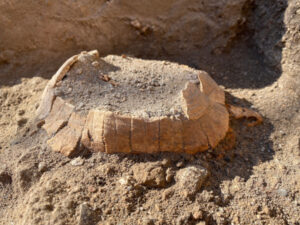
The discovery in June 2022, during excavations in the Stabian baths, of the remains of a Hermann’s tortoise (Testudo hermanni) could be more conclusive[5]. The animal still had its egg inside its shell. Not having been able to find a suitable place to lay, it had died of dystocia—egg retention—before the eruption, in a ruined shop left abandoned after the earthquake of 62.
Now, Hermann’s tortoises lay between May and July, with a peak in June. They do not lay in October. The presence of a dead turtle with its egg in this configuration suggests that the eruption occurred during the laying season, and not in autumn.
Return to August 24
In December 2024, Gabriel Zuchtriegel published an article titled “The date of the destruction of Pompeii: premises for an open debate”. Based on Pedar Foss’s work and on new research by the Archaeological Park, he acknowledges that October 24 “has no documentary basis” and recalls that all the most reliable manuscripts of Pliny agree on August 24.
The director of the Archaeological Park of Pompeii, whose institution had announced in 2018 the discovery of the graffito as evidence of an October date, thus makes a critical return to the traditional consensus. Not by asserting that the eruption occurred on August 24—Pliny may have been wrong—but by demonstrating that archaeology currently has no element sufficiently precise to contest this date.
The question, correctly reformulated, is not “which date among those circulating reconciles best with archaeological data?”, but: “do we currently have sufficient archaeological elements to doubt the date of August 24 transmitted by Pliny?”
Gabriel Zuchtriegel concludes by suggesting to rethink the question itself. Rather than correcting on the basis of archaeobotanical observations a date perceived as uncertain, should we not “rethink, around a date after all not so uncertain, August 24 precisely, our presumed certainties about agriculture and evaluate more specifically the climate of the 1st century of our era?”
Main source
- Zuchtriegel, Gabriel; Comegna, Chiara; Conte, Fabrizio; Russo, Alessandro (2024). «La data della distruzione di Pompei: premesse per un dibattito aperto». E-Journal degli Scavi di Pompei, No. 27, December 12, 2024.
[1] Pliny the Younger, Epistulae VI, 16, 4
[2] Cassius Dio, Roman History, LXVI, 21
[3] Pliny the Elder, Natural History, 15, 92-95.
[4] Las víctimas de la erupción de Pompeya vestían túnica y manto de lana pesada, lo que sugiere condiciones ambientales diferentes en verano. Universitat de València, 3 .12.2025.
[5] Parco Archeologico di Pompei, Il ritrovamento di una testuggine di 2000 anni fa e del suo uovo, press release, June 24,022.
Other articles in English from the Nunc est bibendum blog